BABA(09988)

Search documents
百“虾”大战:当第一批养虾人开始卸载,大厂的战争才真正开始
虎嗅APP· 2026-03-12 14:19
Core Viewpoint - The article discusses the rapid development and competition among major internet companies in China regarding AI agents, highlighting the contrasting trends of user disengagement and corporate engagement in the AI space [4][10]. Group 1: Company Actions and Timeline - Major internet companies have launched various AI products and services in a compressed timeline, with significant actions occurring from late February to early March [6][8]. - Companies like Tencent, ByteDance, Alibaba, and others have introduced products that integrate OpenClaw, offer one-click deployment, and provide user incentives [9][12]. Group 2: Competitive Strategies - Companies are adopting four main strategies: 1. Infrastructure selling, where cloud services like Tencent Cloud and Alibaba Cloud focus on simplifying deployment processes [12]. 2. Gaining entry points, with Tencent's WorkBuddy and ByteDance's ArkClaw aiming to integrate into popular messaging platforms [12]. 3. Ecosystem control, as seen with Xiaomi and NetEase, which are embedding AI agents into their existing ecosystems [12]. 4. Maintaining presence, where some companies feel compelled to participate in the AI trend to avoid being left out [13]. Group 3: Financial Implications - Each company's financial concerns differ: - Tencent is focused on maintaining its social connection platform [15]. - Alibaba is concerned about preserving its transaction pathways [16]. - Baidu aims to retain its position as the starting point for user queries [17]. - ByteDance is focused on ensuring it remains a key player in content distribution [17]. Group 4: User Experience and Market Impact - The article emphasizes that while users may disengage from specific AI products, the experience of using AI agents has lasting effects on their perception of AI technology [19][20]. - The competition among companies is not just about individual products but about establishing a foundational infrastructure for future AI interactions [20].


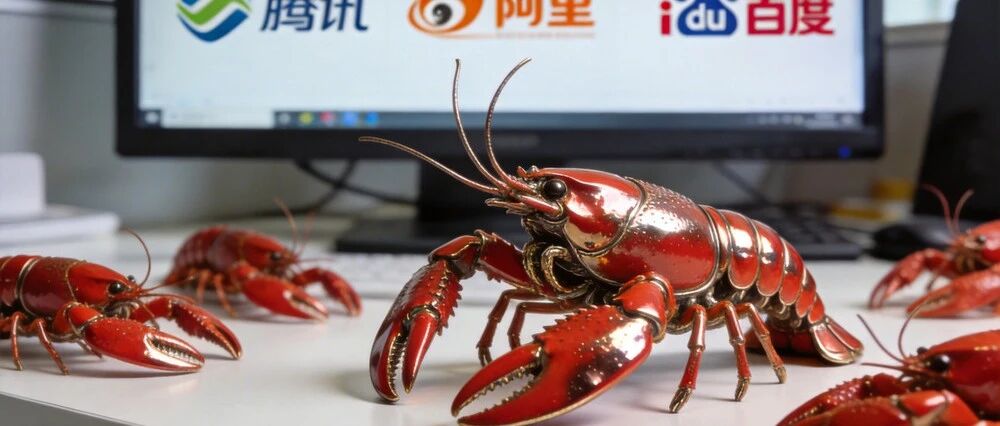
百虾大战!大厂争相驯化野生“龙虾”
新财富· 2026-03-12 12:16
Core Viewpoint - The article discusses the rapid rise of OpenClaw and the ensuing competition among major tech companies in China, referred to as the "Battle of the Shrimp," highlighting the potential and risks associated with this open-source AI tool [3][5][22]. Group 1: OpenClaw's Emergence and Adoption - OpenClaw was launched in January 2026 and quickly gained popularity, surpassing established projects like React and Linux on GitHub within two months [3]. - Major companies including Tencent, Alibaba, ByteDance, and others have launched OpenClaw-based products in a short span, indicating a significant market interest [5][10][11]. - Tencent's product matrix includes offerings for general users, developers, and enterprises, showcasing a comprehensive approach to market penetration [7]. Group 2: Product Features and Innovations - Tencent introduced various products such as WorkBuddy and QClaw for general users, and Lighthouse for developers, emphasizing ease of use and integration with existing platforms [7][8]. - Alibaba's offerings focus on multi-agent collaboration and enterprise security, with products like Qode and HiClaw designed for different user segments [10]. - ByteDance's ArkClaw integrates seamlessly with its Feishu ecosystem, providing a user-friendly experience for task management [11]. Group 3: Security Concerns and Challenges - The open-source nature of OpenClaw presents significant security risks, including potential system vulnerabilities and data breaches, as highlighted by the National Internet Emergency Center [20]. - Users have reported issues with high costs associated with both installation and uninstallation of OpenClaw services, indicating a potential market challenge [18][19]. - The article emphasizes the need for robust security measures as companies seek to transform OpenClaw from a risky open-source tool into a secure productivity solution [22][23]. Group 4: Industry Response and Future Outlook - Major tech companies are implementing security optimizations and leveraging their ecosystems to address OpenClaw's core issues, such as high token consumption and security vulnerabilities [23][29]. - The article suggests that the competition among these companies will lead to a shift from a focus on technology to a focus on safety and commercial sustainability in the AI industry [34]. - The integration of security measures and compliance with regulatory standards will be crucial for the successful adoption of OpenClaw in enterprise environments [33].

阿里 Qwen 郁博文加入字节 + Qwen 新管理架构出炉
程序员的那些事· 2026-03-12 04:51
Group 1 - The departure of key personnel from Alibaba's Qwen team, including Lin Junyang, the technical head, raises concerns about the stability and future direction of the Qwen model [1] - Yu Bowen, the former head of post-training for the Qwen model, has joined ByteDance's Seed team to lead visual models and multimodal interaction, indicating a talent shift in the AI sector [3] - Alibaba has made new management arrangements for the Qwen model team, with Zhou Jingren, the CTO of Alibaba Cloud, taking over the primary management role to enhance resource allocation and collaboration efficiency [5]

图解丨南下资金净买入中海油、阿里和吉利汽车,大肆抛腾讯




Ge Long Hui A P P· 2026-03-11 14:32
Group 1 - Southbound funds net purchased Hong Kong stocks amounting to 34.48 billion HKD on March 11 [1][3] - The top net purchases included China National Offshore Oil Corporation (10.39 billion HKD), Alibaba-W (6.98 billion HKD), Geely Automobile (5.31 billion HKD), Xiaomi Group-W (1.59 billion HKD), Hua Hong Semiconductor (1.55 billion HKD), and SMIC (1.37 billion HKD) [1] - Notable net sales were observed in Tencent Holdings (24.35 billion HKD), ending its previous eight-day net buying streak, as well as China Construction Bank (8.26 billion HKD), Industrial and Commercial Bank of China (1.85 billion HKD), and Yangtze Optical Fibre and Cable (1.2 billion HKD) [1][4] Group 2 - Southbound funds have net purchased Alibaba for three consecutive days, totaling 20.3096 billion HKD [1]
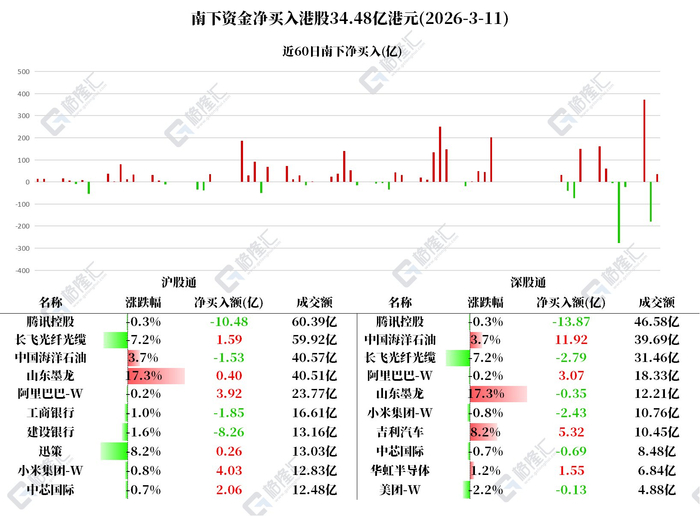
3月11日南向资金追踪:中国海洋石油、阿里巴巴-W、吉利汽车净买入额居前,分别为10.39亿港元、6.98亿港元、5.32亿港元
Jin Rong Jie· 2026-03-11 11:23
Market Overview - The Hang Seng Index decreased by 0.24%, closing at 25,898.76 points, with a total market turnover of 254.48 billion HKD [1]. Southbound Trading Activity - The net buying amounts for southbound funds included: - China National Offshore Oil Corporation (CNOOC) with a net buy of 1.039 billion HKD - Alibaba Group Holding Limited (Alibaba-W) with a net buy of 698 million HKD - Geely Automobile Holdings Limited with a net buy of 532 million HKD [1][2]. - The net selling amounts for southbound funds included: - Tencent Holdings Limited with a net sell of 2.435 billion HKD - China Construction Bank with a net sell of 826 million HKD - Industrial and Commercial Bank of China with a net sell of 185 million HKD [1][2]. Individual Stock Performance - CNOOC's stock price increased by 3.70% to 28.06 HKD [2]. - Geely Automobile's stock price rose by 8.21% to 17.39 HKD [2]. - Alibaba's stock price slightly decreased by 0.22% to 133.20 HKD [2]. - Tencent's stock price fell by 0.27% to 552.00 HKD [2]. - China Construction Bank's stock price decreased by 0.96% to 6.22 HKD [2]. - Industrial and Commercial Bank of China's stock price dropped by 1.64% to 7.78 HKD [2].
全民“养虾”需谨慎;黄仁勋罕见发重磅长文;德国大众集团计划裁员5万人
新财富· 2026-03-11 08:04
Group 1: OpenClaw Product Development - The OpenClaw product form has gained widespread recognition in the industry, leading major companies to quickly follow suit with their own versions [1][3][5] - Tencent has launched a comprehensive "lobster" product matrix, including various versions such as self-developed, local, cloud, enterprise, and desktop products, along with supporting security and knowledge base features [1] - Alibaba has introduced self-developed desktop products with strong local file editing capabilities, supporting custom skill development and multi-agent team collaboration [1] - ByteDance has released the ArkClaw cloud hosting product, which integrates deeply with the Feishu ecosystem and offers excellent user experience for both enterprises and individuals [1] - Other companies like Kimi, MiniMax, Xiaomi, and Huawei have also introduced their own cloud hosting and desktop products, focusing on various features such as long text processing, multi-modal understanding, and system integration [3][5][8] Group 2: Market Reactions and Trends - MiniMax's stock price surged over 22% on March 10, 2026, surpassing Baidu's market capitalization for the first time, indicating strong market recognition of AI-native capabilities [15] - The rapid growth of AI products and the competitive landscape among companies like Tencent, Alibaba, and ByteDance reflect a significant transformation in the Chinese internet industry [15] - The emergence of AI agents is seen as a major breakthrough in tool-based AGI, with companies like Cheetah Mobile emphasizing the importance of local data protection and custom development services [8] Group 3: Regulatory and Security Concerns - The National Internet Emergency Center issued a warning regarding the risks associated with the OpenClaw AI agents, highlighting vulnerabilities such as high permissions and weak default security configurations [10] - Users are advised to take precautions to prevent data breaches and system control issues, especially in critical industries like finance and energy [10]


第一批想卸载小龙虾的人出现了……
吴晓波频道· 2026-03-11 00:29
Core Viewpoint - The rapid rise of the AI application "OpenClaw" (referred to as "小龙虾") is driven by societal FOMO (Fear of Missing Out), despite not achieving widespread adoption [3][32]. Group 1: OpenClaw's Rise and Challenges - OpenClaw, an AI assistant that operates directly on personal computers, gained popularity after Tencent's promotional installation events, leading to a surge in interest and subsequent policy support from various cities [8][22]. - Despite its initial success, many users are now considering uninstalling OpenClaw due to its complexity, high operational costs, and security risks [10][22]. - The installation process requires technical knowledge, which deters non-developers, and the AI's performance in handling complex tasks is limited, leading to user dissatisfaction [12][13]. Group 2: Cost and Security Concerns - The operational costs associated with using OpenClaw are significant, with users reporting daily token consumption that can exceed 10 million tokens, translating to expenses of hundreds to thousands of dollars [15][19]. - Security risks are prevalent, as OpenClaw's access to system-level permissions has led to incidents of data loss and unauthorized transactions, raising concerns about user data safety [16][19]. - Major platforms like Google and Meta have begun banning accounts associated with OpenClaw due to its potential to disrupt content ecosystems and generate excessive operational costs [22][24]. Group 3: Market Dynamics and Future Outlook - The market for AI applications like OpenClaw is competitive, with numerous tech giants launching their versions to capture user interest and retain them within their ecosystems [29][43]. - The potential for monetization exists through cloud service rentals and token usage fees, similar to telecom operators' business models, indicating a lucrative future for companies that can effectively manage user engagement [38][39]. - As the AI landscape evolves, companies are likely to focus on creating a robust application ecosystem, which could lead to significant revenue opportunities in the long term [41][44].

OpenClaw爆火,业内人士称还不是小白用户养虾的时候
21世纪经济报道· 2026-03-11 00:28
Core Viewpoint - OpenClaw, an open-source AI agent, is gaining significant popularity globally, with over 250,000 stars on GitHub in just four months, surpassing established projects like Linux and React, indicating a revolutionary shift in AI from a dialogue tool to an execution assistant [1][4]. Group 1: Market Response and User Engagement - The "养虾" (raising shrimp) phenomenon has led to large gatherings in cities like Shanghai, where over 300 people queued to receive their own OpenClaw, highlighting the strong local interest in AI tools [1]. - Despite the excitement, the actual usage rate among individual users is less than half of the download numbers, indicating challenges in practical application [1][6]. - Major cloud service providers like Alibaba Cloud and Tencent Cloud have introduced deployment solutions, but enterprise-level adoption of OpenClaw remains limited [1][6]. Group 2: Technological Advancements - OpenClaw aims to transition AI capabilities from mere conversation to task execution, marking a significant evolution in human-computer interaction [3][4]. - The architecture of OpenClaw includes four layers that facilitate natural language commands leading to autonomous execution, addressing privacy and response speed concerns [6]. - The tool's ability to automate local tasks and integrate with various applications reduces the technical barriers for users, making it more accessible [5][6]. Group 3: Competitive Landscape - The rise of OpenClaw has prompted other tech giants to accelerate their AI initiatives, with Tencent launching WorkBuddy, which is compatible with OpenClaw's functionalities [9][10]. - The competitive edge of OpenClaw lies in its cross-platform capabilities, although it still requires collaboration with other applications to fully realize its potential [9]. Group 4: User Demographics and Adoption Challenges - The user base for OpenClaw spans a wide age range, from 20 to 60 years old, indicating broad appeal across demographics [8]. - Despite the enthusiasm, there are concerns regarding the readiness of average users to effectively utilize OpenClaw, as it requires a certain level of technical understanding [15]. Group 5: Security and Risk Management - OpenClaw's design introduces potential security risks, including the possibility of executing unauthorized commands and information leaks due to misconfigurations [13][14]. - The need for robust security measures is emphasized, with recommendations for users to implement strict access controls and data encryption to mitigate risks [14]. Group 6: Future Implications - The emergence of OpenClaw signifies a potential shift in productivity dynamics, where individuals may leverage multiple AI agents to enhance their work efficiency [11]. - The balance between open-source innovation and commercial viability will be crucial for the sustainable growth of OpenClaw and similar technologies [14].

挡住豆包的那堵墙,被“龙虾”推倒了
凤凰网财经· 2026-03-10 13:53
Core Viewpoint - The article discusses the competitive landscape among major smartphone manufacturers (Xiaomi, Samsung, and Apple) in developing mobile AI agents, driven by the success of the open-source multi-agent framework OpenClaw, which has transformed user expectations regarding AI capabilities and data privacy [3][12][38]. Group 1: Competitive Landscape - Xiaomi has initiated a closed testing phase for its mobile AI agent product, miclaw, which is based on its self-developed MiMo model, aiming to enhance system-level execution capabilities [3][19]. - Samsung's Galaxy S26 features Google's Gemini AI agent, enabling cross-application operations, although it requires user initiation, contrasting with OpenClaw's proactive capabilities [8][22]. - Apple has decided to collaborate with Google to develop its next-generation AI model based on Gemini, indicating a shift in its traditionally isolated approach to technology [10][25]. Group 2: User Data and Trust - OpenClaw has challenged the prevailing notion that users are overly concerned about data privacy, as many users willingly share data for enhanced AI experiences, indicating a shift in user trust [12][13][38]. - The success of OpenClaw has prompted various tech companies, including ByteDance, Alibaba, Tencent, and others, to rapidly adopt and integrate OpenClaw-related services into their platforms [14][34]. Group 3: Development Strategies - The three major manufacturers are cautiously exploring the potential of mobile AI agents, with each company adopting unique strategies while remaining aware of the limitations of current technology [17][18]. - Xiaomi's miclaw is designed to integrate over 50 system capabilities, but it currently lacks advanced functionalities like payment processing, reflecting a cautious approach to user data handling [19][21]. - Samsung and Google's collaboration on Gemini is a step forward but still conservative, as they face challenges in getting third-party apps to adopt their GUI-based solutions [22][23]. Group 4: Future Implications - The emergence of mobile AI agents poses a potential threat to existing super apps, as these agents could redefine user engagement and application usage patterns [27][46]. - The article suggests that the future of mobile AI agents lies in creating frameworks that allow for seamless integration without overly relying on third-party app cooperation, which has historically been a barrier [36][37]. - The ongoing "shrimp farming" competition among tech giants indicates a significant shift in the industry, with super apps facing challenges in maintaining their dominance as user habits evolve [47].



Alibaba's Q3 Earnings Could Trigger A Rebound (Preview)
Seeking Alpha· 2026-03-10 13:45
Group 1 - The service Beyond the Wall Investing offers significant savings on equity research reports, potentially saving thousands of dollars annually for subscribers [1] - Oakoff Investments provides personal portfolio management and quantitative research, focusing on balancing growth and value through proprietary Wall Street information [2] - The investing group features a fundamentals-based portfolio, weekly insights from institutional investors, and alerts for short-term trade ideas based on technical signals [2]