BABA(09988)

Search documents
AI下半场,没有巨头敢掉队
3 6 Ke· 2026-02-25 00:16
Core Insights - The AI competition among major companies has intensified during the recent Spring Festival, with significant cash incentives and promotional activities [1][2][4] - Companies are focusing on three main areas of AI competition: AI empowerment, independent AI applications, and AI hardware [9][25] Group 1: AI Empowerment - Major companies are embedding AI capabilities into traditional business models, such as Alibaba's Quark browser transforming into an "AI Super Box" by March 2025 [10] - Tencent plans to launch Qbot, an intelligent assistant, in May 2025, enhancing its QQ browser with various AI functionalities [10] - Baidu will transition its traditional search box to an "intelligent box" by July 2025, marking a shift towards AI-driven search [11] - Meituan has launched an AI life assistant named "Xiao Mei" [12] - The integration of AI has positively impacted some business segments, with Tencent's marketing services revenue reaching 36.2 billion yuan in Q3 2025, a 21% increase year-on-year [16] Group 2: Independent AI Applications - Companies are shifting focus to independent AI applications as AI empowerment alone does not alter the competitive landscape [18] - Alibaba's "AI Super Entrance" strategy has pivoted to its Qianwen app, which has surpassed 30 million monthly active users by December 2025 [19] - Doubao continues to leverage sponsorships, such as the Spring Festival Gala, to maintain its leading position in the market [20] - Current AI applications show limited daily usage time, with the highest being around 10 minutes per user [22][23] Group 3: AI Hardware - The competition has expanded from software to hardware, with the launch of the Doubao phone in December 2025, which sold out within a day [25] - The rapid success of the Doubao phone has prompted other companies to restrict access to their platforms on this device [26] - AI glasses have also gained popularity, with Alibaba's Quark AI glasses S1 selling out immediately and a significant increase in global smart glasses shipments [29] - Predictions indicate that global smart glasses shipments could exceed 40 million units by 2029 [30] Group 4: Strategic Directions of Major Companies - Alibaba focuses on providing tool value through its AI applications, aiming to assist users in various tasks [33] - Tencent emphasizes social value, with its "Yuanbao" platform allowing users to invite friends through social media [36] - ByteDance's Doubao offers emotional value, creating a personalized and engaging user experience [41] - The strategies of these companies reflect their core strengths, with Alibaba addressing practical needs, Tencent focusing on social interactions, and ByteDance enhancing emotional connections [43]


中信建投:国内外大模型密集迭代,持续推荐AI板块
Xin Lang Cai Jing· 2026-02-24 23:57
Group 1 - The AI industry is experiencing rapid advancements, with large models continuously iterating and increasing demand for computing power [3][18][29] - Major AI companies are transitioning from a "low-cost/free user acquisition" phase to a "high-quality paid" phase, significantly boosting computing power demand [4][9][24] - During the holiday period, US AI computing stocks performed exceptionally well, with companies like Lumentum, Corning, and Coherent reaching historical highs [12][28][29] Group 2 - Anthropic launched the Claude Sonnet 4.6 model, which shows significant improvements in programming and reasoning capabilities, becoming the default model for its platforms [4][19] - Google's Gemini 3.1 Pro model outperformed several competitors in benchmark tests, achieving a score of 77.1% on the challenging ARC-AGI-2 test, doubling its predecessor's performance [6][21] - Zhizhu AI released the GLM-5 model, featuring a parameter scale of 744 billion and training data of 28.5 trillion tokens, achieving top scores in open-source model benchmarks [7][22] Group 3 - MiniMax introduced the M2.5 model, designed for agent scenarios, demonstrating significant improvements in programming tasks and cost efficiency [9][24] - Alibaba's Qwen3.5-Plus model outperformed similar open-source models, offering competitive pricing and extensive language support [10][25] - The domestic AI market saw a surge in user engagement during the Spring Festival, with significant increases in active users for various AI applications [12][27]




AI终极入口之战:字节阿里赢了,百度腾讯输了?
3 6 Ke· 2026-02-24 23:39
Core Insights - The competition for AI user entry points during the Chinese New Year has seen major investments exceeding 4.5 billion yuan from ByteDance, Alibaba, Baidu, and Tencent, marking a significant moment in China's AI and internet history [1][22] - The battle is not merely about acquiring traffic through financial incentives but about retaining users by integrating AI into daily life and establishing emotional connections [2][24] Group 1: Competitive Landscape - ByteDance's Doubao has successfully maintained its lead, leveraging a combination of entertainment and interaction, while Alibaba's Qianwen made significant strides but could not surpass Doubao [3][7] - Tencent's Yuanbao initially gained traction but quickly fell behind due to strategic contradictions and user retention issues, while Baidu's 500 million yuan investment did not yield the expected results [10][11][16] Group 2: Strategic Approaches - ByteDance's strategy focuses on embedding AI capabilities into high-frequency scenarios, creating emotional value by allowing users to personalize their AI interactions [5][6] - Alibaba's Qianwen has effectively integrated AI into its commercial ecosystem, enhancing user engagement through practical applications in daily services [9][21] Group 3: Challenges Faced - Tencent struggles with internal strategic conflicts, leading to a decline in user engagement with Yuanbao, which failed to provide clear value to users [13][15] - Baidu's reliance on a tool-centric approach limits its ability to compete effectively, as it lacks the ecosystem and user engagement strategies that other competitors have [16][18] Group 4: Future Directions - The competition is expected to shift from merely acquiring users through financial incentives to creating long-term value by embedding AI into everyday life [24][25] - The ultimate success will depend on how well companies can transform short-term user engagement into lasting habits and loyalty [24][27]


智通港股通资金流向统计(T+2)|2月25日
智通财经网· 2026-02-24 23:33
Key Points - The top three stocks with net inflows from southbound funds are Yingfu Fund (02800) with 3.679 billion, Tencent Holdings (00700) with 2.223 billion, and Alibaba-W (09988) with 2.194 billion [1] - The top three stocks with net outflows are China Pacific Insurance (02601) with -265 million, Yangtze Optical Fibre and Cable (06869) with -174 million, and CICC (03908) with -156 million [1] - In terms of net inflow ratios, Prudential (02378) leads with 323.30%, followed by Southern East West Select (03441) with 288.94%, and Mongol Mining (00975) with 219.66% [1] - The stocks with the highest net outflow ratios include Aidi Kang Holdings (09860) at -148.06%, Boleton (01333) at -101.59%, and Bosideng (03998) at -80.14% [1] Net Inflow Summary - Yingfu Fund (02800) had a net inflow of 3.679 billion, representing a 44.79% increase, closing at 26.800 with a decrease of 1.83% [2] - Tencent Holdings (00700) saw a net inflow of 2.223 billion, with an 11.80% increase, closing at 520.000 with a decrease of 3.35% [2] - Alibaba-W (09988) experienced a net inflow of 2.194 billion, reflecting a 17.87% increase, closing at 148.000 with a decrease of 2.76% [2] Net Outflow Summary - China Pacific Insurance (02601) had a net outflow of -265 million, with a -39.19% decrease, closing at 36.640 with a decrease of 4.53% [2] - Yangtze Optical Fibre and Cable (06869) reported a net outflow of -174 million, with a -4.65% decrease, closing at 129.200 with an increase of 1.17% [2] - CICC (03908) faced a net outflow of -156 million, representing a -53.15% decrease, closing at 21.020 with a decrease of 4.89% [2] Net Inflow Ratio Summary - Prudential (02378) had a net inflow ratio of 323.30%, with a net inflow of 15.2564 million, closing at 118.000 with a decrease of 1.50% [3] - Southern East West Select (03441) recorded a net inflow ratio of 288.94%, with a net inflow of 57.6157 million, closing at 11.720 with an increase of 0.43% [3] - Mongol Mining (00975) achieved a net inflow ratio of 219.66%, with a net inflow of 1.05 billion, closing at 12.690 with a decrease of 3.72% [3]
【太平洋科技-每日观点&资讯】(2026-02-24)
远峰电子· 2026-02-24 22:58
Market Overview - Major indices showed declines: North Exchange 50 (-0.22%), Sci-Tech Innovation 50 (-0.72%), Shanghai Composite (-1.26%), Shenzhen Component (-1.28%), ChiNext Index (-1.57%) [1] - TMT sector led the gains with SW Film and Animation Production (+2.66%), SW Semiconductor Equipment (+1.56%), and SW Robotics (+1.15%) [1] - TMT sector faced losses with SW Communication Cables and Accessories (-5.77%), SW Marketing Agency (-4.36%), and SW Passive Components (-2.43%) [1] Domestic News - Semiconductor packaging costs surged due to rising prices of upstream raw materials and key precious metals, prompting China Resources Microelectronics to raise prices across its entire range of microelectronic products by at least 10% [2] - Powerchip Semiconductor Manufacturing Corporation announced strategic agreements with Micron and its global subsidiaries, aiming to strengthen its financial position and transition into a key player in the global AI supply chain [2] - Tianma's new 12-inch Micro-LED high-brightness automotive display screen has been successfully lit, achieving brightness over 50,000 nits and a contrast ratio of 1,000,000:1, making it ideal for high-end panoramic HUD systems [2] - Hanbo High-tech's subsidiary, Chip East, plans to acquire assets in China from South Korea's Dongjin, enhancing its capabilities in the wet electronic chemicals sector [2] International News - The U.S. Department of Defense updated its "1260H list," adding 78 Chinese companies, including Alibaba and Baidu, for allegedly assisting the Chinese military, while removing 12 companies, including Yangtze Memory Technologies [3] - Samsung Electronics has begun delivering its advanced HBM4 chips to unnamed customers to close the gap with competitors in supplying key components for NVIDIA's AI accelerators [3] - TrendForce predicts a 10% annual decline in global smartphone production in 2026 due to rising memory prices, with total production expected to drop to approximately 1.135 billion units [3] - A group of U.S. lawmakers urged the government to strengthen export restrictions on wafer fabrication equipment to China, advocating for a near-total ban on selling chip manufacturing equipment to China [3] AI Insights - Doubao announced the launch of "Expert Mode" on its app and web platform, significantly enhancing its capabilities in mathematics, reasoning, and complex content understanding [4] - Wanjing Technology's AI video creation product has integrated with the Kling 3.0 model, allowing users to generate videos from text and images [4] - Tsinghua University proposed a new framework, RAM, which accelerates large model processing of long texts by 12 times while maintaining natural language interpretability [4] - Peking University introduced FieryGS, a framework that integrates multimodal large models with physical simulations for dynamic flame synthesis [4] Industry Tracking - Star Glory secured 5.037 billion yuan in D++ round financing for the development of its reusable liquid oxygen methane rocket [5] - Shenzhen's Industrial and Information Technology Bureau issued an action plan to promote AI applications in the semiconductor industry, focusing on optimizing chip design and software coding efficiency [5] - Infleqtion is collaborating with NASA's Jet Propulsion Laboratory to launch a quantum gravity sensor by 2030, showcasing a neutral atom quantum sensor [5] - Jingrui Electric Materials plans to invest in a comprehensive base for semiconductor manufacturing materials in Sichuan, including projects for high-purity electronic-grade sulfuric acid and ultra-pure hydrogen peroxide [5]





新年开工第一天,大厂AI部门刚放假
Sou Hu Cai Jing· 2026-02-24 22:20
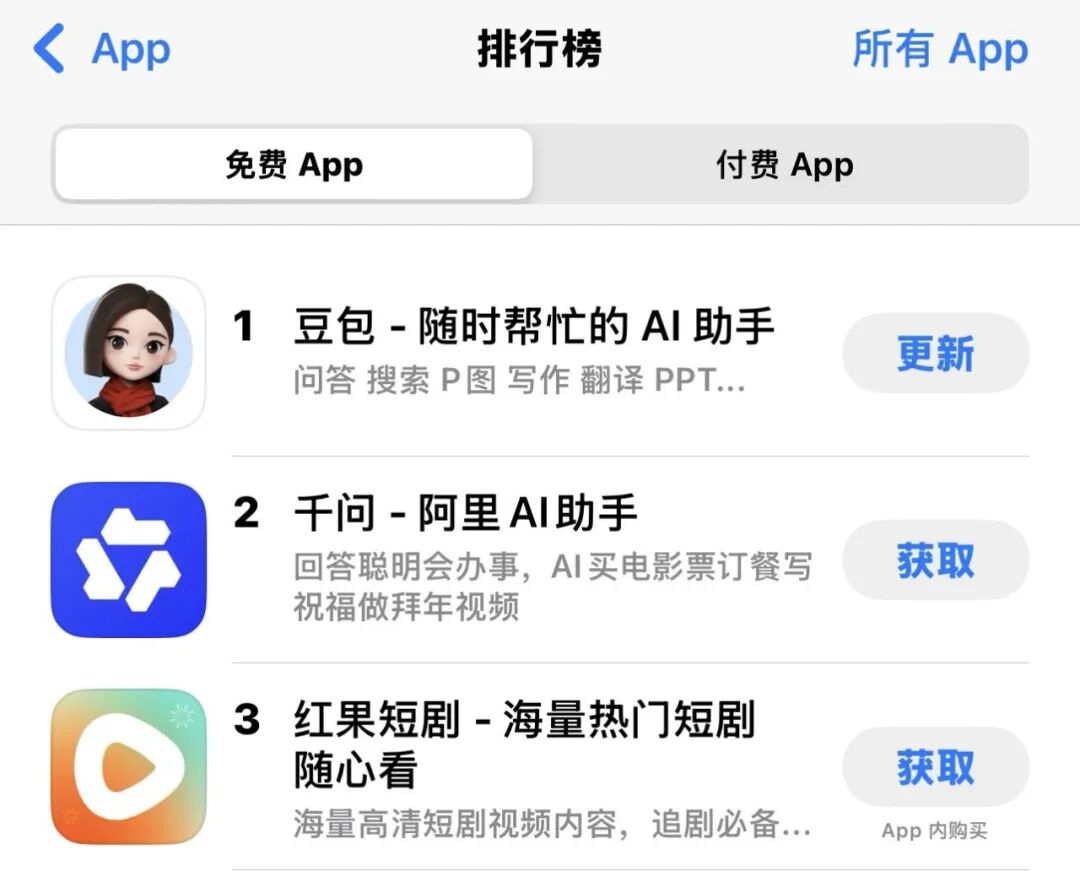
Core Insights - The Chinese AI industry experienced a significant surge during the Spring Festival, with major companies like ByteDance, Alibaba, and Tencent actively engaging in AI-related activities while most workers took a break [2][4] - The competition led to record-breaking user interactions, with ByteDance's Doubao achieving 1.9 billion interactions, Alibaba's Qwen serving over 130 million users, and Tencent's Yuanbao facilitating 3.6 billion lottery draws [4][6] - Despite the impressive metrics, the industry faces challenges related to user retention and operational pressures, highlighting a disconnect between user engagement driven by incentives and genuine usage of AI functionalities [6][7] Company Activities - ByteDance's Doubao served as the exclusive AI cloud partner for the CCTV Spring Festival Gala, managing 1.9 billion interactions and ensuring the stability of 100,000 live lottery draws [2] - Alibaba's Qwen team launched the open-source Qwen 3.5 and integrated AI capabilities into consumer platforms like Taobao and Ele.me, resulting in over 130 million users engaging with the service during the festival [2] - Tencent's Yuanbao distributed 1 billion cash red envelopes and facilitated 3.6 billion lottery draws, requiring continuous technical support to maintain product stability [3] Industry Challenges - The rapid user engagement during the festival exposed operational weaknesses, such as the inability of Zhiyu's GLM-5 to handle user demand, leading to phased access and user complaints [4] - The industry is transitioning from a focus on technical achievements to addressing the challenges of high-frequency user interactions and operational reliability [4][9] - The temporary surge in user activity raises concerns about long-term retention, as users attracted by incentives may not continue to engage with AI services once promotions end [6][7] Future Outlook - The industry is expected to shift from a "money-burning frenzy" to a "commercialization elimination race," emphasizing the need for teams that can balance technology, operations, and business strategies [9] - The true value of AI will be determined by its ability to meet real user needs beyond the temporary spikes in engagement seen during promotional events [9]

2026春节AI大战深度复盘:亿级俱乐部诞生,AI从技术前沿走向全民普惠
Sou Hu Cai Jing· 2026-02-24 16:24
Core Insights - The 2026 Spring Festival marked a pivotal moment for C-end AI development in China, with major players Tencent, ByteDance, and Alibaba investing over 4.5 billion yuan to capture user attention through red envelopes, subsidies, and technology showcases [2][4] - The competition transcended traditional traffic battles, evolving into an ecological gamble for C-end AI entry dominance, facilitating AI's transition from cutting-edge technology to a widely accessible tool for all demographics [2][13] Group 1: Key Achievements - The AI battle during the Spring Festival resulted in the collective entry of Doubao, Yuanbao, Qianwen, and DeepSeek into the "billion-level club," achieving significant user growth and market penetration [2][3] - Doubao reached 200 million monthly active users, Yuanbao surpassed 50 million daily active users and 114 million monthly active users, while Qianwen achieved a peak of 140 million daily active users [3][4] Group 2: Differentiated Strategies - Tencent's strategy focuses on embedding AI within its social ecosystem, leveraging its WeChat user base to create an "embedded AI" model that enhances social interactions rather than replacing them [5][7] - ByteDance employs a technology-driven approach, utilizing its national-level traffic and the Seedance 2.0 video generation model to expand its ecosystem and reach a broader audience [8][9] - Alibaba's Qianwen aims to streamline user interactions with services, transforming its core business model to connect users directly with instant services, thereby enhancing user experience [10][12] Group 3: Industry Transformations - The competition has shifted from focusing solely on product capabilities to a comprehensive evaluation of "model + scenario + ecosystem," emphasizing the importance of contextual adaptation and ecological integration [13][14] - The industry is moving towards a "scene-first" approach, prioritizing localized capabilities that cater to cultural nuances and user needs, thus reducing reliance on foreign models [14] - The evolution from tool-based AI to relationship-based AI highlights the importance of trust and connection, as companies explore deeper user engagement beyond mere efficiency [16][17]

传媒有望承接AI应用新场景
2026-02-24 14:15
Summary of Conference Call Records Industry Overview - The conference call discusses the media industry, particularly focusing on the impact of AI applications on the sector and the performance of various companies during the 2026 Spring Festival period [1][2][3]. Key Points and Arguments AI Applications in Media - ByteDance's AI application scenarios are frequent, with daily active users reaching 155 million and the Doubao model generating 67.633 billion tokens per minute [1] - Alibaba's Qianwen AI saw 200 million uses of its "one-sentence order" feature during the Spring Festival, indicating widespread AI adoption [1][2] - Tencent's Yuanbao saw a significant drop in ranking, highlighting the competitive landscape where ByteDance and Alibaba lead in AI entry points [1][2] Commercialization of AI in Media - The development of AI technology is pushing the media industry into a new phase of commercialization, with a focus on efficiency and output [3] - Advertising and digital marketing are expected to play crucial roles, with the GU strategy already demonstrating market performance [3] - The CDS 2.0 driven AIGC technology is transitioning video generation from a technical demonstration to a commercially viable stage, impacting various verticals like film, gaming, and animation [3] Spring Festival Film Market Performance - The 2026 Spring Festival film market showed a clear performance divide, with "Fast and Furious 3" leading with a box office prediction of 54.3 billion, capturing over 50% of the total box office [4] - Companies benefiting from this include unlisted Pingdu Film and listed Bona Film, Wanda Film, and others [4][5] - Despite a slight decline from the previous year's high base, the overall film market is expected to show a low-open, high-rise trend throughout 2026 [4][5] Impact of AI Films on the Industry - The official release of AI films in 2026 is anticipated to boost the AI film sector, despite challenges such as copyright issues faced by ByteDance's C station [6] - The resistance from the U.S. towards China's C-Dance 2.0 reflects a conflict between new technological revolutions and established interests, suggesting a need for balance between innovation and copyright protection [6][8] Role of AI in Content Creation - AI is increasingly integrated into various stages of film content creation, including scriptwriting and visual effects [7] - Companies that do not embrace AI technology risk being left behind, similar to past transitions in the film industry [7] Strategies for Traditional Film Companies - Traditional film companies should leverage their strengths in digital content, copyright, and IP by incorporating AI to enhance competitiveness [9] Future Outlook for ByteDance and the Film Market - ByteDance's industry chain shows strong potential for growth, driven by innovation despite facing short-term challenges [10] - The overall film market in 2026 is expected to perform well, with companies like Bona Film and Wanda Film poised for success [11] New Developments in the Gaming Sector - The gaming sector is highlighted with new product launches and developments from companies like Shunwang Technology and Perfect World [12] Investment Opportunities in Digital Marketing - The digital marketing sector presents investment opportunities in companies such as BlueFocus, Shunwang Technology, and others, with a focus on AI applications enhancing their business lines [13]

【西街观察】AI大显神通会成为常态
Bei Jing Shang Bao· 2026-02-24 13:45
Core Insights - The integration of AI into daily life reached unprecedented levels during the Spring Festival, with significant user engagement and application across various sectors [1][2] - Major tech companies aggressively competed for user acquisition through subsidies and promotions, resulting in record user interactions and engagement metrics [1][2] - The rapid advancements in AI technology and funding during this period indicate a fast-paced development cycle, with no signs of slowing down despite the holiday [2] Group 1: User Engagement and Metrics - On New Year's Eve, the total interactions with Doubao AI reached 1.9 billion, while Alibaba reported nearly 200 million users placing orders through Qianwen [1] - Tencent disclosed that its daily active users surpassed 50 million, with monthly active users reaching 114 million [1] - The massive user engagement reflects a significant shift in consumer behavior and the growing presence of AI in everyday activities [1][2] Group 2: Competitive Landscape - The Spring Festival served as a concentrated battleground for AI companies, highlighting the importance of product-centric competition beyond initial user acquisition [3] - The competition among companies is expected to intensify, focusing on user experience, commercialization, ecosystem collaboration, and computational power [3] - Historical examples of AI competition, such as ChatGPT and DeepSeek, illustrate the unpredictable nature of the market and the ongoing struggle for dominance [3] Group 3: Technological Advancements - Domestic AI has undergone a comprehensive update across various dimensions, including reasoning, video, embodied, and conversational products [2] - The rapid pace of technological iteration and high funding amounts signal an urgent need for companies to innovate and adapt [2] - The evolving public perception of AI has shifted from fear of replacement to a desire for effective utilization, indicating a maturation of the market [3]
阿里最新开源的原生多模态模型千问3.5登顶全球榜首!
Shang Hai Zheng Quan Bao· 2026-02-24 13:40
Core Insights - The latest open-source model, Qwen 3.5, released by Alibaba, features 397 billion parameters, with only 17 billion activated, and its performance is comparable to Gemini 3, while its token cost is approximately 5% of Gemini 3's [1] - Following the release of Qwen 3.5, major global tech companies including Nvidia, AMD, Apple, and Intel, as well as domestic GPU platforms like Huawei Ascend and Moore Threads, quickly adapted to the model [2] - Qwen 3.5 has achieved significant global traction, with over 400 models open-sourced by Alibaba, covering all sizes and modalities, and has surpassed 1 billion downloads globally, making it the leading open-source large model [2] Group 1 - Qwen 3.5 is recognized as the most popular open-source large model according to the latest ranking by Hugging Face, indicating strong interest from global AI developers [3] - The model's rapid adaptation by both international and domestic tech companies highlights its competitive positioning in the AI landscape [2] - The extensive range of models and high download volume underscores Alibaba's leadership in the open-source AI model sector [2]