BABA(09988)

Search documents
“烧钱”80亿发红包,四款AI轮流登顶榜首,背后公司股价却集体走低,靠“撒钱”能留住用户吗?
Xin Lang Cai Jing· 2026-02-24 12:30
Core Insights - The "AI Red Packet War" among internet companies has concluded following the Spring Festival holiday, with significant financial investments made in AI tools and related apps [1][11] - A total of over 8 billion yuan was reportedly spent by multiple internet companies during this period, raising questions about user retention beyond the monetary incentives [3][13] Investment and User Engagement - Alibaba's Qianwen invested 3 billion yuan, Tencent's Yuanbao distributed 1 billion yuan, and ByteDance's Doubao offered tech gifts during the campaign [3][13] - Yuanbao reported over 50 million daily active users (DAU) and 114 million monthly active users (MAU) during the event, with users participating in over 36 billion lottery draws and completing over 1 billion AI creations [14] - Qianwen facilitated nearly 200 million orders during the Spring Festival, with significant sales in beverage categories [14] App Performance - Four apps, Yuanbao, Qianwen, Antifortune, and Doubao, dominated the iOS free app rankings, with varying durations at the top [4][14] - Post-campaign, Yuanbao's ranking dropped significantly, indicating potential challenges in maintaining user engagement [18] Market Reaction - The capital market showed skepticism towards the "AI Red Packet War," with the Hang Seng Technology Index experiencing declines, and major companies like Alibaba and Tencent seeing their stock prices fall [6][16] User Retention Challenges - Experts suggest that user retention will depend more on the core value and experience of the products rather than the size of the red packets [8][19] - Successful AI tools must integrate into real-life scenarios and provide personalized services to maintain user interest [19][20] Future Outlook - The "AI Red Packet War" may signify a pivotal shift from mobile internet to AI internet in China, similar to how WeChat red packets transformed payment landscapes [19] - The AI assistant market is expected to evolve into a competitive landscape with differentiated offerings, where leading players leverage ecosystems and scale [20]

智通港股通活跃成交|2月24日





智通财经网· 2026-02-24 11:04
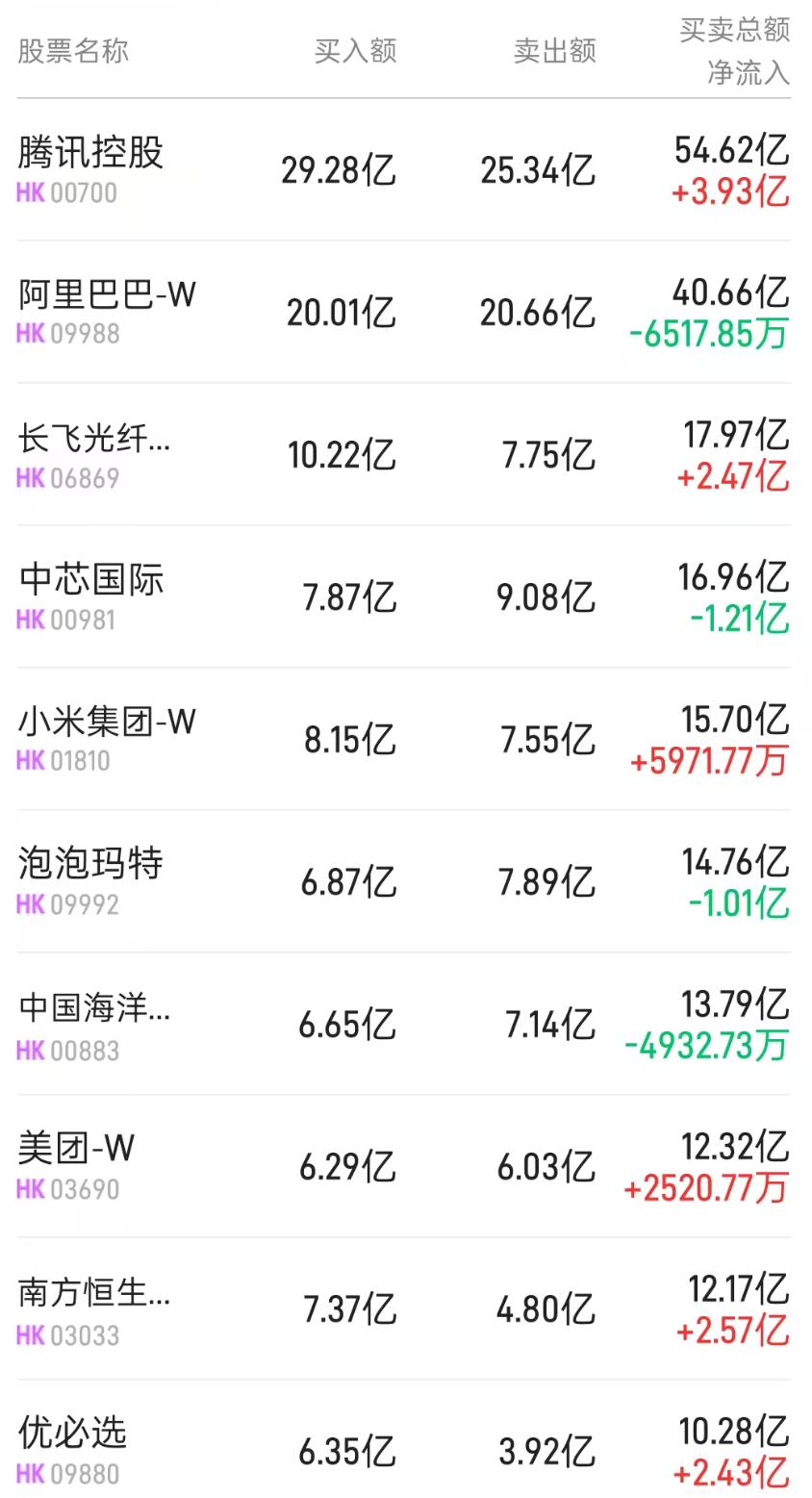
Core Insights - On February 24, 2026, Tencent Holdings (00700), Alibaba-W (09988), and Yangtze Optical Fibre and Cable (06869) were the top three companies by trading volume in the Southbound Stock Connect, with trading amounts of 5.462 billion, 4.066 billion, and 1.797 billion respectively [1] - Tencent Holdings (00700), Alibaba-W (09988), and Yangtze Optical Fibre and Cable (06869) also led in trading volume in the Shenzhen-Hong Kong Stock Connect, with trading amounts of 5.689 billion, 4.025 billion, and 1.901 billion respectively [1] Southbound Stock Connect Trading Activity - **Top Active Companies in Southbound Stock Connect:** - Tencent Holdings (00700): Trading amount of 5.462 billion, net buying of +0.393 billion [2] - Alibaba-W (09988): Trading amount of 4.066 billion, net selling of -0.065 billion [2] - Yangtze Optical Fibre and Cable (06869): Trading amount of 1.797 billion, net buying of +0.247 billion [2] - SMIC (00981): Trading amount of 1.696 billion, net selling of -0.121 billion [2] - Xiaomi Group-W (01810): Trading amount of 1.570 billion, net buying of +0.059 billion [2] - Pop Mart (09992): Trading amount of 1.476 billion, net selling of -0.101 billion [2] - CNOOC (00883): Trading amount of 1.379 billion, net selling of -0.049 billion [2] - Meituan-W (03690): Trading amount of 1.232 billion, net buying of +0.025 billion [2] - Southern Hang Seng Technology (03033): Trading amount of 1.217 billion, net buying of +0.026 billion [2] - UBTECH (09880): Trading amount of 1.028 billion, net buying of +0.024 billion [2] Shenzhen-Hong Kong Stock Connect Trading Activity - **Top Active Companies in Shenzhen-Hong Kong Stock Connect:** - Tencent Holdings (00700): Trading amount of 5.689 billion, net selling of -0.480 billion [2] - Alibaba-W (09988): Trading amount of 4.025 billion, net selling of -0.000384 billion [2] - Yangtze Optical Fibre and Cable (06869): Trading amount of 1.901 billion, net selling of -0.161 billion [2] - Xiaomi Group-W (01810): Trading amount of 1.544 billion, net buying of +0.378 billion [2] - Southern Hang Seng Technology (03033): Trading amount of 1.465 billion, net buying of +1.327 billion [2] - SMIC (00981): Trading amount of 1.394 billion, net buying of +0.342 billion [2] - Meituan-W (03690): Trading amount of 1.039 billion, net buying of +0.066 billion [2] - CNOOC (00883): Trading amount of 0.874 billion, net selling of -0.05057 billion [2] - Kuaishou-W (01024): Trading amount of 0.763 billion, net buying of +0.0304 billion [2] - Pop Mart (09992): Trading amount of 0.762 billion, net selling of -0.0104 billion [2]
恒指跌近500点,科网股全线走低,智谱逆势大涨12%
2 1 Shi Ji Jing Ji Bao Dao· 2026-02-24 10:24
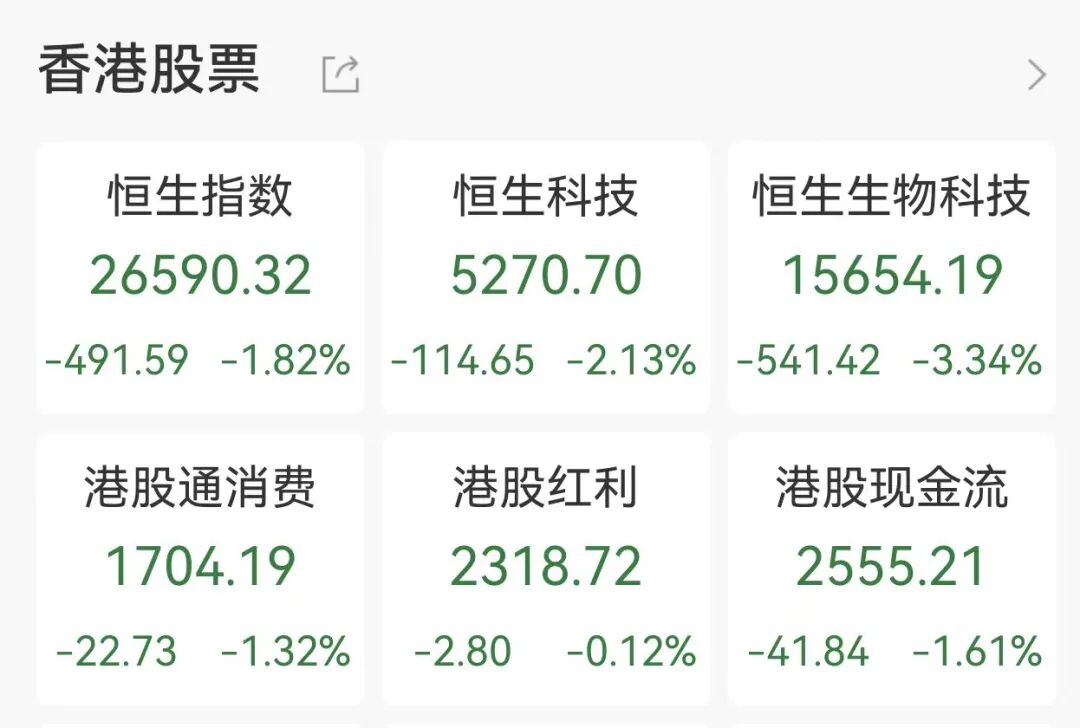
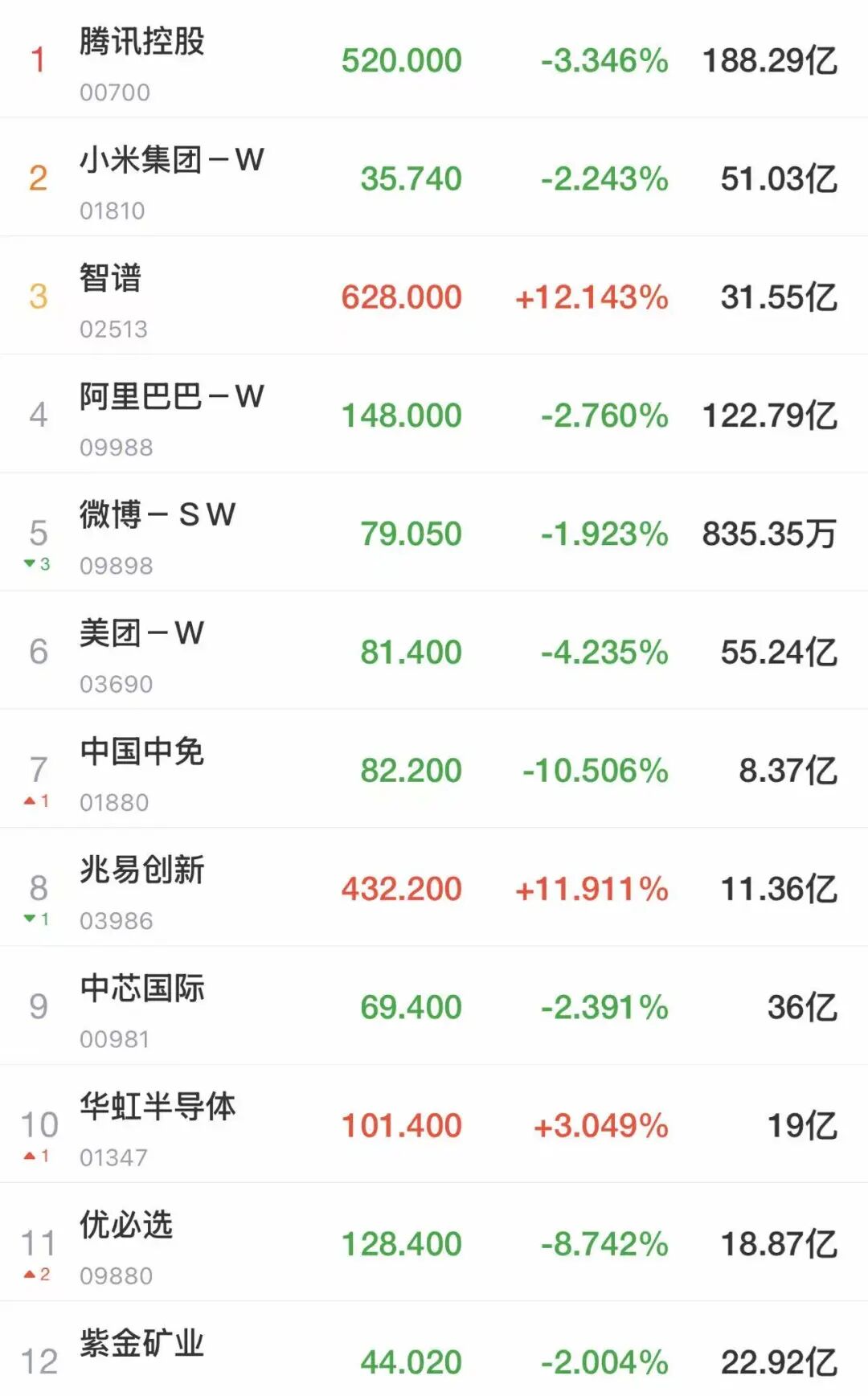
Market Overview - The Hang Seng Index decreased by 491.59 points, or 1.82%, closing at 26,590.32 [1] - The Hang Seng Technology Index fell by 114.65 points, or 2.13%, while the Hang Seng Biotechnology Index dropped by 541.42 points, or 3.34% [1] Technology Sector - Internet technology stocks collectively declined, with Alibaba down by 2.7%, Kingsoft Cloud down by 5%, and Kuaishou and Xiaomi both falling over 2% [1] - Tencent Music saw a drop of 5.62%, closing at 57.10, while Meituan fell by 4.24% to 81.40 [2] - Tencent Holdings decreased by 3.35%, closing at 520.00 [2] Pharmaceutical Sector - The pharmaceutical sector weakened, with notable declines including Tigermed down over 3.6% and Zai Lab down 7.3% [2] - Other companies like WuXi AppTec, Innovent Biologics, and Alibaba Health also reported losses [2][3] - Three-Sixty Pharmaceuticals fell by 6.69%, closing at 22.30, while China Biologic Products dropped by 6.58% to 6.39 [3] Consumer Sector - The consumer discretionary sector experienced a downturn, highlighted by China Duty Free Group falling over 10% [4] - China Duty Free Group closed at 82.20, down 10.51% [4] AI Sector - The AI application sector showed activity, with Zhiyun rising over 12% and accumulating a 177% increase this month [4][5] - MINIMAX-WP increased by 4.70%, closing at 880.00, while Zhiyun reached 628.00, up 12.14% [5] - The latest Hugging Face open-source model rankings featured eight models from Chinese teams, including those from Alibaba and Zhiyun [5] Oil Market - International crude oil futures rose, with Shandong Molong increasing over 11% and accumulating a nearly 45% rise this year [5] - WTI crude futures for March rose by 1.9%, while Brent crude futures for April increased by 1.86% [5]



北水动向|北水成交净买入31.31亿 内资全天抢筹南方恒生科技近16亿港元
智通财经网· 2026-02-24 10:09
Group 1: Market Overview - The Hong Kong stock market saw a net inflow of 31.31 billion HKD from northbound trading, with 9.6 billion HKD from Shanghai and 21.7 billion HKD from Shenzhen [1] - The most bought stocks included Southern Hang Seng Technology (03033), Meituan-W (03690), and Xiaomi Group-W (01810) [1] - The most sold stocks were CNOOC (00883), Tencent (00700), and Alibaba-W (09988) [1] Group 2: Stock Performance - Southern Hang Seng Technology (03033) received a net inflow of 15.84 billion HKD, supported by positive sentiment in the tech sector [5] - Meituan-W (03690) saw a net inflow of 6.87 billion HKD, with a report indicating a 79% year-on-year increase in travel spending during the Spring Festival [5] - Xiaomi Group-W (01810) had a net inflow of 4.37 billion HKD, with plans to focus on core technologies like chips and AI over the next five years [5] Group 3: Individual Stock Insights - Tencent Holdings (00700) had a total trading volume of 54.62 billion HKD, with a net inflow of 3.93 billion HKD [2] - Alibaba-W (09988) experienced a net outflow of 651.785 million HKD, with total trading of 40.66 billion HKD [2] - SMIC (00981) received a net inflow of 2.2 billion HKD, with expectations of sales growth exceeding industry averages by 2026 [6][7]


北水动向|北水成交净买入31.31亿 内资全天抢筹南方恒生科技(03033)近16亿港元
智通财经网· 2026-02-24 09:57
Group 1: Market Overview - The Hong Kong stock market saw a net inflow of 31.31 billion HKD from northbound trading, with 9.6 billion HKD from Shanghai and 21.7 billion HKD from Shenzhen [1] - The most bought stocks included Southern Hang Seng Technology (03033), Meituan-W (03690), and Xiaomi Group-W (01810) [1] - The most sold stocks were CNOOC (00883), Tencent (00700), and Alibaba-W (09988) [1] Group 2: Individual Stock Performance - Southern Hang Seng Technology (03033) received a net inflow of 15.84 billion HKD, with analysts suggesting that the tech sector remains a long-term investment focus due to reduced valuation pressure and accelerating AI applications [4] - Meituan-W (03690) saw a net inflow of 6.87 billion HKD, with a report indicating a 79% year-on-year increase in tourism spending during the Spring Festival [5] - Xiaomi Group-W (01810) had a net inflow of 4.37 billion HKD, with plans to focus on core technologies like chips and AI over the next five years [5] - SMIC (00981) received a net inflow of 2.2 billion HKD, with positive signals for 2026 sales growth expected to exceed industry averages [6] - CNOOC (00883) faced a net outflow of 998.9 million HKD amid geopolitical risks affecting the oil market [6] - Tencent (00700) and Alibaba-W (09988) experienced net outflows of 867.7 million HKD and 690.1 million HKD, respectively [6]

2026春节档:80亿AI红包大战落幕,狂欢过后何去何从?
2 1 Shi Ji Jing Ji Bao Dao· 2026-02-24 09:52
Core Insights - The AI "red envelope war" during the Spring Festival resulted in over 8 billion yuan in spending, marking a significant shift in the competition landscape of the AI industry, with major platforms leveraging their resources to dominate the market [1][3][10] - This event is seen as a pivotal moment for the transition of China's internet towards an AI-driven ecosystem, with the competition determining future business strategies and investment landscapes [3][10] Industry Dynamics - The Spring Festival has traditionally been a prime time for user acquisition, but in 2026, it transformed into a major test for AI technology, directly engaging a nationwide audience [3][4] - Major players like Tencent, Alibaba, and ByteDance invested heavily, with Tencent's "Yuanbao" achieving over 36 billion lottery draws and 11 million "lucky money" red envelopes distributed, while Alibaba's "Qianwen" facilitated 1.3 billion AI shopping experiences [4][5] - The competition highlighted a trend towards market consolidation, where larger companies with resources and technology are increasingly dominating the AI landscape, making it difficult for smaller players to compete [4][6] Competitive Strategies - ByteDance's strategy involved exclusive collaboration with the CCTV Spring Festival Gala, significantly increasing user engagement and interaction, with 1.9 billion AI interactions on New Year's Eve [5][6] - Alibaba's approach focused on integrating AI into consumer transactions, resulting in a 372-fold increase in AI ticket orders, demonstrating the potential for AI to drive real transactions [6][7] - Tencent utilized its social media ecosystem to embed AI interactions within social contexts, achieving user penetration with minimal marketing costs, reminiscent of its earlier success with mobile payments [7][8] Future Challenges - Post-festival, the real challenge lies in retaining users, as the initial surge in interactions may not translate into long-term engagement without addressing genuine user needs [8][9] - The ability to integrate AI into everyday life and solve real problems will be crucial for maintaining user interest and loyalty, as highlighted by industry experts [9][10] - The long-term success of AI platforms will depend on their capacity to create seamless user experiences and establish a strong presence in daily activities, moving beyond short-term engagement strategies [10]
75亿,韩寒赚翻了
商业洞察· 2026-02-24 09:26
Core Viewpoint - The article highlights the significant success of the film "Flying Life 3" during the 2026 Spring Festival, with a total box office exceeding 20 billion yuan within a few days of release, establishing it as the dominant film of the season [4][11][12]. Group 1: Film Performance - The total box office for the Spring Festival period (February 15-23) surpassed 48 billion yuan, with "Flying Life 3," "Silent Awakening," and "Biao Ren: Wind Rises in the Desert" leading the charts [4][8]. - "Flying Life 3" achieved a record-breaking box office of over 10 billion yuan within just two days of its release, contributing over 30% of the total box office for the festival [11][12]. - The film's narrative revolves around the protagonist Zhang Chi, played by Shen Teng, who faces challenges in the racing world, ultimately leading to a triumphant return to racing [11][12]. Group 2: Industry Dynamics - The 2026 Spring Festival is noted as the "longest Spring Festival" in history, featuring eight films, including "Flying Life 3" and "Silent Awakening" [8][18]. - Despite the high number of films, the overall box office performance appears weaker compared to previous years, with the first-day box office at 12.72 billion yuan, marking a five-year low [18][19]. - The article discusses the competitive landscape, with "Flying Life 3" significantly outpacing other films, indicating a clear division in box office performance among the films released [18][19]. Group 3: Investment and Production Insights - Major production companies involved in "Flying Life 3" include Tsingdong Film, Maoyan Entertainment, and Wanda Film, with Tsingdong Film being the largest investor [13][20]. - The article notes that this year's Spring Festival saw the highest participation from A-share companies, although the absence of a blockbuster film raises questions about profitability [20][21]. - The film "Silent Awakening" has also gained attention for its unique setting and themes, contributing to the overall interest in the Spring Festival films [16][20]. Group 4: Cultural Impact - The film "Silent Awakening" has led to increased tourism in Shenzhen, with many filming locations becoming popular tourist spots, reflecting the film's impact beyond the box office [21][23]. - The article suggests that the perception of the Spring Festival is evolving, with new cultural elements being introduced alongside traditional celebrations [24].


港股三大指数全线跳水,恒生科技跌超2%,科技巨头齐跌!中国中免跌超10%,智谱逆势大涨12%|港股收盘
Mei Ri Jing Ji Xin Wen· 2026-02-24 09:05
Market Overview - The Hong Kong stock market experienced a decline across all major indices, with the Hang Seng Index falling by 1.82%, the Hang Seng Tech Index down by 2.13%, and the National Enterprises Index decreasing by 2.06% [1] - Major internet technology stocks also saw significant drops, including Tencent Holdings down nearly 3.3%, Alibaba down 2.7%, and Kingsoft Cloud down 5% [1] Stock Performance - Tencent Holdings closed at 188.29 billion, down 3.346% [2] - Xiaomi Group fell by 2.243%, closing at 51.03 billion [2] - Alibaba's stock decreased by 2.760%, ending at 148.00 billion [2] - Meituan saw a decline of 4.235%, closing at 55.24 billion [2] - China Duty Free Group experienced a significant drop of over 10.506%, closing at 8.37 billion [3] Sector Analysis - The robotics, pharmaceuticals, and duty-free sectors all faced declines, with China Duty Free Group dropping over 10%, and other companies like Tigermed and Zhaoyan New Drug falling by more than 3.6% and 7.3% respectively [3] - Conversely, Zhizhu saw a notable increase of over 12%, marking a rise of over 440% since its listing in January [3] Future Outlook - According to Liu Gang, a managing director at CICC, the credit cycle will determine index space, while industry trends will influence structural strength [3] - Short-term market adjustments may occur, but there is potential for upward correction after a pullback [3] - The mid-term outlook suggests a projected earnings growth of 3% to 4% for Hong Kong stocks, with the Hang Seng Index potentially rising to around 28,000 to 29,000 points [3] - The influx of capital from the south post-Chinese New Year is expected to provide liquidity support for the Hong Kong market [3] - Recommendations include focusing on technology (AI computing and applications), non-bank financials (insurance), and dividend stocks, with an emphasis on the need to confirm earnings and liquidity turning points for the Hang Seng Tech Index [3]
港股收盘:恒生科技指数跌2.13%,机器人概念股跌幅居前,卧安机器人跌约12%
Jin Rong Jie· 2026-02-24 08:24
Market Performance - The Hong Kong stock market saw a decline, with the Hang Seng Index dropping by 1.82% to 26,590.32 points, the Hang Seng Tech Index falling by 2.13% to 5,270.7 points, and the National Enterprises Index decreasing by 2.06% to 9,007.86 points [1] - Notable declines were observed in major tech stocks, including Alibaba (-2.76%), Tencent (-3.35%), and Meituan (-4.24%) [1] Company News - CK Hutchison Holdings expressed opposition to the Panamanian government's forceful takeover of the Panama Ports Company's assets, employees, and operations, which has led to the cessation of operations at Balboa and Cristobal ports [2] - The company plans to explore all possible legal avenues against the Panamanian government and related parties due to the illegality of the government's actions [2] Industry Insights - China Galaxy Securities highlighted that the technology sector remains a long-term investment focus, with expectations of a rebound following recent corrections, driven by advancements in AI models and applications [2] - The firm also noted that the consumer sector is positioned for potential growth as consumer policies increase, while geopolitical risks and U.S. tariff adjustments may benefit precious metals and energy sectors [2]



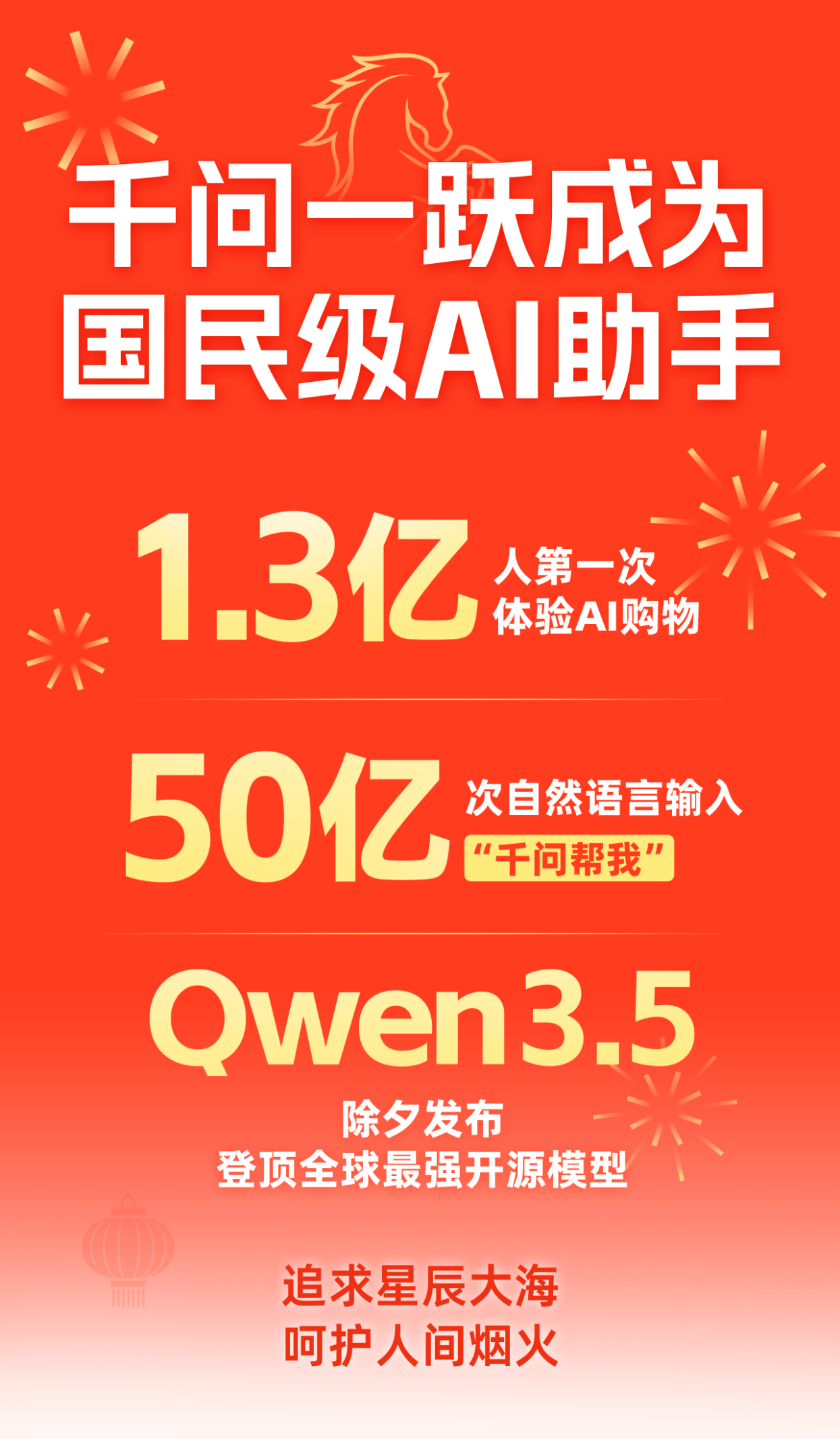
千问发布数据:1.3亿人春节首次体验AI购物
Huan Qiu Wang· 2026-02-24 07:52
Core Insights - During the Spring Festival, over 130 million people experienced AI shopping for the first time, making 5 billion requests using "Qianwen help me" [1][6] - The number of AI ticket orders surged, with a 22-fold increase for event tickets and over 7-fold for flight tickets. Movie ticket orders increased by 372 times, particularly in lower-tier cities where orders rose by 782 times [1][6] - Nearly half of all AI orders originated from county-level cities, and around 4 million users aged 60 and above engaged in AI shopping [1][6] - Qianwen integrates with Alibaba's ecosystem, including Taobao, Alipay, and others, with plans to introduce additional features like AI taxi booking and mobile recharge [1][6] - As of February 7, Qianwen's daily active users reached 73.52 million, nearing Doubao's 78.71 million, achieving this in just three months [1][6] Model Development - On New Year's Eve, Alibaba released the new generation model Qwen 3.5-Plus, which is comparable to Gemini 3 Pro, marking it as the strongest open-source model globally [2][7] - This dual breakthrough in AI capabilities and application usage signifies a significant advancement for Alibaba's AI initiatives during the Spring Festival [2][7]