SPD BANK(600000)

Search documents
浦发银行持续赋能城市更新 共筑人民城市美好未来
Guo Ji Jin Rong Bao· 2025-07-01 16:17
Core Viewpoint - Urban renewal actions are essential for high-quality urban development and meeting the needs of people's lives, with financial institutions playing a crucial role in this process [1][2]. Group 1: Urban Renewal Initiatives - The "14th Five-Year Plan" and the 2035 vision emphasize the need for sustainable urban development and the implementation of urban renewal actions to enhance living quality [2]. - The recent government opinions advocate for establishing sustainable urban renewal models and policies to optimize urban structures and improve quality of life [2][3]. - Shanghai Pudong Development Bank (SPDB) has been proactive in urban renewal, launching its first urban renewal management measures in 2019 and offering tailored financial products to meet diverse project needs [2][3]. Group 2: Financial Support and Products - SPDB has introduced the urban renewal 2.0 product line to address financing needs across various urban infrastructure projects, with a loan balance of nearly 160 billion yuan as of June this year [3]. - The bank has provided significant financial support for specific urban renewal projects, such as 3 billion yuan for the revitalization of the Old East Gate area in Wuxi [4]. - In Shanghai, SPDB participated in a major urban redevelopment project, providing nearly 15 billion yuan in funding to facilitate the relocation of residents [5][6]. Group 3: Cultural and Historical Preservation - Urban renewal is not just about construction but also involves preserving historical and cultural elements of cities [7]. - SPDB has supported projects aimed at protecting historical sites, such as providing 500 million yuan for the renovation of the Meiyuan area in Nanjing [7]. - In Jiangxi, the bank has funded cultural tourism projects, including an 80 million yuan loan for the renovation of the Tao Xi Chuan scenic area in Jingdezhen [8]. Group 4: Future Directions - As urban renewal initiatives expand, SPDB aims to leverage its digital strategy to explore future pathways for urban renewal, enhancing urban spaces and addressing community needs [8].

果然“白衣骑士”,信达投资转股增持跻身浦发前十大股东,双赢模式望成银行补资本新路径
Xin Lang Cai Jing· 2025-07-01 13:43
Group 1 - The core point of the article is that Cinda Investment's significant increase in convertible bonds and subsequent conversion into shares has positioned it as the 10th largest shareholder of Pudong Development Bank, providing crucial capital support as the bank approaches the maturity of its convertible bonds [1][2][3] - Cinda Investment converted 118 million shares of Pudong Development Bank's convertible bonds into common stock, which represents 23.57% of the total issued convertible bonds, thereby increasing the bank's total common stock to approximately 30.26 billion shares [2][3] - Prior to Cinda's intervention, 99.99% of Pudong Development Bank's convertible bonds had not been converted, highlighting the urgency for capital replenishment as the bond maturity date approaches [1][3] Group 2 - The article discusses the trend of Asset Management Companies (AMCs) acting as "white knights" to support banks by converting convertible bonds into equity, which has been seen as a viable solution for capital replenishment [4][5] - This model has been previously demonstrated with Everbright Bank, where China Huarong converted a significant portion of its convertible bonds into equity, becoming a major shareholder [4] - The dual benefits of this model for both AMCs and banks include reduced financial costs for banks and potential investment returns for AMCs, suggesting that this approach may become a regular practice in the industry [5][6]
转债再现“白衣骑士”!信达投资超百亿元转股浦发银行
Zheng Quan Shi Bao· 2025-07-01 12:33
Group 1 - The core point of the news is that China Cinda Asset Management Co., Ltd. has converted approximately 117.85 billion yuan worth of SPDB convertible bonds into common shares, increasing its holdings in SPDB significantly and marking a key step for AMCs in alleviating banks' capital pressure [1][2][3] - As of June 25, 2023, Cinda Securities managed to accumulate 1.1785 billion SPDB convertible bonds, representing 23.57% of the total issuance, which were then transferred to Cinda Investment [2] - Following the conversion, the total number of SPDB common shares increased to 30.264 billion, with the unconverted balance of SPDB convertible bonds dropping to 38.211 billion yuan, reducing the unconverted ratio to 76.42% [3] Group 2 - The SPDB convertible bonds, issued in October 2019, had a total issuance of 500 billion yuan, with a maturity of six years, and had not triggered redemption clauses since their listing [2][3] - Cinda Investment's conversion of the bonds is part of a broader trend where banks are increasingly looking to convert convertible bonds into equity to enhance their core tier one capital and improve capital adequacy ratios [5] - The "Everbright model" is referenced as a precedent where strategic investors can assist banks in converting convertible bonds to alleviate repayment pressures, highlighting a potential new channel for banks to manage their capital needs [5][6]
转债再现“白衣骑士”!信达投资超百亿元转股浦发银行
证券时报· 2025-07-01 12:27
Core Viewpoint - The conversion of approximately 117.85 billion yuan worth of SPDB convertible bonds into common stock by China Cinda Asset Management signifies a crucial step in alleviating capital pressure for banks and optimizing financial resource allocation in China [1][3]. Group 1: SPDB Convertible Bonds - On June 30, SPDB announced that China Cinda's subsidiary, Cinda Investment, converted about 117.85 million SPDB convertible bonds into 912 million shares of SPDB common stock [1][3]. - The total number of SPDB common shares increased to 30.264 billion after the conversion [3]. - The SPDB convertible bonds, issued in October 2019, had a total issuance of 500 billion yuan and were set to mature in six years [3][4]. Group 2: Impact on Capital Adequacy - Prior to the conversion, as of June 26, 2025, the unconverted balance of SPDB convertible bonds was 499.97 billion yuan, representing 99.99% of the total issuance [4]. - Following the conversion, the unconverted balance dropped to 382.11 billion yuan, reducing the unconverted ratio to 76.42% [4]. - If the SPDB convertible bonds remain unconverted, the bank would face a rigid repayment pressure of 500 billion yuan in principal and interest, posing a significant challenge to its capital adequacy ratio [4]. Group 3: Market Context and Trends - The trend of banks converting convertible bonds into equity has been observed, with several banks' convertible bonds exiting the market due to triggering redemption clauses [5][6]. - The issuance of convertible bonds primarily aims to provide low-cost financing and enhance core tier one capital, thereby improving capital adequacy ratios [6]. - The "Everbright Model" is referenced, where strategic investors convert their holdings to alleviate repayment pressures, indicating a potential new channel for banks to manage convertible bond exits [6].


浦发银行太原分行打造“一站式陪伴”金融服务
Zhong Guo Jin Rong Xin Xi Wang· 2025-07-01 11:58
Core Viewpoint - The company is actively enhancing its service system by creating a comprehensive "accompanying service" model that integrates finance and lifestyle, aiming to reshape customer experience and build a financial ecosystem through digital empowerment and scenario-based services [1][2][4]. Group 1: Service System Development - The company has launched five service modules—"Core Loan, Core Transaction, Core Ecosystem, Core Growth, Core Accompaniment"—targeting small and micro enterprises and individual businesses, providing one-stop credit support through online processing and product matching [2]. - Accessibility services have been improved with facilities like barrier-free access, wheelchairs, and reading glasses at branches, along with a dedicated "care window" for elderly and disabled customers [2]. - Regular anti-fraud training sessions and the promotion of the national anti-fraud center app are conducted to enhance financial risk awareness among the elderly [2]. Group 2: Scenario-Based Service Extension - The company emphasizes scenario-based financial services by organizing activities in various settings such as family, corporate, campus, and community, promoting financial education through engaging events [3]. - In the family sector, a "Berry Garden Learning" event was held to teach asset allocation through the growth process of strawberries, combining education with entertainment [3]. - Collaborations with educational institutions and local authorities are established to raise awareness about financial risks and fraud, particularly targeting students and employees in various sectors [3]. Group 3: Digital Empowerment and Community Engagement - The company is enhancing its digital banking services, particularly for elderly users, by optimizing mobile banking features to improve user convenience [4]. - Community service initiatives include the establishment of a "Neighborhood Home" service hub, equipped with first aid kits and health monitoring devices, and hosting cultural events to foster community engagement [4]. - Future plans involve continuing the "Finance for the People" philosophy by integrating human, technology, and ecological dimensions to transform service delivery from product-focused to value-oriented [4].
为什么A股一直没有形成盈利牛?
Datayes· 2025-07-01 11:09
Group 1: Military Industry - The military industry is currently in a state with significant upward potential and a solid bottom, despite weak performance expectations for 2024 and the first quarter of 2025 [1] - Major contracts and bidding notifications have been announced by several listed companies in the aerospace sector, enhancing market expectations for performance recovery [1] Group 2: Innovative Pharmaceuticals - The release of measures to support the high-quality development of innovative drugs has sparked renewed interest in the sector, with a focus on opening public data resources for innovative drug research and expanding commercial health insurance coverage [1] - Institutions have positively evaluated these measures, which are expected to facilitate China's transition from a "generic drug powerhouse" to an "innovative drug stronghold," benefiting leading innovative drug companies and the biotech sector [1] Group 3: Automotive Industry - The automotive industry in the Yangtze River Delta region is facing severe challenges, including high inventory levels, disordered market competition, and increased risks to the financial chain of enterprises [2][3] - Dealers have suggested that manufacturers allow reasonable inventory limits and adjust sales targets to better align with regional market capacities [3] Group 4: Market Performance - The A-share market showed mixed performance with the Shanghai Composite Index rising by 0.39% and the ChiNext Index falling by 0.24%, with a total market turnover of 14,967 billion yuan [6] - The innovative drug concept stocks surged in the afternoon, with companies like Shutaishen and Anglikang reaching historical highs [6] Group 5: Industry Trends - The PCB sector is experiencing activity due to a report from Citigroup predicting significant growth in AI-PCB markets in 2026 and 2027, with an estimated total addressable market of 53 billion yuan, reflecting a 53% year-on-year increase [6][7] - The report also highlights a projected supply gap of at least 3 billion yuan in AI-PCB from 2026, even without considering capacity expansion and assembly yield loss [7]




跨境支付(CIPS)概念下跌1.77%,主力资金净流出45股
Zheng Quan Shi Bao Wang· 2025-07-01 10:25
Group 1 - The cross-border payment (CIPS) concept declined by 1.77%, ranking among the top declines in the concept sector, with stocks like Jida Zhengyuan and *ST Rindong hitting the limit down [1][2] - Major stocks in the CIPS sector that experienced significant declines include Sifang Jingchuang (-9.55%), Lakala (-8.10%), and New Guodu (-7.29%) [2][3] - The CIPS sector saw a net outflow of 3.937 billion yuan, with 45 stocks experiencing net outflows, and 15 stocks seeing outflows exceeding 100 million yuan [2][3] Group 2 - The top net outflow stock was Sifang Jingchuang, with a net outflow of 731 million yuan, followed by Lakala and New Guodu with outflows of 548 million yuan and 400 million yuan, respectively [2][3] - In contrast, the top net inflow stocks included Pudong Development Bank, Industrial Bank, and Ping An Bank, with net inflows of 208 million yuan, 135 million yuan, and 105 million yuan, respectively [2][3] - The overall market sentiment reflected a mixed performance, with some stocks in the CIPS sector showing gains, such as Sanwei Xinan (+5.14%), Jingda Co. (+3.36%), and Construction Bank (+2.86%) [1][2]





浦发银行选举行长谢伟任副董事长!一季度该行营收净利双增
Nan Fang Du Shi Bao· 2025-07-01 09:54
对于2024年全年和2025年一季度的业绩表现,谢伟在近日举行的股东大会上总结为"满意而不满足"。对 于接下来能否保持向好的发展态势,他表示,"我们不会辜负股东、员工的信任,有信心延续更好的发 展态势"。 近日,浦发银行发布公告称,公司董事会会议同意选举谢伟为公司副董事长,待国家金融监督管理总局 核准其副董事长、董事任职资格后履职。同时,同意谢伟任董事会战略与可持续发展委员会(普惠金融 发展委员会)委员、风险管理与关联交易控制委员会(消费者权益保护委员会)委员。 分析称,谢伟由行长兼任副董事长,既体现了董事会对其管理能力的认可,也有助于强化战略决策与执 行的协同性,或推动浦发银行在转型关键期实现更高效的治理。 "有信心延续更好的发展态势" 去年,在董事长张为忠和行长谢伟搭档下,浦发银行取得了一份较为亮眼的业绩:营业收入1707.48亿 元,下降1.55%;剔除上年同期出售上投摩根股权一次性因素影响后,营业收入同比增长0.92%;实现 归属于母公司股东的净利润452.57亿元,同比增加85.55亿元,增长23.31%。据了解,这一净利润增幅 创近十二年新高。 今年一季度,在不少股份行业绩同比下滑的情况下,浦发银 ...
浦发银行(600000) - 上海浦东发展银行股份有限公司关于可转债转股结果暨股份变动公告
2025-07-01 09:48
公告编号:临2025-039 证券代码:600000 证券简称:浦发银行 优先股代码:360003 360008 优先股简称:浦发优1 浦发优2 转债代码:110059 转债简称:浦发转债 上海浦东发展银行股份有限公司 关于可转债转股结果暨股份变动公告 本公司董事会及全体董事保证本公告内容不存在任何虚假记载、误导性陈述 或者重大遗漏,并对其内容的真实性、准确性和完整性承担法律责任。 重要内容提示: 一、浦发转债的发行上市概况 经中国证券监督管理委员会《关于核准上海浦东发展银行股份有限公司公开 发行可转换公司债券的批复》(证监许可[2019]1857 号)核准,上海浦东发展银 行股份有限公司(以下简称"公司")公开发行了 50,000 万张可转换公司债券(以 下简称"可转债""浦发转债"),每张面值人民币 100 元,发行总额人民币 500 亿元,期限 6 年。 截至 2025 年 6 月 30 日,尚未转股的浦发转债金额为人民币 38,211,383,000 元,占浦发转债发行总量的比例为 76.4228%。 经上海证券交易所自律监管决定书[2019]247 号文同意,公司 500 亿元可转 债于 2019 ...
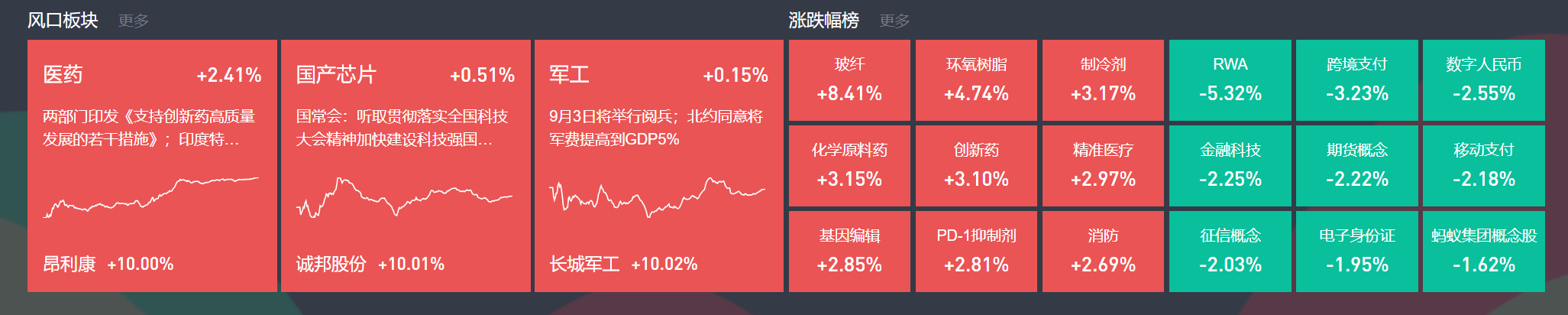
7月1日主题复盘 | 创新药反弹,国产芯片持续活跃,玻纤大涨
Xuan Gu Bao· 2025-07-01 08:19
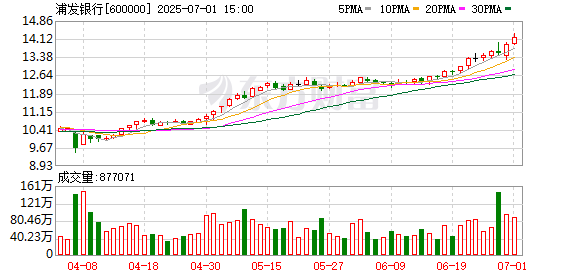
Market Overview - The market experienced fluctuations with mixed performance across the three major indices, with a total trading volume of 1.49 trillion [1] - The innovative drug sector saw a resurgence, with stocks like Angli康 and塞力医疗 hitting the daily limit [1] - Chip stocks continued their strong performance, with companies such as诚邦股份 and凯美特气 also reaching the daily limit [1] - Bank stocks rebounded, with建设银行 and浦发银行 reaching historical highs [1] - The military industry showed localized activity, with stocks like长城军工 and际华集团 hitting the daily limit [1] - Stablecoin concept stocks declined, with吉大正元 hitting the daily limit down [1] Key Highlights Pharmaceutical Sector - The pharmaceutical sector rebounded significantly, with昂立康 hitting the daily limit and reaching a historical high [3] - The National Healthcare Security Administration and the National Health Commission issued measures to support the high-quality development of innovative drugs, including increased support for R&D and inclusion in insurance directories [3][4] - Companies like阳普医疗, 塞力医疗, and山河药辅 also reached the daily limit [3] Chip Sector - The domestic chip sector remained strong, with stocks like诚邦股份, 凯美特气, and常青股份 hitting the daily limit [6] - Reports indicated that Texas Instruments is raising prices for various analog devices by 30%, with some data converters seeing price increases of 100% [6] - The semiconductor industry is entering a new growth cycle driven by AI innovations and electric vehicle developments, which is expected to boost demand for high-performance analog chips [6][8] Glass Fiber Sector - The glass fiber sector saw significant gains, with companies like宏和科技, 中材科技, and山东玻纤 hitting the daily limit [9] - Market rumors suggest that NVIDIA's upcoming Rubin cabinet may utilize quartz cloth with lower dielectric constants, enhancing its application prospects in AI servers [9][10] Military Sector - The military sector showed mixed performance, with some stocks experiencing gains while others remained stable [11] Other Sectors - The electric power, PCB, and brain science sectors showed localized activity, while solid-state batteries and blockchain concepts faced declines [11]