
Sinopec Corp.(600028)

Search documents
两大能源央企重组 专家看好协同效应
Shang Hai Zheng Quan Bao· 2026-01-08 15:22
Core Viewpoint - The merger between China Petroleum & Chemical Corporation (Sinopec) and China Aviation Oil Group aims to create a comprehensive aviation fuel supply system, enhancing energy security, international competitiveness, and green transformation capabilities while optimizing state-owned capital allocation [1][4]. Group 1: Company Overview - Sinopec is the world's largest refining company and China's largest aviation fuel producer, while China Aviation Oil Group is Asia's largest aviation fuel service provider [1][3]. - Sinopec is a major integrated energy and chemical group, being the largest supplier of refined oil and petrochemical products in China, with the second-largest number of gas stations globally [3]. - China Aviation Oil Group provides fuel supply services to 258 transport airports and 454 general airports in China, serving 585 global airline customers [3]. Group 2: Strategic Significance of the Merger - The merger is seen as a significant step in advancing strategic restructuring and professional integration among central enterprises, enhancing national aviation energy supply security and promoting green low-carbon transformation [4][5]. - The integration is expected to create synergies that will enhance the overall competitiveness of both companies [4]. Group 3: Sustainable Aviation Fuel (SAF) Development - SAF is recognized as a mainstream route for decarbonizing the aviation industry, with the International Air Transport Association (IATA) estimating that SAF will contribute 65% of carbon reductions needed for the aviation sector to achieve carbon neutrality by 2050 [7]. - Sinopec has developed its own bio-jet fuel technology and has established a production facility with an annual capacity of 100,000 tons, which can utilize waste cooking oil, significantly reducing carbon emissions [8][9]. - The merger is expected to enhance the research and development, industrialization capabilities, and international trade advantages in the SAF sector, promoting high-quality development of the industry chain [9].

美宣称:将无限期控制委石油销售丨今日财讯
Sou Hu Cai Jing· 2026-01-08 15:08
Group 1 - The People's Bank of China conducted a reverse repurchase operation of 1.1 trillion yuan with a term of 3 months (90 days) [2] - China Petroleum & Chemical Corporation (Sinopec) and China Aviation Oil Holding Company announced a restructuring, with China Aviation Oil being the largest aviation fuel service provider in Asia [2] - Domestic flight ticket prices have significantly dropped after New Year's Day, with some tickets as low as 210 yuan, equivalent to a 1.1% discount [2] Group 2 - Multiple automotive companies have announced promotional discounts in response to the impact of the new energy vehicle purchase tax, including Tesla's low-interest financing options [5] - Bawang Tea has denied rumors of plans for a Hong Kong IPO, stating that there are currently no such plans [6] - The U.S. government has announced it will indefinitely control the sale of Venezuelan oil, with revenues being deposited into U.S. controlled accounts [7] Group 3 - The memory market has entered a "super bull market" phase, surpassing historical highs from 2018, driven by increased demand from AI and server capacity [8]






两大央企重组,影响多大?最新解读来了
券商中国· 2026-01-08 14:58
Core Viewpoint - The merger between China Petroleum & Chemical Corporation (Sinopec) and China Aviation Oil Group aims to enhance national aviation energy supply security, promote green and low-carbon transformation in aviation energy supply, and establish a world-class aviation energy supplier [1][2]. Group 1: Company Overview - Sinopec is the largest refined oil and petrochemical product supplier in China, the world's largest refining company, and the second-largest chemical company, with a comprehensive energy industry chain [2]. - China Aviation Oil is the largest integrated aviation fuel service provider in Asia, involved in procurement, transportation, storage, testing, sales, and refueling of aviation fuel [2]. Group 2: Market Potential - The demand for aviation kerosene in China is projected to reach approximately 50 million tons by 2030, with an average annual growth rate of around 4% during the 14th Five-Year Plan period [2]. - According to S&P forecasts, China's aviation fuel consumption is expected to grow to 75 million tons by 2040 [2]. Group 3: Synergies and Competitive Position - The merger is expected to create significant synergies by leveraging integrated refining and aviation fuel supply systems, reducing intermediate links, and lowering supply costs [3]. - Currently, China's aviation fuel production, sales, and refueling operations are fragmented across different companies, which limits overall competitiveness compared to international integrated oil and gas companies [3]. Group 4: Green Transformation - The merger will facilitate the high-quality development of sustainable aviation fuel (SAF) industry, with Sinopec being the first in Asia to have independent R&D and commercial production of bio-jet fuel [3]. - China Aviation Oil plays a crucial role in the promotion and ecological construction of SAF, and the merger will enhance collaboration in this area [3]. Group 5: Strategic Context - This merger marks the first central enterprise-level restructuring case entering the 14th Five-Year Plan, aligning with the government's push for strategic and professional mergers and acquisitions [4]. - The State-owned Assets Supervision and Administration Commission (SASAC) emphasizes the importance of integrating key technologies, market channels, and strategic resources through mergers [4].

中国石化中航油官宣重组,抢占绿色航空战略高地
中国能源报· 2026-01-08 14:38
Core Viewpoint - The merger between China Petroleum & Chemical Corporation (Sinopec) and China Aviation Oil Group (CAOG) represents a historic collaboration between the world's largest refining company and Asia's largest aviation fuel service provider, aiming to create a more efficient aviation fuel supply chain and support the green transformation of the aviation industry [1][3]. Group 1: Merger Overview - The merger was approved by the State Council on January 8, marking a significant step in integrating the aviation fuel supply chain from crude oil refining to airport fueling [1]. - Sinopec is the leading supplier of aviation kerosene in China, with a production exceeding 26 million tons in 2023, while CAOG dominates the aviation fuel procurement, storage, and distribution across major airports [3]. Group 2: Strategic Implications - The integration aims to eliminate intermediate links, allowing Sinopec's aviation kerosene products to enter the market more efficiently, thus reducing supply costs and enhancing operational efficiency [4]. - The merger aligns with the State-owned Assets Supervision and Administration Commission's directive for state-owned enterprises to focus on their core businesses and achieve resource integration [3]. Group 3: Green Aviation Fuel Focus - The collaboration is not only about current supply chain security but also positions both companies to embrace the future of sustainable aviation fuel (SAF), which is expected to grow significantly in the coming years [5][6]. - The target for blending biofuels in aviation has been raised from 2% to 5%, indicating a strong commitment to reducing carbon emissions in the aviation sector [6]. Group 4: Industry Impact - The merger is expected to reshape the competitive landscape of the aviation fuel market in China, compelling other state-owned and private refining companies to seek new differentiation strategies or collaborative models [10]. - The combined entity will leverage its scale and position to lead the green transformation of the aviation fuel market, emphasizing the importance of resource control and green technology in future energy competition [10].
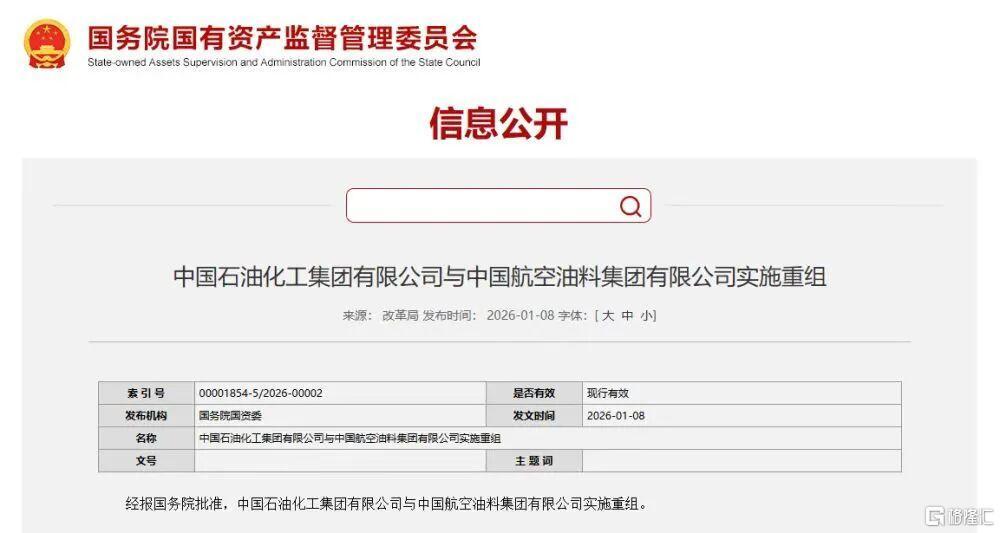
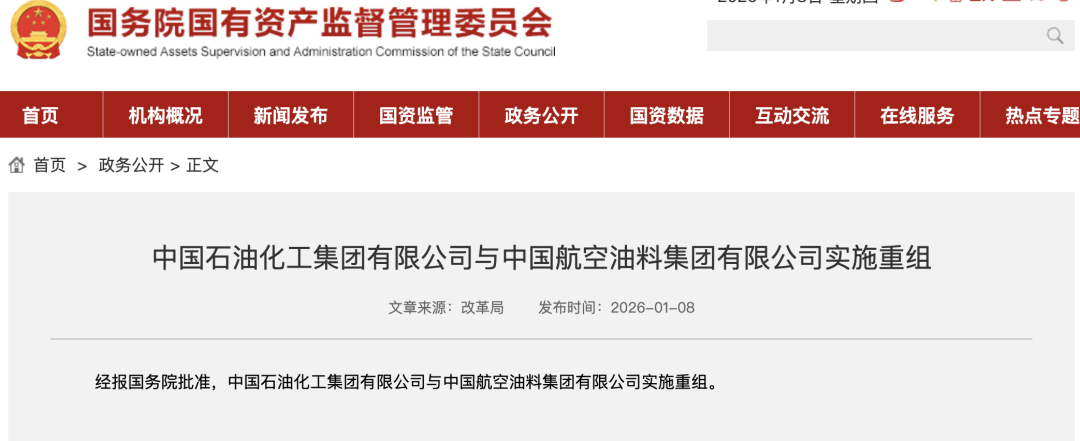
经报国务院批准,中国石油化工集团有限公司与中国航空油料集团有限公司实施重组
Ge Long Hui· 2026-01-08 14:26
(责任编辑:宋政 HN002) 【免责声明】本文仅代表作者本人观点,与和讯网无关。和讯网站对文中陈述、观点判断保持中立,不对所包含内容 的准确性、可靠性或完整性提供任何明示或暗示的保证。请读者仅作参考,并请自行承担全部责任。邮箱: news_center@staff.hexun.com 格隆汇1月8日|经报国务院批准,中国石油化工集团有限公司与中国航空油料集团有限公司实施重组。 ...

两大央企重组获批,新“巨无霸”诞生了!
Ge Long Hui· 2026-01-08 14:25
Core Viewpoint - The restructuring of China Petroleum & Chemical Corporation (Sinopec) and China Aviation Oil Group has created a super energy entity, significantly reshaping the aviation fuel industry in China [1][3]. Group 1: Company Overview - Sinopec is the world's largest refining company and the leading aviation fuel producer in China, controlling 40% of domestic aviation fuel production capacity and having technological advantages in sustainable aviation fuel (SAF) [3]. - China Aviation Oil is Asia's largest aviation fuel service company, monopolizing 95% of the aviation fuel sales network and providing a comprehensive supply chain from procurement to airport refueling [3]. - The merger transforms the relationship between the two companies from "buyer and seller" to a unified entity, streamlining the production and refueling process [3]. Group 2: Market Context - Global aviation fuel demand is projected to reach 389 million tons in 2025, with a year-on-year growth of 3.9%, while domestic demand is expected to exceed 40 million tons during the 14th Five-Year Plan period, with an average annual growth rate of 4% [5]. - The restructuring addresses key bottlenecks in the industry, such as redundancy in intermediate links and high costs, which have hindered development [5]. Group 3: Strategic Implications - This restructuring is part of a broader trend of professional integration among state-owned enterprises, with six groups of ten companies having undergone strategic mergers during the 14th Five-Year Plan [5]. - The merger is expected to enhance the efficiency of state capital allocation and position China's aviation fuel industry to compete with international giants like Shell and ExxonMobil [5]. Group 4: Impact on A-shares - Two types of stocks are highlighted for attention: Sinopec, which will benefit from stable aviation fuel sales and high-value-added business opportunities, and sustainable aviation fuel (SAF) concept stocks, such as HXN Energy and Longkun Environment, which will benefit from the merger's acceleration of SAF promotion [5].
两大能源央企官宣重组 业内:旨在打造“从炼厂到机翼”全链条一体化
Mei Ri Jing Ji Xin Wen· 2026-01-08 14:24
Group 1 - The core point of the news is the restructuring of China Petroleum & Chemical Corporation (Sinopec) and China Aviation Oil Group, which aims to create an integrated supply chain from refining to aviation, enhancing supply stability and efficiency in the oil and gas industry [2][3] - Sinopec is the largest supplier of refined oil and petrochemical products in China, and the world's largest refining company, while China Aviation Oil Group is the largest aviation fuel supplier in Asia, providing services to 258 transportation airports and 454 general airports in China [2] - The restructuring is expected to reduce intermediate trade and coordination costs, potentially alleviating the financial pressure on airlines, as aviation fuel accounts for about one-third of airline costs [3] Group 2 - The integration will enhance the resilience and response speed of the supply chain, addressing challenges such as extreme weather and geopolitical conflicts, thereby supporting the safe operation of the civil aviation system [3] - The move is also seen as a way to optimize state-owned capital layout, avoid homogeneous competition, and create a modern energy enterprise that can compete with international giants like Shell and BP, thereby increasing global market share and pricing power [3] - Sinopec has been actively developing sustainable aviation fuel (SAF) opportunities, having established China's first large-scale industrial facility for bio-jet fuel production, which has already been utilized in domestic and international flights [4][5]
两大央企重组营收超中石油!航油采购和出行成本会降吗
第一财经· 2026-01-08 14:18
Core Viewpoint - The restructuring of China Petroleum & Chemical Corporation (Sinopec) and China Aviation Oil Group (CAOG) aims to integrate upstream production and downstream sales of aviation fuel, potentially leading to a significant increase in revenue and operational efficiency for both companies [3]. Group 1: Company Overview - Sinopec ranked 6th globally in the 2025 Fortune Global 500 with a revenue of $407.5 billion, while CAOG ranked 481st with $33.4 billion in revenue. Post-restructuring, their combined revenue is expected to surpass that of China National Petroleum Corporation (CNPC) [3]. - CAOG is the largest aviation fuel service provider in Asia, handling procurement, transportation, storage, testing, sales, and refueling, while Sinopec is the world's largest refining company and China's top aviation fuel producer [3]. Group 2: Market Impact - CAOG holds a monopoly in the domestic aviation fuel sales market, supplying nearly all domestic and international airlines in China. The pricing mechanism for aviation fuel is based on CAOG's comprehensive procurement cost plus local airport markups, ensuring profitability even during airline losses [5]. - The merger is expected to provide CAOG with more stable upstream resources and expand Sinopec's sales channels, potentially reducing aviation fuel costs by eliminating intermediaries [5][6]. Group 3: Pricing Mechanism - The current pricing mechanism for aviation fuel involves a "comprehensive procurement cost" that includes a factory price and a markup based on market conditions. Changes in this mechanism will determine whether the merger leads to actual price reductions for airlines [6]. Group 4: Sustainable Aviation Fuel (SAF) - The merger is anticipated to accelerate the production and use of Sustainable Aviation Fuel (SAF), which is crucial for reducing carbon emissions in the aviation sector. The use of SAF is becoming increasingly important as countries set carbon peak and reduction targets [7]. - Although there are no mandatory regulations for airlines to use SAF in China, several domestic airlines have conducted verification flights with SAF. Sinopec has been a pioneer in SAF production, with significant production capabilities and partnerships to enhance SAF development [8].

大动作!两大央企实施重组
Jin Rong Shi Bao· 2026-01-08 14:16
Core Viewpoint - The restructuring of China Petroleum & Chemical Corporation (Sinopec) and China Aviation Oil Group aims to create the world's largest aviation fuel supply chain enterprise, enhancing energy security and reducing aviation fuel supply costs [3][4]. Group 1: Company Overview - China Petroleum & Chemical Corporation (Sinopec) was established on September 14, 1983, with a registered capital of 326.5 billion RMB, headquartered in Beijing, and is the largest aviation fuel producer in China [3]. - China Aviation Oil Group was founded on October 11, 2002, also headquartered in Beijing, and is the largest aviation fuel supplier in Asia, providing services at over 280 airports globally for more than 400 airline customers [3][4]. Group 2: Strategic Importance - The merger will leverage Sinopec's upstream production capacity and China Aviation Oil's nationwide refueling network, forming a core aviation fuel supply chain for the civil aviation industry [4]. - This restructuring is part of a broader strategy by central enterprises to enhance operational efficiency and respond to international competition and green transformation initiatives [4].
中国石化“牵手”中国航油 影响几何?
Xin Hua She· 2026-01-08 14:05
Core Viewpoint - The restructuring of China Petroleum & Chemical Corporation (Sinopec) and China Aviation Oil Group is a strategic move aimed at enhancing the efficiency and competitiveness of the aviation fuel supply chain in China, aligning with national energy security and carbon reduction goals [2][3]. Group 1: Strategic Considerations - The merger allows for a comprehensive integration from crude oil refining to aircraft refueling, potentially reducing supply costs and enhancing the international competitiveness of China's aviation fuel industry [3]. - Sinopec is recognized as the earliest enterprise in China to possess sustainable aviation fuel (SAF) production capabilities, while China Aviation Oil has been proactive in promoting SAF applications [3]. Group 2: Industry Trends - The restructuring reflects a broader trend of central enterprise consolidation, with multiple state-owned enterprises undergoing strategic mergers to optimize resource allocation and enhance industrial resilience [4]. - The "14th Five-Year Plan" emphasizes the need for optimizing the layout and structure of state-owned enterprises, aiming to strengthen core functions and competitiveness [4]. Group 3: Challenges Ahead - Post-merger, the companies face the challenge of transitioning from "physical integration" to "chemical fusion," which is crucial for realizing the full benefits of the merger [5]. - There are significant challenges in ensuring national energy security and achieving the "dual carbon" goals, with expectations for the merger to create a win-win scenario for the market, industry, and society [5].