
CM BANK(600036)

Search documents
大行评级丨中银国际:上调招商银行H股目标价至56.85港元 维持“买入”评级
Ge Long Hui· 2025-11-05 03:12
Core Viewpoint - China International Capital Corporation (CICC) reports that China Merchants Bank's net profit attributable to shareholders in the third quarter grew by 1% year-on-year, a slowdown from the 2.7% growth in the second quarter [1] Group 1: Financial Performance - The asset quality of China Merchants Bank remains excellent, with net interest margin stabilizing [1] - The bank's return on average equity (ROAE) is projected to reach 13.2% by 2025, the highest among peers [1] Group 2: Stock Valuation - CICC raised the target price for China Merchants Bank's H-shares from HKD 54.42 to HKD 56.85, equivalent to a forecasted price-to-book ratio of 1.15 times for this year [1] - The investment rating is maintained at "Buy" [1]

深圳首次以市委、市政府名义表彰企业家
3 6 Ke· 2025-11-05 02:39
Group 1 - Shenzhen is recognized as a leading "entrepreneur-friendly city" in China, often referred to as the "ceiling for enterprises" [1] - The city established the first official "Entrepreneur Day" in the country, celebrated annually on November 1 since 2019, highlighting its commitment to supporting entrepreneurs [2] - During this year's "Entrepreneur Day," Shenzhen awarded 60 business leaders the title of "Outstanding Builders of Socialism with Chinese Characteristics in Non-Public Economy" and recognized 30 companies with the "Shenzhen Contribution Award" [2][5] Group 2 - The list of awardees includes prominent figures from various industries, such as technology, finance, and manufacturing, showcasing a diverse representation of Shenzhen's business landscape [3][4] - Shenzhen's private economy is significant, with over 2.7 million private enterprises as of June 2025, contributing approximately 40% of fixed asset investment, over 50% of tax revenue, nearly 60% of GDP, and over 70% of import and export volume [6] - The city is home to 10 companies listed in the 2025 Fortune Global 500, indicating its strong economic presence and the prominence of private enterprises [6] Group 3 - Shenzhen's success as a hub for entrepreneurs is attributed to its innovative policies and a culture that encourages risk-taking and supports failure [8][10] - The city has a well-developed industrial chain and an active capital market, which further enhances its attractiveness for business development [10] - The inclusive spirit of Shenzhen, encapsulated in the phrase "Once you come, you are a Shenzhen person," draws talent from across the country [9]







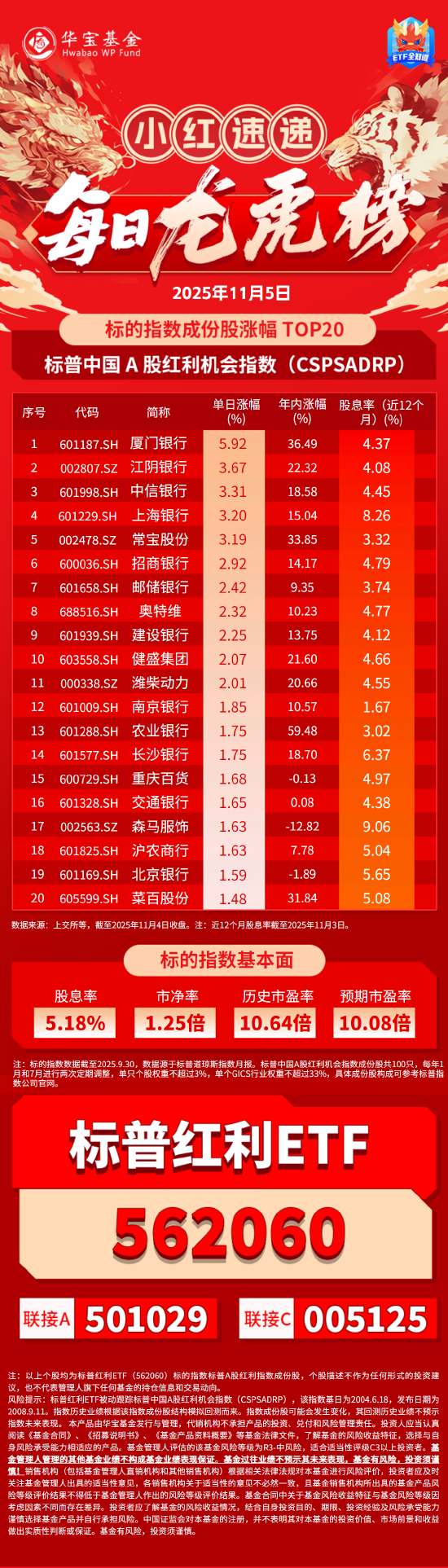
小红日报 | 银行再度领涨!标普红利ETF(562060)标的指数收跌0.06%显韧性
Xin Lang Ji Jin· 2025-11-05 00:50
Core Insights - The article highlights the top-performing stocks in the S&P China A-Share Dividend Opportunity Index, showcasing significant year-to-date gains and dividend yields for various companies [1]. Group 1: Stock Performance - Xiamen Bank (601187.SH) leads with a 5.92% increase in the latest trading session and a 36.49% year-to-date gain, along with a dividend yield of 4.37% [1]. - Jiangyin Bank (002807.SZ) follows with a 3.67% daily increase and a 22.32% year-to-date gain, offering a dividend yield of 4.08% [1]. - CITIC Bank (601998.SH) shows a 3.31% rise today and an 18.58% increase year-to-date, with a dividend yield of 4.45% [1]. - Shanghai Bank (601229.SH) has a daily increase of 3.20% and a year-to-date gain of 15.04%, boasting a high dividend yield of 8.26% [1]. - Other notable performers include Changbao Co. (002478.SZ) with a 3.19% daily increase and a 33.85% year-to-date gain, and China Merchants Bank (600036.SH) with a 2.92% daily rise and a 14.17% year-to-date increase [1]. Group 2: Dividend Yields - Shanghai Bank (601229.SH) offers the highest dividend yield at 8.26%, indicating strong returns for investors [1]. - Other companies with notable dividend yields include Semei Clothing (002563.SZ) at 9.06% and Changsha Bank (601577.SH) at 6.37% [1]. - The average dividend yield among the top 20 stocks reflects a trend towards higher returns for dividend-seeking investors [1].




中金:银行已进入高质量发展阶段 高股息投资成为主要范式
智通财经网· 2025-11-05 00:09
Group 1 - The core viewpoint is that stability is likely to characterize the banking industry's performance in 2026, with expected steady year-on-year growth in revenue and profit for listed banks, primarily due to a further narrowing of net interest margin pressure [1][2] - Credit growth may slow down further, driven by weak credit demand and insufficient risk compensation, while social financing growth will depend on fiscal policy [1][2] - After several years of fee reductions and the digestion of high base pressure, the growth rate of fee income is expected to stabilize and rebound [2] Group 2 - Small and micro enterprises, along with retail customer exposures, remain the main sources of non-performing loans, but corporate business exposures are expected to maintain stability or even show an improving trend in net non-performing loan generation rates [2] - The industry is likely to see accelerated supply-side reforms, evidenced by a rapid decrease in the number of bank licenses, leading to improved competition and operational landscape [2] - The banking sector has entered a high-quality development phase, with only a few listed banks achieving double-digit growth, and high-dividend investment becoming the main paradigm [3]
上市银行三季报透视:营业收入合计超4.3万亿元
Zhong Guo Zheng Quan Bao· 2025-11-04 23:25
Core Insights - The overall performance of A-share listed banks in the first three quarters of 2025 exceeded expectations, with a total operating income surpassing 4.3 trillion yuan, and over 60% of banks reporting year-on-year growth in operating income [1][2] - The stabilization of net interest margin (NIM) is identified as a key factor supporting the revenue growth of listed banks, despite being in a downward trend [1][3] Revenue Performance - As of the end of Q3 2025, the total assets of listed banks grew by 9.3% year-on-year, indicating steady expansion [2] - The overall operating income of listed banks increased by 0.9% year-on-year, while net profit rose by 1.5% [2] - More than 25 out of 42 listed banks achieved year-on-year growth in operating income, with Xi'an Bank, Chongqing Bank, and Nanjing Bank leading with growth rates of 39.11%, 10.40%, and 8.79% respectively [2] - Nanjing Bank reported an operating income of 41.949 billion yuan, with net interest income accounting for 60.09% and non-interest income for 39.91% [2] Net Interest Margin Trends - The net interest margin for listed banks in Q3 2025 was 1.33%, remaining stable compared to the first half of 2025 [3] - The decline in funding costs and the stable LPR contributed to the stabilization of NIM, with banks optimizing their asset and liability structures [3] - Changshu Bank led the industry with a net interest margin of 2.57% [3] - Despite a 10 basis point decrease in NIM for Industrial Bank to 1.72%, the decline was relatively small compared to peers [3] Non-Interest Income Challenges - The volatility in the bond market has pressured non-interest income, with many banks reporting significant declines in fair value changes [4] - Nanjing Bank's non-interest income fell by 11.63% year-on-year, with a fair value loss of 334 million yuan in Q3 2025 compared to a profit of 4.676 billion yuan in the same period last year [4] - China Merchants Bank reported a slight decline in operating income by 0.51% year-on-year, with non-interest income down by 4.23% [5] - The decline in non-interest income is attributed to reduced returns from bond and fund investments, with China Merchants Bank reporting a fair value loss of 8.827 billion yuan in the first three quarters [5]
上市银行三季报透视:营业收入合计超4.3万亿元 息差释放企稳信号
Zhong Guo Zheng Quan Bao· 2025-11-04 22:30
Core Insights - The overall performance of A-share listed banks in the first three quarters of 2025 exceeded expectations, with a total operating income of over 4.3 trillion yuan, and more than 60% of banks reporting year-on-year growth in operating income [1][2] - The stabilization of net interest margin (NIM) is considered a key factor supporting the revenue growth of listed banks, with signs of stabilization observed despite being in a downward trend [1][3] Revenue Performance - As of the end of Q3 2025, the total assets of listed banks grew by 9.3% year-on-year, indicating steady expansion [2] - The overall operating income of listed banks increased by 0.9% year-on-year, while net profit rose by 1.5% [2] - Over 25 of the 42 listed banks reported year-on-year growth in operating income, with Xi'an Bank, Chongqing Bank, and Nanjing Bank leading with growth rates of 39.11%, 10.40%, and 8.79% respectively [2] Net Interest Margin - The net interest margin for listed banks was 1.33% in Q3 2025, remaining stable compared to the first half of 2025 [3] - Factors contributing to the stabilization of NIM include a controlled negative impact from monetary policy adjustments and a coordinated adjustment of deposit rates alongside LPR cuts [3] - Changshu Bank reported the highest NIM at 2.57% among the listed banks [3] Non-Interest Income Challenges - Despite positive growth in operating income and net profit, fluctuations in the bond market have led to a decline in non-interest income, particularly in fair value changes [4][5] - Nanjing Bank reported a significant drop in fair value changes, with a loss of 334 million yuan in Q3 2025 compared to a profit of 4.676 billion yuan in the same period last year [4] - China Merchants Bank's non-interest income also declined, with a 4.23% drop in non-interest income, primarily due to reduced returns from bond and fund investments [5]
上市银行三季报透视: 营业收入合计超4.3万亿元 息差释放企稳信号
Zhong Guo Zheng Quan Bao· 2025-11-04 20:39
Core Insights - The overall performance of A-share listed banks in the first three quarters of 2025 exceeded expectations, with a total operating income of over 4.3 trillion yuan, and more than 60% of banks reporting year-on-year growth in operating income [1][2] - The stabilization of net interest margin (NIM) is considered a key factor supporting the revenue growth of listed banks [1][3] Revenue Performance - As of the end of Q3 2025, the total assets of listed banks grew by 9.3% year-on-year, indicating steady expansion [2] - The overall operating income of listed banks increased by 0.9% year-on-year, while net profit rose by 1.5% [2] - Over 25 out of 42 listed banks reported year-on-year growth in operating income, with Xi'an Bank, Chongqing Bank, and Nanjing Bank leading with growth rates of 39.11%, 10.40%, and 8.79% respectively [2] Net Interest Margin Trends - The net interest margin for listed banks was 1.33% in Q3 2025, remaining stable compared to the first half of 2025 [3] - The decline in liability costs and the narrowing of asset yield reductions contributed to the stabilization of NIM [3] - Changshu Bank reported the highest NIM at 2.57% among the listed banks [3] Non-Interest Income Challenges - Despite positive growth in operating income and net profit, fluctuations in the bond market have pressured non-interest income, leading to significant declines in fair value changes [5][6] - Nanjing Bank reported a 28.52% increase in net interest income but an 11.63% decrease in non-interest income, with a fair value loss of 334 million yuan in Q3 2025 [5] - China Merchants Bank experienced a 0.51% decline in operating income, with non-interest income down by 4.23%, primarily due to reduced returns from bond and fund investments [6]

营业收入合计超4.3万亿元 息差释放企稳信号
Zhong Guo Zheng Quan Bao· 2025-11-04 20:17
Core Insights - The overall performance of A-share listed banks in the first three quarters of 2025 exceeded expectations, with total operating income surpassing 4.3 trillion yuan, and over 60% of banks reporting year-on-year growth in operating income [1][2] - The stabilization of net interest margin (NIM) is identified as a key factor supporting the revenue growth of listed banks, with several bank executives indicating signs of stabilization despite being in a downward trend [1][2] Revenue Performance - As of the end of Q3 2025, listed banks' total assets grew by 9.3% year-on-year, maintaining steady expansion [1] - The overall operating income of listed banks increased by 0.9% year-on-year, while net profit rose by 1.5% [1] - More than 25 out of 42 listed banks achieved year-on-year growth in operating income, with Xi'an Bank, Chongqing Bank, and Nanjing Bank leading with growth rates of 39.11%, 10.40%, and 8.79% respectively [1] Net Interest Margin Trends - The net interest margin for listed banks was reported at 1.33% in Q3 2025, remaining stable compared to the first half of 2025 [2] - The decline in liability costs is expected to continue, which may support the improvement of NIM [2] - The stability in NIM is attributed to the unchanged Loan Prime Rate (LPR) and a significant decrease in the cost of liabilities [2] Non-Interest Income Challenges - Despite positive growth in operating income and net profit, fluctuations in the bond market have led to a decline in non-interest income for many banks [3][4] - For instance, Nanjing Bank reported a year-on-year decrease of 11.63% in non-interest income, with a significant loss in fair value changes of financial assets [3] - Similarly, China Merchants Bank experienced a decline in non-interest income by 4.23%, primarily due to reduced earnings from bond and fund investments [4]
债市波动拖累银行非息收入,央行重启国债买卖能否修复行情?
第一财经· 2025-11-04 16:13
2025.11. 05 本文字数:1834,阅读时长大约4分钟 作者 | 第一财经 陈君君 A股上市银行2025年三季报披露完毕,营收增长普遍承压,非息收入同比下滑成为突出特征。截至 三季度末,42家A股上市银行中,24家非息收入同比负增长,8家投资净收益同比下滑。 多家银行在业绩解读中表示,债券市场剧烈波动导致的估值损失,是拖累非息收入乃至整体营收的核 心因素。业内普遍关注,央行近期宣布重启公开市场国债买卖操作,能否为四季度债市走势及银行非 息收入修复注入关键变量。 债市波动成非息收入下滑主因 前三季度,债券市场走势震荡,不少银行在财报中感受到"阵痛"。 Wind数据显示,截至三季度末,42家上市银行中有24家非息收入同比下降,31家公允价值变动净 收益为负,占比超过七成。业内人士指出,今年债市收益率持续上行,债券价格下跌,令银行持有的 债券资产出现账面损失,成为压制非息收入的核心因素。 "去年三季度债市行情较好,收益率水平低、估值上涨,而今年缺乏利好,收益率反弹使得债券价格 回落,从而影响了投资收益。"某上市城商行银行金融市场部人士对记者表示。 从单家银行来看,招商银行在公允价值变动损益项下亏损幅度最大, ...

数字化时代的公司金融怎么做?专访招行刘学武:交易银行正成企业“数字中枢”的外部延伸
Xin Lang Cai Jing· 2025-11-04 15:45
Core Insights - The competition among banks for corporate clients and corporate finance business is intensifying, with transaction banking departments taking on significant responsibilities [1] - The demand for financial services is at its peak, driven by the increasing complexity and frequency of corporate financial needs [1][2] - The traditional transaction banking model is being transformed by digitalization, with a focus on data connectivity throughout the entire lifecycle of enterprises [2] Group 1: Trends in Transaction Banking - Transaction banking is evolving into an external extension of enterprises' "digital intelligence hub," providing real-time, visible, and automated data support [2][3] - Financial technology is becoming a primary battleground for transaction banking, with innovations driven by technology integration into customer interfaces [2] - The restructuring of industrial ecosystems is creating new opportunities for financial connections, as industries accelerate their digital transformation [3] Group 2: Collaboration and Ecosystem Building - The banking sector is not the only player in the digital age; various institutions hold vast data assets and are entering the transaction banking space [4] - Collaboration among banks and other entities is essential to meet the diverse needs of private and small to medium-sized enterprises in cross-border and supply chain financing [4] - The core advantages of banks include stable low-cost funding, mature risk control systems, and comprehensive product matrices, while technology companies excel in real-time data-driven risk management and agile online services for small enterprises [4]