
CM BANK(600036)

Search documents
果然“炸了”!刚刚,重磅来了
中国基金报· 2025-09-13 05:12
Core Viewpoint - The public fund market is experiencing a significant reshuffle, with a notable increase in the scale of bank-affiliated stock index funds by 37.9% in the first half of 2025, indicating widespread acceptance and recognition of stock index funds in the market [2][14]. Group 1: Fund Performance and Rankings - Ant Fund leads the market with an equity fund holding scale of 822.9 billion yuan, showing an 11% increase compared to the previous period [4][16]. - China Merchants Bank ranks second with an equity fund holding scale of 492 billion yuan, achieving a remarkable 20% growth [4][16]. - Other top institutions include Tian Tian Fund and Industrial and Commercial Bank of China, with equity fund holdings exceeding 330 billion yuan [4][16]. Group 2: Institutional Growth Trends - The bank-affiliated stock index funds have seen a substantial increase in acceptance, with a 37.9% growth in holding scale, significantly outpacing third-party and brokerage firms [12][14]. - Agricultural Bank of China reported a staggering 169% increase in stock index fund holdings, while Industrial and Commercial Bank and Bank of China also experienced growth rates of 40% [8][14]. - The overall growth of equity funds among the top 100 institutions reached 14.6%, reflecting a broader trend of increasing acceptance of passive investment strategies [14]. Group 3: Market Dynamics - The brokerage sector has shown the largest increase in equity fund holdings, with a growth rate of 6.6%, driven by a client base with a higher risk appetite [10][12]. - The rapid recovery of the stock market has led to increased investment in equity funds, particularly among brokerage clients [10][12]. - The competitive advantage of leading institutions like Ant Fund and China Merchants Bank continues to strengthen, with their sales channels showing superior growth compared to industry averages [8][14].








深圳金融史,一个波澜壮阔的中国金融改革奇迹
首席商业评论· 2025-09-13 03:58
Core Viewpoint - Shenzhen has transformed from a financial desert in 1979 to one of China's three major financial centers by 2024, showcasing a remarkable journey of financial reform and innovation [5][8]. Group 1: Initial Creation and Exploration (1979-1990) - Shenzhen was designated as a "test field" for economic reform in 1979, leading to the establishment of the first foreign bank branch in China and the birth of national banks like China Merchants Bank [9]. - The first stock in New China was issued in 1983, marking the beginning of the capital market, with significant events like the public offering of Shenzhen Development Bank in 1987 [9]. - The emergence of non-bank financial institutions, such as Ping An Insurance in 1988, laid the groundwork for future financial giants [9]. Group 2: Leap and Growth (1990-2004) - The establishment of the Shenzhen Stock Exchange in December 1990 marked a significant leap in Shenzhen's financial history, providing direct financing channels for enterprises [10]. - By the end of 2004, the Shenzhen Stock Exchange had 536 listed companies with a total market value of 1.1 trillion yuan and an annual trading volume of 1.6 trillion yuan [10]. - Shenzhen became a hub for venture capital, with over 20 billion yuan invested in more than 100 projects by 2004 [10]. Group 3: Adjustment and Transformation (2004-2019) - The introduction of the SME Board in 2004 provided a dedicated platform for small and medium enterprises, with over 327 companies listed and more than 300 billion yuan raised by 2009 [12]. - The launch of the ChiNext in 2009 focused on innovative and growth-oriented enterprises, leading to a surge in the number of listed companies from 28 to nearly 800 by 2019 [12]. - The establishment of Qianhai as a financial innovation zone in 2010 facilitated cross-border financial services, with over 52,000 financial enterprises registered by 2019 [16]. Group 4: Elevation and Leadership (2019-Present) - Shenzhen's financial sector has been elevated under national strategies, with over 400 companies listed on the ChiNext through a registration system by 2025, raising over 500 billion yuan [18]. - The total number of companies on the Shenzhen main board is expected to approach 1,600 by mid-2025, with a market value nearing 40 trillion yuan [18]. - The implementation of the "Cross-Border Wealth Management Connect" in 2024 has seen significant participation from banks and a substantial increase in cross-border transactions [19]. Group 5: Achievements and Strengths - By the end of 2024, Shenzhen's financial institutions held deposits of 135.78 trillion yuan and loans of 94.83 trillion yuan, with total banking assets reaching 13.57 trillion yuan [21]. - The Shenzhen Stock Exchange had 2,852 listed companies with a market capitalization of 33.04 trillion yuan, ranking it among the top globally [21][23]. - The insurance sector reported premium income of 195.82 billion yuan in 2024, with total assets of 7.3 trillion yuan [25]. Group 6: Reflection and Future Outlook - Over 45 years, Shenzhen has evolved from a financial desert to a global financial technology leader, with significant achievements in various financial sectors [34]. - The city's success is attributed to its innovative spirit, close ties between finance and the real economy, and a highly market-oriented system [34]. - Looking ahead, Shenzhen's financial industry is poised for further growth and innovation, building on its past successes [34].



金融监管总局9月以来开出近2.7亿罚单,涉及17家机构
Xin Lang Cai Jing· 2025-09-13 01:35
9月12日,国家金融监督管理总局行政处罚信息公示公布了多张罚单,广发银行、建设银行、招商银 行、中国进出口银行等多家金融机构受罚,相关人员也被禁止从事相关工作或罚款。值得注意的是,这 已经是金融监管总局9月以来公布的第二批罚单,涉及信贷审批、监管信息报送、资金运作风险等多个 问题。据统计,9月以来,金融监管总局已经公布的两批罚单共涉及18个当事人(17家机构罚单及1张个 人罚单),罚款金额合计约2.69亿元。(智通财经) ...
中国银行业正迎来重要拐点
2 1 Shi Ji Jing Ji Bao Dao· 2025-09-13 00:27
Core Viewpoint - The banking industry is facing a critical turning point as net interest margins have fallen below non-performing loan ratios, indicating a dual pressure of shrinking income and rising risk [1][4][5] Group 1: Financial Indicators - As of Q1 2025, the non-performing loan ratio for commercial banks was 1.51%, while the net interest margin was 1.43%, marking the lowest net interest margin since 2005 [1][5] - By Q2 2025, the net interest margin further declined to 1.42%, with the non-performing loan ratio rising to 1.49% [1] - Over 20% of the 42 listed banks reported net interest margins lower than their non-performing loan ratios, highlighting a concerning trend in the industry [1][6] Group 2: Industry Response - In response to these challenges, banks are shifting towards middle-income business models, with a notable resurgence in insurance and banking (银保) business, which accounted for over 50% of income for the first time in 15 years [2][21] - Major banks like China Merchants Bank and Ping An Bank reported over 40% year-on-year growth in insurance income [2] Group 3: Asset and Liability Management - The continuous decline in net interest margins is attributed to a combination of low asset yields and rigid liability costs, exacerbated by insufficient effective credit demand and external pressures from bond market financing [10][12] - Banks are adjusting their asset-liability strategies to cope with narrowing margins, focusing on optimizing their loan structures and reducing costs [13] Group 4: Asset Quality and Risk - The total non-performing loan balance for commercial banks was reported at 34,342 billion yuan in Q2 2025, with a slight decrease from Q1 [15] - The provision coverage ratio improved to 211.97%, indicating enhanced risk mitigation capabilities [15] - However, the non-performing loan generation rate and overdue loan rates are on the rise, suggesting ongoing pressure on asset quality [17][19] Group 5: Middle-Income Business Growth - The middle-income business segment is showing signs of recovery, with non-interest income growing by 6.97% year-on-year in the first half of 2025, reversing a downward trend [21][22] - The insurance business is becoming a key growth driver, with banks leveraging their networks to enhance insurance sales [23]


服贸会秀“绿”绩
2 1 Shi Ji Jing Ji Bao Dao· 2025-09-12 23:06
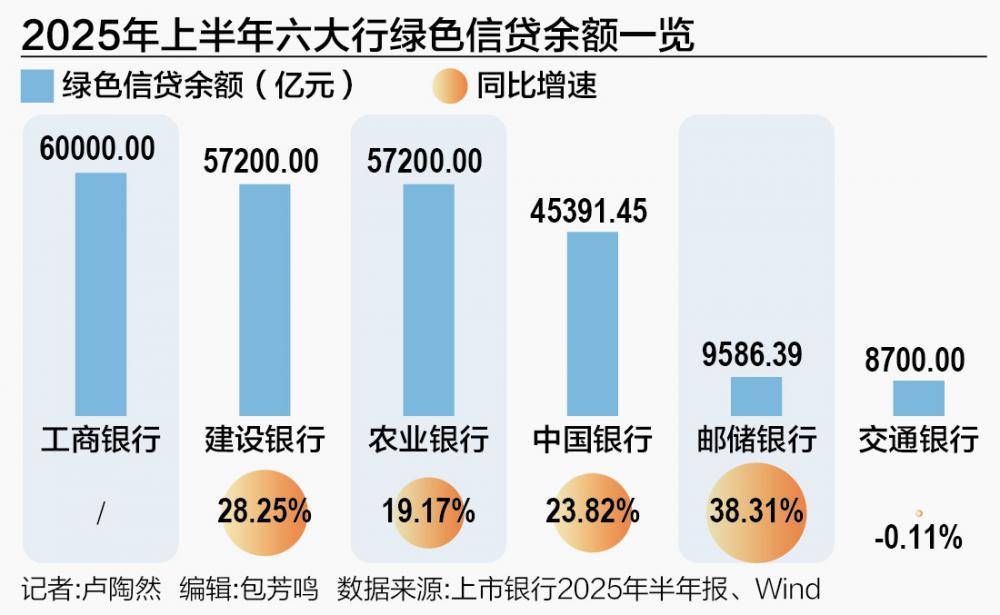
Core Insights - As of the end of Q2 2025, China's green loan balance reached approximately 42.4 trillion yuan, and the green bond balance exceeded 2.2 trillion yuan, positioning China among the top globally [1] - The carbon reduction support tool has guided financial institutions to issue carbon reduction loans exceeding 1.38 trillion yuan [1] - A total of 37 listed banks reported a combined green loan balance of 29.22 trillion yuan, with an average balance exceeding 800 billion yuan, reflecting a year-on-year growth of 41.79% [1][5] Green Loan Growth - The green loan balance of the banking system in China is leading globally, with state-owned banks playing a significant role [4] - Among the six major state-owned banks, the Industrial and Commercial Bank of China (ICBC) leads with a green loan balance of 6 trillion yuan, followed by China Construction Bank and Agricultural Bank of China, each with 5.72 trillion yuan [5] - Postal Savings Bank of China showed a remarkable year-on-year growth rate of 38.31%, nearing the 1 trillion yuan mark [5] Innovation in Green Financial Products - Banks are actively expanding and innovating specialized green financial products and service models, covering areas such as clean energy and environmental remediation [2] - The green financial product system is becoming increasingly diverse, showcasing various practical paths and innovative outcomes [2] Carbon Reduction Support Tool - The carbon reduction support tool is becoming a key indicator of banks' green financial capabilities, effectively directing financial resources towards green and low-carbon sectors [9] - In Q2 2025, 16 banks reported carbon reduction loans that facilitated a carbon reduction equivalent of over 7 million tons, with a total loan amount of nearly 24 billion yuan [9] - Major banks like ICBC and China Construction Bank have over 100 projects funded through carbon reduction loans, leading in both project numbers and loan amounts [9] Performance of Smaller Banks - Smaller banks, including city commercial banks and rural commercial banks, are showing significant growth in green loan balances, with some achieving substantial year-on-year increases [8] - Zhangjiagang Rural Commercial Bank led the rural commercial banks with a growth rate of 30.25% in green loan balances [7] - Smaller banks are encouraged to leverage local advantages and develop differentiated paths to support local green projects [8]



金融监管总局一个星期开出近2.7亿罚单,涉及17家机构,多人遭禁业
Xin Lang Cai Jing· 2025-09-12 22:13
Core Viewpoint - The National Financial Regulatory Administration has issued a second batch of fines in September, totaling over 166 million yuan, targeting various financial institutions for issues related to credit approval, regulatory data reporting, and capital operation risks [1][2][11]. Summary by Category Fines and Penalties - A total of 18 entities, including policy banks, state-owned banks, joint-stock banks, and local banks, have been penalized, with fines amounting to approximately 269 million yuan in September alone [2][11]. - Specific fines include: - Guangfa Bank: 66.7 million yuan for improper management of loans and regulatory data reporting [2]. - Hengfeng Bank: 61.5 million yuan for similar issues [2][3]. - Minsheng Bank: 5.9 million yuan for inadequate system control [4]. - Citic Bank: 5.5 million yuan for inaccurate risk classification [5]. - China Export-Import Bank: 1.3 million yuan for poor country risk management [6]. Regulatory Focus - The regulatory focus remains on compliance in credit and bill operations, with significant scrutiny on the capital operations of wealth management subsidiaries and financial asset investment companies [11]. - The recent fines highlight a trend of "responsibility to individuals," with 32 individuals facing penalties, including warnings, fines, and bans from the banking industry [11]. Institutional Responses - Guangfa Bank and Hengfeng Bank have both acknowledged the penalties and stated that they have completed the necessary rectifications and are committed to improving their risk management and internal controls [2][3]. - Huaxia Wealth Management has also accepted the penalties and emphasized compliance with regulatory requirements in their operations [7]. Notable Cases - The only individual penalty involved former employees of the Industrial and Commercial Bank of China, who were banned from the banking industry for serious violations of prudent management rules [11].


金价高位震荡 多家银行调整贵金属业务
Zhong Guo Jing Ying Bao· 2025-09-12 18:54
Core Viewpoint - International gold prices have been rising, prompting banks to adjust their precious metals business to manage market volatility and risk control [1][2][3] Group 1: Bank Adjustments - Several banks, including China Construction Bank and China Merchants Bank, have made adjustments to their precious metals business, such as increasing risk levels for gold investment products and optimizing risk assessments [1][3] - Construction Bank will close trading functions for clients with no transactions for 12 consecutive months, while China Merchants Bank has adjusted margin levels and price fluctuation limits for certain contracts [2][3] - The adjustments mainly affect personal clients' trading services related to the Shanghai Gold Exchange, indicating a tightening of risk management practices [2][3] Group 2: Investment Strategies - Investors are advised to participate in gold investments based on their financial situation and risk tolerance, with conservative investors recommended to limit their gold investments to 10%-15% of their investable assets [1][3] - The current high gold prices, combined with central bank policies and global economic conditions, suggest a long-term support for gold prices, making it a strategic asset allocation choice [6][7] - Investment strategies such as regular gold accumulation and timing-based investments are recommended to manage risks and enhance returns [6][8] Group 3: Market Dynamics - The rapid increase in gold prices has led to higher margin requirements and adjustments in trading limits, affecting investors' risk management strategies [3][5] - The demand for gold buyback services has increased as residents seek to liquidate physical gold, with several banks expanding their buyback networks [4][5] - Banks are enhancing their risk management measures, including establishing price risk warning mechanisms and optimizing risk assessments for personal clients [5][6]
贴息落地“金九银十” 银行激活旺季消费动能
Zhong Guo Jing Ying Bao· 2025-09-12 18:54
Core Viewpoint - The implementation of the personal consumption loan interest subsidy policy is expected to stimulate consumer spending during the peak consumption season of "Golden September and Silver October" by reducing loan costs and encouraging borrowing [1][2][3] Group 1: Policy Implementation and Impact - The personal consumption loan interest subsidy policy officially started on September 1, 2025, and will last until August 31, 2026, offering a 1% annual interest subsidy for eligible loans [2][3] - Major banks have quickly responded to the policy, with some reporting a 10% increase in consumption loan issuance compared to the same period last year, covering key areas such as automotive, home renovation, and electronics [2][3] - The policy allows for a maximum subsidy of 3,000 yuan per loan, with some interest rates dropping below 3%, which is expected to attract a diverse customer base [1][2][3] Group 2: Consumer Behavior and Market Dynamics - The subsidy policy is anticipated to lower financing costs, significantly enhancing the willingness of consumers, particularly middle-income families and young professionals, to take out loans for consumption upgrades [3][4][5] - The policy is designed to attract customers with good credit but short-term liquidity issues, allowing them to optimize their debt structure and cash flow [4][5] Group 3: Risks and Challenges - While the policy aims to stimulate demand, there are concerns about potential risks such as fund misappropriation and excessive borrowing, which could lead to increased credit risk [6][7] - Banks are advised to strengthen risk control measures and ensure that funds are used for legitimate consumption purposes to mitigate these risks [7][8] Group 4: Competitive Landscape and Strategic Responses - The subsidy policy has intensified competition among banks, particularly for those not included in the program, prompting them to enhance their consumer finance offerings through innovative products and services [8][9] - Banks are encouraged to leverage technology and data analytics to improve customer experience and operational efficiency, thereby maintaining competitiveness in the evolving market [9][10]


三家机构被罚超千万,最新回应
中国基金报· 2025-09-12 16:19
Core Viewpoint - A series of significant fines have been imposed on multiple financial institutions in China, highlighting ongoing regulatory scrutiny and the need for compliance improvements within the industry [2][12]. Group 1: Major Fines Imposed - Three financial institutions received fines exceeding ten million yuan: Guangfa Bank was fined 66.7 million yuan, Hengfeng Bank 61.5 million yuan, and Huaxia Wealth Management 12 million yuan [4][5]. - The total fines for ten institutions reached 162.9 million yuan, indicating a broader trend of regulatory enforcement across the sector [2][9]. Group 2: Reasons for Penalties - Guangfa Bank was penalized for improper management of loans, bills, and factoring, as well as non-compliance in regulatory data reporting [4][5]. - Hengfeng Bank faced similar issues related to loan and wealth management practices, along with non-compliance in data reporting [4][5]. - Huaxia Wealth Management was fined for irregular investment operations and inadequate system controls [4][5]. Group 3: Institutional Responses - Hengfeng Bank acknowledged the penalty and committed to addressing the underlying issues, enhancing internal controls, and improving risk management [6]. - Guangfa Bank accepted the regulatory decision and has already implemented corrective measures to optimize its risk management framework [7]. - Huaxia Wealth Management expressed its commitment to compliance and improving risk management capabilities to protect investor interests [7]. Group 4: Additional Penalties - Seven other institutions were also fined for various compliance issues, including inadequate system management and improper handling of wealth management products [9][10][11]. - Notable fines included 5.9 million yuan for Minsheng Bank and 5.5 million yuan for Citic Bank, reflecting a widespread regulatory crackdown [9][10].

中行APP热销固收增强产品“盯上”沪深300指数
2 1 Shi Ji Jing Ji Bao Dao· 2025-09-12 12:31
Core Viewpoint - The recent performance of the stock and bond markets has been characterized by volatility, with the stock market showing relative strength while the bond market has trended downward [2]. Group 1: Product Overview - The evaluated product is the "Bank of China Wealth Management - Stable Wealth Fixed Income Enhanced Index Tracking Strategy" with a 14-day holding period [7]. - The equity investment portion of the product follows an index tracking strategy, specifically tracking the CSI 300 Index, which consists of 300 representative securities from the Shanghai and Shenzhen markets [7][19]. - The CSI 300 Index is considered a core broad-based index reflecting the overall performance of the A-share market and is a popular benchmark for ETF funds, with a total scale of 1.18 trillion yuan as of September 12 [7]. Group 2: Performance Metrics - Since its inception, the product has achieved an annualized return of 4.57%, outperforming 63.53% of similar products, while the weighted annualized return is 4.63%, beating 70.01% of peers [8][12]. - The product's risk control score is 96, and it has a maximum drawdown of only 0.06% since inception, indicating strong risk management [8][12]. - The product's total score is 63, ranking it above 59.97% of similar products, with specific scores of 58 for performance, 96 for risk control, 10 for risk-adjusted return, and 61 for comprehensive fee rate [8][10]. Group 3: Investment Strategy - The product primarily invests in fixed-income assets, with at least 80% of the total assets allocated to debt instruments, while equity investments are capped at 20%, with a maximum of 10% in non-preferred stock equity [12][19]. - This "fixed income + equity" product is suitable for investors seeking stable performance while also wanting to participate in potential stock market gains [19]. - The product requires a minimum holding period of 14 days, which may affect liquidity for investors [19].
