CM BANK(600036)

Search documents
银行资负跟踪:降准降息预期走弱
GF SECURITIES· 2026-03-15 09:12
Investment Rating - The industry investment rating is "Buy" [3] Core Views - The expectation for interest rate cuts and reserve requirement ratio reductions has weakened, indicating a shift towards a more cautious monetary policy approach [14] - The central bank is expected to maintain a balanced approach in using monetary policy tools, focusing on supporting the economy while ensuring bank profitability [14] - Personal mortgage rates in China are nearing the average levels seen during the zero interest rate periods in the US, UK, and Japan, reflecting a stable monetary policy stance [14] - The central bank aims to keep interbank liquidity ample without resorting to excessive liquidity injections, supporting banks in capital replenishment and reducing funding costs [14] Summary by Sections Section 1: Weakening Expectations for Rate Cuts - The central bank's recent actions indicate a preference for a "prudent choice" in monetary policy, balancing multiple objectives [14] - The current credit interest rates are at historical lows, with a focus on maintaining bank interest margins while promoting low financing costs through market regulation [14] - The central bank's operations have resulted in a net withdrawal of 2,511 billion CNY, with a focus on maintaining liquidity stability [15] Section 2: Central Bank Dynamics and Market Rates - The central bank conducted 1,765 billion CNY in 7-day reverse repos at a rate of 1.40%, with a net withdrawal of 2,511 billion CNY overall [15] - Market rates have shown slight increases, with R001 and R007 rising to 1.39% and 1.50% respectively [15] - Upcoming liquidity events include a significant reverse repo maturity and tax payment dates, which may affect market liquidity [25] Section 3: Bank Financing Tracking - The total outstanding amount of interbank certificates of deposit (NCD) is 18.47 trillion CNY, with a weighted average interest rate of 1.67% [22] - The issuance of interbank certificates of deposit totaled 8,459 billion CNY, with a completion rate of 94.1% [22] - The commercial bank bond market remains stable, with no new issuances reported during the period [22]


“日光基”频现!规模首破3000亿元!这类基金受追捧
券商中国· 2026-03-14 23:33
Core Viewpoint - The FOF (Fund of Funds) market has experienced explosive growth in 2026, becoming a prominent category in the public fund industry, with total assets surpassing 300 billion yuan, significantly reshaping the competitive landscape of the sector [1][8]. Group 1: FOF Market Performance - FOF products have seen a surge in issuance, with several products raising over 4 billion yuan, indicating a strong market demand [1][2]. - The market has witnessed a peak in fundraising, with multiple "one-day sell-out" products, including the China Europe Yingxin Stable 6-Month Holding FOF raising 5.125 billion yuan in 62 days [2][3]. - As of March 14, 2026, a total of 40 FOF products have been established this year, raising a combined amount of 61.973 billion yuan, marking a significant increase compared to the same period in 2025 [8]. Group 2: Reasons for FOF Popularity - The current low-interest-rate environment and increased market volatility have heightened the demand for stable and diversified investment products, which FOFs effectively address [3][4]. - FOFs help investors navigate the complexities of market timing and fund selection, providing a professional asset allocation solution that minimizes risks associated with individual funds [4]. Group 3: Distribution Channels and Strategies - Bank channels have emerged as a key driver of FOF growth, shifting from merely selling products to offering comprehensive asset allocation solutions [5][6]. - Major banks have developed proprietary FOF brands and collaborated closely with fund companies to design and manage these products, enhancing their appeal to clients [6][7]. - The majority of FOF products launched this year have short holding periods of 3 to 6 months, aligning with domestic investors' preferences for stable, short-term investments [7]. Group 4: Industry Structure and Competition - The total FOF market size has officially surpassed 300 billion yuan, with 84 fund managers competing in this space, indicating significant growth potential [8][9]. - The industry is witnessing a reshuffling of rankings, with several fund managers, such as Fuguo Fund and Zhongou Fund, significantly increasing their FOF assets, while others have seen declines [9][10]. - The current competitive landscape shows a clear tiered structure, with leading firms like Fuguo Fund and Zhongou Fund holding over 20 billion yuan in FOF assets, while others are still establishing their presence [8][9].




银行2月资金月报:受季节因素影响,机构资金流出,散户资金流入较多





ZHONGTAI SECURITIES· 2026-03-14 13:20
Investment Rating - The report maintains an "Overweight" rating for the banking sector [2] Core Insights - The banking sector experienced a decline of -0.55% in February, underperforming the CSI 300 index by 0.64 percentage points, ranking 28th among 31 first-level industries [5][11] - Institutional funds saw a net outflow due to profit-taking and portfolio adjustments before the Spring Festival, while retail investors actively entered the market, particularly in city commercial banks and joint-stock banks [5][6][11] - The macroeconomic environment remains relatively loose, with the central bank's net fund injection reaching 900 billion yuan in February, indicating a stable liquidity situation [5][6] Summary by Sections 1. Banking Sector Performance - The banking sector's total market capitalization is approximately 147,098.51 billion yuan, with a circulating market value of 140,825.95 billion yuan [2] - The top three performing bank stocks in February were Nanjing Bank (+6.84%), Huaxia Bank (+5.52%), and Shanghai Bank (+4.76%) [5][11] - The highest turnover rates were observed in Qingdao Bank (51.80%), Xi'an Bank (37.35%), and Zhengzhou Bank (28.65%) [5][11] 2. Fund Flows - Institutional funds experienced a net outflow, particularly in city commercial banks, while retail funds saw significant inflows [5][6][11] - The total number of retail investors increased, contributing to a total inflow of 1.1 trillion yuan into the capital market in January and February, a year-on-year increase of 791 billion yuan [6][11] 3. Macro Environment - The central bank's monetary policy remains accommodative, with a year-on-year high in fund injections [5][6] - Interest rates for DR001 and DR007 decreased to 1.33% and 1.49%, respectively, indicating a more favorable funding environment [5] 4. Investment Recommendations - The report suggests focusing on banks with regional advantages and strong certainty, particularly city and rural commercial banks in regions like Jiangsu, Shanghai, Chengdu, and Shandong [6] - It also highlights the attractiveness of high-dividend large banks, recommending major banks such as Agricultural Bank, Construction Bank, and Industrial and Commercial Bank [6]
银行视角十五五规划解读:金融强国再加码,银行转型和估值重塑窗口开启
Yin He Zheng Quan· 2026-03-14 08:44
Investment Rating - The report maintains a "Recommended" rating for the banking sector, highlighting multiple favorable factors including policy, fundamentals, and capital market conditions [4]. Core Insights - The "14th Five-Year Plan" emphasizes the acceleration of building a financial power, focusing on risk prevention, strong regulation, and promoting high-quality development, which will significantly reshape the banking industry's operating environment, business structure, profit models, and valuation systems [6][9]. - The banking sector is expected to undergo a critical phase of structural adjustment, model transformation, and valuation reshaping, shifting from total expansion to structural optimization to capture incremental business opportunities [4][6]. - The report identifies that the financial services provided by banks will increasingly focus on supporting the real economy, particularly in areas such as technology innovation, green finance, and consumption [13][15]. Summary by Sections 1. Financial Power Enhancement - The "14th Five-Year Plan" outlines the need for a robust central bank system and a comprehensive macro-prudential management framework, aiming to enhance the resilience of the banking system and support stable operations [9][10]. - Systemically important banks are likely to face stricter regulatory requirements, which may increase compliance costs in the short term but will strengthen the banking system in the long run [10][11]. 2. Capital Market Reforms - Continuous deepening of capital market reforms is expected to provide financial support for the banking sector's valuation reshaping, with an emphasis on enhancing the participation of long-term capital [15][4]. - The report notes that the average dividend payout ratio for banks is projected to remain stable at a relatively high level, with significant potential for long-term capital inflows [15]. 3. Differentiated Development - The plan encourages financial institutions to focus on their core businesses and improve governance, which will help reduce homogeneous competition in the banking sector [17][20]. - The optimization of the financial system is expected to enhance the pricing order and improve net interest margins for banks [20][22]. 4. Regulatory and Legislative Enhancements - The report highlights the acceleration of financial legislation, with new laws aimed at enhancing the regulatory framework for the banking sector, including the formulation of a financial law and a financial stability law [22][23]. - Comprehensive financial regulation will focus on preventing systemic risks, particularly in key areas such as real estate and local government debt [22][24].


招商银行上海分行:金融教育新篇章,书香阅读伴同行
Zhong Guo Jin Rong Xin Xi Wang· 2026-03-14 08:23
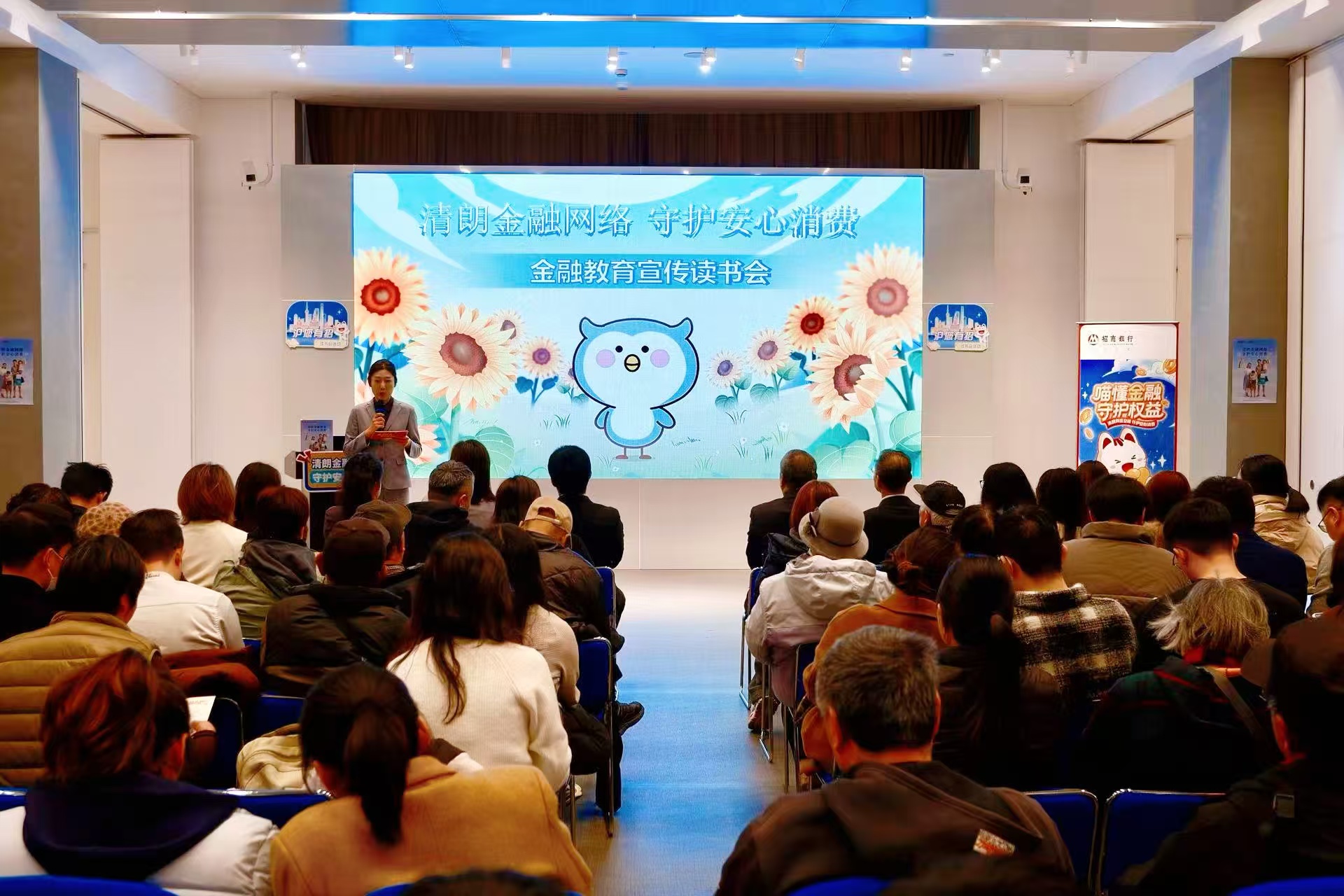
Core Viewpoint - China Merchants Bank Shanghai Branch is innovatively integrating financial education with reading culture through the "Smart Reading Finance: Safe Journey" themed activity, aiming to enhance financial literacy and create a safer financial environment for consumers [3][4]. Group 1: Financial Education Initiative - The "Smart Reading Finance: Safe Journey" activity was launched in conjunction with the implementation of the "National Reading Promotion Regulations" on February 1, 2026, focusing on financial knowledge as a core element [3]. - This initiative aims to improve consumer financial literacy and strengthen the protection of property safety through cultural engagement [3][4]. - The bank has established a volunteer service team for financial education, with party members leading efforts to promote financial knowledge in various community settings [4]. Group 2: Community Engagement and Interaction - During the activity, party members wore badges to enhance visibility and provided face-to-face consultations with the public, ensuring personalized service [4]. - The collaboration with the Huangpu District Library allowed for a seamless integration of cultural reading and financial knowledge dissemination, enhancing the warmth and effectiveness of the educational outreach [4][5]. - The reading sessions included discussions on consumer safety and rights protection, using relatable financial scenarios to educate consumers on risk prevention [5]. Group 3: Diverse Activity Formats - The activities featured various formats, including situational performances that illustrated common financial scams and traps, effectively raising consumer awareness [5]. - Interactive elements such as financial knowledge quizzes and one-on-one consultations were incorporated to further engage consumers and enhance their financial literacy [5]. - At the end of the events, financial knowledge booklets were distributed to participants, promoting the dissemination of financial knowledge within communities [5]. Group 4: Expanding Outreach - To broaden the reach of financial education, the bank has developed a multi-faceted promotional strategy that includes library events, branch outreach, and rural community engagement [6]. - During the "3.15" campaign, 59 financial education reading sessions were held, covering 32 communities and 27 villages in Shanghai, making financial knowledge accessible to the public [6]. - Special teams were formed to address financial risks in rural areas, utilizing local dialects and relatable case studies to effectively communicate financial concepts [6]. Group 5: Future Commitment - The bank plans to continue advancing financial education initiatives, integrating them into its services to enhance consumer rights protection and overall financial literacy [6].
谁在加杠杆,谁在领涨:从宏观债务周期看银行股九轮行情与选股逻辑
HUAXI Securities· 2026-03-14 00:20
Investment Rating - The industry rating is positive, with a focus on high dividend low valuation state-owned banks and policy-driven specialty targets [4][5]. Core Insights - The report reveals the deep connection between macro leverage cycles and the differentiation in bank stock performance from 2005 to 2025, identifying five key sectors driving leverage: residents, non-local government financing vehicles, central government, local government, and urban investment [1][11]. - The pricing logic of bank stocks has evolved from growth/model premium to dividend/certainty premium, influenced by three major shifts in macro leverage [1][11]. - The current macro leverage cycle indicates a continuation of government leverage, a reduction in resident leverage, and a focus on high dividend low valuation state-owned banks as new leaders in the market [3][5]. Summary by Sections Macro Leverage Cycle: Underlying Logic of Bank Stock Differentiation - The macro leverage cycle from 2005 to 2025 shows distinct phases, with the first phase (2005-2007) characterized by low leverage and a gradual increase, primarily driven by the resident sector [13][14]. - The second phase (2008-2015) saw significant leverage from government and urban investment, with a notable increase in bank stock performance [14][42]. - The third phase (2016-2021) involved a simultaneous increase in resident leverage and a decrease in non-local government financing vehicles, leading to a focus on retail banks [15][16]. - The fourth phase (2022-2025) indicates a shift where the government becomes the main leverage driver, while residents and urban investment vehicles stabilize or reduce leverage [15][16]. Stock Selection Logic Based on Macro Leverage Cycle - The report establishes a three-dimensional stock selection system: identifying core leverage sectors at the macro level, focusing on fundamental strengths at the micro level, and dynamically adjusting portfolios based on leverage shifts [2][11]. - The recommended stock selection lines include high dividend low valuation state-owned banks, policy-driven specialty targets, and quality regional commercial banks benefiting from structural leverage in non-local enterprises [5][11]. Investment Recommendations - The report emphasizes the importance of aligning with the current leverage cycle, suggesting three main stock selection lines: high dividend low valuation state-owned banks, policy-oriented targets, and quality regional commercial banks [5][11].

招商银行股份有限公司关于拟赎回优先股的公告
Shang Hai Zheng Quan Bao· 2026-03-13 20:05
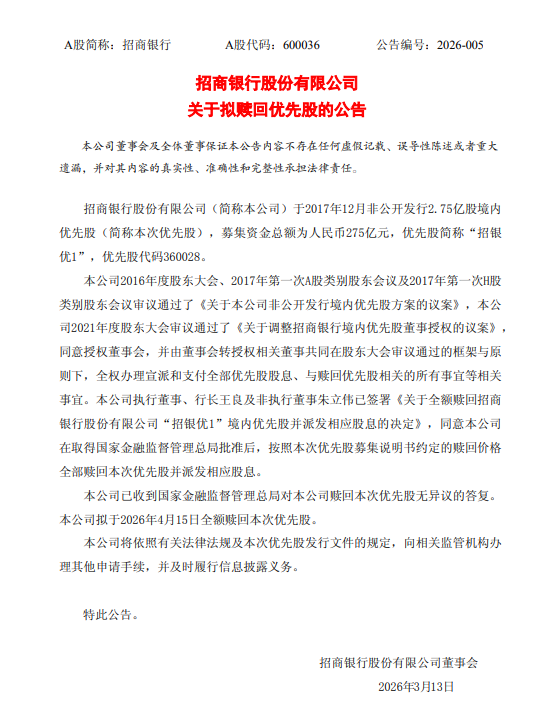
Core Viewpoint - The company plans to fully redeem its preferred shares, totaling 275 million RMB, on April 15, 2026, following the necessary approvals and authorizations [2][4]. Group 1: Redemption Details - The company issued 275 million RMB worth of preferred shares in December 2017, totaling 275 million shares at a par value of 100 RMB each [2][4]. - The redemption price will include the par value of the preferred shares plus accrued dividends calculated from December 18, 2025, to April 15, 2026 [6]. - The company has received a no-objection response from the National Financial Regulatory Administration regarding the redemption [2][4]. Group 2: Authorization and Procedures - The board of directors has been authorized to handle all matters related to the declaration and payment of dividends and the redemption of the preferred shares [2][4][6]. - The decision to redeem the preferred shares has been signed by the company's executive director and non-executive director [2][4].
招商银行南昌分行创新开展沉浸式金融教育宣传活动
Zhong Guo Jin Rong Xin Xi Wang· 2026-03-13 12:51
Group 1 - The event "Clear Financial Network, Protecting Safe Consumption" was held on March 12 in Nanchang, Jiangxi Province, aiming to integrate traditional Chinese culture with financial knowledge to enhance public financial literacy and risk prevention capabilities [1][5] - The event was guided by the Jiangxi Financial Regulatory Bureau, hosted by the Jiangxi Banking Association, and organized by the Nanchang branch of China Merchants Bank, utilizing an innovative approach combining cultural relics, finance, and intangible cultural heritage [1][5] Group 2 - The Nanchang branch of China Merchants Bank created an immersive atmosphere a month prior to the event, featuring a giant theme exhibition and case studies on financial fraud prevention, attracting 429,500 visitors [1][5] - The event included a non-heritage opening ceremony with over 2,000 participants, showcasing the blend of traditional culture and modern finance through various themed exhibition halls [3][7] Group 3 - The "Walking Financial Classroom" was introduced, where participants learned about ancient credit regulations and modern credit systems, the dual currency system of the Han Dynasty, and Confucian principles of integrity [3][7] - Interactive quiz sessions were incorporated to enhance engagement, allowing participants to exchange completed quizzes for cultural creative gifts, effectively stimulating learning enthusiasm [3][7] Group 4 - Customized postcards featuring traditional Han Dynasty patterns were created to promote the event's theme, serving as both a commemorative item and an educational tool [4][8] - The event represents an important practice for the Nanchang branch of China Merchants Bank in fulfilling consumer protection responsibilities and innovating financial education models, aiming to enhance public awareness of financial safety [4][8] Group 5 - The bank plans to continue its commitment to "finance for the people," innovating financial education formats and expanding educational content to protect consumers' rights and contribute to a healthy local financial ecosystem [4][8]
招商银行长沙分行启动2026年“3·15”金融消费者权益保护教育宣传活动
Chang Sha Wan Bao· 2026-03-13 11:13
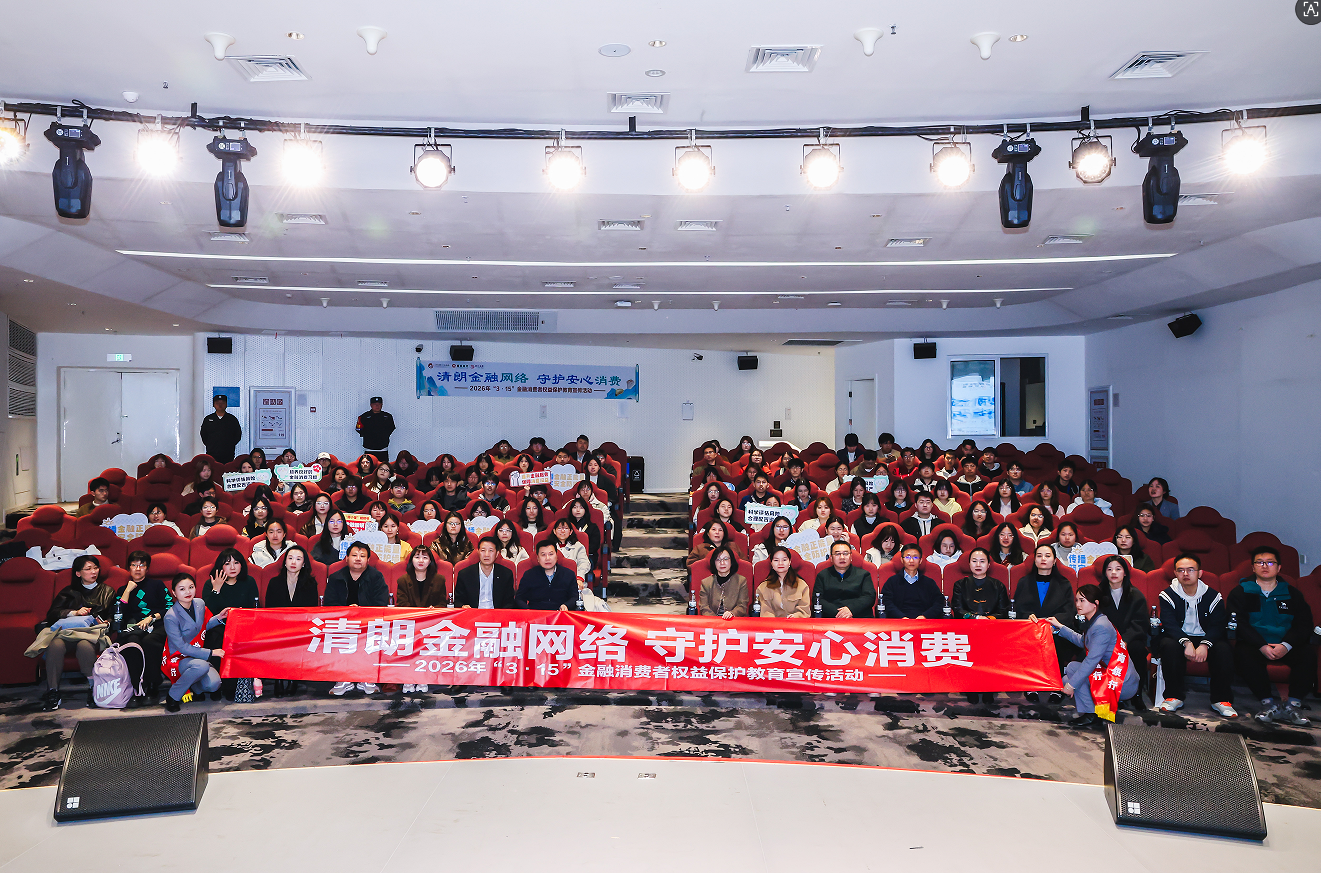
Core Viewpoint - The article discusses the launch of the "2026 '3·15' Financial Consumer Rights Protection Education Campaign" by China Merchants Bank Changsha Branch, aimed at enhancing public financial literacy and protecting consumer rights in finance [1][4]. Group 1: Campaign Objectives - The campaign focuses on two main themes: protecting financial rights and promoting digital financial services to enhance people's livelihoods, as well as raising awareness to prevent financial network issues [4]. - The initiative aims to create a safe and trustworthy financial consumption environment by addressing public concerns and consumer hot topics through systematic financial education [4]. Group 2: Target Audience and Activities - The campaign will particularly target vulnerable groups such as the elderly, children, and new employment forms, addressing their specific financial needs [4]. - Various activities will be organized, including financial knowledge lectures, themed salons, and on-site consultations in communities, schools, enterprises, and business districts to deliver practical financial knowledge [4]. Group 3: Innovative Promotion Methods - The campaign will utilize digital channels to create engaging online content focused on financial safety, fraud prevention, and rational investment, including original comics and educational short videos [5]. - By leveraging mobile banking apps and official social media platforms, the campaign aims to effectively reach and engage the public in learning about financial policies and risk prevention [5]. Group 4: Long-term Strategy - In 2026, the Changsha Branch will align with the strategic deployment of "Advancing the 14th Five-Year Plan, Striving for a New Journey," focusing on building a long-term, multi-dimensional, and inclusive financial education mechanism [5]. - The bank emphasizes a people-centered approach, aiming to improve the consumer rights protection system and enhance public financial literacy and risk prevention capabilities [5].

招商银行:拟于4月15日全额赎回“招银优1”
Xin Lang Cai Jing· 2026-03-13 10:49
Core Viewpoint - China Merchants Bank announced the full redemption of its domestic preferred shares "Zhaoyin You1" on April 15, 2026, after receiving approval from the National Financial Regulatory Administration [1][3] Group 1: Issuance and Approval - In December 2017, China Merchants Bank issued 275 million domestic preferred shares, raising a total of RMB 27.5 billion [1][3] - The issuance was approved at the 2016 annual general meeting and subsequent shareholder meetings in 2017 and 2021 [1][3] Group 2: Redemption Process - The bank's board of directors has been authorized to handle all matters related to the declaration and payment of preferred share dividends and the redemption process [1][3] - Executives Wang Liang and Zhu Liwei signed the decision for the full redemption of the preferred shares and the corresponding dividend distribution [1][3] Group 3: Regulatory Response - China Merchants Bank has received a non-objection response from the National Financial Regulatory Administration regarding the redemption of the preferred shares [1][3]