
CM BANK(600036)

Search documents
银行行业资金流出榜:招商银行、华夏银行等净流出资金居前
Zheng Quan Shi Bao Wang· 2026-01-22 09:25
Market Overview - The Shanghai Composite Index rose by 0.14% on January 22, with 22 out of the 28 sectors experiencing gains. The top-performing sectors were building materials and defense, with increases of 4.09% and 3.23% respectively. The banking sector was among the top decliners, down by 0.43% [1] Capital Flow Analysis - The main capital flow showed a net outflow of 21.612 billion yuan across the two markets. However, 12 sectors saw net inflows, with the telecommunications sector leading at a net inflow of 8.019 billion yuan and a daily increase of 2.83%. The defense sector also performed well, with a net inflow of 5.713 billion yuan and a daily increase of 3.23% [1] - Conversely, 19 sectors experienced net outflows, with the electronics sector leading at a net outflow of 13.206 billion yuan, followed by the power equipment sector with a net outflow of 7.206 billion yuan. Other sectors with significant outflows included non-ferrous metals, automobiles, and pharmaceuticals [1] Banking Sector Performance - The banking sector saw a decline of 0.43% with a net outflow of 545 million yuan. Out of 42 stocks in this sector, 26 rose while 14 fell. Notably, 25 stocks had net inflows, with Jiangsu Bank leading at a net inflow of 224 million yuan, followed by Bank of Communications and Minsheng Bank with inflows of 152 million yuan and 98.929 million yuan respectively [2] - The stocks with the highest net outflows included China Merchants Bank, Huaxia Bank, and Shanghai Pudong Development Bank, with outflows of 743 million yuan, 184 million yuan, and 156 million yuan respectively [2] Individual Stock Performance - The following table summarizes the performance of key banking stocks based on their net capital flow and daily change: | Stock Code | Stock Name | Daily Change (%) | Turnover Rate (%) | Net Capital Flow (10,000 yuan) | | --- | --- | --- | --- | --- | | 600036 | China Merchants Bank | -1.02 | 0.91 | -7426.622 | | 600015 | Huaxia Bank | -0.92 | 0.82 | -1836.242 | | 600000 | Shanghai Pudong Development Bank | -1.02 | 0.46 | -1555.792 | | 601939 | China Construction Bank | -1.92 | 1.44 | -1473.762 | | 601988 | Bank of China | -0.56 | 0.12 | -1247.776 | | 601288 | Agricultural Bank of China | -2.16 | 0.15 | -504.228 | | 601166 | Industrial Bank | -1.33 | 0.69 | -398.051 | | 601998 | CITIC Bank | -1.58 | 0.17 | -213.897 | | 002936 | Zhengzhou Bank | 0.53 | 1.30 | -147.699 | | 601665 | Qilu Bank | 1.65 | 0.89 | -144.610 | | 601577 | Changsha Bank | 0.75 | 0.32 | -122.400 | | 601187 | Xiamen Bank | -1.40 | 0.49 | -100.037 | | 603323 | Suning Bank | 1.01 | 1.52 | -89.489 | | 002839 | Zhangjiagang Bank | 0.90 | 1.07 | -67.650 | | 002958 | Qingnong Commercial Bank | 0.97 | 0.86 | -54.434 | | 601963 | Chongqing Bank | 0.10 | 0.48 | -44.601 | | 601997 | Guiyang Bank | 0.35 | 0.71 | -9.478 | | 600928 | Xi'an Bank | 0.82 | 0.49 | 47.776 | | 601860 | Zijin Bank | 0.73 | 1.18 | 49.415 | [2][3]






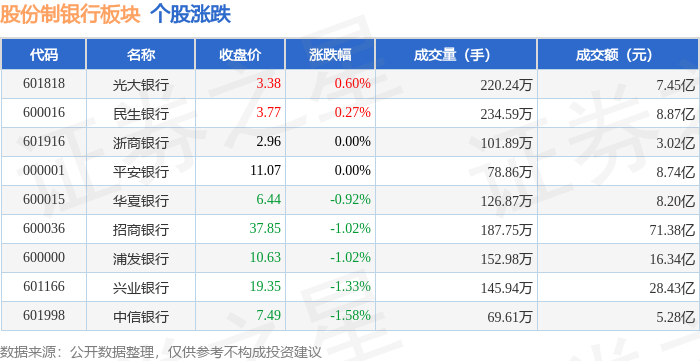
股份制银行板块1月22日跌0.86%,中信银行领跌,主力资金净流出9.6亿元
Zheng Xing Xing Ye Ri Bao· 2026-01-22 09:01
从资金流向上来看,当日股份制银行板块主力资金净流出9.6亿元,游资资金净流出2.76亿元,散户资金 净流入12.36亿元。股份制银行板块个股资金流向见下表: | 代码 | 名称 | 收盘价 | 涨跌幅 | 成交量(手) | 成交额(元) | | --- | --- | --- | --- | --- | --- | | 601818 | 光大银行 | 3.38 | 0.60% | 220.24万 | 7.45 Z | | 600016 | 民生银行 | 3.77 | 0.27% | 234.59万 | 8.87亿 | | 601916 | 浙商银行 | 2.96 | 0.00% | 101.89万 | 3.02亿 | | 000001 | 平安银行 | 11.07 | 0.00% | 78.86万 | 8.74亿 | | 600015 | 华夏银行 | 6.44 | -0.92% | 126.87万 | 8.20亿 | | 600036 | 招商银行 | 37.85 | -1.02% | 187.75万 | 71.38亿 | | 600000 | 浦发银行 | 10.63 | -1.02% | 152.98万 ...





商业航天热已经传到银行了!招行浦发放卫星,放贷已经卷到外太空了?
Sou Hu Cai Jing· 2026-01-22 08:53
Group 1 - The core idea of the articles highlights the unexpected collaboration between commercial banks and the aerospace industry, where banks like China Merchants Bank and Shanghai Pudong Development Bank are launching their own satellites for financial risk management [1][2] - The satellites, named "Zhaoyin Jinkui" and "Pudong Shuzhi," are designed to enhance banks' ability to monitor collateral and project progress, providing a technological upgrade to traditional methods of oversight [1] - With the integration of AI, these satellites can analyze construction activities and logistics in real-time, achieving a monitoring accuracy of over 95%, thus preventing potential financial losses from project mismanagement [1] Group 2 - The trend indicates a shift in the banking industry, where competition is extending beyond traditional financial metrics like interest rates to include technological capabilities such as satellite surveillance [2] - This development suggests that in the near future, banks may need to invest in space technology to remain competitive, indicating a new frontier in the financial services sector [2]
数字人民币2.0:从M0到M1的质变
GF SECURITIES· 2026-01-22 05:07
Investment Rating - The report provides a "Buy" rating for all major banks analyzed, indicating a positive outlook for the banking sector [7]. Core Insights - The digital renminbi has entered its 2.0 era, transitioning from a central bank liability (M0) to a commercial bank liability (M1), allowing it to earn interest and be included in deposit insurance and reserve requirements [6][14]. - This transformation positions China as the first economy to offer interest on its central bank digital currency (CBDC), fundamentally altering its monetary attributes and creating a new financial paradigm in the digital economy [27]. - The digital renminbi's interest-bearing feature enhances user motivation to hold it, shifting its perception from a mere payment tool to a viable store of value, thus promoting its integration into everyday financial activities [27][28]. Summary by Sections 1. Digital Renminbi 2.0 Era - The digital renminbi (e-CNY) is now classified as a digital deposit currency, which can earn interest and is managed under a new regulatory framework [14]. - Major state-owned banks have begun offering interest on digital renminbi wallet balances, marking a significant shift in its utility and appeal [14][27]. 2. Development Progress and Application Status - The development of the digital renminbi began in 2014, with significant milestones including pilot tests in various cities and the establishment of a comprehensive operational framework by 2025 [32][33]. - As of November 2025, the digital renminbi has processed 34.8 billion transactions amounting to 16.7 trillion yuan, with extensive coverage across multiple provinces and cities [37]. 3. Global CBDC Development Trends - The report identifies three main trends in global CBDC development: active retail CBDC initiatives, innovation in payment systems, and cautious approaches in some countries like the U.S. [6]. - China's proactive stance in developing its CBDC positions it favorably in the global digital economy landscape, particularly in cross-border trade applications [30].


成交额超82亿!A500ETF基金(512050)红盘向上,超600家上市公司预告2025年业绩
Xin Lang Cai Jing· 2026-01-22 03:25
Core Viewpoint - The A500 index and related ETF are showing positive performance, with significant growth in specific sectors such as semiconductors, new energy vehicles, and artificial intelligence, driven by technological innovation and favorable commodity prices [1][2]. Group 1: A500 Index and ETF Performance - As of January 22, 2026, the A500 index rose by 0.04%, with notable increases in individual stocks such as Gotion High-tech (12.39%) and Deepin Technology (10.54%) [1]. - The A500 ETF (512050) increased by 0.08%, with a latest price of 1.24 yuan, and a trading volume of 82.86 billion yuan, indicating active market participation [1]. - Over the past month, the A500 ETF's scale grew by 90.21 billion yuan, reflecting significant growth [1]. Group 2: Market Trends and Company Performance - As of January 21, 2026, 578 A-share listed companies released earnings forecasts, with 29 companies providing earnings reports, indicating a solid growth trend and structural optimization in the industry [1]. - Emerging sectors such as semiconductors, new energy vehicles, and AI are performing well, with companies attributing their growth to the acceleration of AI implementation and the improved outlook of the new energy vehicle supply chain [1]. - The performance of companies in the non-ferrous metals sector has improved due to rising prices of commodities like gold and copper, while breakthroughs in overseas business have also contributed to earnings growth [1]. Group 3: Regulatory Environment and Market Outlook - Short-term market consolidation is expected after reaching new highs, with recent regulatory policies likely to stabilize market sentiment [2]. - In the medium term, the market is anticipated to maintain an upward trajectory, supported by the active guidance of long-term capital into the market and macroeconomic factors [2]. - As the annual earnings forecast disclosure period intensifies, market sentiment is expected to heat up, shifting focus from macro liquidity to micro performance verification [2].




财政金融促内需一揽子政策点评:财政金融六项政策落地,关注结构调优和息差改善
Yin He Zheng Quan· 2026-01-22 02:47
Investment Rating - The report maintains a "Recommended" rating for the banking industry [1] Core Insights - The implementation of six fiscal and financial policies aims to stimulate domestic demand, focusing on structural optimization and interest margin improvement [3] - The fiscal interest subsidies, typically between 1-1.5 percentage points, are designed to lower overall financing costs, boost investment and consumption demand, and guide financial resources towards key areas such as technology innovation and support for small and micro enterprises [3] - The report highlights that the fiscal policies will positively support banks in optimizing their structures and stabilizing interest margins, with expectations of a narrowing decline in interest margins due to the upcoming maturity of high-interest fixed deposits in 2026 [3] - The establishment of a 500 billion yuan special guarantee plan for private investment and the optimization of risk-sharing mechanisms for corporate bonds are expected to enhance banks' asset quality and increase their willingness to issue long-term loans [3] - The report suggests that the collaborative fiscal and financial policies will directly benefit credit growth, structural optimization, and risk expectation improvement, while the stable interest margin guidance remains unchanged [3] Summary by Sections Banking Industry - The report emphasizes the positive impact of fiscal policies on credit growth and structural optimization, with a focus on improving risk expectations and stabilizing interest margins [3] - Specific recommendations for individual banks include Industrial and Commercial Bank of China, Agricultural Bank of China, Postal Savings Bank of China, Jiangsu Bank, Hangzhou Bank, and China Merchants Bank [3]



多家银行公布消费贷“国补”升级方案 信用卡分期纳入贴息范围
Zhong Guo Zheng Quan Bao· 2026-01-21 23:41
Core Viewpoint - The Ministry of Finance has announced an optimization of the personal consumption loan interest subsidy policy, which includes expanding the scope of eligible loans and extending the policy period until the end of 2026, allowing each borrower to receive a maximum subsidy of 3000 yuan [1][2]. Group 1: Policy Changes - The new policy includes the inclusion of credit card installment payments in the subsidy support range and the removal of previous restrictions on certain consumption areas [1][2]. - The subsidy limit for individual borrowers has been increased to 3000 yuan per year, with the previous limits on single transaction amounts and total loan amounts being removed [2]. - The policy now allows for subsidies on all types of consumption loans, not just those in specific categories such as home appliances or education [2]. Group 2: Implementation and Participation - Major banks, including Agricultural Bank, Bank of China, and others, have begun to implement the new subsidy measures, with over 500 financial institutions now eligible to process these loans [1][2]. - The implementation period for the credit card installment subsidy is set for the entire year of 2026, and customers can apply for retroactive subsidies for transactions made between January 1, 2026, and the announcement date [3][4]. Group 3: Consumer Guidance - Banks have emphasized that there will be no fees charged for processing personal consumption loans and credit card installment subsidies, and they will not work with third-party intermediaries [5][6]. - Customers are advised to apply for loans through official channels and to be cautious of fraudulent activities related to loan applications [6].

关于平安匠心优选混合型 证券投资基金恢复大额申购、定期定额投资及转换转入业务的公告
Zhong Guo Zheng Quan Bao - Zhong Zheng Wang· 2026-01-21 23:40
2其他需要提示的事项 根据法律法规和基金合同的相关规定,平安基金管理有限公司(以下简称"本公司")决定自2026年1月 22日(含)起取消平安匠心优选混合型证券投资基金(以下简称"本基金")对投资者大额申购、定期定 额投资和转换转入业务的限制,恢复办理本基金的正常申购、定期定额投资和转换转入业务。 公告送出日期:2026年1月22日 如有疑问,可拨打平安基金管理有限公司客户服务电话:400-800-4800进行咨询,或登陆公司网站 fund.pingan.com获得相关信息。 1公告基本信息 风险提示:本公司承诺以诚实信用、勤勉尽责的原则管理和运用基金资产,但不保证基金一定盈利,也 不保证最低收益。敬请投资者注意投资风险。投资者投资于上述基金前应认真阅读基金的基金合同及相 关公告。 ■ 特此公告。 平安基金管理有限公司 2026年1月22日 平安鼎信债券型证券投资基金 基金经理变更公告 公告送出日期:2026年1月22日 1 公告基本信息 ■ 2 新任基金经理的相关信息 ■ 3 其他需要说明的事项 上述事项已按规定向中国证券投资基金业协会办理相关手续。 特此公告。 平安基金管理有限公司 2026年1月22日 ...

多家银行公布 消费贷“国补”升级方案
Zhong Guo Zheng Quan Bao· 2026-01-21 21:42
Core Viewpoint - The Ministry of Finance has announced an optimization of the personal consumption loan interest subsidy policy, which includes expanding the scope of eligible loans and extending the policy period until the end of 2026, allowing each borrower to receive a maximum subsidy of 3,000 yuan [1][2]. Group 1: Policy Changes - The subsidy policy now includes credit card installment payments and removes previous restrictions on certain consumption areas, allowing all types of consumption loans to qualify for subsidies [1][2]. - The maximum subsidy limit of 500 yuan per single transaction and the previous cap of 1,000 yuan for loans under 50,000 yuan have been eliminated, enabling borrowers to receive a total of 3,000 yuan in subsidies annually [2]. Group 2: Implementation and Participation - Major banks such as Agricultural Bank of China, Bank of China, and others have already begun implementing the new subsidy measures, with over 500 financial institutions now eligible to process these loans [1][2]. - The policy aims to enhance accessibility for consumers in urban and rural areas by including city commercial banks, rural commercial banks, foreign banks, and consumer finance companies [2]. Group 3: Credit Card Installment Subsidy - The credit card installment subsidy policy will be effective throughout 2026, and customers can apply for retroactive subsidies for installments made between January 1, 2026, and the policy announcement date [3][4]. - Banks require customers to sign a supplementary agreement to benefit from the subsidy on credit card installments, ensuring compliance with the policy [3][4]. Group 4: Consumer Protection and Compliance - Banks emphasize that no fees will be charged for processing personal consumption loans and credit card installment subsidies, and they will not engage third-party intermediaries [5][6]. - Strict measures are in place to prevent fraudulent activities related to loan applications, and any violations will be recorded in the borrower's credit history [5][6].
多家银行公布消费贷“国补”升级方案
Zhong Guo Zheng Quan Bao· 2026-01-21 21:08
Core Viewpoint - The Ministry of Finance has announced an optimization of the personal consumption loan interest subsidy policy, which includes expanding the scope of eligible loans and extending the policy period until the end of 2026, allowing each borrower to receive a maximum subsidy of 3,000 yuan [1][2] Group 1: Policy Changes - The new policy includes the inclusion of credit card installment payments for interest subsidies and the removal of previous restrictions on certain consumption areas [1][2] - The subsidy limit for individual borrowers has been increased to 3,000 yuan per year, with no cap on single transaction subsidies [1][2] - The policy now allows for any type of consumption loan to qualify for interest subsidies, broadening the eligible categories significantly [2] Group 2: Implementation and Participation - Over 500 financial institutions, including city commercial banks and foreign banks, are now authorized to implement the new subsidy measures, with expectations for local small and medium banks to follow suit [2] - Banks are actively marketing consumption loans during the "opening season," with annualized interest rates starting at 3%, potentially dropping to as low as 2% with the subsidy [2] Group 3: Credit Card Subsidy Details - The credit card installment interest subsidy policy will be effective throughout 2026, applicable only to RMB bills [2][3] - Customers must sign a supplementary agreement to benefit from the subsidy, and banks will not charge any fees for processing these loans [3][4] - Banks emphasize the importance of legitimate transactions and warn against fraudulent activities related to loan applications [4]