CM BANK(600036)

Search documents
招行信用卡迎新“掌门”:厉明东到任,老将刘加隆转任顾问、曾三度执掌卡中心
Xin Lang Cai Jing· 2026-01-20 10:37
Core Insights - The leadership of China Merchants Bank's Credit Card Center has changed, with Liu Jialong retiring and Li Mingdong set to take over pending regulatory approval [1][2] Group 1: Leadership Transition - Liu Jialong, a veteran with 30 years at China Merchants Bank, has served multiple terms as the head of the Credit Card Center and has been instrumental in the development of the bank's credit card business [1][4] - Li Mingdong, the incoming general manager, has extensive experience in retail finance and wealth management, having held various senior positions within the bank [1][5] Group 2: Credit Card Business Development - Under Liu Jialong's leadership, the bank's credit card business has been at the forefront of industry innovation, particularly in digital transformation, including the launch of the first mobile app in the industry and the introduction of smart customer service platforms [4] - The bank's credit card issuance has seen significant growth, with over 1 billion cards issued by the end of 2017, although the industry is now facing a decline, with the total number of credit cards in China dropping from 8.07 billion in September 2022 to 7.07 billion in September 2025 [5][6] Group 3: Industry Challenges - The credit card industry is undergoing a transformation from rapid growth to a focus on high-quality development, facing challenges such as risk management, declining consumer spending, and narrowing interest margins [6] - As of September 2025, the bank reported a credit card transaction volume of 20,209.60 billion yuan, a year-on-year decrease of 8.54%, and a decline in both interest and non-interest income [6] - The bank's non-performing loan ratio for credit cards was reported at 1.74% as of September last year, a slight decrease from 1.75% at the end of 2024 [7]


财政部连发多份重要文件,事关贷款贴息、民间投资贷款担保等 一揽子政策全文公布
Sou Hu Cai Jing· 2026-01-20 09:03
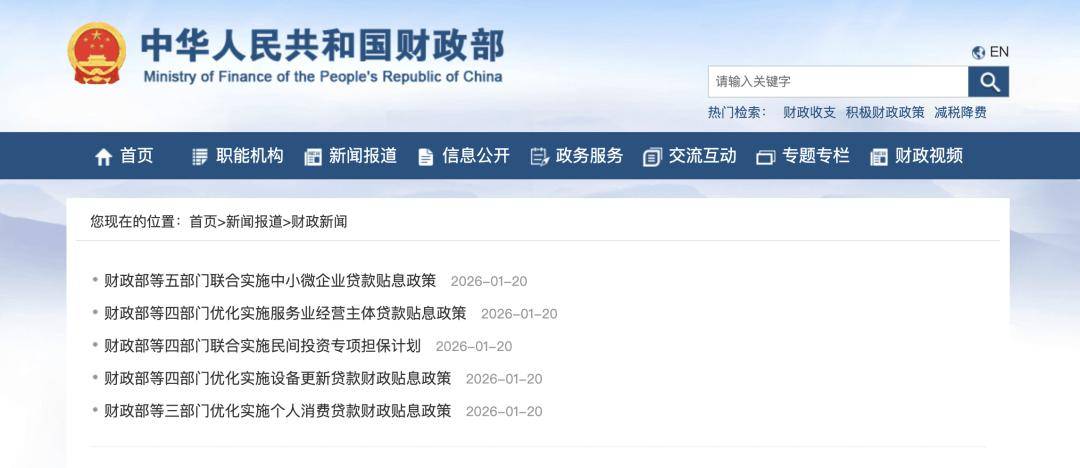
Group 1 - The core viewpoint of the news is the implementation of a financial subsidy policy for equipment renewal loans to support businesses in reducing financing costs and promoting effective investment [3][4][5] - The policy includes a 1.5% interest subsidy on fixed asset loans for equipment renewal projects, applicable for a maximum of two years, and is effective until December 31, 2026 [3][4] - The scope of support has been expanded to include various sectors such as construction, aviation, digital technology, and green energy, emphasizing high-end, intelligent, and digital equipment updates [4][6] Group 2 - A total of 26 banks are designated as eligible for processing the interest subsidy loans, including major national banks and several regional banks [4][5] - The subsidy process has been optimized to include a "pre-allocation + settlement" method, streamlining the application and approval process for banks and provincial financial departments [5][6] - The policy aims to enhance the experience of businesses by ensuring timely communication regarding subsidy payments through modern technology [6][7] Group 3 - The policy for small and micro enterprises includes a 1.5% interest subsidy on fixed asset loans, with a maximum loan amount of 50 million yuan, effective from January 1, 2026 [8][9] - The targeted sectors for this subsidy include new energy vehicles, medical equipment, and various service industries, aiming to stimulate investment and production [9][10] - The operational mechanism involves a "total-to-total" model for coordination between financial institutions and fiscal departments to ensure efficient processing of subsidy funds [11][12] Group 4 - The service industry loan subsidy policy has been extended until December 31, 2026, with an increased maximum loan amount of 10 million yuan and a 1% interest subsidy for one year [16][17] - New sectors such as digital, green, and retail have been added to the support scope, enhancing the policy's relevance to current economic trends [17][18] - The funding allocation process has been refined to improve efficiency and reduce redundancy in the approval process [18][19] Group 5 - A special guarantee plan for private investment has been introduced with a total quota of 500 billion yuan over two years, aimed at supporting small and micro enterprises [22][24] - The plan includes risk-sharing mechanisms where banks bear at least 20% of the loan risk, while the government guarantee fund covers up to 80% [24][25] - The initiative encourages innovative financing models and aims to enhance the capital strength of the government guarantee fund to support private investments effectively [26][27]





A股重磅!宽基ETF连续出现净赎回,有“巨无霸”份额回落至“924”行情之前,多只科创、创业板系ETF份额缩水,发生了啥?
Jin Rong Jie· 2026-01-20 08:57
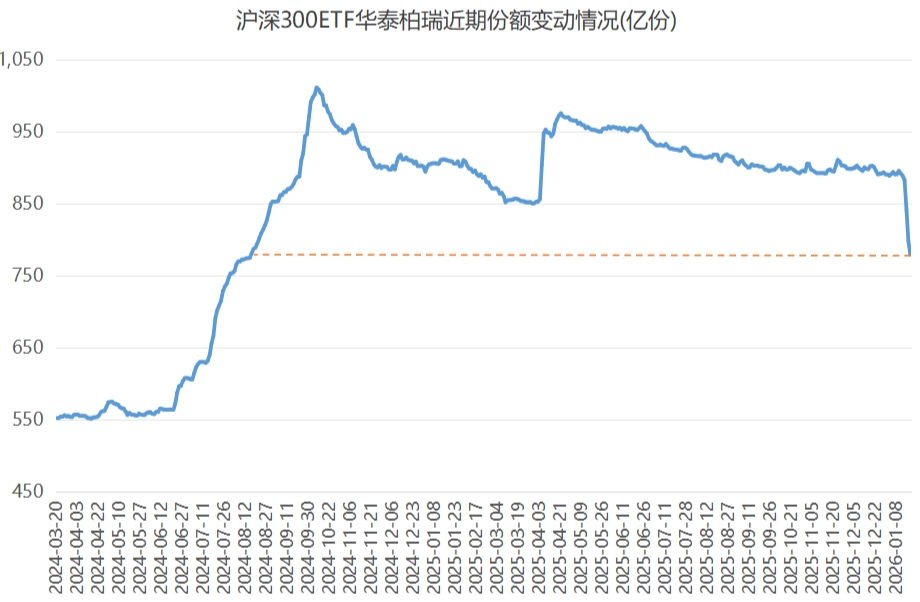
Group 1 - Recent net redemptions in A-share broad-based ETFs have drawn market attention, with significant outflows recorded on January 15 and 16, totaling 687 billion and 863 billion respectively, marking the highest single-day outflows in history [1] - As of January 19, four out of six major broad-based ETFs saw their shares decline by over 10% in the last three trading days, with the largest, Huatai-PB CSI 300 ETF, dropping to 778.63 billion shares, a scale of approximately 369.2 billion, the lowest since August 2024 [1] - The ChiNext and STAR Market ETFs also experienced significant declines, with the E Fund STAR 50 ETF and E Fund ChiNext ETF seeing share reductions of 34.55% and 20.22% respectively [3] Group 2 - In contrast to the outflows from broad-based ETFs, certain commodity, cross-border, and narrow-based ETFs attracted significant inflows, with the Southern Nonferrous ETF being the only product to receive over 10 billion in net inflows, totaling 100.87 billion, driven by rising base metal prices [3] - Other ETFs such as Yongying Satellite ETF, Harvest Software ETF, and GF Media ETF also received net inflows exceeding 6 billion [3] - According to CITIC Securities, the impact of ETF redemptions on individual stocks was significant, with main board, ChiNext, and STAR Market stocks experiencing sell-offs of 946 billion, 334 billion, and 265 billion respectively during the peak outflow days [3] Group 3 - Regulatory measures have been implemented to cool down the market following rapid price increases and overheated sentiment, including raising the minimum margin requirement for margin trading from 80% to 100% [5][6] - The China Securities Regulatory Commission emphasized the need for comprehensive market monitoring and timely counter-cyclical adjustments to maintain market stability and prevent excessive volatility [6] - There are differing views on the long-term outlook for A-shares, with some analysts suggesting the potential for a slow bull market due to reforms, while others remain skeptical about escaping historical volatility patterns [7]



股份制银行板块1月20日涨0.54%,中信银行领涨,主力资金净流入3.9亿元
Zheng Xing Xing Ye Ri Bao· 2026-01-20 08:56
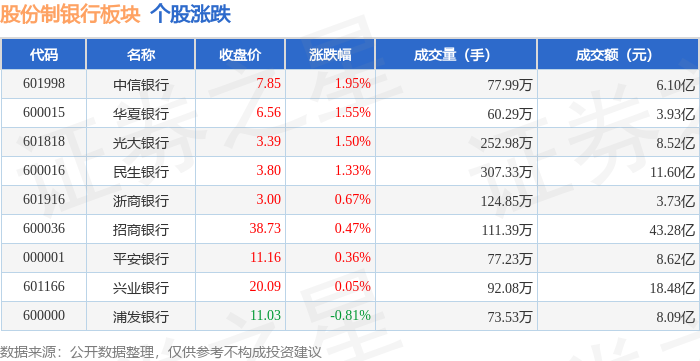
Core Viewpoint - The banking sector saw a slight increase of 0.54% on January 20, with CITIC Bank leading the gains, while the Shanghai Composite Index experienced a minor decline of 0.01% [1] Group 1: Stock Performance - CITIC Bank closed at 7.85, up by 1.95% with a trading volume of 779,900 shares and a transaction value of 610 million yuan [1] - Huaxia Bank closed at 6.56, up by 1.55% with a trading volume of 602,900 shares and a transaction value of 393 million yuan [1] - Everbright Bank closed at 3.39, up by 1.50% with a trading volume of 2,529,800 shares and a transaction value of 852 million yuan [1] - Minsheng Bank closed at 3.80, up by 1.33% with a trading volume of 3,073,300 shares and a transaction value of 1.16 billion yuan [1] - Zhejiang Commercial Bank closed at 3.00, up by 0.67% with a trading volume of 1,248,500 shares and a transaction value of 373 million yuan [1] - China Merchants Bank closed at 38.73, up by 0.47% with a trading volume of 1,113,900 shares and a transaction value of 4.33 billion yuan [1] - Ping An Bank closed at 11.16, up by 0.36% with a trading volume of 772,300 shares and a transaction value of 862 million yuan [1] - Industrial Bank closed at 20.09, up by 0.05% with a trading volume of 920,800 shares and a transaction value of 1.85 billion yuan [1] - Shanghai Pudong Development Bank closed at 11.03, down by 0.81% with a trading volume of 735,300 shares and a transaction value of 809 million yuan [1] Group 2: Capital Flow - The banking sector experienced a net inflow of 390 million yuan from institutional investors, while retail investors contributed a net inflow of 169 million yuan [1] - The sector saw a net outflow of 558 million yuan from speculative funds [1] - Specific capital flows for major banks include: - China Merchants Bank: 14.2 million yuan net inflow from institutional investors, 259 million yuan net inflow from retail investors [2] - Minsheng Bank: 11.2 million yuan net inflow from institutional investors, with net outflows from both speculative and retail investors [2] - Industrial Bank: 68.9 million yuan net inflow from institutional investors, with significant net outflows from speculative investors [2] - Everbright Bank: 38.9 million yuan net inflow from institutional investors, with net outflows from retail investors [2] - Huaxia Bank: 38.3 million yuan net inflow from institutional investors, with net outflows from retail investors [2] - Zhejiang Commercial Bank: 20.2 million yuan net inflow from institutional investors, with net outflows from retail investors [2] - CITIC Bank: 17.7 million yuan net inflow from institutional investors, with net outflows from both speculative and retail investors [2] - Ping An Bank: 4.9 million yuan net inflow from institutional investors, with net outflows from retail investors [2] - Shanghai Pudong Development Bank: 53.2 million yuan net outflow from institutional investors, with a net inflow from speculative investors [2]





小摩:预计内银今年股价上升 惟流动性顺风中相对落后 升民行评级至“增持”
Zhi Tong Cai Jing· 2026-01-20 06:49
Core Viewpoint - Morgan Stanley predicts that China Bank (601988) will experience absolute stock price appreciation but may underperform the market by 2026 [1] Group 1: Bank Ratings - Morgan Stanley upgraded the rating of Minsheng Bank (600016) from "Neutral" to "Overweight" [1] - The rating of Agricultural Bank (601288) was downgraded from "Overweight" to "Neutral" [1] Group 2: Market Liquidity and Growth Expectations - Approximately 110 trillion RMB of fixed-term deposits are expected to mature by 2026, including around 7 trillion RMB of excess household savings, which may provide liquidity support to the capital market and boost market performance [1] - The recovery of net interest income and wealth management fees is expected to lead to moderate improvements in revenue and profit growth for domestic banks in 2026 [1] Group 3: Stock Performance Preferences - In the context of high dividend stocks, Morgan Stanley prefers Bank of Communications (601328), China Bank (03988), and China Construction Bank (601939) [1] - Banks such as Ningbo Bank (002142), Shanghai Pudong Development Bank (600000), Industrial Bank (601166), and China Merchants Bank (600036) are seen as having better growth potential [1] - Growth-oriented stocks are expected to outperform high dividend stocks [1]




小摩:预计内银今年股价上升 惟流动性顺风中相对落后 升民行(01988)评级至“增持”
智通财经网· 2026-01-20 06:48
Core Viewpoint - JPMorgan expects Chinese bank stocks to achieve absolute price increases but may underperform the market by 2026 [1] Group 1: Ratings Changes - JPMorgan upgraded the rating of Minsheng Bank (01988) H-shares from "Neutral" to "Overweight" [1] - JPMorgan downgraded the rating of Agricultural Bank of China (01288) H-shares from "Overweight" to "Neutral" [1] Group 2: Market Predictions - JPMorgan anticipates approximately 110 trillion RMB in time deposits maturing by 2026, including around 7 trillion RMB in excess household savings, which could provide liquidity support to the capital market and boost market performance [1] - The bank expects a moderate improvement in revenue and profit growth for domestic banks in 2026, driven by a recovery in net interest income and wealth management fees [1] Group 3: Stock Preferences - Among high-dividend stocks, JPMorgan prefers Bank of Communications (601328.SH), Bank of China (03988), and China Construction Bank (00939) [1] - Banks such as Ningbo Bank (002142.SZ), Shanghai Pudong Development Bank (600000.SH), Industrial Bank (601166.SH), and China Merchants Bank (03968)(600036.SH) are seen as having good growth potential [1] - JPMorgan predicts that growth-oriented stocks will outperform high-dividend stocks [1]
大行评级|小摩:预计内银股将实现绝对股价上涨,偏好交通银行与建设银行
Ge Long Hui· 2026-01-20 06:33
Core Viewpoint - Morgan Stanley forecasts that domestic bank stocks will experience absolute price increases but may underperform the market by 2026 [1] Group 1: Market Outlook - The bank anticipates approximately 110 trillion yuan in time deposits maturing by 2026, including around 7 trillion yuan in excess household savings, which could provide liquidity support to the capital markets and boost market performance [1] - The recovery in net interest income and wealth management fees is expected to lead to moderate improvements in revenue and profit growth for domestic bank stocks by 2026 [1] - Despite the liquidity-driven rally, bank stocks may lag in performance compared to the overall market [1] Group 2: Stock Preferences - Among high-dividend stocks, the bank prefers Bank of Communications and China Construction Bank [1] - Ningbo Bank, Shanghai Pudong Development Bank, Industrial Bank, and China Merchants Bank are identified as having better growth potential [1] - The bank upgraded the rating of Minsheng Bank from "Neutral" to "Overweight," while downgrading Agricultural Bank of China from "Overweight" to "Neutral" [1]
国泰海通:预计2025年银行利息净收入增速转正 息差阶段性企稳
Zhi Tong Cai Jing· 2026-01-20 06:20
Core Viewpoint - The report from Guotai Junan predicts that the revenue and net profit growth rate for listed banks in 2025 will be 1.5% and 2.2% respectively, benefiting from stable interest margins and declining credit costs [1][2] Revenue and Profit Forecast - The expected revenue and net profit growth rates for the sample banks (26 listed banks) in 2025 are 1.5% and 2.2%, which represent an increase of 0.3 percentage points compared to the first three quarters of 2025 [2] - The net interest income growth is projected to turn positive, with an expected annual growth rate of 0.3%, improving from a negative growth of -0.6% in the first three quarters of 2025 [1][2] Asset Growth - For Q4 2025, the growth rates of interest-earning assets and loans are expected to be 9.04% and 8.07% respectively, showing a slight decline from Q3 2025 [2] - By the end of December 2025, the growth rates for loans and bond investments are projected to be 6.9% and 16.4%, respectively, both lower than the end of September 2025 [2] Interest Margin - The interest margin for 2025 is expected to stabilize at 1.40%, with the net interest income growth projected to improve to 0.3% for the year [2] - The stability in interest margin is attributed to the repricing of high-cost long-term deposits and a stable Loan Prime Rate (LPR) [2] Non-Interest Income - The growth rate for non-interest income is expected to be 4.8% in 2025, a decrease of 2.8 percentage points compared to the first three quarters of 2025 [3] - The attractiveness of dividend insurance products is expected to drive growth in fee income through the bancassurance channel [3] Asset Quality - The credit cost for 2025 is projected to be 0.58%, a decrease of 8 basis points compared to the first three quarters of 2025 [4] - The non-performing loan (NPL) ratio is expected to remain stable at 1.21%, with a slight decrease in the provision coverage ratio to 239.1% [4] Investment Recommendations - For 2026, the investment focus in the banking sector includes identifying banks with potential for growth, recommending Ningbo Bank, China Merchants Bank, and Nanjing Bank [4] - Emphasis on banks with convertible bond expectations, recommending Chongqing Bank and Changshu Bank [4] - Continuation of dividend strategies is anticipated, recommending Bank of Communications, Jiangsu Bank, and others [4]



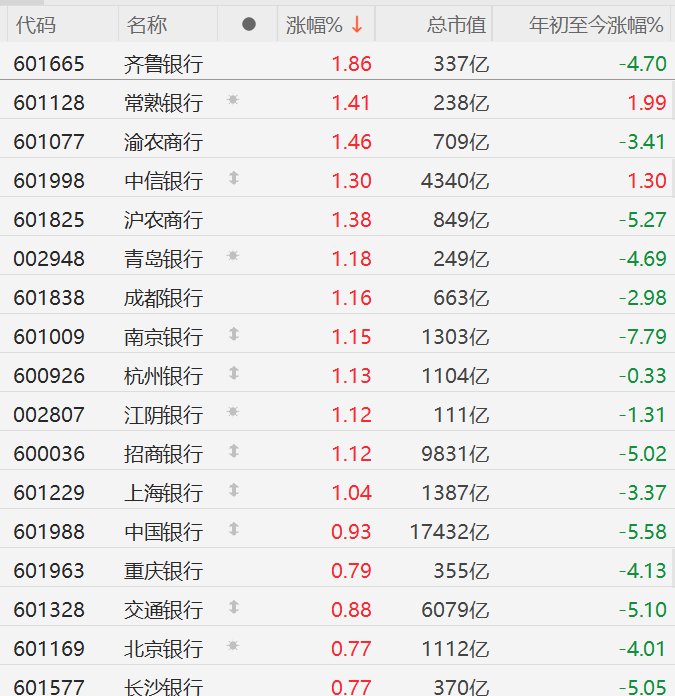
银行股逆势普涨,齐鲁银行涨近2%
Ge Long Hui· 2026-01-20 03:06
Group 1 - The A-share market saw a significant increase in bank stocks, with Qilu Bank rising nearly 2% and several other banks, including Changshu Bank and Chongqing Rural Commercial Bank, increasing by over 1% [1] - The total market capitalization of Qilu Bank is 33.7 billion, while Changshu Bank has a market cap of 23.8 billion [2] - Year-to-date performance shows that Qilu Bank has decreased by 4.70%, while Changshu Bank has increased by 1.99% [2] Group 2 - Other banks that experienced gains include Yunnan Rural Commercial Bank (1.46%), CITIC Bank (1.30%), and Shanghai Bank (1.04%) [2] - The total market capitalization of CITIC Bank is 434 billion, and it has a year-to-date performance of 1.30% [2] - Despite the gains, many banks still show negative year-to-date performance, such as Shanghai Bank (-3.37%) and China Bank (-5.58%) [2]


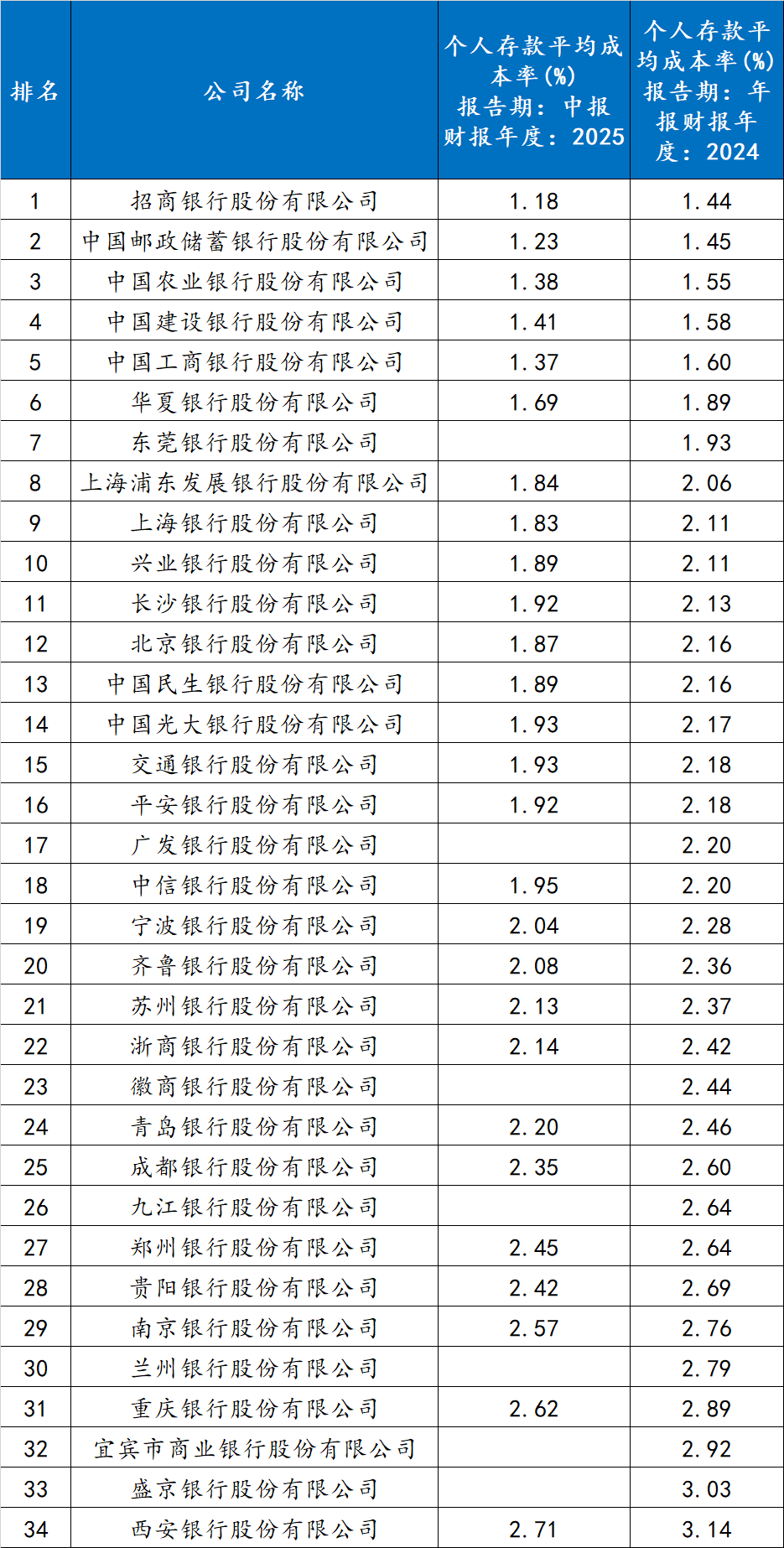
银行个人负债成本排名
Xin Lang Cai Jing· 2026-01-19 13:16
Core Insights - The average cost of personal deposits is a key indicator of banks' liability costs, with lower rates indicating stronger competitiveness in attracting deposits [1][7]. Group 1: Ranking of Banks by Deposit Cost - The banks with the lowest average cost of personal deposits are primarily state-owned large banks and some retail-focused joint-stock banks, with China Merchants Bank leading at 1.18% for the 2025 mid-year report [2][8]. - Following China Merchants Bank are China Postal Savings Bank at 1.23% and Agricultural Bank of China at 1.38%, benefiting from extensive branch networks and strong customer bases [2][8]. - The top six banks all have costs below 2%, indicating strong deposit cost control capabilities [2][8]. Group 2: Cost Trends and Observations - A notable trend is the general decline in average deposit costs across most banks when comparing 2024 annual reports to 2025 mid-year reports, with China Merchants Bank decreasing from 1.44% to 1.18% [6][12]. - This decline reflects a reduction in liability cost pressures for the banking industry, positively impacting net interest margins and profitability [6][12]. - However, lower deposit costs must align with asset yield and risk management capabilities, as a healthy bank seeks to balance these factors [12]. Group 3: Challenges for Joint-Stock and Regional Banks - Joint-stock banks and regional commercial banks generally face higher average deposit costs, often exceeding 2%, which can challenge their net interest margin management [5][11]. - National joint-stock banks like Industrial Bank and Minsheng Bank have costs ranging from 2.11% to 2.18%, while some regional banks experience even greater cost pressures [5][11].