
CSSC Holdings(600150)

Search documents
四川大决策投顾:引领海洋强国战略的核心力量
Zhong Guo Chan Ye Jing Ji Xin Xi Wang· 2025-07-02 07:09
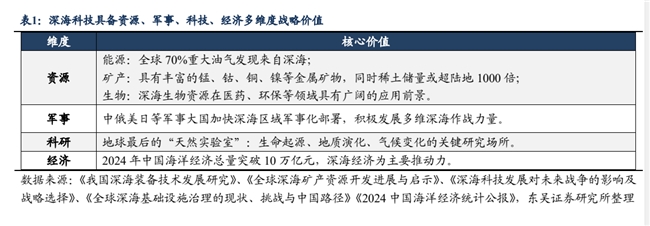
Core Insights - Deep-sea technology is entering a "policy-driven → technological breakthrough → industrial expansion" golden period, similar to the initial stage of the low-altitude economy in 2024 [1][14] - The performance support for deep-sea technology is stronger than that of the early low-altitude economy, and both belong to national strategic emerging industries, indicating a potential continuation of the market trend [1][14] Industry Value Dimensions - **Resources**: Deep-sea resources include abundant energy, minerals, and biological resources, with over 70% of major oil and gas discoveries coming from depths exceeding 1,000 meters [2][4] - **Military**: The militarization of deep-sea regions is accelerating due to global competition for resources, with major military powers developing capabilities for deep-sea operations [2][4] - **Scientific Research**: The deep sea serves as a "natural laboratory" for studying life origins, geological evolution, and climate change, with significant potential yet to be explored [2][4] - **Economic Impact**: China's marine economy is projected to exceed 10 trillion yuan in 2024, with deep-sea technology as a core driver [3][4] Deep-Sea Technology Industry Chain - **Upstream**: Focuses on basic materials and core components, requiring high strength and corrosion resistance due to deep-sea conditions [6] - **Midstream**: Involves equipment manufacturing and system integration, with underwater robots being a key area of development [6] - **Downstream**: Applications include resource development, marine observation, and military defense [7] Key Segments of Deep-Sea Technology - **Underwater Operations Equipment**: The global UUV market is valued at 57 billion yuan in 2023, expected to grow to 85 billion yuan by 2028, with a CAGR of 8.32% [10] - **Marine Engineering Equipment**: The marine engineering sector is experiencing an upturn, benefiting major companies like Zhenhua Heavy Industries and China Shipbuilding [10] - **Offshore Power Generation**: Floating wind and solar power generation are emerging trends, with high entry barriers and promising market potential [11] - **Marine Resource Development**: Offshore oil and gas production is becoming a major source of China's energy increase, with significant reserves in the South China Sea [12] - **Marine Aquaculture**: The marine fishery sector is a crucial part of China's economy, with substantial growth potential in deep-sea aquaculture [13] Investment Logic and Stock Analysis - Deep-sea technology is positioned for growth through a cycle of policy support, technological advancements, and industrial expansion, mirroring the low-altitude economy's development path [14] - Relevant stocks include Zhongtian Technology, Dongfang Cable, and China Shipbuilding, among others [14]


41.76亿元资金今日流出国防军工股
Zheng Quan Shi Bao Wang· 2025-07-01 10:19
Market Overview - The Shanghai Composite Index rose by 0.39% on July 1, with 20 out of the 28 sectors in the Shenwan classification experiencing gains, led by the comprehensive and pharmaceutical sectors, which increased by 2.60% and 1.80% respectively [1] - The defense and military industry saw a decline of 0.24%, with a net outflow of 4.176 billion yuan in main capital [1] Defense and Military Industry Performance - Within the defense and military sector, there are 139 stocks, with 47 stocks rising and 92 stocks falling on the day [1] - The top three stocks with the highest net inflow of capital are: - China Ship Emergency: 354 million yuan - China Shipbuilding: 148 million yuan - Lijun Shares: 145 million yuan [1] - The stocks with the highest net outflow of capital include: - Inner Mongolia First Machinery: 942 million yuan - North Navigation: 532 million yuan - China Ordnance: 394 million yuan [2] Capital Flow Analysis - The following stocks had significant capital inflow: - China Ship Emergency: 20.04% increase with a turnover rate of 15.27% - China Shipbuilding: 2.43% increase with a turnover rate of 1.80% - Lijun Shares: 9.98% increase with a turnover rate of 25.07% [1] - Conversely, the stocks with notable capital outflow include: - Inner Mongolia First Machinery: -0.21% change with a turnover rate of 16.23% - North Navigation: -3.78% change with a turnover rate of 15.58% - China Ordnance: 3.70% change with a turnover rate of 18.44% [2][3]


2025上半年中国船舶拍卖市场:司法拍卖回升,平台分化加剧
Xin Lang Cai Jing· 2025-07-01 09:57
Core Insights - The domestic ship auction market in the first half of the year continued its recovery, with a total of 423 ships auctioned and 181 sold, representing year-on-year increases of 57.2% and 69.2% respectively, with a total transaction value of approximately 2 billion yuan, up 62.3% year-on-year [1] Group 1: Auction Market Performance - Judicial auctions showed remarkable performance, with 139 ships sold for 438 million yuan, marking a year-on-year surge of 247.5% and 140.2% [1] - Commercial auctions experienced a decline in transaction volume, but due to a higher proportion of high-value ship transactions, the total transaction value reached 1.46 billion yuan, a year-on-year increase of 42.1% [1] - The total number of auctioned ships increased significantly, with 405 ships auctioned and 173 sold in the first half of 2025, compared to 270 auctioned and 107 sold in the same period of 2024, reflecting growth rates of 50.0% and 61.7% respectively [3] Group 2: Market Segmentation - The international shipping market showed significant activity, particularly in the capesize segment, influenced by fluctuations in iron ore prices, leading to increased inquiries for bulk carriers over 50,000 tons [2] - The coastal market remained sluggish, with transactions for ships over 40,000 deadweight tons being quiet, while smaller vessels of 1-2 thousand tons emerged as a few bright spots [2] - Engineering vessels led in transaction value, with a total of 819 million yuan, a staggering year-on-year increase of 532.2% [2] Group 3: Judicial Auction Trends - The proportion of judicial auctions increased, accounting for 27.3% of total transaction value, up 14.1 percentage points year-on-year, reversing a four-year decline [3] - Major maritime courts such as Tianjin and Ningbo led in transaction value, with Tianjin Maritime Court achieving a single transaction of 127 million yuan [5] Group 4: Platform Performance - The three major ship auction platforms showed significant divergence, with the "Pai Chuan Wang" platform achieving a transaction value of 1.3 billion yuan, a year-on-year increase of 188.3%, capturing 89% of the commercial auction market [6] - The Guangzhou Shipping Trading Platform managed to sell ships worth 120 million yuan, while the "Gang Yun Pai" platform only sold 4 tugboats for a mere 1.3 million yuan [6][8]

LNG船迎历史交付高峰 船厂码头建造忙
Yang Shi Wang· 2025-07-01 09:52
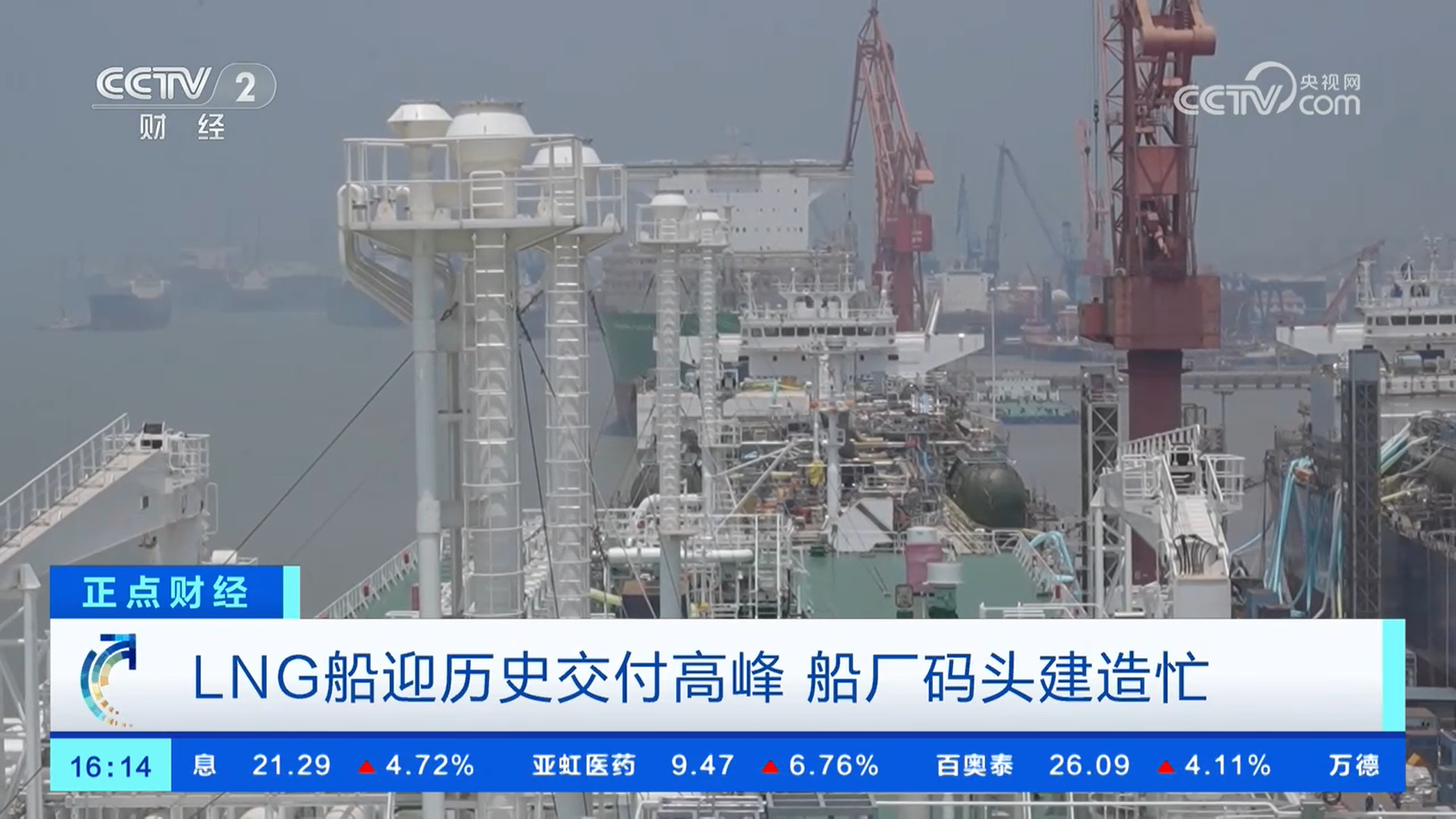
Core Insights - The demand for LNG (Liquefied Natural Gas) carriers has surged in recent years, with a significant delivery peak expected this year as order fulfillment timelines approach [1][5] - The average construction cycle for LNG vessels has decreased from 30 months to 15 months due to advancements in building technology, with a concentrated release of orders anticipated in 2025 [5] - The domestic production level of LNG vessels has been steadily increasing, marking a significant transformation in China's shipbuilding industry [6] Industry Developments - A successful sea trial of a 175,000 cubic meter LNG vessel was reported, with plans for delivery within the year after final touches [1] - The China State Shipbuilding Corporation (CSSC) anticipates delivering over 10 LNG vessels this year, with a current backlog of approximately 60 vessels valued at around 150 billion yuan [5] - The domestic production rate of LNG vessels has reached over 80%, with significant advancements in the localization of key components such as engines [6][8] Technological Advancements - The LNG ship engines, which utilize dual-fuel technology, are designed to significantly reduce carbon emissions, aligning with the green trends in the shipping market [8] - The overall localization rate of LNG ship engines has approached 80%, with major materials and components now sourced domestically [8]
中国船舶(600150) - 中国船舶关于2025年第二次临时股东会调整召开时间的公告
2025-07-01 09:30
证券代码:600150 证券简称:中国船舶 公告编号:2025-050 中国船舶工业股份有限公司 关于2025年第二次临时股东会调整召开时间的公告 2025年第二次临时股东会 2.原股东会召开日期:2025 年 7 月 4 日 14 点 30 分 3.原股东会股权登记日: | 股份类别 | 股票代码 | 股票简称 | 股权登记日 | | --- | --- | --- | --- | | A股 | 600150 | 中国船舶 | 2025/6/30 | 二、调整召开时间涉及的具体内容和原因 公司第九届董事会第二次会议于 2025 年 6 月 18 日审议通过了《关 于召开 2025 年第二次临时股东会的议案》,并于 2025 年 6 月 19 日披露 了《中国船舶工业股份有限公司关于召开 2025 年第二次临时股东会的通 知》(公告编号:2025-044)。 根据上海证券交易所(以下简称"上交所")并购重组审核委员会发 布的《上海证券交易所并购重组审核委员会 2025年第8次审议会议公告》, 上交所并购重组审核委员会定于 2025 年 7 月 4 日召开 2025 年第 8 次并 购重组审核委员会审议会议,审 ...
交运行业2025Q2业绩前瞻:关注船舶板块左侧机会,看好顺丰、顺丰同城业绩增长
Shenwan Hongyuan Securities· 2025-07-01 09:12
Investment Rating - The report maintains an "Overweight" rating for the transportation industry, indicating expectations for the industry to outperform the overall market [11]. Core Insights - The shipping sector is expected to see performance improvements driven by a shift in oil production policies and a tightening supply of older vessels, with demand for small container ships increasing due to regional industrial shifts [1][2]. - The shipbuilding market is anticipated to recover as demand is expected to rebound following the easing of trade tensions, with new orders and ship prices likely to rise [2]. - The aviation sector is experiencing steady growth in passenger traffic, with a narrowing decline in ticket prices, suggesting a recovery in airline revenues [2]. - The express delivery industry is facing a decline in growth rates, with increased competition in the mid-to-high-end e-commerce segment, but companies like SF Express are expected to maintain strong growth [2][3]. Shipping Sector Summary - The demand for oil tankers and bulk carriers is improving, with Q2 performance estimates showing significant increases for companies like COSCO Shipping Energy and China Merchants Energy [2]. - The small container ship market is experiencing rising charter rates and second-hand prices, with a tight supply situation expected to persist until at least 2030 [2]. Shipbuilding Sector Summary - The easing of the 301 tariffs is expected to release pent-up demand in the shipbuilding market, with new orders likely to increase as trade relations improve [2]. - The report highlights that China's shipbuilding industry is recovering from previous pressures, with new orders returning to a leading position [2]. Aviation Sector Summary - The aviation market is entering a peak season with stable growth in passenger numbers, and airlines are expected to benefit from improved cost structures due to lower fuel prices [2]. - Recommendations include major airlines such as China Southern Airlines and China Eastern Airlines, which are projected to return to profitability [3]. Express Delivery Sector Summary - The express delivery industry is seeing a decrease in growth rates, with competition intensifying in the e-commerce segment, particularly for mid-to-high-end services [2]. - Despite the overall slowdown, SF Express is expected to continue its high growth trajectory, driven by operational expansions and new service offerings [2]. Road and Rail Sector Summary - The report anticipates stable growth in highway traffic and toll revenues, with recommendations for companies like Zhejiang Expressway and Ninghu Expressway [2]. - Rail passenger traffic is also expected to grow, albeit at a slower pace, with recommendations for high-speed rail companies [2].



盘前必读丨A股主板ST股票涨跌幅拟调整为10%;央行这场例会释放新信号
Di Yi Cai Jing· 2025-06-29 23:34
Group 1 - Structural opportunities will be a key topic throughout the mid-year reporting season, while index-based opportunities may need to wait until the end of Q3 or Q4 [1][18] - The A-share market is expected to show a trend of oscillating upwards, with three main lines of investment opportunities: high safety margin assets, technology as a long-term mainstay, and consumer sectors boosted by policy [18] - The third quarter will see a restart of IPOs for technology companies, with a focus on AI and military sectors for structural opportunities [18] Group 2 - The U.S. stock market saw all three major indices rise, with the Dow Jones up 1% and the S&P 500 and Nasdaq both reaching historical highs [3] - Consumer confidence has significantly improved, with the University of Michigan's consumer confidence index rising to 60.7, the highest level in four months [4] - The People's Bank of China is implementing a moderately loose monetary policy to stabilize economic growth and maintain reasonable price levels, while also addressing challenges such as insufficient domestic demand [7]


深海科技:海洋强国战略的关键支柱产业赛道投资图谱
Tianfeng Securities· 2025-06-29 07:16
Group 1 - The ocean economy is a significant driver of GDP growth, with the national marine production value expected to exceed 10 trillion yuan in 2024, accounting for 7.8% of the GDP, and contributing 11.5% to economic growth [1][8] - The government has highlighted "deep-sea technology" in its reports, indicating its importance alongside commercial aerospace and low-altitude economy, suggesting a rapid development potential in deep-sea equipment and exploration [1][8] - The deep-sea technology sector is identified as a key pillar for building a maritime power, encompassing three main areas: deep-sea materials, deep-sea equipment manufacturing, and deep-sea digital applications [3][17] Group 2 - Various provinces and cities are accelerating the development of marine economy, with policies focusing on high-end, intelligent, and green development, and establishing multi-level industrial systems [2][13] - Shanghai's marine industry development plan (2025-2035) proposes a "3+5+X" industrial system, while Guangdong's regulations emphasize support for eight emerging marine industry clusters [2][14] - The deep-sea materials sector is crucial for deep-sea technology, involving structural and buoyancy materials necessary for the development of marine resources, with a focus on high-performance steel, alloy materials, and composite materials [3][21] Group 3 - The deep-sea equipment sector is essential for supporting deep-sea development, facing challenges from complex underwater environments, with significant growth in China's shipbuilding industry, which saw a 13.8% increase in completed shipbuilding volume in 2024 [4][26] - The deep-sea digitalization and intelligence sector is a vital direction for deep-sea technology development, aiming to create a "digital ocean" that enhances marine decision-making and governance through advanced information technologies [5][17] - The report suggests focusing on marine engineering equipment manufacturing, marine equipment components, and marine observation instruments as key areas for investment [4][26]




中国船舶重工集团海洋防务与信息对抗股份有限公司2024年年度股东大会决议公告
Shang Hai Zheng Quan Bao· 2025-06-27 20:33
Meeting Overview - The annual general meeting of China Shipbuilding Industry Corporation was held on June 27, 2025, at the China Shipbuilding Building, Haidian District, Beijing [2] - The meeting was convened by the board of directors and chaired by Chairman Chen Yuanjin, utilizing a combination of on-site and online voting methods [2][3] Resolutions Passed - The following resolutions were approved during the meeting: - 2024 Board of Directors Work Report [3] - 2024 Supervisory Board Work Report [3] - 2024 Financial Settlement Report [4] - 2024 Profit Distribution Plan [4] - 2024 Annual Report Full Text and Summary [4] - 2024 Independent Directors' Work Report [4] - Proposal for Guarantee Limit for Subsidiaries in 2025 [4] Legal Compliance - The meeting's procedures and resolutions were confirmed to comply with the Company Law, Shareholders' Meeting Rules, Governance Standards, and the company's articles of association [6] - The legal representatives from Guohao Law Firm (Beijing) confirmed the legitimacy of the meeting and its resolutions [5][6]

中国船舶: 中国船舶工业股份有限公司换股吸收合并中国船舶重工股份有限公司暨关联交易报告书(草案)摘要(上会稿)
Zheng Quan Zhi Xing· 2025-06-27 16:24
Core Viewpoint - The merger between China Shipbuilding Industry Co., Ltd. and China Shipbuilding Heavy Industry Co., Ltd. aims to enhance operational quality, core competitiveness, and shareholder value through the integration of their shipbuilding and repair businesses, aligning with national reforms in state-owned enterprises [9][10][15]. Summary by Sections Merger Overview - The transaction involves a share swap merger where China Shipbuilding will issue A-shares to the shareholders of China Shipbuilding Heavy Industry, effectively absorbing the latter [9][10]. - Post-merger, China Shipbuilding will inherit all assets, liabilities, and operations of China Shipbuilding Heavy Industry, leading to the latter's delisting [10][11]. Financial Implications - The merger is expected to significantly increase total assets from approximately 18.20 billion to 40.36 billion RMB and total liabilities from about 12.67 billion to 26.41 billion RMB [25]. - The operating revenue is projected to rise from 7.86 billion to 13.34 billion RMB, enhancing the scale and operational efficiency of the combined entity [25]. Shareholder Structure - Before the merger, China Shipbuilding had a total share capital of 447,242.88 million shares, while China Shipbuilding Heavy Industry had 2,280,203.53 million shares. Post-merger, the total share capital will increase to 751,650.05 million shares [18][24]. - The controlling shareholder, China Shipbuilding Group, will maintain a significant stake of approximately 49.29% in the merged entity [18][24]. Strategic Goals - The merger aims to eliminate intra-industry competition, consolidate resources, and enhance the core functions of the surviving company, focusing on high-end, green, and intelligent shipbuilding [15][17]. - The combined company will leverage synergies to improve production efficiency and market competitiveness, positioning itself as a leading global shipbuilding enterprise [17][18]. Market Context - The shipbuilding industry in China is experiencing growth, with increasing international market share and improved economic performance, which the merger is expected to capitalize on [17]. - The transaction aligns with the industry's shift towards high-quality, low-carbon production, responding to rising global demand for new shipbuilding capacity [17].