
GUANGHUI ENERGY(600256)

Search documents
2025年1-10月新疆维吾尔自治区工业企业有5507个,同比增长8.92%
Chan Ye Xin Xi Wang· 2025-12-11 03:35
Group 1 - The core viewpoint of the article highlights the growth of industrial enterprises in the Xinjiang Uygur Autonomous Region, with a total of 5,507 enterprises reported as of January-October 2025, marking an increase of 451 enterprises compared to the previous year, representing a year-on-year growth of 8.92% [1] Group 2 - The report indicates that the number of industrial enterprises in Xinjiang has increased significantly, contributing to 1.05% of the national total [1] - The data referenced in the article is sourced from the National Bureau of Statistics and compiled by Zhiyan Consulting, a leading industry consulting firm in China [1] - The article mentions that the threshold for scale industrial enterprises has been raised from an annual main business income of 5 million yuan to 20 million yuan since 2011 [1]




能源ETF广发(159945)跌0.26%,半日成交额98.84万元
Xin Lang Cai Jing· 2025-12-10 03:38
Core Viewpoint - The Energy ETF Guangfa (159945) experienced a slight decline of 0.26% as of the midday close on December 10, with a trading volume of 0.9884 million yuan [1] Group 1: ETF Performance - The Energy ETF Guangfa (159945) closed at 1.160 yuan, reflecting a decrease of 0.26% [1] - The fund's performance benchmark is the CSI All Share Energy Index, managed by Guangfa Fund Management Co., Ltd. [1] - Since its inception on June 25, 2015, the fund has achieved a return of 16.53%, while its return over the past month has been -4.62% [1] Group 2: Major Holdings Performance - Major holdings within the Energy ETF include: - China Shenhua: down 0.77% - China Petroleum: down 0.82% - Shaanxi Coal: down 0.27% - China Petrochemical: down 0.84% - China National Offshore Oil: up 0.18% - Jereh: up 1.42% - Yanzhou Coal: up 0.15% - Guanghui Energy: up 0.61% - China Coal Energy: down 0.45% - Shanxi Coking Coal: up 0.61% [1]






美俄谈判推进,降息预期升温,本周油价震荡运行:能源周报(20251201-20251207)-20251208
Huachuang Securities· 2025-12-08 08:43
Investment Strategy - Crude oil supply is limited while demand remains resilient, leading to expectations of fluctuating prices in the future [9][10] - The global oil and gas capital expenditure trend is declining, with a significant reduction of nearly 22% from the 2014 peak to 2021 [9][10] - Major energy companies are cautious with capital expenditures due to long-term low oil prices and increasing decarbonization pressures [9][10] - OPEC+ has announced no further production increases for the next year, indicating limited supply growth [9][10] Crude Oil - Brent crude oil spot price is $64.58 per barrel, up 0.87% week-on-week, while WTI crude oil spot price is $59.33 per barrel, up 1.23% week-on-week [10][32] - The market is responding to geopolitical risks and expectations of interest rate cuts by the Federal Reserve, which have contributed to price fluctuations [10][32] Coal - The average market price for Qinhuangdao port thermal coal (Q5500) is 802.7 yuan per ton, down 3.32% week-on-week, indicating weak demand and rising inventories [11][12] - Total coal inventory at major ports in the Bohai Rim reached 27.61 million tons, up 3.77% week-on-week, while southern ports reported 6.426 million tons, up 2.57% [11][12] - Domestic key power plants reported a daily coal consumption of 4.77 million tons, down 3.44% week-on-week, with coal inventory at 13.01 million tons, up 2.09% [11][12] Coking Coal - Coking coal prices are declining due to weak supply and demand dynamics, with the price of main coking coal at 1,630 yuan per ton, down 2.40% week-on-week [13][14] - Steel mills are showing cautious purchasing behavior due to lower profitability, impacting coking coal demand [13][14] Natural Gas - The EU has reached an agreement to phase out Russian gas imports by 2027, which may impact global gas supply dynamics [15][16] - The average price of NYMEX natural gas is $4.95 per million British thermal units, up 7.7% week-on-week, while European gas prices have decreased [15][16] Oilfield Services - The oilfield services sector is expected to maintain its growth due to government policies supporting energy security and capital expenditures [17][18] - The number of active drilling rigs globally is reported at 1,800, with a slight decrease in the Middle East and Asia-Pacific regions [17][18]


煤炭行业周报(12月第1周):保供政策提升库存,库存涨煤价跌-20251207
ZHESHANG SECURITIES· 2025-12-07 12:30
Investment Rating - The industry rating is "Positive" [1] Core Viewpoints - The coal sector has seen a rise, but it underperformed compared to the CSI 300 index, with a weekly increase of 0.77% against the CSI 300's 1.28% [2] - Inventory levels are increasing due to supply policies, while coal prices are declining rapidly. Despite increased production, supply constraints are expected to persist, leading to potential coal shortages in certain regions [6][32] - The report anticipates a rise in the coal price center in the fourth quarter, with current coal asset dividends being reasonable [6][32] Summary by Sections Coal Market Performance - As of December 5, 2025, the coal sector's performance was 0.77% up, lagging behind the CSI 300 index by 0.51 percentage points. A total of 21 stocks rose, while 14 fell, with New Dazhou A showing the highest increase of 14.98% [2] Key Data on Coal Sales and Inventory - The average daily coal sales for monitored enterprises from November 28 to December 4, 2025, were 6.98 million tons, down 5% week-on-week and down 9.5% year-on-year. Total coal inventory was 24.67 million tons, a decrease of 0.3% week-on-week and 20.5% year-on-year [2][30] Price Trends in Coal Types - As of December 5, 2025, the price of thermal coal (Q5500K) was 706 CNY/ton, up 1.15% week-on-week, while the price of imported thermal coal fell by 4.69% to 874 CNY/ton. Prices for coking coal and anthracite also showed declines [3][4] Investment Recommendations - The report suggests prioritizing investments in high-dividend thermal coal companies such as China Shenhua, Shaanxi Coal, and others. For coking coal, companies like Huaibei Mining and Shanxi Coking Coal are recommended. Additionally, companies with improved profits in the coking sector are highlighted [6][32]


煤炭开采行业周报:12月煤价仍有上涨动能-20251207
Guohai Securities· 2025-12-07 10:33
Investment Rating - The report maintains a "Recommended" rating for the coal mining industry [1] Core Viewpoints - The coal price has upward momentum in December, driven by seasonal demand increases and supply constraints [4][7] - The coal mining industry is characterized by high asset quality and strong cash flow among leading companies, indicating a favorable long-term outlook for coal prices [7] Summary by Sections 1. Thermal Coal - As of December 5, the price of thermal coal at northern ports is 785 RMB/ton, a decrease of 31 RMB/ton week-on-week [14] - Production in the Sanxi region has seen a slight decrease in capacity utilization, down 0.61 percentage points [14][21] - Coastal and inland power plants have increased daily coal consumption by 7.3 and 35.3 thousand tons respectively [14][23] - The inventory of power plants in 25 provinces is 136.12 million tons, down 115 thousand tons year-on-year [14][34] 2. Coking Coal - The capacity utilization rate for coking coal mines has decreased by 0.17 percentage points to 84.5% [5][40] - The average crossing volume at Ganqimaodu port has increased, indicating stable import levels [5][44] - The price of main coking coal at ports is 1,630 RMB/ton, down 40 RMB/ton week-on-week [5][41] 3. Coke - The production rate of independent coking plants has increased slightly to 72.66% [53][59] - The average profit per ton of coke has decreased to approximately 30 RMB/ton, down 16 RMB/ton week-on-week [57] - The price of coke at Rizhao port is 1,630 RMB/ton, a decrease of 50 RMB/ton week-on-week [54] 4. Anthracite - The price of anthracite remains stable, with the small block price at 930 RMB/ton [69] 5. Key Companies and Profit Forecasts - Key companies to focus on include China Shenhua, Shaanxi Coal, and Yanzhou Coal, all rated as "Buy" [9]


需求偏弱震荡或延续,供给约束深跌亦难为
Xinda Securities· 2025-12-07 07:53
Investment Rating - The investment rating for the coal mining industry is "Positive" [2] Core Viewpoints - The current phase is seen as the beginning of a new upward cycle for the coal economy, with a resonance between fundamentals and policies, making it an opportune time to accumulate coal sector investments [11][12] - The supply side constraints are expected to support prices despite high inventory levels and mild weather conditions, with coal prices anticipated to exhibit a bottoming and oscillating trend [11][12] - The underlying investment logic of coal capacity shortages remains unchanged, with a balanced short-term supply-demand scenario and a long-term gap still present [11][12] Summary by Sections Coal Price Tracking - As of December 6, the market price for Qinhuangdao port thermal coal (Q5500) is 791 RMB/ton, down 27 RMB/ton week-on-week [30] - The international thermal coal FOB price for Newcastle (NEWC5500) is 85.5 USD/ton, down 1.8 USD/ton week-on-week [30] - The price for coking coal at Jing Tang port is 1650 RMB/ton, down 60 RMB/ton week-on-week [32] Supply and Demand Tracking - The capacity utilization rate for sample thermal coal mines is 91.5%, an increase of 0.2 percentage points week-on-week [48] - The daily coal consumption in inland 17 provinces has increased by 32.10 thousand tons/day, a rise of 9.07% week-on-week [47] - The daily coal consumption in coastal 8 provinces has increased by 10.70 thousand tons/day, a rise of 5.72% week-on-week [47] Inventory Situation - The coal inventory in inland 17 provinces has decreased by 100.60 thousand tons, a decline of 0.99% week-on-week [47] - The coal inventory in coastal 8 provinces has increased by 51.10 thousand tons, an increase of 1.48% week-on-week [47] Company Performance - The coal sector has shown a positive performance with a 0.77% increase, although it underperformed compared to the broader market [14][17] - Key companies to focus on include China Shenhua, Shaanxi Coal, and Yanzhou Coal, which are noted for their stable operations and strong performance [12][13]


煤炭开采行业跟踪周报:供需均显疲弱,煤价维持下行走势-20251207
Soochow Securities· 2025-12-07 03:12
Investment Rating - The industry investment rating is maintained at "Accumulate" [1] Core Views - The coal mining industry is experiencing weak supply and demand, leading to a downward trend in coal prices. The current port coal price is at 785 RMB/ton, down 31 RMB/ton from the previous week. The average daily coal inflow to the four ports in the Bohai Rim is 1.95 million tons, a decrease of 105,100 tons or 5.11% week-on-week. The average daily coal outflow is 1.73 million tons, down 260,000 tons or 13.05% week-on-week. The inventory at the ports has increased by 1 million tons to 27.614 million tons, an increase of 3.77% [1][2][31] Summary by Sections 1. Market Review - The Shanghai Composite Index closed at 3,902.81 points, down 0.29% week-on-week. The coal sector index closed at 2,887.25 points, up 0.37% week-on-week, with a trading volume of 55.814 billion RMB, an increase of 25.76% [10] 2. Coal Prices - The price of thermal coal at the production site has shown a slight decline. As of December 5, the price of 5500 kcal thermal coal in Datong is 635 RMB/ton, down 19 RMB/ton. The price of 6000 kcal thermal coal in Yanzhou is 1,010 RMB/ton, down 140 RMB/ton. The port price of thermal coal is 785 RMB/ton, down 31 RMB/ton [16][19] 3. Inventory and Shipping - The average daily coal inflow and outflow at the Bohai Rim ports have both decreased. The average daily inflow is 1.95 million tons, and the outflow is 1.73 million tons. The number of anchored vessels has decreased to 75, down 24 vessels or 24% week-on-week. The coal inventory at the ports has increased to 27.614 million tons [26][31] 4. Recommendations - The report suggests focusing on insurance capital inflows and recommends resource stocks, particularly thermal coal stocks like Haohua Energy and Guanghui Energy, which are considered undervalued [2][36]

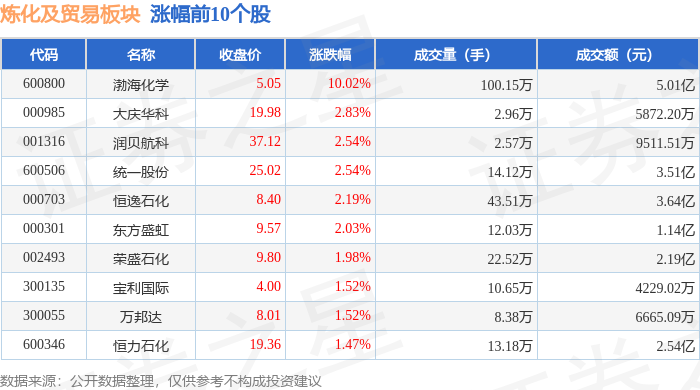
炼化及贸易板块12月5日跌0.64%,和顺石油领跌,主力资金净流出1.97亿元
Zheng Xing Xing Ye Ri Bao· 2025-12-05 09:13
证券之星消息,12月5日炼化及贸易板块较上一交易日下跌0.64%,和顺石油领跌。当日上证指数报收于 3902.81,上涨0.7%。深证成指报收于13147.68,上涨1.08%。炼化及贸易板块个股涨跌见下表: | 代码 | 名称 | 收盘价 | 涨跌幅 | 成交量(手) | 成交额(元) | | | --- | --- | --- | --- | --- | --- | --- | | 600800 | 渤海化学 | 5.05 | 10.02% | 100.15万 | | 5.01亿 | | 000985 | 大庆华科 | 19.98 | 2.83% | 2.96万 | 5872.20万 | | | 001316 | 润贝航科 | 37.12 | 2.54% | 2.57万 | 9511.51万 | | | 600506 | 统一股份 | 25.02 | 2.54% | 14.12万 | | 3.51亿 | | 000703 | 恒逸石化 | 8.40 | 2.19% | 43.51万 | | 3.64亿 | | 000301 | 东方盛虹 | 9.57 | 2.03% | 12.03万 | | 1.14亿 ...


能源ETF广发(159945)开盘跌0.34%,重仓股中国神华跌0.36%,中国石油跌0.30%
Xin Lang Cai Jing· 2025-12-05 01:35
Core Viewpoint - The Energy ETF Guangfa (159945) opened at a decline of 0.34%, indicating a slight downturn in the energy sector on December 5th [1] Group 1: ETF Performance - The Energy ETF Guangfa (159945) opened at 1.187 yuan [1] - Since its establishment on June 25, 2015, the fund has achieved a return of 19.05% [1] - The fund's performance over the past month has seen a decline of 0.68% [1] Group 2: Major Holdings - Major stocks within the Energy ETF include: - China Shenhua: down 0.36% - China Petroleum: down 0.30% - Shaanxi Coal and Chemical Industry: up 0.44% - China Petroleum & Chemical Corporation: unchanged - China National Offshore Oil Corporation: up 0.21% - Jereh Oilfield Services: up 0.46% - Yanzhou Coal Mining: down 0.14% - Guanghui Energy: unchanged - China Coal Energy: down 0.36% - Shanxi Coking Coal: up 0.30% [1]
解密主力资金出逃股 连续5日净流出621股
Zheng Quan Shi Bao Wang· 2025-12-04 09:37
Group 1 - As of December 4, a total of 621 stocks in the Shanghai and Shenzhen markets have experienced a net outflow of main funds for five consecutive days or more [1][2] - WanTai Biologics has the longest streak of net outflow, with 27 consecutive days, followed by Zhongyou Capital with 26 days [1] - BlueFocus Media has the largest total net outflow amount, with 4.874 billion yuan over eight days, followed by Shanghai Electric with 3.172 billion yuan over 11 days [1] Group 2 - The stock with the highest percentage of net outflow relative to trading volume is Guanghui Energy, which has seen a 1.19% decline over the past seven days [1] - The table lists various companies with their respective net outflow days, amounts, percentages, and cumulative price changes, indicating a trend of declining stock prices among those with significant net outflows [1][2][3] - Notable companies with substantial net outflows include Longi Green Energy, Zhongyou Capital, and Guanghui Energy, all showing negative cumulative price changes [1][2]




