
JAC(600418)

Search documents
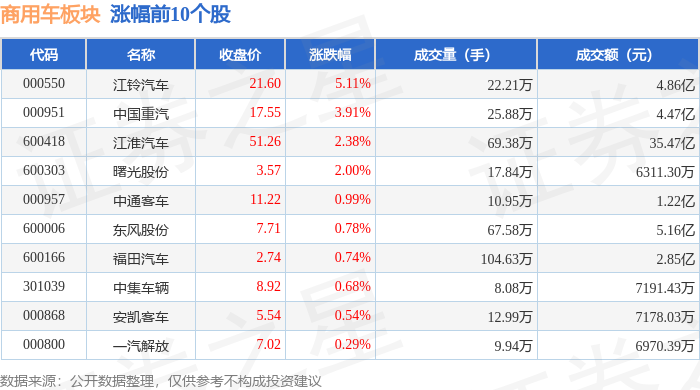
商用车板块9月24日跌0.25%,汉马科技领跌,主力资金净流入1.95亿元
Zheng Xing Xing Ye Ri Bao· 2025-09-24 08:39
Market Overview - The commercial vehicle sector experienced a decline of 0.25% on September 24, with Hanma Technology leading the drop [1] - The Shanghai Composite Index closed at 3853.64, up 0.83%, while the Shenzhen Component Index closed at 13356.14, up 1.8% [1] Individual Stock Performance - Jiangling Motors saw a closing price of 21.60, with a rise of 5.11% and a trading volume of 222,100 shares, totaling a transaction value of 486 million [1] - China National Heavy Duty Truck Corporation closed at 17.55, up 3.91%, with a trading volume of 258,800 shares and a transaction value of 447 million [1] - JAC Motors closed at 51.26, increasing by 2.38%, with a trading volume of 693,800 shares and a transaction value of 3.547 billion [1] - Hanma Technology closed at 7.99, down 4.43%, with a trading volume of 1,231,500 shares and a transaction value of 999.7 million [2] Capital Flow Analysis - The commercial vehicle sector saw a net inflow of 195 million from institutional investors, while retail investors experienced a net outflow of 77.42 million [2][3] - Major stocks like JAC Motors had a net inflow of 278 million from institutional investors, while it faced a net outflow of 160 million from retail investors [3] - China National Heavy Duty Truck Corporation had a net inflow of 23.18 million from institutional investors, with retail investors showing a net outflow of 944,800 [3]


江淮险胜东风 重汽/庆铃晋级 8月轻卡影响力榜单来了 | 头条
第一商用车网· 2025-09-24 06:50
Core Viewpoint - The "Light Truck First Influence Index" in August 2025 shows a significant decline in scores compared to both the previous month and the same month last year, indicating a downward trend in market influence among major light truck brands in China [1]. Group 1: Influence Index Scores - The total score for the "Light Truck First Influence Index" in August 2025 was 1309, a decrease of 21.8% from July 2025's score of 1674 and a 27.8% decline from August 2024's score of 1812 [1]. - The average weekly score for August indicates a consistent decline compared to both the previous month and the same month last year [1]. Group 2: Brand Rankings - The top three brands in the August 2025 "Light Truck First Influence Index" were: 1. Jianghuai 1 Card with a score of 256 2. Dongfeng Light Truck with a score of 254 3. FAW Jiefang Light Truck with a score of 212 [3][12]. - Other notable brands included China National Heavy Duty Truck HOWO at fourth with 156 points, and Foton Aoling at fifth with 123 points [3][12]. Group 3: Market Activities - Despite being a traditionally slow season, light truck sales continued to grow in August 2025, with various brands actively engaging in marketing activities [4]. - Jianghuai delivered a record 2470 units of 4.2-meter new energy box trucks to KuaYue Express, marking a significant collaboration in green logistics [5]. - Dongfeng Light Truck launched a series of promotional events, including a large-scale tour and product showcases, enhancing brand visibility [9][14]. Group 4: Brand Innovations and Collaborations - Jianghuai 1 Card held multiple solution release events across ten cities, focusing on innovative transport solutions for various market segments [13]. - China National Heavy Duty Truck HOWO promoted its new energy models and organized a fuel efficiency competition to engage customers [16]. - Qingling Light Truck signed a strategic cooperation agreement for its new electric refrigerated trucks, enhancing its position in the cold chain logistics market [18].



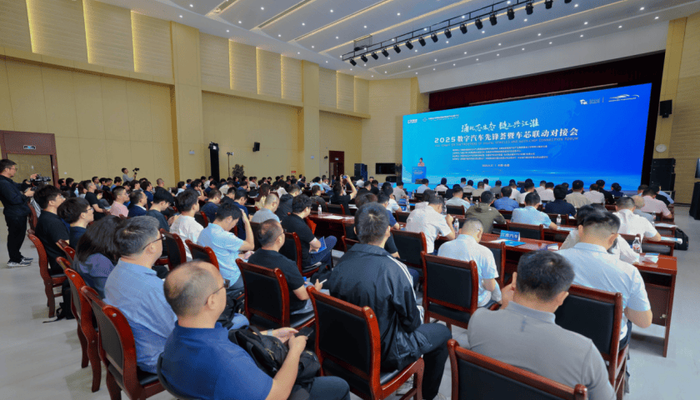
凝“芯”聚“汽”,数字汽车先锋荟暨车芯联动对接会成功在安徽省汽车办举行!
Xin Lang Cai Jing· 2025-09-24 01:46
Core Insights - The automotive chip is considered the "heart" of the intelligent connected new energy vehicle industry, and its localization process is crucial for the security of the supply chain [2][3] - The event held on September 22 aimed to promote collaborative innovation in automotive chips and build an ecosystem for the industry, attracting nearly 200 representatives from various sectors [2][3] Industry Overview - The shift towards electrification and intelligence in vehicles has significantly increased the number of chips used in smart connected new energy vehicles, making chips a new core of the industry [3] - The localization rate of automotive chips in China has risen from less than 3% five years ago to over 20% currently [3] Regional Development - Anhui Province has become a leader in automotive and new energy vehicle production, with outputs of 2.06 million and 1.02 million vehicles respectively from January to August this year [3] - The province aims to accelerate the construction of a "strong intelligent vehicle province" by incorporating smart automotive chip technology into its automotive industry planning [3] Event Highlights - The event facilitated over a hundred negotiations and established several cooperation intentions among automotive chip companies, Tier 1 suppliers, and financial institutions [2][14] - The collaborative model emphasized the role of Jianghuai Automobile Group in leading the supply chain and connecting nearly 40 quality chip companies for precise negotiations [5][10] Technological Trends - The automotive chip industry in China is entering a rapid development phase, with a focus on collaborative innovation to enhance the quality of the automotive industry [5][15] - Future trends in automotive chips include the rise of RISC-V architecture and a shift towards integrated development between chip design and vehicle development [15][17] Strategic Initiatives - The Anhui Provincial Automotive Innovation Center is tasked with matching supply and demand for chips, accelerating the application of cutting-edge technologies, and addressing common challenges in the industry [14][17] - The center aims to build a deep integration mechanism among government, industry, academia, finance, and services to strengthen the automotive chip ecosystem in Anhui [17]
丰茂股份(301459):携手江淮拓展液冷管路业务,“汽车+数据中心”液冷协同发展
Xinda Securities· 2025-09-23 12:01
Investment Rating - The investment rating for Fengmao Co., Ltd. (301459) is not explicitly stated in the provided documents, but the analysis suggests a positive outlook based on strategic partnerships and growth projections [1]. Core Insights - The strategic partnership with Jianghuai Automobile aims to enhance product offerings in fluid pipeline solutions, leveraging Fengmao's R&D capabilities and Jianghuai's expertise in metal processing and lightweight materials [2]. - The collaboration is expected to establish a robust supply chain for high-end passenger vehicles, enhancing market penetration and customer resource access [2]. - The dual focus on automotive and data center liquid cooling markets is anticipated to drive growth, with significant opportunities arising from applying proven technologies in new sectors [2]. - Revenue projections for Fengmao Co., Ltd. are estimated at 1.09 billion, 1.47 billion, and 1.79 billion yuan for 2025, 2026, and 2027 respectively, with net profits expected to reach 186 million, 260 million, and 317 million yuan in the same years [3]. Financial Summary - Total revenue for 2023 is reported at 802 million yuan, with a year-on-year growth rate of 31.8%. Projections indicate continued growth with 949 million yuan in 2024 and 1.09 billion yuan in 2025 [3]. - The net profit attributable to the parent company for 2023 is 138 million yuan, with a growth rate of 35.1%, and is expected to grow to 186 million yuan in 2025 [3]. - The gross margin is projected to remain stable around 30% over the forecast period, indicating consistent profitability [3]. - Earnings per share (EPS) are forecasted to increase from 1.33 yuan in 2023 to 3.05 yuan by 2027, reflecting strong earnings growth [3].
主力动向:9月23日特大单净流出624.76亿元
Zheng Quan Shi Bao Wang· 2025-09-23 10:02
Market Overview - The total net outflow of large orders in the two markets reached 62.476 billion yuan, with 1,304 stocks experiencing net inflows and 3,525 stocks facing net outflows [1] - The Shanghai Composite Index closed down by 0.18% [1] Industry Performance - Only three industries saw net inflows from large orders: banking (1.039 billion yuan), construction decoration (650 million yuan), and coal (151 million yuan) [1] - The electronics industry had the highest net outflow of large orders, totaling 16.175 billion yuan, followed by the computer industry with 11.571 billion yuan [1] Company Highlights - 26 stocks had net inflows exceeding 200 million yuan, with沃尔核材 leading at 1.186 billion yuan, followed by上海建工 at 1.127 billion yuan [1][2] - Stocks with significant net outflows included江淮汽车 with a net outflow of 2.121 billion yuan,山子高科 with 1.818 billion yuan, and东方财富 with 1.793 billion yuan [1][4] Stock Performance - Stocks with net inflows over 200 million yuan saw an average increase of 6.99%, outperforming the Shanghai Composite Index [2] - Notable performers included长川科技 and沃尔核材, which closed at their daily limit [2] Detailed Stock Data - Top stocks by net inflow: - 沃尔核材: 11.86 billion yuan, 10.00% increase [2] - 上海建工: 11.27 billion yuan, 7.69% increase [2] - 长川科技: 7.70 billion yuan, 20.00% increase [2] - Top stocks by net outflow: - 江淮汽车: -2.121 billion yuan, -4.28% decrease [4] - 山子高科: -1.818 billion yuan, -0.47% decrease [4] - 东方财富: -1.793 billion yuan, -2.86% decrease [4]




江淮汽车股价跌5.01%,弘毅远方基金旗下1只基金重仓,持有5.8万股浮亏损失15.2万元
Xin Lang Cai Jing· 2025-09-23 06:01
Group 1 - Jianghuai Automobile's stock price fell by 5.01% on September 23, closing at 49.69 yuan per share, with a trading volume of 3.898 billion yuan and a turnover rate of 3.50%, resulting in a total market capitalization of 108.523 billion yuan [1] - The stock has experienced a continuous decline over three days, with a cumulative drop of 9.44% during this period [1] - Jianghuai Automobile, established on September 30, 1999, and listed on August 24, 2001, is primarily engaged in the research, production, sales, and service of commercial vehicles, passenger vehicles, automotive chassis, and core automotive components [1] Group 2 - The Hongyi Yuanfang Fund holds a significant position in Jianghuai Automobile, with its fund "Hongyi Yuanfang Automotive Industry Upgrade Mixed A" (015527) owning 58,000 shares, accounting for 3.06% of the fund's net value, ranking as the tenth largest holding [2] - The fund has incurred a floating loss of approximately 152,000 yuan today, with a total floating loss of 316,100 yuan during the three-day decline [2] - The fund was established on December 16, 2022, with a current scale of 27.037 million yuan, achieving a year-to-date return of 58% and a one-year return of 92.25% [2]
江淮汽车(600418):夯实商乘基本盘,尊界切入智能豪华赛道
Changjiang Securities· 2025-09-23 01:05
Investment Rating - The report gives a "Buy" rating for the company [11][13]. Core Views - The company is a well-established domestic automaker leveraging state-owned assets for diversified development. The dual-track resilience of commercial and passenger vehicles solidifies growth foundations, while the collaboration with Huawei enables entry into the ultra-luxury intelligent vehicle segment [5][10]. Summary by Sections Company Overview - Jianghuai Automobile, established in 1964, is a comprehensive automotive enterprise integrating research, production, sales, and service across commercial and passenger vehicles. The company is controlled by the Anhui Provincial State-owned Assets Supervision and Administration Commission, with Volkswagen also holding shares through a joint venture [8][23][25]. Financial Performance - In 2024, the company reported revenue of 42.116 billion yuan, a year-on-year decline of 6.28%. The commercial vehicle segment accounted for over 50% of total revenue. The net profit attributable to shareholders was -2.741 billion yuan, a 60% decrease year-on-year, primarily due to losses from the Volkswagen Anhui joint venture and asset impairments [8][29][31]. Commercial Vehicle Segment - The commercial vehicle sector has a diversified layout centered around the Jianghuai 1 card, with light trucks maintaining a leading position in exports. In 2024, the export volume reached 36,000 units, marking 14 consecutive years at the top of the industry. The passenger vehicle segment has undergone brand integration and model simplification, focusing on three main brands: Jianghuai, Ruifeng, and Yi [9][42]. Ultra-Luxury Intelligent Vehicle Segment - The ultra-luxury vehicle market, priced above 600,000 yuan, is stable, with 464,000 units sold in 2024. The report highlights the significant growth of domestic brands, with a compound annual growth rate of approximately 187% from 2020 to 2024. The collaboration with Huawei has led to the launch of the Zun Jie S800, a high-end intelligent luxury sedan, which has shown strong market potential [10][11][75]. Future Profit Projections - The company is expected to achieve net profits attributable to shareholders of 3.97 billion yuan, 3.807 billion yuan, and 7.479 billion yuan for the years 2025, 2026, and 2027, respectively. The current market valuation corresponds to price-to-earnings ratios of 288.07, 30.01, and 15.28 times for the same years [5][11].
2025世界制造业大会新能源汽车产业集群建设对接会召开 多个研发及产业化项目签约
Zheng Quan Shi Bao Wang· 2025-09-22 11:29
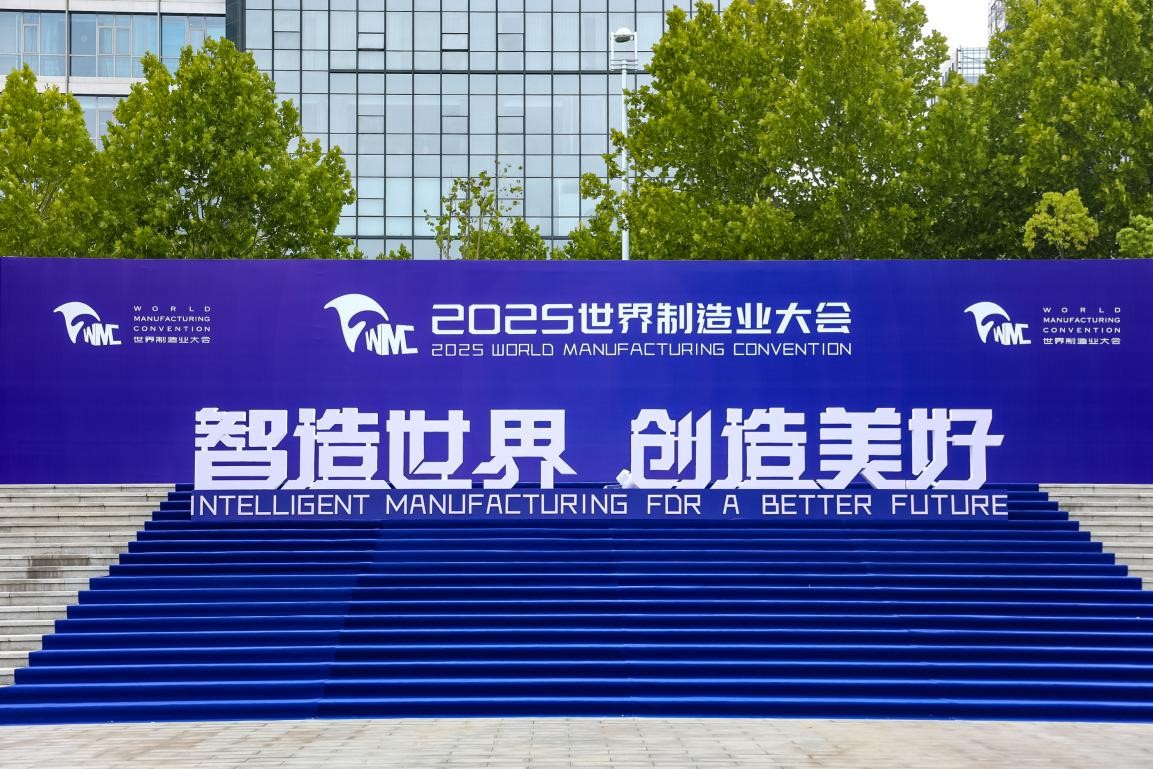
Group 1 - The 2025 World Manufacturing Conference focused on the construction of a new energy vehicle (NEV) industry cluster, with multiple innovative companies presenting projects and signing agreements [1] - One of the signed projects is the "Next Generation Autonomous and Controllable NEV Platform R&D and Industrialization Project," led by the Anhui Automotive Innovation Center in collaboration with several universities and Jianghuai Automobile [1] - This project aims to establish a comprehensive autonomous and controllable NEV platform technology architecture, enhancing R&D efficiency, optimizing supply chain costs, and accelerating model iteration through eight new concepts [1] Group 2 - Another signed project is the "RISC-V Instruction Set Architecture-based Automotive-grade Chip R&D and Industrialization Project," led by Aoyikes, in partnership with the Anhui Automotive Innovation Center and others [1] - This project addresses critical issues in the RISC-V automotive-grade MCU chip sector, aiming to build a competitive and autonomous RISC-V chip industry chain and supply chain, promoting high-quality development of China's automotive chip industry [1] - The Anhui province's automotive industry is rapidly advancing, producing 10% of the country's automobiles and 11% of NEVs, with the highest production and export volumes in the first half of the year [2]
江淮汽车闪耀2025世界制造业大会
Jing Ji Wang· 2025-09-22 10:37
Core Viewpoint - The 2025 World Manufacturing Conference in Hefei, Anhui, showcased China's manufacturing achievements, with Jianghuai Automobile prominently participating by presenting its luxury electric vehicle, the Zun Jie S800, and the hybrid MPV, Rui Feng RF8, highlighting advancements in smart manufacturing, green travel, and industry chain collaboration [1][12] Group 1: Jianghuai Automobile's Innovations - The Zun Jie S800, developed in collaboration with Huawei, is produced at the Zun Jie Super Factory, which is the first 5G full-link automotive manufacturing base in Anhui, utilizing over 1800 intelligent robots for fully automated and digital production [3][4] - The factory has been recognized as a national-level intelligent manufacturing benchmark enterprise, establishing a new standard for high-end automotive smart manufacturing in China [4] - The Zun Jie S800 features advanced technologies such as the HUAWEI ADS 4.0 driver assistance system and an 800V high-voltage architecture, redefining luxury standards in safety, comfort, and performance [4][6] Group 2: Market Performance and Industry Collaboration - Since its launch, the Zun Jie S800 has garnered significant attention, achieving over 14,000 pre-orders within 109 days, marking a breakthrough for Chinese brands in the ultra-luxury smart electric vehicle sector [6] - Jianghuai Automobile has formed a "Quality Alliance" with 235 top global supply chain partners, with 93 located in Anhui, enhancing the development of smart connectivity and precision manufacturing [6][10] - The company aims to empower the entire industry chain through product innovation, contributing to high-quality regional economic development and the transformation of the automotive industry [6][12] Group 3: Rui Feng RF8 and Service Excellence - The Rui Feng RF8, a plug-in hybrid MPV, was showcased as the official vehicle for the conference, emphasizing its spacious design and advanced features, including a 1.5TGDI + 3DHT hybrid system with a total range of 1250 km [8][10] - Jianghuai Automobile has provided over 300 vehicles for the World Manufacturing Conference since its inception in 2018, achieving a goal of "zero accidents, zero errors" in service quality [10] - The company continues to be recognized for its product and service capabilities, reinforcing its role as a trusted partner in the global manufacturing service sector [10][12]
江淮汽车(600418) - 江淮汽车八届二十九次董事会决议公告
2025-09-22 09:45
证券代码:600418 证券简称:江淮汽车 公告编号:2025-040 安徽江淮汽车集团股份有限公司 八届二十九次董事会决议公告 (一)审议通过《关于制定〈安徽江淮汽车集团股份有限公司高级管理人 员聘任和管理制度〉的议案》 表决结果:11 票同意,0 票反对,0 票弃权。 (二)审议通过《关于修改部分董事会专门委员会工作细则的议案》 表决结果:11 票同意,0 票反对,0 票弃权。 特此公告。 安徽江淮汽车集团股份有限公司 本公司董事会及全体董事保证本公告内容不存在任何虚假记载、误导性陈述 或者重大遗漏,并对其内容的真实性、准确性和完整性承担法律责任。 一、董事会会议召开情况 安徽江淮汽车集团股份有限公司(以下简称"公司"或"江淮汽车")八届 二十九次董事会会议于 2025 年 9 月 22 日以通讯方式召开。会议的召开符合《公 司法》和《公司章程》的规定。本次会议应出席董事 11 人,实际出席会议董事 11 人。 二、董事会会议审议情况 与会董事以记名投票的方式审议以下议案并形成决议如下: 董事会 2025 年 9 月 23 日 ...