TONGWEI CO.,LTD(600438)

Search documents
光伏行业供给侧改革有望深化,光伏龙头ETF(159609)盘中交投活跃,配置机遇备受关注
Xin Lang Cai Jing· 2025-07-04 06:26
Group 1 - The China Securities Photovoltaic Industry Index (931151) decreased by 0.70% as of July 4, 2025, with mixed performance among constituent stocks [1] - Leading stocks included Lin Yang Energy (601222) up 4.55%, Daqo New Energy (688303) up 3.58%, and Kehua Data (002335) up 2.35%, while Jinlang Technology (300763) led the decline at 3.67% [1] - The Photovoltaic Leaders ETF (159609) saw an active trading session with a turnover of 7.55% and a transaction volume of 20.52 million yuan, reflecting a vibrant market [1] Group 2 - The article emphasizes the need to break away from "involution" competition to achieve high-quality development, advocating for market-oriented reforms and the elimination of local protectionism [1] - The report highlights the importance of institutional guidance for healthy competition and acknowledges the role of industry associations and corporate self-discipline [1] - Current efforts by GCL-Poly Energy and Tongwei Co. to promote capacity consolidation in the polysilicon industry align with policy directions and are expected to receive support [1] Group 3 - The Photovoltaic Leaders ETF closely tracks the China Securities Photovoltaic Industry Index, which selects up to 50 representative listed companies in the photovoltaic industry chain [2] - The index's valuation is at a historical low, with a latest price-to-book ratio (PB) of 1.8, indicating significant value [2] - As of June 30, 2025, the top ten weighted stocks in the index accounted for 55.39%, including companies like Sungrow Power Supply (300274) and LONGi Green Energy (601012) [2]

政策重拳治理无序竞争,光伏产业链价格承压,供给侧改革成反转关键
Di Yi Cai Jing· 2025-07-04 05:38
Group 1 - The current pace of industry clearing is significantly lagging, with chaotic competition and inefficient capacity difficult to exit, indicating that the complexity of the industry far exceeds market economic rules [1][2] - The Ministry of Industry and Information Technology (MIIT) has initiated measures to address low-price disorder in the photovoltaic industry, emphasizing legal compliance and guiding companies to enhance product quality [2] - Despite rising expectations for production cuts, prices across the photovoltaic industry chain continue to be under pressure due to weak demand following the end of the installation rush, with silicon wafer prices down approximately 20% and silicon material prices down 16% compared to late February [2][3] Group 2 - Global new installed capacity is expected to reach 520 GW in 2025, with a year-on-year growth rate declining to -5%, indicating a downward trend in growth [3] - In the domestic market, the implementation of the "136 Document" in 2025 is anticipated to further slow down the overall installed capacity growth, with projections of approximately 240-250 GW of new installations, reflecting a year-on-year decline of about 10% [3] - The price of silicon materials has stabilized recently, driven by unclear recovery expectations and policy implementation, although the market remains cautious due to inventory and weak demand [3][4] Group 3 - Silicon wafers are influenced by both upstream silicon material supply and downstream demand, with recent collective price support actions from silicon material manufacturers potentially providing support for silicon wafer prices [4] - N-type battery prices have declined, with average prices for various types falling below cash costs, indicating a pessimistic outlook for future price trends [4] - Component prices are currently stable, with future performance dependent on whether upstream segments can maintain price levels [4] Group 4 - Goldman Sachs predicts that the turning point for photovoltaic capacity may occur in the second half of 2026, with high-cost capacity expected to exit on a large scale starting in 2025 [5] - The average cash profit margin for the photovoltaic industry is projected to reach a turning point by the end of 2025, based on three main factors: the need for capacity exit to undergo 2-3 years of financial loss testing, the time lag between demand growth and capacity digestion, and slow adjustments in technology, policy, and trade environments [5]


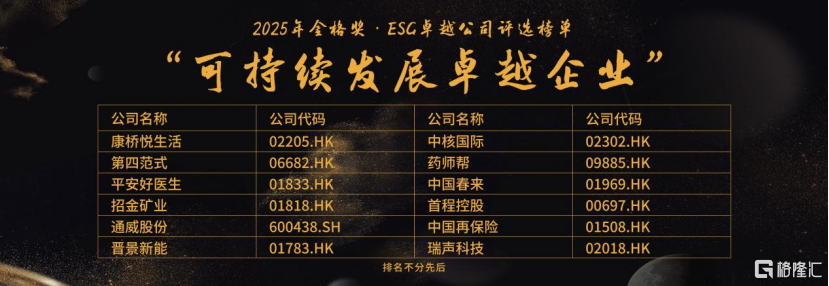
格隆汇中期策略峰会2025之“格隆汇金格奖”——“ESG可持续发展卓越企业”奖项揭晓:第四范式(06682.HK)、晋景新能(01783.HK)、康桥悦生活(02205.HK)等12家企业上榜
Ge Long Hui· 2025-07-04 05:22
Core Viewpoint - The "Gelonghui Golden Award" ESG Excellence Company selection recognizes companies that excel in environmental, social, and governance dimensions, contributing to China's dual carbon goals and setting benchmarks for long-term value in the capital market [1][2]. Group 1: Award Winners - Twelve companies were awarded the "ESG Sustainable Development Excellence Enterprise" title, including Fourth Paradigm (06682.HK), JinJing New Energy (01783.HK), Kangqiao Yuelife (02205.HK), Ping An Good Doctor (01833.HK), AAC Technologies (02018.HK), Shoucheng Holdings (00697.HK), Tongwei Co., Ltd. (600438.SH), Yaoshi Bang (09885.HK), Zhaojin Mining (01818.HK), China Chunlai (01969.HK), China Reinsurance (01508.HK), and China Nuclear International (02302.HK) [1]. - The ranking of the awarded companies is in alphabetical order and does not indicate any specific order of merit [1]. Group 2: Evaluation Criteria - The selection process involved quantitative data analysis and evaluation by an expert panel to determine the final results [1]. - The award aims to highlight companies that actively promote green transformation and social responsibility through transparent governance [1]. Group 3: Scope of the Selection - The ESG Excellence Company selection covers all listed companies on the Hong Kong Stock Exchange, Shanghai Stock Exchange, Shenzhen Stock Exchange, New York Stock Exchange, American Stock Exchange, and NASDAQ [2]. - The initiative is designed to create a reference value ranking of outstanding companies in the ESG field within the investment community [2].

高盛:中国光伏玻璃及多晶硅-股价因对供给侧政策预期过度反应上涨
Goldman Sachs· 2025-07-04 03:04
Investment Ratings - The report maintains a "Sell" rating on Flat A/H, Xinyi Solar, and Tongwei, while it has a "Buy" rating on Longi [10][11][19]. Core Insights - The recent rally in share prices for Solar Glass and Poly is seen as an overreaction to supply-side policy expectations, with a noted average increase of 17% from June 30 to July 2 [1][2]. - There is an anticipated decline in demand for solar modules, with projections indicating a year-over-year decrease of 57% in China and 40% globally for the second half of 2025 [2]. - The report highlights the need for significant production cuts in the glass segment to balance supply and demand, estimating that a 30% cut is necessary given the current oversupply situation [5][6]. Summary by Key Sub-segments Poly - Poly inventory reached 140GW by the end of June, equating to four months of average demand, indicating significant oversupply [5]. - The report anticipates a 15% decline in poly prices in the second half of 2025 to 2026, driven by excess capacity [20]. Glass - A 30% production cut is deemed necessary to align supply with demand, with current monthly supply at 50GW against an average demand of 34GW [6]. - The report suggests that the industry may face prolonged margin pressure due to challenges in executing production cuts [6]. Module - Increased inventory pressure is expected to enhance the bargaining power of module manufacturers, leading to price discounts of 5%-10% on contracts for Poly and Glass [6]. - Longi is expected to maintain a relatively resilient profitability outlook due to anticipated upstream price cuts [7]. Company-Specific Insights Longi - Longi is rated "Buy" due to its potential EBITDA inflection in the second half of 2025 and superior mid-cycle return on equity (ROE) compared to peers [7][10]. - The 12-month target price for Longi is set at Rmb19.8, indicating a potential upside of 27.2% from the current price [10]. Xinyi Solar - Xinyi Solar is rated "Sell" due to a deteriorating industry landscape and structural margin pressures, with a target price of HK$1.9, reflecting a downside of 31.2% [11][12]. Flat A/H - Flat A/H is also rated "Sell," with a target price of Rmb10.3, indicating a downside of 39.1% [15][16]. Tongwei - Tongwei is rated "Sell" due to its high exposure to the Poly segment and anticipated structural margin pressures, with a target price of Rmb13, suggesting a downside of 27% [19][23].

工业硅:情绪发酵,盘面波动放大,多晶硅:市场消息发酵,盘面波动加剧
Guo Tai Jun An Qi Huo· 2025-07-04 01:31
2025 年 07 月 04 日 工业硅:情绪发酵,盘面波动放大 多晶硅:市场消息发酵,盘面波动加剧 张 航 投资咨询从业资格号:Z0018008 zhanghang2@gtht.com 【基本面跟踪】 工业硅、多晶硅基本面数据 | | | 指标名称 | T | T-1 | T-5 | T-22 | | --- | --- | --- | --- | --- | --- | --- | | | | Si2509收盘价(元/吨) Si2509成交量(手) | 8,010 | -200 | 290 | 940 | | | | | 1,196,542 -447,106 | | 108,921 | 810,987 | | | | Si2509持仓量(手) | 380,840 | -5,521 | 59,498 | 180,647 | | 工业硅、多晶硅期货市场 | | PS2508收盘价(元/吨) | 35,050 | 0 | 3,335 | - | | | | PS2508成交量(手) | 482,063 | 70,477 | 257,028 | - | | | | PS2508持仓量(手) | 76,908 | ...
负债超30000亿!工信部, 光伏再发声
DT新材料· 2025-07-03 13:38
Group 1 - The article discusses the current market development status of hydrogen production technologies, specifically ALK/PEM/AEM, and highlights innovations in key materials and hydrogen production system technologies [1][11] - It emphasizes the importance of technological innovation and international cooperation in the photovoltaic industry to achieve sustainable development [2] - The total liabilities of photovoltaic companies reached approximately 2 trillion yuan, with an overall debt-to-asset ratio of 63.24%, indicating a year-on-year increase of 2.65 percentage points [2] Group 2 - A ranking of photovoltaic companies by total liabilities shows that the top three companies have liabilities exceeding 1 billion yuan, with significant year-on-year growth in some cases, such as Tongwei Co., which saw a 41.78% increase [3][4] - The article provides a detailed list of companies with their total liabilities and year-on-year growth rates, highlighting the financial health of the industry [3][4] - The article also includes a ranking of companies by debt-to-asset ratio, with some companies showing extremely high ratios, indicating potential financial risks [7][8] Group 3 - The upcoming "2025 Renewable Energy Hydrogen Production Industry Development Forum" will focus on key materials and system technologies, discussing trends in green hydrogen project applications [11][12] - The forum will feature various sessions on the current status and development trends of renewable energy hydrogen production, including discussions on PEM and alkaline hydrogen production technologies [13][15] - Notable speakers from leading institutions and companies will present their research and innovations in hydrogen production technologies, emphasizing the industry's growth potential [29][37]


减产预期催生股价反弹,光伏行业困境反转依赖“铁腕”出清
第一财经网· 2025-07-03 11:09
Group 1 - Supply-side changes are crucial for the photovoltaic industry's capacity clearance, and supply clearance is a decisive factor for the industry to recover in the second half of the year [1] - The photovoltaic sector has seen a collective rise in stock prices, with companies like Tongwei Co., Ltd. and Shuangliang Eco-Energy hitting the daily limit on July 2 [1][4] - The cash flow of silicon material manufacturers is under pressure due to continuous losses, with the average asset-liability ratio of photovoltaic companies rising [1][4] Group 2 - Silicon material prices have shown a slight recovery due to stable supply and demand, while silicon wafer prices have declined due to weak terminal demand [2][3] - The average transaction price of multi-crystalline silicon N-type raw materials increased by 0.87% to 34,700 yuan/ton, while N-type granular silicon remained at 33,500 yuan/ton [2] - The production of multi-crystalline silicon in June was approximately 102,000 tons, with a significant year-on-year decrease of 44.1% in the first half of the year [3] Group 3 - The reduction in production capacity is essential for reversing the current difficulties in the multi-crystalline silicon industry [4][5] - The asset-liability ratio of many photovoltaic companies has exceeded 70%, indicating significant financial pressure [4][5] - Companies like Tongwei and Daqo Energy have indicated that the supply-demand imbalance is unlikely to change in the short term, with silicon material prices expected to remain low [5] Group 4 - The global nominal capacity of multi-crystalline silicon is projected to reach approximately 3.04 million tons by May 2025, with domestic capacity accounting for about 97% [6] - The photovoltaic industry's supply-side adjustments are expected to deepen, with the multi-crystalline silicon sector likely to be one of the first to complete adjustments [6]

通威股份(600438) - 通威股份有限公司关于“通22转债”预计满足转股价格修正条件的提示性公告
2025-07-03 11:02
| 股票代码:600438 | 股票简称:通威股份 | | | 公告编号:2025-064 | | --- | --- | --- | --- | --- | | 债券代码:110085 | 债券简称:通 | 22 | 转债 | | 通威股份有限公司关于 "通 22 转债"预计满足转股价格修正条件的提示性公告 本公司董事会及全体董事保证本公告内容不存在任何虚假记载、误导性陈 述或者重大遗漏,并对其内容的真实性、准确性和完整性承担法律责任。 一、"通 22 转债"发行上市概况 经中国证券监督管理委员会证监许可[2021]4028 号文核准,公司于 2022 年 2 月 24 日公开发行了 12,000 万张可转换公司债券,每张面值 100 元,共计 120 亿元。本次可转债期限 6 年,自 2022 年 2 月 24 日起至 2028 年 2 月 23 日止, 票面利率为第一年 0.20%、第二年 0.40%、第三年 0.60%、第四年 1.50%、第 五年 1.80%、第六年 2.00%。 经上海证券交易所自律监管决定书[2022]61 号文同意,公司本次发行的 1,200,000.00 万元可转换公司债券于 ...
通威股份(600438):子公司永祥股份增资扩股完成 硅料报价上涨
Xin Lang Cai Jing· 2025-07-03 04:27
公司近况 7 月2 日,公司公告子公司永祥股份引入战略投资者进展暨实施增资扩股完成。公司与11 家战略投资者 就增资扩股事宜签署相关协议,收到本次战略投资者股权增资款合计约49.16 亿元人民币,并于近日完 成永祥股份的工商变更登记手续。 评论 硅料行业报价上涨,中期供给侧改革可期。根据硅业分会本周数据,N型复投料成交价格区间为3.40- 3.80 万元/吨,成交均价3.47 万元/吨,环比小幅回升0.87%;N型颗粒硅成交价格区间为3.30-3.40 万元/ 吨,成交均价维持在3.35 万元/吨。我们认为硅料报价上涨主要由于:1)近期硅料产量相对稳定,行业 累库压力有限;2)国家相关部门多措并举,持续释放供给侧改革利好信号。我们认为当前光伏板块底 部明确,走出本轮底部周期的关键在于解决供给大于需求的矛盾,而光伏行业经过超过一年经营性亏 损,单纯市场化出清存在一定难度,政策端供给侧改革是最直接有效的方法。考虑硅料环节供需矛盾相 对深、成本曲线相对陡峭、且位于光伏主产业链最上游,因此我们认为硅料环节的供给侧改革对于产业 链供需和盈利修复影响更大。考虑通威股份为硅料行业产能/销量市占第一,成本位于西门子法硅料成 ...
★上市公司多措并举开辟差异化发展路径
Zhong Guo Zheng Quan Bao· 2025-07-03 01:56
在当下中国经济新旧动能转换的关键时期,产业格局正经历深刻变革,新产业蓬勃兴起,传统产业加速 升级。然而,"内卷式"竞争这一顽疾却在部分行业悄然滋生。部分光伏、储能等领域企业为争夺市场份 额,不惜低价倾销,扰乱市场秩序。 多位受访的业内人士对中国证券报记者表示,"内卷式"竞争的深层次原因主要是技术创新不足、专利保 护缺失、市场信号不清等。面对这一困境,国家发改委、国家市场监管总局等多部门密集出台整治举 措,力求斩断"内卷"枷锁。与此同时,业内头部企业纷纷探索破局之道,以模式创新、技术革新及强化 专利保护为利刃,在激烈竞争中开辟差异化发展路径,引领行业从"价格内卷"向"价值创造"转型。 以模式创新走差异化之路 在市场供求关系变化的背景下,光伏、储能行业的上市公司逐渐从"供给侧创新"向"需求侧创新"转变, 挖掘贴近市场需求的发展新模式。 "未来靠单独生产组件来'卷'产品,已经不能满足客户的需求,未来光伏产品要从过去的'单一性'向'系 统性'转变,以模式创新实现差异化发展。"天合光能战略、产品与市场负责人张映斌在接受中国证券报 记者采访时表示,随着不同细分场景需求的日渐多元,为客户提供综合解决方案将是光伏行业破除"内 ...