TONGWEI CO.,LTD(600438)

Search documents
硅能源概念下跌1.73%,主力资金净流出39股
Zheng Quan Shi Bao Wang· 2025-09-10 12:04
Market Overview - As of September 10, the silicon energy concept index declined by 1.73%, ranking among the top decliners in the concept sector [1] - Within the sector, major decliners included Daqo New Energy, Kexin Electric, and Runhe Materials, while notable gainers were Huilv Ecology, Fenghuo Electronics, and *ST Xinyuan, which rose by 1.73%, 1.45%, and 1.15% respectively [1] Concept Sector Performance - The top-performing concept sectors included Short Drama Games (+2.61%), Horse Racing Concept (+2.40%), and Football Concept (+2.25%), while the silicon energy sector was among the worst performers [2] - The silicon energy sector experienced a net outflow of 1.85 billion yuan, with 39 stocks seeing net outflows, and 7 stocks with outflows exceeding 50 million yuan [2] Major Stocks in Silicon Energy Sector - Tongwei Co. led the outflows with a net outflow of 600 million yuan, followed by Longi Green Energy with 398 million yuan, and TCL Zhonghuan with 170 million yuan [2] - Other significant outflows included Daqo New Energy (115 million yuan) and TBEA (71 million yuan) [2] Notable Inflows - Stocks with notable net inflows included Huilv Ecology (129 million yuan), Baose Co. (3.7 million yuan), and Fengfan Co. (1.7 million yuan) [2] Detailed Stock Performance - Key stocks in the silicon energy sector showed varied performance, with Tongwei Co. down by 6.00%, Longi Green Energy down by 2.33%, and Daqo New Energy down by 8.05% [3] - Other notable declines included Runhe Materials (-6.07%) and Kexin Electric (-6.74%) [3]




101.05亿元资金今日流出电力设备股
Zheng Quan Shi Bao Wang· 2025-09-10 08:52
Market Overview - The Shanghai Composite Index rose by 0.13% on September 10, with 13 industries experiencing gains, led by the communication and electronics sectors, which increased by 3.49% and 1.78% respectively [1] - The power equipment industry had the largest decline, falling by 1.18% [1] Fund Flow Analysis - The main funds in the two markets experienced a net outflow of 5.62 billion yuan, with 9 industries seeing net inflows [1] - The communication industry had the highest net inflow of funds, totaling 9.07 billion yuan, while the electronics sector followed with a net inflow of 7.51 billion yuan [1] - The power equipment industry led the net outflow, with a total of 10.10 billion yuan, followed by the non-ferrous metals industry with a net outflow of 3.78 billion yuan [1] Power Equipment Industry Performance - Within the power equipment sector, there are 362 stocks, with 94 stocks rising and 263 stocks declining [2] - The top three stocks with the highest net inflow in the power equipment industry were: - XianDao Intelligent (6.93 billion yuan) - Enjie Co., Ltd. (3.76 billion yuan) - DaoShi Technology (3.10 billion yuan) [2] - The stocks with the largest net outflow included: - Ningde Times (-9.27 billion yuan) - Tongwei Co., Ltd. (-6.00 billion yuan) - Wolong Electric Drive (-5.56 billion yuan) [2][3] Power Equipment Industry Stock Performance - The top gainers in the power equipment sector included: - XianDao Intelligent: +4.55% - Enjie Co., Ltd.: +10.00% - DaoShi Technology: +6.87% [2] - The top decliners in the sector included: - Ningde Times: -1.24% - Tongwei Co., Ltd.: -6.00% - Wolong Electric Drive: -2.10% [3]





光伏设备板块9月10日跌2.34%,上能电气领跌,主力资金净流出37.25亿元
Zheng Xing Xing Ye Ri Bao· 2025-09-10 08:38
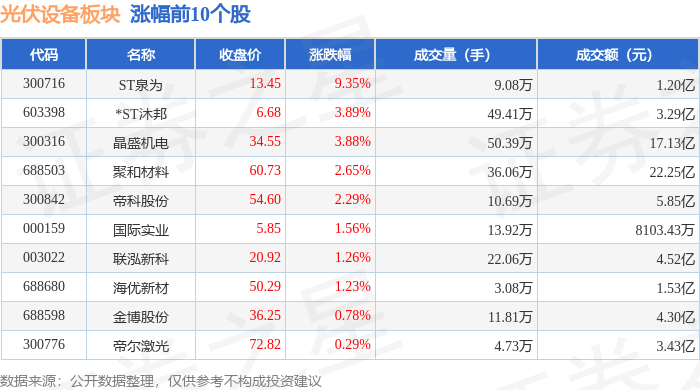
Core Insights - The photovoltaic equipment sector experienced a decline of 2.34% on September 10, with Shangneng Electric leading the drop [1] - The Shanghai Composite Index closed at 3812.22, up 0.13%, while the Shenzhen Component Index closed at 12557.68, up 0.38% [1] Stock Performance - ST Quanwei (300716) saw a significant increase of 9.35%, closing at 13.45 with a trading volume of 90,800 shares and a transaction value of 120 million [1] - Shangneng Electric (300827) led the declines with a drop of 9.93%, closing at 33.30 with a trading volume of 940,000 shares and a transaction value of 319.5 million [2] - Other notable declines included Tongwei Co. (600438) down 6.00% and Jinlang Technology (300763) down 4.43% [2] Capital Flow - The photovoltaic equipment sector saw a net outflow of 3.725 billion in main funds, while retail investors contributed a net inflow of 3.119 billion [2] - The table of capital flow indicates that major funds were predominantly exiting the sector, while retail investors were actively buying [3] Individual Stock Capital Flow - Jing Sheng Mechanical & Electrical (300316) had a net inflow of 1.39 billion from main funds, while retail investors showed a net outflow of 1.23 billion [3] - Haiyou New Materials (688680) experienced a net inflow of 1.615 billion from main funds, but a net outflow of 1.613 billion from retail investors [3]


电力设备新能源2025年9月投资策略:固态电池产业化持续推进,国内储能系统招标高增
Guoxin Securities· 2025-09-10 08:00
Group 1: Solid-State Battery Industry - The solid-state battery industrialization is progressing with support from policies, material advancements, and application developments. Key companies to watch include Xiamen Tungsten, Tianqi Lithium, and others in the supply chain [2][3] - Major developments include the mass production of semi-solid batteries by Zhuhai Guanyu and the upcoming solid-state battery projects by Yiyuan Lithium Energy and others [2] Group 2: Domestic Energy Storage Systems - The domestic energy storage system bidding capacity reached 47.2 GWh in August 2025, reflecting a year-on-year increase of 2158% and a month-on-month increase of 1142%. Cumulative bidding for the year reached 144.1 GWh, up approximately 216% year-on-year [3] - The high demand for energy storage systems indicates a strong need for new power systems in China, laying a foundation for stable market development in 2026-2027. Key companies include Sungrow Power, Yiyuan Lithium Energy, and others [3] Group 3: AIDC Power Equipment Sector - AIDC power equipment companies are expected to benefit from increased capital expenditures, with Alibaba reporting a capital expenditure of 38.7 billion yuan in Q2 2025, up 220% year-on-year [3][32] - The demand for data center construction remains strong, and companies like Jinpan Technology and New Special Electric are positioned to gain from this trend [3][32] Group 4: Power Grid Equipment Sector - Power grid equipment companies are experiencing steady growth, with major firms maintaining robust performance in the first half of 2025. A surge in high-voltage bidding is anticipated in the second half of the year [4][42] - Key companies to focus on include Guodian NARI, Siyi Electric, and others, as they expand their product offerings and international presence [4][42] Group 5: Wind Power Sector - Wind power companies are seeing simultaneous increases in volume and profit, with significant growth in both onshore and offshore projects expected in the latter half of 2025 [4][59] - Companies like Goldwind Technology and Dongfang Cable are recommended for investment as they are well-positioned to benefit from this growth [4][59] Group 6: Investment Recommendations - The report suggests monitoring the recovery of the power grid equipment sector, the progress of offshore wind projects, the advancement of solid-state battery industrialization, and the global demand for energy storage installations [4]



通威股份跌2.03%,成交额3.93亿元,主力资金净流出1246.26万元
Xin Lang Cai Jing· 2025-09-09 02:15
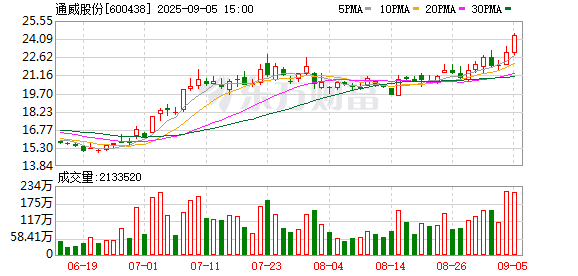
Group 1 - The core viewpoint of the news is that Tongwei Co., Ltd. has experienced fluctuations in stock price and significant changes in financial performance, with a notable decline in revenue and net profit for the first half of 2025 [1][2][3] - As of September 9, Tongwei's stock price was 23.59 yuan per share, with a market capitalization of 106.2 billion yuan, and a year-to-date increase of 6.69% [1] - The company's main business segments include photovoltaic-related products (65.86% of revenue) and feed, food, and related products (32.89%) [1] Group 2 - For the first half of 2025, Tongwei reported operating revenue of 40.509 billion yuan, a year-on-year decrease of 7.51%, and a net profit attributable to shareholders of -4.955 billion yuan, a decline of 58.35% [2] - The company has distributed a total of 25.192 billion yuan in dividends since its A-share listing, with 16.923 billion yuan distributed in the last three years [3] - As of June 30, 2025, the top ten circulating shareholders included Hong Kong Central Clearing Limited, which reduced its holdings by 29.9198 million shares [3]
中银晨会聚焦-20250908
Bank of China Securities· 2025-09-08 01:59
Key Insights - The report highlights a potential turning point for the US dollar, indicating a shift from strong to weak, which may lead to a systematic revaluation of Chinese technology assets during the global asset rebalancing process [4][5][6] - The report identifies specific companies as key investment opportunities, including 京沪高铁, 桐昆股份, 雅克科技, 宁德时代, 恒瑞医药, 三友医疗, 北京人力, 菲利华, 兆易创新, and 鹏鼎控股 [1] Strategy Research - The report discusses the implications of a weak dollar environment, suggesting that it could benefit Chinese technology assets as they undergo a revaluation process [6] - It notes that the current long-wave economic downturn is characterized by global restructuring and asset price volatility, which could create investment opportunities in emerging markets and non-US equities [4][5] Electric Equipment Sector - 通威股份 reported a significant loss in the first half of 2025, with revenue of 405.09 billion yuan, a decrease of 7.51% year-on-year, and a net loss of 49.55 billion yuan, which has expanded compared to the previous year [7][8] - The company maintains a strong position in the photovoltaic sector, with a global market share of approximately 30% in polysilicon sales and leading sales in solar cells and modules [8] - The report anticipates a recovery in profits for 通威股份 in the second half of 2025, driven by rising silicon prices due to regulatory changes aimed at reducing "involution" in the industry [9] Retail Sector - 王府井 reported a revenue of 5.361 billion yuan in the first half of 2025, down 11.17% year-on-year, with a net profit of 81 million yuan, a decrease of 72.33% [15][16] - The company is undergoing a transformation to adapt to changing consumer preferences, with a focus on enhancing its business ecosystem and launching new retail formats [17] - The report highlights the resilience of the outlet business, which saw a revenue increase, while other segments faced challenges due to store closures and changing consumption patterns [16]

比亚迪获15家券商推荐;通威股份评级被调低丨券商评级观察
2 1 Shi Ji Jing Ji Bao Dao· 2025-09-08 01:29
南财投研通数据显示,9月1日至9月7日,券商给予上市公司目标价共707次,按最新收盘价计算,目标 价涨幅排名居前的公司有古井贡酒、中国建筑、晋控煤业,目标价涨幅分别为82.49%、71.95%、 66.46%,分别属于白酒、房屋建设、煤炭开采行业。 首次覆盖方面,9月1日至9月7日券商共给出了133次首次覆盖,其中明星电力、永创智能获得中邮证券 分别给予"增持""增持"评级,今创集团获得东海证券给予"增持"评级,通润装备获得爱建证券给予"买 入"评级,翔港科技获得东北证券给予"买入"评级。 免责声明:文中涉及的观点、数据、个股等要素仅供参考,不构成投资建议,操作风险自担,投资有风 险,入市需谨慎。 评级调高方面,9月1日至9月7日,券商调高上市公司评级达到27家次,最新数据包括了华泰金融控股 (香港)对平煤股份的评级从"增持"调高至"买入",华泰金融控股(香港)对潞安环能的评级从"增持"调高 至"买入",浙商证券对艾比森的评级从"增持"调高至"买入"。 评级调低方面,9月1日至9月7日,券商调低上市公司评级达到22家次,最新数据包括了中银国际证券对 通威股份的评级从"买入"调低至"增持",中邮证券对裕太微的评 ...

通威股份有限公司关于参加举办四川辖区2025年投资者网上集体接待日及半年度报告业绩说明会活动的公告
Shang Hai Zheng Quan Bao· 2025-09-05 21:43
股票代码:600438 股票简称:通威股份 公告编号:2025-074 债券代码:110085 债券简称:通22转债 通威股份有限公司 关于参加举办四川辖区2025年投资者网上集体接待日 本公司董事会及全体董事保证本公告内容不存在任何虚假记载、误导性陈述或者重大遗漏,并对其内容 的真实性、准确性和完整性承担法律责任。 重要内容提示: 为进一步加强与投资者的互动交流,通威股份有限公司(以下简称"公司")将参加由四川省上市公司协 会、深圳市全景网络有限公司联合举办的"四川辖区2025年投资者网上集体接待日及半年度报告业绩说 明会"活动,现将相关事项公告如下: 一、说明会类型 本次活动以网络互动方式召开,届时公司高管将在线就公司2025年半年度经营成果、公司治理、发展战 略等投资者关心的问题,与投资者进行沟通与交流。投资者可登录"全景路演"网站 (https://rs.p5w.net/),参与本次互动交流。 公司董事长、CEO刘舒琪女士;独立董事陈磊先生;财务总监周斌先生;董事会秘书严轲先生。 及半年度报告业绩说明会活动的公告 四、联系人及咨询办法 电话:028-86168555 ● 会议召开时间:2025年9月1 ...
通威股份:关于参加举办四川辖区2025年投资者网上集体接待日及半年度报告业绩说明会活动的公告
Zheng Quan Ri Bao· 2025-09-05 15:43
证券日报网讯 9月5日晚间,通威股份发布公告称,公司将参加"四川辖区2025年投资者网上集体接待日 及半年度报告业绩说明会"。会议召开时间为2025年9月12日。 (文章来源:证券日报) ...
新高!翻倍!光伏板块彻底爆发,硅料龙头市值站稳千亿!
Jin Shi Shu Ju· 2025-09-05 13:33
Core Viewpoint - The photovoltaic sector has shown clear signs of a cyclical reversal, with significant stock price increases across the board, indicating a potential recovery in the industry [2][5]. Group 1: Stock Performance - On September 5, the photovoltaic equipment sector surged by 8.15%, with all 74 constituent stocks closing in the green, and eight stocks rising over 10% [2]. - Notable stock performances included JinkoSolar (19.99%), Changsheng Electric (18.24%), and Sungrow Power (16.67%) [2]. - From April to September, several photovoltaic stocks have doubled in value, with Sungrow Power increasing from 51.90 CNY to 137.66 CNY, a rise of 165%, and JinkoSolar from 43.24 CNY to 89.24 CNY, a rise of 106% [2]. Group 2: Market Capitalization - Tongwei Co., Ltd. has reached a total market capitalization of 109.8 billion CNY, making it the third photovoltaic stock in A-shares to surpass the 100 billion CNY mark [3]. - The top 12 photovoltaic companies by market capitalization include Sungrow Power (280.59 billion CNY), Jiangxi Green Energy (137.16 billion CNY), and Tongwei Co., Ltd. (109.80 billion CNY) [4]. Group 3: Silicon Material Sector - The leading silicon material companies have also seen significant stock price increases, with Tongwei Co., New Special Energy, GCL-Poly Energy, and Daqo New Energy all experiencing gains between 6.18% and 17.28% [6]. - The price of silicon materials has risen for ten consecutive weeks, with n-type polysilicon prices increasing by 42% and 43% respectively [8][9]. Group 4: Industry Trends - The Ministry of Industry and Information Technology has emphasized the importance of addressing overcapacity in the photovoltaic sector, indicating that "anti-involution" has become a national strategic focus [10]. - Major silicon material companies are planning to consolidate smaller producers by September 22, which is expected to stabilize the market [10][11]. - The anticipated recovery in silicon material prices is expected to positively impact the entire photovoltaic supply chain, leading to a healthier industry environment [11].