TONGWEI CO.,LTD(600438)

Search documents
“反内卷”纠偏初显成效!光伏行业扭困现曙光
证券时报· 2025-08-29 08:14
Core Viewpoint - The photovoltaic industry is facing significant losses across the supply chain, with major manufacturers reporting substantial deficits in their financial results for the first half of the year [1][4][6]. Financial Performance - The top five manufacturers in terms of module shipments reported a combined loss of approximately 160 billion yuan in the first half of the year [1][6]. - JinkoSolar reported a revenue of 31.83 billion yuan, a year-on-year decrease of 32.63%, with a net loss of 2.91 billion yuan, a year-on-year increase in losses of 342.4% [4]. - Longi Green Energy's revenue was 32.81 billion yuan, down 14.83% year-on-year, with a net loss of 2.57 billion yuan, a reduction in losses of 26.61% compared to the previous year [4]. - Trina Solar and JA Solar both reported significant revenue declines and net losses, with Trina Solar's revenue at 31.06 billion yuan (down 27.72%) and a net loss of 2.92 billion yuan (up 654.47%) [4]. - Tongwei Co. achieved a revenue of 40.51 billion yuan, down 7.51%, with a net loss of 4.96 billion yuan, an increase in losses of 58.35% [5]. Cash Flow Health - Cash flow has emerged as a critical indicator of survival for photovoltaic companies, with several firms reporting improvements in cash flow despite overall losses [8][9]. - TCL Zhonghuan reported a net cash flow from operating activities of 523 million yuan, a year-on-year increase of 308.4% [9]. - Trina Solar's net cash flow was 1.843 billion yuan, with a second-quarter figure of 2.679 billion yuan [9]. - However, companies like Daqo New Energy reported negative cash flow, with a net cash flow of -1.608 billion yuan [9]. Industry Pricing and Competition - The photovoltaic industry is undergoing a "reverse involution" movement, with a reduction in low-price sales and fierce competition [1][10]. - Regulatory bodies have initiated measures to combat low-price, disorderly competition, emphasizing the need for quality improvement and the orderly exit of outdated production capacity [11]. - Recent trends indicate a recovery in prices across various segments of the supply chain, with manufacturers expressing hope for prices to stabilize above cost levels [11][12].





“反内卷”纠偏初显成效!光伏行业扭困现曙光!
Zheng Quan Shi Bao Wang· 2025-08-29 07:26
Core Viewpoint - The photovoltaic industry is facing significant losses across the supply chain, with major manufacturers reporting substantial deficits in their financial results for the first half of the year [1][3][4]. Financial Performance - The top five manufacturers in terms of module shipments reported a combined loss of approximately 160 billion yuan in the first half of the year [1][4]. - JinkoSolar reported a revenue of 31.83 billion yuan, a year-on-year decrease of 32.63%, with a net loss of 2.91 billion yuan, a year-on-year increase in losses of 342.4% [3]. - Longi Green Energy's revenue was 32.81 billion yuan, down 14.83%, with a net loss of 2.57 billion yuan, a reduction in losses of 26.61% compared to the previous year [3]. - Trina Solar's revenue was 31.06 billion yuan, down 27.72%, with a net loss of 2.92 billion yuan, a year-on-year increase in losses of 654.47% [3]. - JA Solar reported revenue of 23.90 billion yuan, down 36.01%, with a net loss of 2.58 billion yuan, an increase in losses of 195.13% [3][4]. - Tongwei Co. achieved revenue of 40.51 billion yuan, down 7.51%, with a net loss of 4.96 billion yuan, an increase in losses of 58.35% [4]. Cash Flow Health - Cash flow has become a critical indicator of survival for photovoltaic companies, with some firms reporting improved cash flow despite overall losses [5][6]. - TCL Zhonghuan reported a net cash flow from operating activities of 0.523 billion yuan, a year-on-year increase of 308.40% [5]. - Trina Solar's net cash flow from operating activities was 1.843 billion yuan, with a second-quarter figure of 2.679 billion yuan [5]. - Canadian Solar reported a net cash flow from operating activities of 3.78 billion yuan, a year-on-year increase of over 150% [5]. - However, companies like Daqo New Energy reported a negative cash flow of -1.608 billion yuan [6]. Industry Pricing and Policy - The photovoltaic industry is undergoing a "reverse involution" movement, with a reduction in low-price sales and fierce competition [1][7][8]. - The Chinese government has initiated measures to combat low-price, disorderly competition, emphasizing the need for quality improvement and the orderly exit of outdated production capacity [7]. - Recent meetings and legislative changes have aimed to regulate below-cost sales practices, indicating a shift towards maintaining stable pricing in the industry [7][8].

光伏行业扭困现曙光 "反内卷"纠偏初显成效
Zheng Quan Shi Bao· 2025-08-29 02:36
Core Viewpoint - The photovoltaic industry is facing significant losses across the supply chain, with major manufacturers reporting substantial financial setbacks in the first half of the year, despite some signs of cash flow improvement and a reduction in aggressive price competition [1][2][3][4]. Financial Performance - The top five global manufacturers of photovoltaic modules, including JinkoSolar, LONGi Green Energy, Trina Solar, JA Solar, and Tongwei Co., all reported losses in the first half of the year, with a combined loss of approximately 160 billion yuan [2][3]. - JinkoSolar's revenue decreased by 32.63% to 31.83 billion yuan, with a net loss of 2.91 billion yuan, a decline of 342.4% year-on-year [2]. - LONGi Green Energy's revenue fell by 14.83% to 32.81 billion yuan, resulting in a net loss of 2.57 billion yuan, although this was an improvement compared to the previous year [2]. - Trina Solar's revenue dropped by 27.72% to 31.06 billion yuan, with a net loss of 2.92 billion yuan, marking a shift from profit to loss [2]. - JA Solar reported a revenue decline of 36.01% to 23.90 billion yuan, with a net loss of 2.58 billion yuan, an increase in loss of 195.13% [2]. - Tongwei Co. achieved a revenue of 40.51 billion yuan, down 7.51%, with a net loss of 4.96 billion yuan, an increase in loss of 58.35% [3]. Cash Flow Situation - Cash flow health is critical for the survival of photovoltaic companies, with some firms reporting improved cash flow despite overall losses [4]. - TCL Zhonghuan reported a net cash flow of 523 million yuan, an increase of 308.40% year-on-year [4]. - Trina Solar's net cash flow was 1.843 billion yuan, with a second-quarter cash flow of 2.679 billion yuan [4]. - Canadian Solar reported a net cash flow of 3.78 billion yuan, an increase of over 150% [4]. - However, companies like Daqo Energy reported negative cash flow of -1.608 billion yuan, and JinkoSolar, Tongwei, and LONGi Green Energy also reported negative cash flows [4]. Industry Trends - The photovoltaic industry is undergoing a "reverse involution" movement, with efforts to reduce low-price competition and improve product quality [6][7]. - The Chinese government has initiated measures to regulate low-price competition, including new laws to classify below-cost sales as illegal [6]. - Industry associations have called for enhanced self-regulation to maintain fair competition and promote the exit of outdated production capacity [6][7]. - Recent trends indicate a recovery in prices across various segments of the supply chain, with manufacturers hopeful for a return to sustainable pricing [6][7].
每日报告精选-20250829





GUOTAI HAITONG SECURITIES· 2025-08-29 02:04
Macroeconomic Insights - The average import tax rate in the U.S. increased by 6.6 percentage points compared to the end of 2024, which is lower than market expectations[5] - If the average import tax rate rises by 10% this year, it could push the PCE year-on-year growth rate to 3.1% and the core PCE to 3.4% under stable demand conditions[7] Consumer and Business Impact - As of June, U.S. businesses bore approximately 63% of the tariff costs, while consumers accounted for less than 40%[6] - The consumer price sensitivity may lead businesses to absorb a significant portion of tariff costs, affecting pricing strategies[6] Durable Goods and Construction Sector - Domestic demand for construction remains weak, with steel and glass prices declining, while cement prices have rebounded due to enhanced production management[9] - Retail sales of passenger vehicles increased, with a year-on-year growth of 8% in daily sales from August 11 to August 17[10] Insurance Sector Performance - The insurance industry reported a total premium income of CNY 420.85 billion from January to July 2025, reflecting a year-on-year growth of 6.8%[14] - Life insurance premiums reached CNY 258.61 billion in July, marking a significant year-on-year increase of 33.5%[15] Steel Industry Outlook - China's crude steel production from January to July 2025 was 594 million tons, a decrease of 3.1% year-on-year, indicating a contraction in production capacity[25] - The steel industry is expected to stabilize in 2025 due to a combination of demand recovery and supply-side reductions[27]
通威股份(600438):电池组件盈利环比修复,负债率水平有所降低
Changjiang Securities· 2025-08-28 12:43
Investment Rating - The investment rating for the company is "Buy" and is maintained [8]. Core Views - In the first half of 2025, the company reported a revenue of 40.509 billion yuan, a year-on-year decrease of 7.51%, with a net profit attributable to shareholders of -4.955 billion yuan. In Q2 2025, revenue reached 24.575 billion yuan, showing a year-on-year growth of 1.44% and a quarter-on-quarter increase of 54.24%, with a net profit of -2.363 billion yuan [2][6]. Summary by Sections Financial Performance - In H1 2025, the company sold 161,300 tons of silicon, capturing approximately 30% of the global market share. The silicon consumption per kilogram of silicon material decreased to below 1.04 kg/kg.si, with steam consumption nearly zero. The N-type material's metal content dropped to below 0.1 ppbw, and surface metal content reduced to below 0.2 ppbw, indicating potential for further cost optimization. However, due to the decline in silicon prices, the losses in the silicon business are expected to widen in Q2 2025 [11]. - The company maintained its position as the global leader in battery shipments, with H1 2025 battery sales reaching 49.89 GW. The company continues to explore cost reduction and efficiency enhancement, with key competitive indicators such as product A-grade rate, conversion efficiency, and non-silicon costs leading the industry. The newly launched TNC2.0 component product achieved a maximum power output of 645W (210R version). The unit profitability in Q2 2025 is expected to show significant recovery compared to Q1 due to the impact of domestic price increases [11]. - In the component business, H1 2025 component sales reached 24.52 GW (with 5.08 GW sold in overseas markets), representing a year-on-year growth of 31.33%. The domestic distributed shipment continues to lead the market, and the centralized sales maintain good cooperation with major state-owned power enterprises. The company’s production indicators, such as A-grade rate and fragment rate, are industry-leading and further optimized, with non-battery costs per watt decreasing by 11% year-on-year and period expenses dropping by 31% year-on-year, indicating a recovery in profitability in Q2 compared to Q1 [11]. - Financially, the company recognized an asset impairment loss of 2.421 billion yuan due to inventory depreciation in H1 2025, with Q2 accounting for 1.625 billion yuan, which negatively impacted performance. The company demonstrated excellent expense control, with a period expense ratio of 8.46% in Q2 2025, a decrease of 4.99 percentage points quarter-on-quarter, primarily due to a reduction in management expense ratio to 2.5%. The asset-liability ratio decreased by 0.32 percentage points to 71.9% in Q2 2025, and if convertible bond liabilities are excluded, the ratio stands at 66%. The company has sufficient liquidity with cash and trading financial assets amounting to 33.2 billion yuan [11].
8股获社保基金增持均超千万股
Zheng Quan Shi Bao Wang· 2025-08-28 11:13
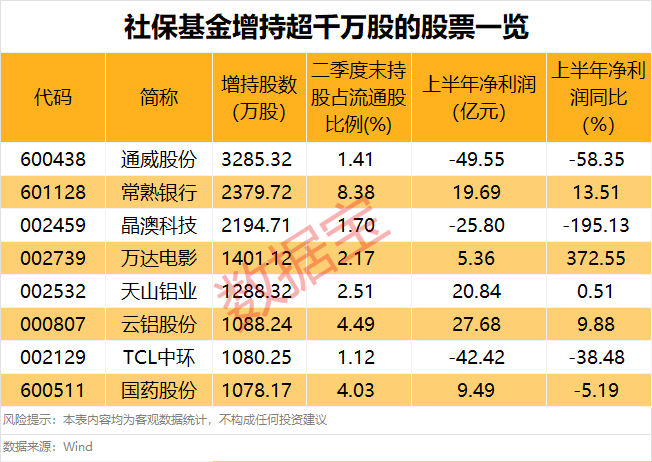
Core Viewpoint - The social security fund has made significant adjustments to its stock holdings, with a focus on long-term investment strategies, reflecting its presence in the top ten shareholders of 425 companies as of August 28 [1] Group 1: Stock Adjustments - In the second quarter, the social security fund entered 108 new stocks, increased holdings in 108 stocks, reduced holdings in 111 stocks, and maintained its position in 98 stocks [1] - Among the stocks with increased holdings, eight stocks saw an increase of over 10 million shares, with Tongwei Co., Ltd. having the largest increase of 32.85 million shares, raising its holding percentage from 0.68% to 1.41% [1][2] Group 2: Performance of Increased Holdings - The companies with significant increases in holdings include Wanda Film, Changshu Bank, and Tianshan Aluminum, all of which reported year-on-year growth in their performance for the first half of the year [1] - Wanda Film reported the highest net profit growth, with total operating revenue of 6.689 billion yuan, a year-on-year increase of 7.57%, and a net profit of 536 million yuan, reflecting a staggering growth of 372.55% [1][2] Group 3: Detailed Stock Data - The following stocks were notably increased by the social security fund: - Tongwei Co., Ltd.: 32.85 million shares, holding percentage 1.41%, net profit -495.5 million yuan, year-on-year change -58.35% [2] - Changshu Bank: 23.80 million shares, holding percentage 8.38%, net profit 1.969 billion yuan, year-on-year change 13.51% [2] - Wanda Film: 14.01 million shares, holding percentage 12.17%, net profit 536 million yuan, year-on-year change 372.55% [2] - Tianshan Aluminum: 12.88 million shares, holding percentage 2.51%, net profit 2.084 billion yuan, year-on-year change 0.51% [2]


光伏半年报观察:龙头企业员工薪酬普降、有高管“零报酬”,天合研发人员涨薪7300元
Sou Hu Cai Jing· 2025-08-28 09:54
Core Viewpoint - The photovoltaic industry continues to face significant losses, with only one out of eight leading companies reporting profitability in the first half of 2025, while the others are struggling with expanding losses [3][4]. Financial Performance - Among the eight leading photovoltaic companies, only Aters maintained profitability, while the others reported losses, with Longi Green Energy and Aiko Solar showing reduced losses of 50% and 80% respectively [3][4]. - Total revenues for the companies showed a decline, with Tongwei Co. reporting 40.51 billion yuan, down 7.51%, and JinkoSolar reporting 31.83 billion yuan, down 32.72% [4]. - The overall net loss for 31 A-share listed photovoltaic companies reached 12.58 billion yuan in Q1 2025, a year-on-year increase of 274.3% [7]. Employee Compensation and Management Costs - Employee compensation across the leading companies has generally decreased, with Tongwei's employee compensation dropping from 2.025 billion yuan to 1.342 billion yuan, leading to a 37.33% reduction in management costs [8][9]. - Key management personnel compensation also saw reductions, with Longi Green Energy's key management remuneration decreasing from 7.03 million yuan to 5.80 million yuan [10][11]. Strategic Shifts and New Growth Areas - Companies are increasingly focusing on energy storage as a new growth area, with Aters reporting a significant increase in its energy storage sales, achieving 3.1 GWh in the first half of 2025, a 19.23% year-on-year increase [13][14]. - Trina Solar is also pivoting towards energy storage, with a notable increase in its second-quarter shipments [14]. Market Dynamics and Future Outlook - The industry is experiencing a shift towards quality, technology, and service competition rather than price wars, as indicated by TCL Zhonghuan's management [15]. - Despite the ongoing challenges, there are signs of price recovery in the supply chain, with recent bidding prices for components showing an upward trend [15].

“2025中国民营企业500强”发布 通威集团等6家成都民营企业上榜
Sou Hu Cai Jing· 2025-08-28 09:17
10家四川企业上榜 其中包括 通威集团等6家成都民营企业 8月28起 全国工商联 在辽宁沈阳发布 "2025中国民营企业500强" 结果显示 通威集团、其亚集团、新希望六和等 | 101 | 华友控股集团有限公司 | 浙江省 | 10173396 | | --- | --- | --- | --- | | 102 | 歌尔殿份有限公司 | 山东省 | 10095384 | | 103 | 中天科技集团有限公司 | 江苏省 | 10091588 | | 104 | 江西方大钢铁集团有限公司 | 江西省 | 10073262 | | 105 | 中天控股集团有限公司 | 浙江省 | 10034950 | | 106 | 方同舟控股有限公司 | 北京市 | 9973280 | | 107 | 河北太行钢铁集团有限公司 | 河北省 | 9803410 | | 108 | 山东寿光鲁清石化有限公司 | 山东省 | 9403683 | | 109 | 贝壳控股有限公司 | 北京市 | 9345749 | | 110 | 日照钢铁控股集团有限公司 | 山东省 | 9291005 | | 111 | 品科能源股份有限公司 | ...
主题量化投资系列之二:基于“反内卷”的量化投资策略研究
CMS· 2025-08-28 09:04
Group 1 - The report highlights that from the second half of 2024, policies aimed at preventing "involution-style" competition will become more frequent and will gradually be institutionalized by 2025, impacting key industries such as photovoltaics, steel, automotive, and lithium battery materials [1][4][8] - The "anti-involution" process is characterized by three stages: capacity expansion, intensified competition, and industry clearing and recovery, with significant implications for investment strategies [4][23][48] - The report identifies that the photovoltaic industry has seen substantial investment and capacity expansion, driven by government policies and market demand, leading to a competitive landscape where companies are increasingly investing in upstream materials like silicon [27][30][41] Group 2 - The steel industry has experienced a plateau in production levels, maintaining around 1 billion tons since 2020, indicating a need for structural adjustments in response to market conditions [34][44] - The automotive sector has witnessed a surge in capacity expansion since 2020, supported by government incentives and a focus on new energy vehicles, leading to significant increases in fixed asset investments [35][36] - The lithium battery industry has seen a dramatic rise in lithium carbonate prices, from approximately 40,000 yuan per ton in early 2020 to over 500,000 yuan per ton by the end of 2022, reflecting the rapid growth of the new energy vehicle market [37][39] Group 3 - The report emphasizes the importance of identifying high-quality companies during the industry clearing phase, where weaker firms exit the market and stronger firms show signs of operational efficiency improvement [48][50] - It notes that industry concentration is a significant indicator of recovery, with leading companies in sectors like new energy vehicles and photovoltaics regaining market share as competition rationalizes [56][59] - The report outlines a quantifiable investment strategy based on industry structure, company fundamentals, and valuation factors, aimed at capturing opportunities arising from the "anti-involution" policies [63][64]



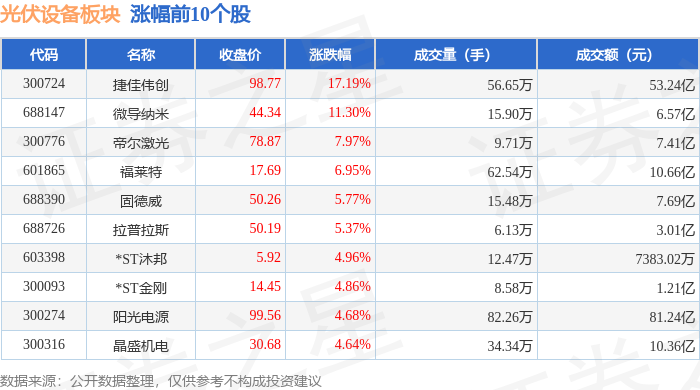
光伏设备板块8月28日涨2.8%,捷佳伟创领涨,主力资金净流出6054.36万元
Zheng Xing Xing Ye Ri Bao· 2025-08-28 08:42
Market Overview - On August 28, the photovoltaic equipment sector rose by 2.8%, with Jiejia Weichuang leading the gains [1] - The Shanghai Composite Index closed at 3843.6, up 1.14%, while the Shenzhen Component Index closed at 12571.37, up 2.25% [1] Stock Performance - Jiejia Weichuang (300724) closed at 98.77, up 17.19% with a trading volume of 566,500 shares and a transaction value of 5.324 billion [1] - Weidao Nano (688147) closed at 44.34, up 11.30% with a trading volume of 159,000 shares and a transaction value of 657 million [1] - Other notable performers include: - Dier Laser (300776) at 78.87, up 7.97% [1] - Fulete (601865) at 17.69, up 6.95% [1] - Goodwe (688390) at 50.26, up 5.77% [1] Fund Flow Analysis - The photovoltaic equipment sector experienced a net outflow of 60.54 million from institutional investors, while retail investors saw a net inflow of 542 million [2] - Key stocks with significant fund flow include: - Sunshine Power (300274) with a net inflow of 18.1 million from institutional investors [3] - Tongwei Co. (600438) with a net inflow of 16.8 million from institutional investors [3] - Fulete (601865) with a net inflow of 13.7 million from institutional investors [3]