
FYG,FUYAO GLASS(600660)

Search documents
新财富创富榜来了!他首度登顶,梁文锋杀进前十



券商中国· 2025-06-24 03:30
Core Viewpoint - The 2025 New Fortune 500 Rich List reveals a significant increase in the total market value of listed entrepreneurs, reaching 13.7 trillion yuan, an 11% year-on-year growth, indicating a new wave of wealth creation driven by innovation and overseas expansion [3][14]. Group 1: Wealth Distribution and Rankings - The top ten wealthiest individuals are heavily influenced by AI, with Zhang Yiming of ByteDance topping the list with a holding value of 481.57 billion yuan, marking a 42% increase from the previous year [4][18]. - The list features a notable shift, with four individuals from Hangzhou, Zhejiang, highlighting the region's growing economic prominence [43]. - The average holding value of the 500 entrepreneurs is 273.8 million yuan, with a threshold of 66.2 million yuan to make the list [8]. Group 2: Industry Insights - The TMT (Technology, Media, and Telecommunications), pharmaceutical, and daily consumer goods sectors are the top three wealth-generating industries, contributing 110, 54, and 52 individuals respectively [51]. - The TMT sector saw a significant increase in wealth, with a total of 334.08 billion yuan, a 46% increase from the previous year [51]. - The pharmaceutical sector experienced a decline, with 54 individuals listed, down from 64, indicating ongoing valuation adjustments [51]. Group 3: AI and Technological Advancements - AI has emerged as a key driver of wealth creation, with companies like DeepSeek and ByteDance leading the charge in user engagement and valuation [4][21]. - The rise of AI has also led to a resurgence in the semiconductor industry, with China exporting 2.981 billion chips worth approximately 159.5 billion USD, marking a significant shift in the global market [56]. - The AI sector is still in its nascent stage, with notable entries like Liang Wenfeng of DeepSeek entering the top ten, reflecting the rapid growth and potential of AI applications [60]. Group 4: Regional Wealth Creation - Wealth creation is becoming more balanced across regions, with western provinces like Sichuan, Tibet, and Xinjiang seeing an increase in listed individuals, while traditional economic hubs like Zhejiang and Shanghai continue to grow [5][6]. - The shift from real estate to technology and AI reflects a broader transformation in China's economic landscape, with younger entrepreneurs increasingly dominating the wealth rankings [46][45]. Group 5: Future Outlook - The ongoing evolution of industries, particularly in AI and technology, suggests a promising future for innovation-driven wealth creation in China [60][62]. - The integration of AI into various sectors, including automotive and consumer electronics, is expected to further enhance China's competitive edge in the global market [62][63].

张一鸣首次问鼎首富,梁文锋跻身前十!最新榜单来了
中国基金报· 2025-06-24 02:48
Core Insights - The total market value of the 500 entrepreneurs listed in the "2025 New Fortune 500 Rich List" is 13.7 trillion yuan, an increase of 11% year-on-year [2] - The average market value per entrepreneur is 27.38 billion yuan, with a minimum threshold of 6.62 billion yuan to be included in the list [2] Group 1: Top Entrepreneurs - Zhang Yiming, at 42 years old, ranks first with a holding value of 481.57 billion yuan, marking a 42% increase from 2024 [8][9] - Zhong Shanshan, previously the richest, has seen a decline in wealth to 362.41 billion yuan, a drop of 21% [9][10] - The top ten includes significant increases in wealth for entrepreneurs like Ma Huateng (45% increase) and Lei Jun (96% increase) [9][10] Group 2: Industry Trends - The TMT (Technology, Media, and Telecommunications) sector leads with 110 entrepreneurs, a 25% increase from the previous year, and accounts for 33.4 billion yuan in total wealth [12][14] - The AI sector is a major driver of wealth, with significant contributions from chip manufacturing and AI applications [15][19] - The automotive industry, particularly in electric vehicles, has also seen a rise in wealth among its leaders, with six industry billionaires benefiting from this trend [20][21] Group 3: Economic Geography Shift - The economic focus has shifted, with four of the top ten entrepreneurs now based in Hangzhou, Zhejiang, compared to six from Guangdong eighteen years ago [11] - The rise of the internet and AI has transformed the primary industries contributing to wealth creation, moving away from real estate [11] Group 4: Consumer Sector Highlights - The consumer sector is emerging as a new highlight, with coffee and tea brands gaining prominence, featuring multiple entrepreneurs from this space in the rankings [25][24]


电池厂账期255天反超整车,头部供应商压账痼疾待纠治
Di Yi Cai Jing· 2025-06-23 13:30
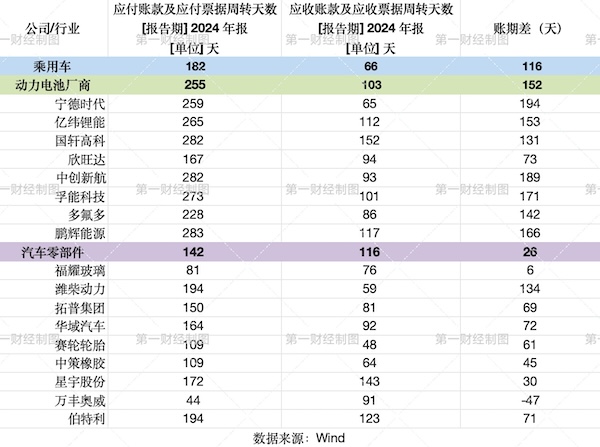
Core Viewpoint - The issue of extended payment terms is a significant concern across the entire automotive supply chain, not just limited to vehicle manufacturers [1] Group 1: Payment Terms in the Automotive Industry - The average collection period for eight listed passenger car companies in A-shares for 2024 is 66 days, while the average payment period is 182 days, resulting in a difference of 116 days [2][3] - The traditional automotive supply chain has a clear hierarchical structure, with Tier 1 suppliers having direct contracts with automakers, while Tier 2 and Tier 3 suppliers provide components and parts, respectively [1] - The long payment terms are often passed down from larger suppliers to smaller ones, creating financial pressure on small and medium-sized enterprises [1][6] Group 2: Payment Terms in Battery Manufacturers - In the case of eight listed battery manufacturers, the average collection period for 2024 is 103 days, while the average payment period is 255 days, leading to a difference of 152 days [4] - Leading battery manufacturer CATL has a collection period of 65 days and a payment period of 259 days, showing a significant negotiation advantage [5] - Other battery manufacturers like EVE Energy and Guoxuan High-Tech have even longer payment periods, indicating a trend of extended payment terms in the battery sector [5] Group 3: Payment Terms in Automotive Parts Suppliers - The average payment period for 255 listed automotive parts companies is 142 days, with an average collection period of 116 days, resulting in a difference of 26 days [5] - Larger automotive parts companies tend to have shorter collection periods, indicating better cash flow management compared to smaller firms [6] - Among the top 19 companies with a market value over 200 billion, some have payment periods below 100 days, while others exceed 200 days, highlighting the disparity in financial health within the industry [6] Group 4: Industry Response to Payment Issues - To address the issue of extended payment terms, both automakers and leading parts suppliers must take responsibility for maintaining a healthy and high-quality industry [7] - The China Iron and Steel Industry Association emphasized the need for leading enterprises to set an example and combat unhealthy competition within the supply chain [7]




车企缩短账期,供应链现金流改善
HTSC· 2025-06-23 11:39
Report Summary 1. Industry Investment Rating There is no industry investment rating provided in the report. 2. Core Viewpoints - The commitment of 17 key automakers to shorten the payment period to suppliers within 60 days is a positive response to the "Regulations on Ensuring Payment for Small and Medium - sized Enterprises", which helps to alleviate market concerns about automakers' repayment ability and promotes the healthy development of the industry [2][10][11]. - For automakers, the shortened payment period has limited impact on cash - flow as they have sufficient bank credit. For component manufacturers, it can improve capital turnover, increase cash on hand, and potentially reduce impairment losses and improve profitability [2][13][15]. - The bond market shows that under the central bank's support, the mid - to long - term credit bonds remain strong. The issuance sentiment of credit bonds is warming up, and the secondary trading of short - duration bonds is active with a slight increase in long - duration trading [3][52][62]. 3. Summary by Directory 3.1 Credit Hotspot: Automakers Shortening Payment Periods - 17 key automakers, including BYD, Geely, FAW, etc., promised to unify the supplier payment period within 60 days. SAIC and BAIC additionally promised not to use commercial acceptance bills, while FAW and Jianghuai promised to streamline approval processes [10]. - As of June 22, 2025, there are 8 automaker bond - issuing entities with a cumulative outstanding bond scale of 66.9 billion yuan, and 4 component bond - issuing entities with a cumulative outstanding bond scale of 4 billion yuan [11]. - For automakers, although the shortened payment period may have a short - term impact on operating cash - flow, the cash - flow pressure is limited due to their good credit and sufficient unused bank credit. For example, if the accounts payable and notes turnover rate is adjusted to 6, the capital gap of most automakers is about 50 billion yuan, and Geely Holding Group's gap exceeds 100 billion yuan [13][15]. - For component manufacturers, the shortened payment period can improve capital turnover and cash on hand. On average, component companies may receive 3.5 billion yuan in additional monetary funds, which can enhance operational flexibility and risk - resistance ability [15]. - In terms of bond - issuing entity spreads, the industry spread of industrial bonds consists of liquidity premium and credit risk premium. In the short term, the commitment benefits component manufacturers more, and some high - spread entities may see a narrowing of spreads. Automakers' spreads are mainly affected by liquidity premium [20]. 3.2 Market Review - From June 6 to June 13, 2025, the monetary policy expectations at the Lujiazui Forum were not met, but the central bank maintained a loose tax - period capital environment. The mid - to long - term credit bonds remained strong, with yields of 7 - 10Y varieties mostly falling by more than 4BP. Some spreads increased slightly due to the strong performance of interest - rate bonds [3][27]. - The yields of Tier 2 and perpetual bonds also generally declined, with 5 - 10Y yields falling by about 4BP. The median spreads of public bonds in various industries showed mixed trends, and the median spreads of urban investment bonds in most provinces declined, with Inner Mongolia's spread dropping by more than 4BP [3][27]. 3.3 Primary Issuance - From June 16 to June 20, 2025, corporate credit bonds issued a total of 334.7 billion yuan, a slight 4% decrease from the previous period; financial credit bonds issued a total of 173 billion yuan, a 61% increase from the previous period. The net financing of corporate credit bonds was 28.7 billion yuan, with urban investment bonds having a net repayment of 26.5 billion yuan and industrial bonds having a net financing of 59.6 billion yuan [4][52]. - The issuance of credit bonds continued to recover after holiday factors and annual report updates. The average issuance rates of medium - short - term notes and corporate bonds showed a downward trend [4][52]. 3.4 Secondary Trading - Active trading entities are mainly medium - to high - grade, medium - short - term, and central and state - owned enterprises. Urban investment bond trading is mainly concentrated in high - grade platforms in economically strong provinces and core platforms in high - spread areas of large economic provinces. Real - estate bond trading is mainly AAA - rated with a maturity of 1 - 3 years, and private enterprise bond trading is also mainly AAA - rated with medium - short maturities [5][62]. - The proportion of trading volume of urban investment bonds with a maturity of over 5 years increased slightly from 0% to 2% compared to the previous week [5][62].


汽车行业周报:以旧换新“国补”将持续,理想汽车完成2500座5C超充站建设以及i6工信部产品公告-20250623
Guohai Securities· 2025-06-23 07:03
Investment Rating - The report maintains a "Buy" rating for the automotive sector [1] Core Views - The continuation of the "old-for-new" subsidy policy is expected to support automotive consumption, leading to a positive outlook for the automotive sector [7][17] - The completion of 2,500 5C supercharging stations by Li Auto indicates strong infrastructure development, surpassing Tesla's charging network in China [3][13] - The launch of the Li Auto i6, a pure electric SUV, is anticipated in September 2025, showcasing advancements in electric vehicle technology [4][14] Summary by Sections Recent Developments - Li Auto has completed its goal of building 2,500 5C supercharging stations, with the latest located at Shanghai Disneyland, featuring a design of three groups of dual-gun 5C charging piles [3][13] - The i6 model has been officially announced and is set to launch in September 2025, featuring a pure electric architecture and various powertrain options [4][14] - The "old-for-new" subsidy policy will continue, with central funding expected to be distributed in batches, totaling 3 trillion yuan for the year [5][15] Market Performance - The automotive sector underperformed compared to the Shanghai Composite Index, with a weekly decline of 2.6% from June 16 to June 20, 2025 [18] - The performance of individual stocks varied, with Li Auto experiencing a decline of 7.1% during the same period [18][23] Investment Recommendations - The report recommends several companies poised to benefit from the current market conditions, including Li Auto, BYD, and Great Wall Motors, among others [7][17] - It highlights the potential for high-end vehicle manufacturers to gain from the ongoing shift towards premium offerings in the automotive market [7][17]




福耀玻璃(600660) - 福耀玻璃2025年度第一期超短期融资券发行情况公告
2025-06-20 08:46
证券代码:600660 证券简称:福耀玻璃 编号:2025-018 福耀玻璃工业集团股份有限公司 2025 年度第一期超短期融资券发行情况公告 董 事 局 本公司董事局及全体董事保证本公告内容不存在任何虚假记载、误导性陈述或者重大遗 漏,并对其内容的真实性、准确性和完整性承担法律责任。 公 司 2025 年 度 第 一 期 超 短 期 融 资 券 发 行 的 相 关 文 件 已 在 中 国 货 币 网 (www.chinamoney.com.cn)和上海清算所网站(www.shclearing.com)上刊登。 特此公告。 福耀玻璃工业集团股份有限公司 福耀玻璃工业集团股份有限公司(以下简称"公司")于2023年4月27日召开的 2022年度股东大会审议通过了《关于公司发行超短期融资券的议案》,同意公司向中 国银行间市场交易商协会(以下简称"交易商协会")申请注册发行总额不超过人民 币20亿元(含人民币20亿元)的超短期融资券。具体内容详见公司分别于2023年3 月17日及2023年4月28日在《上海证券报》《中国证券报》《证券时报》、上海证券交 易所网站等指定信息披露媒体上披露的《福耀玻璃工业集团股份有限公 ...
闽企勇闯天涯启示录:从“制造出海”到“质造领航”
Zhong Guo Zheng Quan Bao· 2025-06-19 20:34
Core Insights - Chinese companies are increasingly shifting from product export to technology export, enhancing their global competitiveness through innovation and resource integration [1][2][3] Group 1: Company Developments - CATL announced plans to build its third battery factory in Europe in partnership with Stellantis, which is expected to generate over 10 billion yuan in equipment demand and significant material needs [2] - Fuyao Glass has established a strong presence in the global automotive supply chain, with over 40% of its revenue coming from overseas markets, and reported a 12.16% increase in revenue for Q1 2025 [3][4] - King Long Motors delivered 121 electric buses to Chile, marking a significant step in its international expansion, with total exports exceeding 140,000 buses to nearly 150 countries [1][2] Group 2: Industry Trends - The trend of "going global" is seen as essential for Chinese companies to remain competitive, with many firms actively seeking to establish a global presence and diversify their markets [3][6] - The global supply chain is being reshaped as companies like Weike Technology enhance their manufacturing capabilities across multiple countries, improving cost efficiency and responsiveness [2][3] - The overall GDP of Fujian Province is projected to reach 57,761.02 billion yuan in 2024, ranking it eighth among China's provinces, indicating a strong economic foundation for companies to expand internationally [2] Group 3: Innovation and Technology - Continuous investment in R&D is crucial for maintaining competitive advantages, as demonstrated by Fuyao Glass's innovative products like 5G antenna glass and AR-HUD displays [5][6] - Companies are leveraging capital markets to support their global expansion strategies, with Anta Sports using acquisitions to enhance its brand presence internationally [5][6] - The shift from "Made in China" to "Created in China" reflects a broader trend of Chinese manufacturing focusing on quality and innovation rather than just cost advantages [7]
上证中游产业指数上涨0.39%,前十大权重包含万华化学等
Jin Rong Jie· 2025-06-18 09:03
Group 1 - The Shanghai Midstream Industry Index rose by 0.39% to 2851.61 points, with a trading volume of 87.133 billion yuan [1] - Over the past month, the Shanghai Midstream Industry Index has decreased by 1.31%, down 8.06% over the last three months, and down 4.06% year-to-date [1] - The index is composed of three parts: the upstream, midstream, and downstream industry indices, reflecting the overall performance of related listed companies in the Shanghai market [1] Group 2 - The top ten weighted stocks in the Shanghai Midstream Industry Index include: SMIC (3.23%), Haiguang Information (2.48%), Cambricon (2.36%), China State Construction (2.34%), Sany Heavy Industry (2.11%), Weir Shares (2.1%), COSCO Shipping Holdings (2.03%), Wanhua Chemical (2.0%), Zhongke Shuguang (1.96%), and Fuyao Glass (1.8%) [1] - The index's holdings are entirely composed of stocks listed on the Shanghai Stock Exchange, with a 100% allocation [1] Group 3 - The industry composition of the index shows that 46.09% is in industrials, 36.38% in information technology, 10.18% in materials, 5.30% in consumer discretionary, and 2.06% in communication services [2] - The index samples are adjusted biannually, with adjustments occurring on the next trading day after the second Friday of June and December [2] - In special circumstances, the index may undergo temporary adjustments, including the removal of companies that are delisted or undergo mergers, acquisitions, or spin-offs [2]




兴业证券:打造差异化卖点+解决防晒痛点 调光汽玻产业趋势加速
智通财经网· 2025-06-18 03:28
Core Viewpoint - The dimmable automotive glass industry is accelerating, with significant growth expected in the future, particularly in the application of dimmable skylights that address previous concerns regarding sun protection and privacy features [1][2]. Industry Trends - Dimmable glass is transitioning from high-end luxury vehicles to mainstream models, with predictions that it will become a popular trend in new cars by 2025, as seen in models like the Zhiji L6 and Xiaomi YU7 [3]. - The penetration rate of dimmable skylights is expected to increase, driven by consumer demand for enhanced features and differentiation in a homogenized automotive market [2][3]. Market Potential - The domestic automotive dimmable film market is projected to reach 2.1 billion yuan by 2025, with long-term potential estimated at 21.4 billion yuan, primarily for use in skylights, rear side windows, and rear windshields [4]. - The PDLC (Polymer Dispersed Liquid Crystal) technology is leading in domestic production, with significant cost advantages and the ability to meet design requirements for curved surfaces, positioning it to dominate the future dimmable skylight market [3][4]. Competitive Landscape - The market for dimmable films is characterized by high technical barriers, with international suppliers currently dominating. However, domestic manufacturers are making strides in PDLC technology, while other technologies like EC (Electrochromic) remain largely foreign-controlled [4].


汽车调光玻璃专题:打造差异化卖点+解决防晒痛点,调光汽玻产业趋势加速
2025-06-16 15:20
Summary of Automotive Smart Glass Conference Call Industry Overview - The automotive smart glass industry is experiencing a shift from high-end models to mainstream vehicles, with multiple popular models expected to feature smart glass as a selling point by 2025, driven by breakthroughs in domestic smart film technology, particularly Haoyou New Material's PDLC black film technology [1][5][9] Key Points and Arguments - **Technology Paths**: There are four main technology paths for smart glass: Electrochromic (EC), Polymer Dispersed Liquid Crystal (PDLC), Liquid Crystal (LC), and Suspended Particle Device (SPD). EC and PDLC are the most widely used. EC offers low haze, low energy consumption, and good insulation but has slow response times and high costs. PDLC provides fast response and good privacy but has weaker insulation and higher haze [6][10] - **Market Penetration**: As of the end of 2024, the panoramic sunroof installation rate in China's passenger car market is 17.4%, indicating significant room for growth. Smart panoramic roofs can address sun protection and insulation issues, enhancing consumer experience and becoming a new selling point for car manufacturers [8][12] - **Market Size**: The current market for automotive smart films in China is approximately 2 billion yuan, with potential growth to 20 billion yuan. The long-term penetration rate for panoramic roofs is expected to reach 40%, with half of them featuring smart functions [12][13] - **Cost Dynamics**: The value of a panoramic sunroof with smart functions can reach 3,000 to 5,000 yuan, significantly higher than standard sunroof glass. The price of non-functional panoramic sunroof glass is around 1,500 yuan, while smart versions can range from 4,000 to 8,000 yuan [10][15] Additional Important Insights - **Industry Players**: Key players in the smart glass market include Haoyou New Material for PDLC, with other notable companies in EC and LC technologies. Haoyou's high domestic production rate and lower process requirements provide a cost advantage [11][14] - **Consumer Trends**: The trend of equipping smart glass is shifting from foreign joint ventures to more domestic brands, with models like the Zhiji L6 set to feature smart roofs as standard by 2025, priced around 200,000 yuan [2][9] - **Investment Recommendations**: Investors are advised to focus on Fuyao Glass, which offers competitive pricing for standard and smart sunroofs, and Haoyou New Material, which has the potential for large-scale production of its PDLC technology [15]