FYG,FUYAO GLASS(600660)

Search documents
法巴证券汽车零部件 “攻守” 图谱:两家具壁垒,两家等催化
Zhi Tong Cai Jing· 2025-06-16 09:29
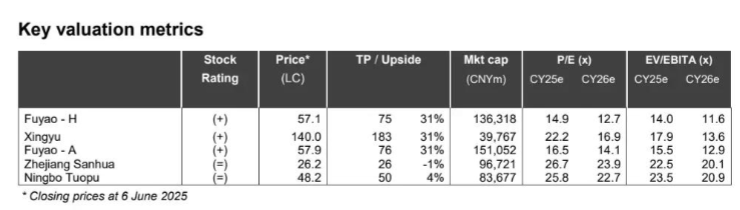
Core Viewpoint - BNP Paribas Exane Research has a cautious outlook on the Chinese automotive parts industry for 2025, primarily due to concerns about weak demand in the second half of the year [2] Group 1: Industry Overview - Investor discussions focused on the impact of ongoing price pressures on Chinese automotive parts companies and the long-term growth potential in overseas markets [1] - Most investors share a short-term cautious view on the industry, aligning with BNP Paribas' perspective [2] - There is a notable interest in the potential for Chinese automotive parts companies to penetrate global supply chains, despite limited short-term revenue contributions [3] Group 2: Company Ratings and Valuations - Fuyao Glass Industry Group has a rating of "Outperform" with a target price of 76 CNY for A-shares and 75 HKD for H-shares, supported by its market leadership and broad customer base [10][11] - Xingyu has been rated "Outperform" with a target price of 183 CNY, attributed to its shift in customer structure and technology upgrades [5][6] - Ningbo Tuopu Group is rated "Neutral" with a target price of 50 CNY, facing pressure on margins and capital expenditures amid intense competition [14] - Zhejiang Sanhua is rated "Neutral" with a target price of 26 CNY, with expectations of demand slowdown and price pressure due to competition among OEMs [19][20] Group 3: Key Valuation Metrics - Fuyao Glass: Market cap of 136.318 billion CNY, P/E of 14.9x for CY25e, EV/EBITA of 14.0x for CY25e [4] - Xingyu: Market cap of 39.767 billion CNY, P/E of 22.2x for CY25e, EV/EBITA of 17.9x for CY25e [4] - Ningbo Tuopu: Market cap of 83.677 billion CNY, P/E of 25.8x for CY25e, EV/EBITA of 23.5x for CY25e [4] - Zhejiang Sanhua: Market cap of 96.721 billion CNY, P/E of 26.7x for CY25e, EV/EBITA of 22.5x for CY25e [4]


福耀玻璃20250615
2025-06-15 16:03
Summary of Fuyao Glass Conference Call Industry Overview - The European automotive glass market is projected to reach approximately 18 billion RMB in 2024, with the OEM market accounting for about 14.5 billion RMB and the AM market space estimated at 300-400 million RMB, expected to grow at an annual rate of around 4% [2][3] - The market concentration is high, with a CR3 of 81% in 2024; Saint-Gobain holds the largest market share at around 35%, while Fuyao ranks third with a market share of approximately 21% [2][5] Key Insights and Arguments - The ongoing Russia-Ukraine conflict has exacerbated instability in local supply chains in Europe, leading to fluctuations in production costs [2] - The conflict has altered the natural gas supply landscape in Europe, significantly reducing Russian gas exports and increasing the EU's reliance on liquefied natural gas imports, which has resulted in persistent high energy prices [6] - Fuyao's export strategy aims to enhance its market share in Europe, having already surpassed a 20% OEM market share [2][4] Competitive Landscape - Fuyao is expected to increase its production capacity for European exports, with a new facility in Fuzhou projected to produce around 4 million sets by the end of 2025, potentially capturing 25% of the market [4][10] - Competitors like Saint-Gobain and Pilkington are significantly affected by the energy crisis, leading to weakened profitability [4][12] - Fuyao's unique production model involves manufacturing float glass and automotive components domestically and then transporting them to Europe for value-added processing, which mitigates energy supply issues and enhances efficiency [9] Development Phases - Fuyao's development in the European market can be categorized into three phases: 1. Initial layout phase before 2017, with limited factory capacity in Russia 2. Slow growth phase from 2017 to 2020, where market share increased from 5% to 8-9% 3. Rapid growth phase from 2021 to present, with market share exceeding 20% [8] Future Outlook - Fuyao's market share in Europe is expected to exceed 40% in the OEM segment in the coming years, with revenue projected to double from approximately 4 billion RMB to around 9.8 billion RMB due to an increase in average selling price [10][13] - Net profit is anticipated to maintain around 20%, growing from 800 million RMB to 2 billion RMB [10] Competitor Analysis - Competitors like Saint-Gobain and Pilkington have extensive local factory networks but are struggling due to high natural gas prices, leading to production halts and a shift towards exporting raw glass from Southeast Asia and Japan for further processing in Europe [11][12] Additional Insights - Fuyao's net profit margin is significantly higher at 20%, compared to its competitors who are hovering around the breakeven point [12] - The company is well-positioned to capitalize on the increasing demand for high-value products such as HUDs and dual-layer edge windows, enhancing its EPS growth potential [13]
汽车行业周报:多家车企发布“60天账期宣言”,特斯拉暂定6月22日正式运营Robotaxi-20250615
Guohai Securities· 2025-06-15 14:03
Investment Rating - The report maintains a "Recommended" rating for the automotive industry [1] Core Views - The automotive sector is expected to benefit from the continuation of the vehicle trade-in policy in 2025, which is anticipated to support upward consumer spending [16] - The report highlights the emergence of high-end domestic brands and the potential for increased penetration of advanced driving technologies [16] - The report emphasizes the importance of the Robotaxi initiative by Tesla, which is set to launch on June 22, 2025, as a significant development in the industry [14] Summary by Sections Recent Developments - Multiple automotive companies have announced a "60-day payment term" commitment to suppliers, aiming to alleviate financial pressure [12] - The global first L3-level AI vehicle, the Xiaopeng G7, was officially unveiled with a pre-sale price of 235,800 yuan, featuring advanced AI capabilities [13] - Tesla plans to initiate its Robotaxi pilot service in Austin, Texas, with the first deliveries expected on June 28, 2025 [14] Market Performance - From June 9 to June 13, 2025, the A-share automotive sector underperformed compared to the Shanghai Composite Index, with a weekly decline of 0.8% [17] - The performance of individual segments showed a mixed trend, with passenger vehicles down by 2.0% and commercial vehicles up by 7.2% during the same period [17] Recommendations - The report recommends several companies based on their potential to benefit from the current market dynamics: 1. Domestic brands like Li Auto, JAC Motors, Geely, BYD, and Great Wall Motors are expected to thrive in the high-end market segment [16] 2. Companies involved in advanced driving technologies, such as Xiaopeng Motors, Huayang Group, Desay SV, and Kobot, are highlighted for their growth potential [16] 3. The report suggests focusing on companies with strong positions in the supply chain, such as Top Group, Sanhua Intelligent Control, and Beite Technology [16] 4. In the commercial vehicle sector, it anticipates a recovery in heavy truck demand, recommending companies like Foton Motor and China National Heavy Duty Truck [16]



多家车企统一供应商账期,Robotaxi试运营渐近
CMS· 2025-06-15 08:31
Investment Rating - The report maintains a "Recommendation" rating for the automotive industry, indicating a positive outlook for the sector [5]. Core Insights - The automotive industry experienced an overall decline of -0.7% from June 8 to June 14, with various companies committing to a supplier payment period not exceeding 60 days [1][24]. - Tesla's Robotaxi service is set to launch on June 22, with plans for the first fully autonomous vehicle delivery on June 28 [1][27]. - The report highlights significant collaborations, such as GAC Toyota's partnership with Xiaomi and Huawei to enhance smart vehicle technology [25]. Market Performance Overview - The automotive sector's performance was -0.7%, while the broader market indices showed slight declines: Shanghai A-share index at -0.2% and Shenzhen A-share index at -0.3% [2][9]. - Among automotive sub-sectors, commercial vehicles saw a notable increase of +7.2%, while passenger vehicles and auto parts experienced declines of -2.0% and -1.6%, respectively [11][2]. Individual Stock Performance - Notable stock performances included Jiuling Technology (+55.0%), Meichen Technology (+41.0%), and Tongxin Transmission (+35.3%) [3][14]. - Conversely, stocks such as Chaojie Co. (-23.2%), Niutai Ge (-11.7%), and Zhongma Transmission (-10.7%) faced significant declines [3][14]. Recent Industry Developments - 17 automotive companies have pledged to limit supplier payment terms to 60 days, including major players like BYD and Geely [24]. - GAC Group has committed to completing dealer rebate payments within two months to support dealer stability [24]. - Chery is on track to become the first Chinese automaker to export over 5 million vehicles [26]. Investment Recommendations - The report recommends focusing on companies with strong sales performance or potential blockbuster vehicles, such as BYD, Seres, Great Wall Motors, and JAC Motors [8]. - For commercial vehicles, it suggests investing in Yutong Bus, China National Heavy Duty Truck, and Weichai Power [8]. - In the auto parts sector, it highlights companies with cost and product advantages, recommending Fuyao Glass and Top Group among others [8].





比较研究系列:从财报看三类车企有何新变化趋势
Ping An Securities· 2025-06-12 08:05
Investment Rating - The report maintains an "Outperform" rating for the automotive industry [1] Core Insights - The report highlights the resilience of private car manufacturers, emphasizing their strong profitability and the acceleration of advanced driver-assistance systems (ADAS) by 2025. Key players like BYD and Geely are expected to lead in this area [3][13] - The report notes that new energy vehicle (NEV) sales are projected to remain robust, particularly in the second half of 2025, driven by favorable policies and tax exemptions [12][10] - State-owned enterprises are facing profitability challenges but are actively collaborating with Huawei to transform their business models towards electrification and smart technologies [4][16] Summary by Sections 1. Overall Automotive Industry - The automotive sales in China surpassed 30 million units in 2023, with exports being a significant growth driver. Domestic sales have not yet returned to 2017 levels [6][7] - Policies such as the vehicle replacement program are expected to stimulate demand, potentially adding 3.5 million units in 2025 [11][10] 2. Major Private Car Manufacturers - Private manufacturers are showing strong operational resilience, with profitability driven by high-end strategies, exports, and NEV scale effects. BYD's net profit for 2024 is projected at 37 billion yuan, a 29.9% increase year-on-year [14][15] - The report indicates that private manufacturers are leading the penetration of ADAS in the market, with significant advancements expected by 2025 [24][25] 3. Major New Forces in Automotive - New entrants are under pressure to achieve self-sustainability, with a focus on new product launches to validate growth potential. Companies like Li Auto and Xpeng are expected to introduce new models in 2025 [32][40] - The report notes that while losses are narrowing for these companies, the urgency to establish self-funding capabilities is increasing due to changes in the financing environment [37][39] 4. Major State-Owned Enterprises - State-owned enterprises are experiencing weaker profitability due to various factors, including declining investment returns from joint ventures and challenges in achieving scale in NEVs [16][4] - Collaborations with Huawei are being intensified to facilitate the transition towards smart and electric vehicles [4][16] 5. Investment Recommendations - The report recommends investing in private manufacturers like Seres, BYD, Great Wall Motors, and Geely due to their strong profitability and market positioning. It also suggests monitoring new entrants like Li Auto, Xpeng, and Xiaomi for their growth potential [3][4]
平安证券:民营车企2025年加速辅助驾驶平权 推荐比亚迪股份等
Zhi Tong Cai Jing· 2025-06-12 07:51
Group 1: Private Car Manufacturers - The profitability of private car manufacturers is strong, with significant advancements in high-end strategies, increased export ratios, and scale effects in the new energy vehicle sector [1] - Key players like Seres, BYD, and Geely are expected to lead the acceleration of advanced driver assistance systems by 2025, enhancing their market position [1] - The overseas market is contributing considerable profits, with BYD maintaining high per-vehicle profitability due to its scale and supply chain advantages [1] Group 2: New Force Car Manufacturers - New force car manufacturers are facing increased urgency to achieve self-sustainability, with companies like Li Auto showing stable profitability and improvements in gross margins for Leap Motor and Xpeng [2] - The financing environment and valuation levels for new force manufacturers have changed significantly since their initial public offerings, necessitating quicker self-financing [2] - Product launches in 2025 will be crucial for these companies to expand their growth potential, with Li Auto focusing on pure electric models and Xpeng diversifying its product matrix [2] Group 3: State-Owned Car Manufacturers - State-owned car manufacturers are experiencing weaker profitability due to declining investment returns from joint ventures and challenges in achieving scale effects in the new energy vehicle sector [3] - Many state-owned enterprises are actively deepening strategic cooperation with Huawei to facilitate their transition towards smart and electric vehicle production [3] - The domestic automotive market is undergoing structural adjustments, leading to decreased profitability in the fuel vehicle segment [3]
平安证券:民营车企2025年加速辅助驾驶平权 推荐比亚迪股份(01211)等
智通财经网· 2025-06-12 07:47
Group 1: Private Car Manufacturers - Private car manufacturers exhibit strong profit resilience, driven by high-end breakthroughs, increased export ratios, and scale effects in the new energy vehicle sector [1] - Key players like BYD and Geely are expected to lead the push for advanced driver assistance systems by 2025, capitalizing on their scale and industry advantages [1] - The profitability of major private car manufacturers is improving, with Seres benefiting from the popularity of its AITO series and Great Wall Motors leveraging its core brands like Tank and pickup trucks [1] Group 2: New Forces in the Automotive Industry - New forces in the automotive sector are facing increased urgency to achieve self-sustainability, with companies like Li Auto maintaining robust profitability while others like Leap Motor and Xpeng show significant improvements in gross margins [2] - The upcoming product launches in 2025 are crucial for these new entrants to expand their growth potential, with Li Auto focusing on pure electric models and Xpeng enhancing its product matrix with range-extended models [2] - The financing environment and valuation levels for new forces have changed significantly since their initial public offerings, necessitating a quicker path to self-sufficiency [2] Group 3: State-Owned Car Manufacturers - State-owned car manufacturers are experiencing weaker profitability due to declining investment returns from joint ventures and challenges in achieving scale effects in the new energy vehicle market [3] - Many state-owned enterprises are actively deepening strategic partnerships with Huawei to facilitate their transition towards smart and electric vehicle production [3] - The domestic automotive market's structural adjustments have led to decreased profitability in the traditional fuel vehicle segment, adding to the pressures faced by state-owned manufacturers [3]
内卷行情拨云见日,车市生态优化向上
HTSC· 2025-06-12 02:25
Investment Rating - The industry is rated as "Overweight" [6] Core Views - Multiple automakers have committed to shortening payment terms to within 60 days, which is expected to improve the automotive supply chain ecosystem [1] - The shortening of payment terms is anticipated to alleviate concerns regarding automakers' repayment capabilities and promote healthy industry development [1] - The average cash turnover rates for components, complete vehicles, and dealers in 2024 are projected to be 4.5, 2.2, and 8.9 respectively, with the new payment terms expected to enhance cash flow [1] - The reduction in payment terms aligns with international standards, potentially benefiting Chinese brands in overseas markets [2] - Price competition has paused, leading to a narrowing of discount rates, which is favorable for healthy competition within the industry [2] Summary by Sections Section 1: Impact of Shortened Payment Terms - The adjustment to a 60-day payment term is expected to have limited impact on the cash flow of complete vehicle manufacturers, as many currently operate with payment terms exceeding 110 days [2] - The new terms are expected to enhance the cash turnover ability and cash levels of upstream component manufacturers, with an estimated increase in cash funds of approximately 32 billion yuan (+37%) if accounts receivable turnover improves to 6 [3] Section 2: Export Growth of Domestic Passenger Vehicles - Domestic brands are leading in competitiveness within the market, driving foreign brands out [4] - In 2024, market shares for domestic brands in various price segments are projected to be 80%, 48%, and 42% respectively, with year-on-year increases of 7, 14, and 4 percentage points [4] - In May, domestic brand exports reached 375,000 units, a year-on-year increase of 18% and a month-on-month increase of 10% [4] - The global market is viewed as a significant growth opportunity for Chinese automakers, with a recommendation to focus on industry leaders with global competitiveness [4]


比较研究系列:以长板优势推进品牌进阶,智驾强监管筑牢安全底座
Ping An Securities· 2025-06-11 05:43
Investment Rating - The report maintains an "Outperform" rating for the industry [1] Core Insights - The high-end strategy of automotive companies is categorized into two types: those with clear advantages focusing on their strengths and those adopting benchmarking strategies [4][58] - The tightening regulations on intelligent driving are leading to a shift in marketing strategies among automotive companies, emphasizing safety and compliance [28][59] - Leading intelligent driving suppliers are expanding their product matrices and customer bases through integrated hardware and software solutions [60] Summary by Sections 1. Leveraging Strengths for Brand Advancement - Automotive companies like Li Auto, Great Wall Motors, and Xiaomi are focusing on their unique strengths to enhance brand positioning [4][58] - Li Auto's MEGA model maintains a flagship position with a price above 500,000 yuan, while Great Wall Motors continues to deepen its off-road market with the launch of the Tank 300 [8][19] - The introduction of new large SUVs during the 2025 Shanghai Auto Show aims to capture market share and elevate brand value [9][21] 2. Strengthening Safety and Regulatory Compliance - The intelligent driving sector is entering a period of stringent regulation, with new guidelines affecting marketing and OTA upgrades [28][29] - Companies are adjusting their marketing strategies to highlight safety features and avoid misleading claims about autonomous capabilities [35][36] 3. Leading Intelligent Driving Suppliers: Integrated Solutions and Rich Product Matrix - Major suppliers like Huawei and Horizon Robotics are offering diverse solutions across various price segments, with Huawei's ADS 4 and Horizon's HSD series [42][60] - High-end products are undergoing further iterations, with Huawei's ADS 4 flagship version introducing commercial L3 solutions [46][60] - The rapid expansion of user bases and significant R&D investments are leading to economies of scale for these suppliers [50][60] 4. Investment Recommendations - The report recommends focusing on automotive companies with distinctive brand advantages and ongoing development, specifically highlighting Li Auto, Great Wall Motors, and Xiaomi [58][60] - It also suggests looking at companies benefiting from the scale of new energy vehicles, such as BYD and Geely, and suppliers like Horizon Robotics and Fuyao Glass that are poised to gain from the proliferation of intelligent driving technologies [60]



汽车行业2025年6月投资策略:RoboX商业化落地加速,关注板块二季度业绩
Guoxin Securities· 2025-06-08 14:33
Core Insights - The report maintains an "Outperform" rating for the automotive sector, emphasizing the acceleration of RoboX commercialization and the focus on the sector's performance in Q2 2025 [1][3] - The automotive industry is transitioning towards electric and intelligent vehicles, with significant growth expected in the domestic market, particularly for new energy vehicles [11][12] Sales Tracking - In May 2025, retail sales of passenger cars in China reached 1.93 million units, a year-on-year increase of 13%, with cumulative retail sales for the year at 8.802 million units, up 9% [1] - Wholesale figures for the same month showed 2.329 million units, marking a 14% increase year-on-year, with cumulative wholesale sales for the year at 10.797 million units, up 12% [2] Market Performance - The automotive sector saw a 1.88% increase in May, outperforming the CSI 300 index by 0.04 percentage points, while the overall automotive sector has risen 29.05% since the beginning of 2025 [2] - The inventory warning index for automotive dealers in May 2025 was 52.7%, indicating improved market conditions as it decreased by 5.5 percentage points year-on-year [2] Investment Recommendations - The report suggests focusing on domestic brands and the opportunities in incremental components driven by electric and intelligent trends, highlighting companies like Leap Motor, Xpeng, and Geely for vehicle recommendations [3][11] - For intelligent components, companies such as Coboda, Huayang Group, and Junsheng Electronics are recommended, while for robotics, Top Group and Sanhua Intelligent Control are highlighted [3][11] Company Earnings Forecasts - Key companies are projected to have varying earnings per share (EPS) and price-to-earnings (PE) ratios, with Leap Motor expected to have an EPS of -0.05 in 2025 and a PE of -1126, while Geely is forecasted to have an EPS of 1.36 and a PE of 13 [4] Industry Outlook - The automotive industry is expected to maintain a 2% annual compound growth rate over the next 20 years, with new energy vehicle sales projected to reach 1.216 million units in 2024, reflecting a 37% increase [12][16] - The report anticipates that by 2025, the sales of new energy vehicles will exceed 1.5 million units, with a year-on-year growth of over 20% [21]