FYG,FUYAO GLASS(600660)

Search documents
2025年中国平板玻璃产量为97591万重量箱 累计下降3%
Chan Ye Xin Xi Wang· 2026-01-30 03:45
Core Viewpoint - The report highlights the trends and forecasts in the Chinese flat glass industry from 2026 to 2032, indicating a slight growth in production despite a recent decline in cumulative output for 2025 [1] Industry Summary - According to the National Bureau of Statistics, the production of flat glass in China reached 88.29 million weight cases in December 2025, marking a year-on-year increase of 3.4% [1] - The cumulative production of flat glass for the entire year of 2025 was 975.91 million weight cases, reflecting a decrease of 3% compared to the previous year [1] - The report is published by Zhiyan Consulting, a leading industry consulting firm in China, which has been focusing on industry research for over a decade [1]





2025年中国夹层玻璃产量为16422.8万平方米 累计增长2.7%
Chan Ye Xin Xi Wang· 2026-01-30 03:45
Core Viewpoint - The Chinese laminated glass industry is experiencing a decline in production, with a notable decrease in output projected for December 2025 compared to the previous year [1] Industry Summary - According to the National Bureau of Statistics, the production of laminated glass in China is expected to reach 15.56 million square meters in December 2025, representing a year-on-year decrease of 7.1% [1] - For the entire year of 2025, the cumulative production of laminated glass is projected to be 164.228 million square meters, reflecting a cumulative growth of 2.7% [1] - The report by Zhiyan Consulting provides insights into the current market status and development trends of the laminated glass industry in China from 2026 to 2032 [1] Company Summary - Listed companies in the laminated glass sector include Qibin Group (601636), Nanfang A (000012), Fuyao Glass (600660), Jinjing Technology (600586), Kaisheng New Energy (600876), Yaopi Glass (600819), Shandong Pharmaceutical Glass (600529), and Yamaton (002623) [1]

汽车行业:25年四季度末公募基金超配汽车行业0.62pct
GF SECURITIES· 2026-01-29 11:52
Investment Rating - The industry investment rating is "Buy" [2] Core Insights - As of Q4 2025, the public fund allocation to the automotive industry is 5.08%, an increase of 0.19 percentage points from the previous quarter. The automotive industry is over-allocated by 0.62 percentage points compared to its free float market value of 4.47% [5][27][29] - The allocation to automotive parts, motorcycles and others, and commercial vehicles is over 0.80, 0.62, and 0.01 percentage points respectively, while passenger vehicles and automotive services are under-allocated by 0.78 and 0.03 percentage points respectively [27][29] - The report indicates a trend of increasing allocation to the automotive sector since Q2 2023, driven by favorable policy environments and rising demand for passenger vehicles [5][17] Summary by Sections Section 1: Fund Allocation - The public fund allocation to the automotive industry at the end of Q4 2025 is 5.08%, which is a 0.19 percentage point increase from Q3 2025. The allocation has seen fluctuations over the years, with a peak of 6.20% in Q3 2014 [16][17] - The allocation to the automotive sector has been influenced by various factors, including tax incentives and the rapid development of new energy and intelligent vehicles [16][17] Section 2: Over-Allocation Analysis - The automotive industry is over-allocated by 0.62 percentage points, with specific over-allocations in automotive parts (0.80 percentage points) and motorcycles and others (0.62 percentage points) [27][29] - The passenger vehicle sector is under-allocated by 0.78 percentage points, indicating a potential area for investment consideration [27][29] Section 3: Individual Stock Allocation - As of Q4 2025, the top ten automotive stocks held by public funds include Zhejiang Rongtai (113 funds), Top Group (104), and Fuyao Glass (91) [43][46] - The total market value of the top ten automotive stocks held by public funds is led by Ninebot Company-WD (7.4 billion), followed by New Spring Shares (6.9 billion) and Zhejiang Rongtai (5.9 billion) [46]


福耀玻璃今日大宗交易折价成交35.58万股,成交额2099.46万元
Xin Lang Cai Jing· 2026-01-28 09:37
Group 1 - The core point of the news is that Fuyao Glass conducted a block trade on January 28, with a total of 355,800 shares traded, amounting to 20.9946 million yuan, which represents 1.47% of the total trading volume for that day [1] - The transaction price was 59 yuan per share, which is a discount of 5.01% compared to the market closing price of 62.11 yuan [1]

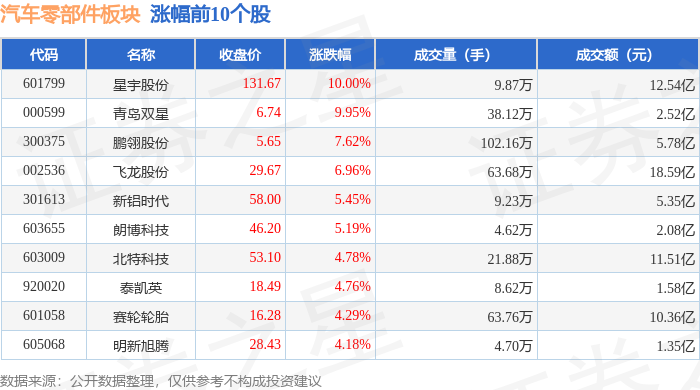
汽车零部件板块1月28日跌1.21%,威唐工业领跌,主力资金净流出35.74亿元
Zheng Xing Xing Ye Ri Bao· 2026-01-28 08:58
Group 1 - The automotive parts sector experienced a decline of 1.21% on January 28, with Weitang Industrial leading the drop [1] - The Shanghai Composite Index closed at 4151.24, up 0.27%, while the Shenzhen Component Index closed at 14342.9, up 0.09% [1] - Notable gainers in the automotive parts sector included Liangyu Co., which rose by 10.00% to a closing price of 131.67, and Qingdao Double Star, which increased by 9.95% to 6.74 [1] Group 2 - Weitang Industrial saw a significant drop of 13.00%, closing at 19.88, with a trading volume of 378,800 shares and a transaction value of 779 million [2] - The automotive parts sector experienced a net outflow of 3.574 billion in main funds, while retail investors saw a net inflow of 2.824 billion [2] - The top net inflows from retail investors included Qingdao Double Star with 92.09 million, while significant outflows were noted in companies like Feilong Co. with a net outflow of 158 million [3]


2026年汽车投资策略
2026-01-28 03:01
Summary of the Conference Call Industry Overview - The conference focused on the automotive industry, specifically strategies and forecasts for 2026, with a review of the automotive market from 2005 to 2025 [1][2]. Key Insights and Arguments 1. **Sales Growth and Valuation**: - Sales growth is a sufficient but not necessary condition for the valuation of the automotive sector to increase. Historical data shows that years with sales growth corresponded with rising valuations, but there were exceptions in years like 2012 and post-2020 [3]. - The automotive sector's valuation tends to respond approximately three months ahead of sales growth before 2020, and this response time has shortened to about one month post-2020 [3]. 2. **Comparison with 2018**: - The year 2026 is expected to mirror 2018, which also faced declining sales due to policy changes. In 2018, the automotive sector began to decline three months before sales dropped significantly [4][5]. 3. **Impact of Policy Changes**: - The introduction of a 5% purchase tax on new energy vehicles in 2026 and changes in subsidy structures are expected to impact demand negatively [1][2]. 4. **Investment Opportunities**: - The focus for 2026 is on new growth areas, particularly in smart driving technologies. Companies in this sector are seen as undervalued, with many trading below 30x P/E ratios while maintaining decent growth rates [7][8]. 5. **Low Valuation and High Growth Stocks**: - Several companies were highlighted as having strong growth potential while being undervalued, including: - **Mastec**: Estimated 20% growth in 2026 with a P/E of 15-16x [10]. - **Yatong**: Expected 30% growth with a P/E of around 20x [10]. - **Fuyou Glass**: Anticipated 15% growth with a P/E of about 15x [11]. - **Weichai Power**: Projected 15% growth with a similar P/E [11]. 6. **Sector-Specific Insights**: - Companies like **Desay SV** and **Kobota** are expected to see significant revenue growth due to their involvement with major clients like Li Auto and NIO, with projected revenues of 90 billion and 21 billion respectively for Q4 [17][21]. - **Huayang Group** is expected to maintain a growth rate of over 20% in 2026, driven by high-margin products [24]. Other Important but Overlooked Content - The conference also discussed the potential risks associated with rising raw material costs, particularly for companies in the forging sector, which could impact earnings realization [13]. - The importance of technological cycles, including the shift towards electric and smart vehicles, was emphasized as a key driver for future growth in the automotive sector [6][7]. - The discussion included a focus on the competitive landscape, with companies like Fuyou Glass expected to benefit from a more favorable market position as competitors exit [30][31]. Conclusion - The automotive industry is facing challenges due to policy changes and market dynamics, but there are significant investment opportunities in undervalued companies with strong growth potential, particularly in the smart driving and electric vehicle segments. The insights from the conference provide a comprehensive overview of the current state and future outlook of the automotive sector.


全球视野看电车之四:德国电车补贴重启,欧洲新能源进一步加速
Changjiang Securities· 2026-01-27 09:15
Investment Rating - The investment rating for the automotive and automotive parts industry is "Positive" and maintained [6]. Core Insights - The German government plans to restart the electric vehicle (EV) subsidy policy that was suspended in 2023, with a total budget of €3 billion (approximately ¥24 billion), aimed at boosting the domestic automotive industry and accelerating the green transition [2][4][18]. - The subsidy will provide between €1,500 and €6,000 for eligible low- to middle-income families purchasing new energy vehicles priced below €45,000, effective from January 1, 2026, until 2029 or until funds are exhausted [18]. - The expected impact of the subsidy is to significantly increase the penetration rate of new energy vehicles in Germany, with projections indicating that at least 500,000 vehicles will be subsidized, accounting for approximately 29.5% of the expected new energy vehicle sales in 2025 [18][21]. Summary by Sections Event Description - On January 19, the German government announced the restart of the EV subsidy policy, with a total budget of €3 billion, to enhance the penetration of new energy vehicles in the market [4][18]. Market Performance - The report indicates that the penetration rate of new energy vehicles in Germany is expected to rise significantly due to the subsidy, with a projected 84,700 new energy vehicles sold in 2025, representing a year-on-year growth of 48.3% [13][18]. - The overall new energy vehicle sales in Europe are projected to reach 3.9 million units in 2025, with a year-on-year increase of 32.7% [13][18]. Implications for Domestic Companies - The subsidy is expected to benefit domestic companies such as BYD, Leapmotor, and SAIC, as many of their models are priced below €45,000 [30]. - The increase in new energy vehicle penetration in Europe is anticipated to positively impact the performance of domestic component manufacturers and vehicle producers operating in the European market [30].



汽车周洞察:汽车行业2025Q4基金持仓分析
Changjiang Securities· 2026-01-27 09:15
Investment Rating - The investment rating for the automotive industry is "Positive" and is maintained [9] Core Insights - In Q4 2025, the fund holding ratio in the automotive industry slightly increased to 4.35%, up by 0.02 percentage points from the previous quarter, indicating an overall overweight of 0.14% compared to the market capitalization of automotive stocks in A-shares [2][5] - The configuration ratio for automotive manufacturing decreased to 1.04%, down by 0.12 percentage points, while the configuration ratio for automotive parts increased to 3.31%, up by 0.14 percentage points [5] - The wholesale sales of passenger vehicles in Q4 2025 reached 8.846 million units, showing a year-on-year decrease of 0.3% but a quarter-on-quarter increase of 15.1% [5] Summary by Sections Market Performance - The A-share automotive sector increased by 2.15%, outperforming the CSI 300 index which decreased by 0.62% [28] - Among sub-sectors, commercial vehicle parts rose by 7.36%, while automotive sales and services fell by 5.74% [28] Fund Holdings - The top fifteen fund holdings in the automotive sector for Q4 2025 include Fuyao Glass, Slin Intelligent Drive, and Sailun Tire, with significant inflows into Slin Intelligent Drive and outflows from Jianghuai Automobile [6][17] Investment Recommendations - The report emphasizes three main investment themes: 1. Overseas expansion with recommendations for companies like Minth Group and BYD 2. High-end passenger vehicles and parts with a focus on companies like Geely and Ideal Automotive 3. Embracing AI technology with recommendations for companies like Top Group and Xpeng Motors [7][22][23]


【汽车零部件&机器人主线周报】宇树公开2025年销量,马斯克宣称2027年底人形机器人将ToC
东吴汽车黄细里团队· 2026-01-26 12:15
Investment Highlights - The SW auto parts index increased by 3.85% this week, ranking second in the SW auto sector, with a year-to-date increase of 9.12% [3][14] - The latest trading day PE (TTM) for SW auto parts is at the 90.08% historical percentile, while PB (LF) is at the 83.70% historical percentile [3][38] Robotics Sector Review - The Wande Robotics Index rose by 1.38% this week, with a year-to-date increase of 7.07%, underperforming the SW auto parts sector by 2.47% [4][40] - The latest trading day PE (TTM) for Wande Robotics is at the 94.65% historical percentile, and PB (LF) is at the 96.30% historical percentile [4][45] Core Coverage Stocks Weekly Performance - Notable weekly gains include: New Coordinates +36.30%, Minshi Group +25.33%, Daimai Co. +12.57%, Top Group +11.30%, and Xusheng Group +9.87% [6][52] Major Events This Week - Elon Musk announced plans to sell Tesla's humanoid robot to the public by the end of 2027 [7][46] - Yushu announced its humanoid robot sales for 2025, exceeding 5,500 units [8][46] Investment Recommendations - For auto parts, focus on structural opportunities by selecting product-oriented companies and those entering high-value sectors to increase ASP, with a priority on establishing capacities in Europe, North America, and Southeast Asia [9][57] - In robotics, seek certainty in opportunities, particularly with the anticipated release of Optimus V3 in Q1 2026, and monitor order timelines and application developments from domestic companies like Xiaopeng, Yushu, and Zhiyuan [9][57]



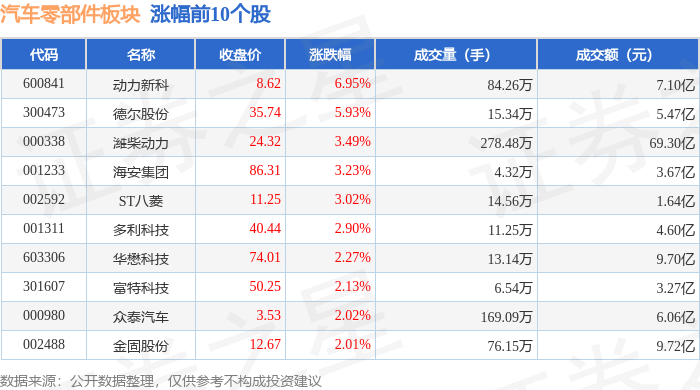
汽车零部件板块1月26日跌3.19%,超捷股份领跌,主力资金净流出84.31亿元
Zheng Xing Xing Ye Ri Bao· 2026-01-26 09:37
Market Overview - The automotive parts sector experienced a decline of 3.19% on January 26, with Chaojie Co., Ltd. leading the drop [1] - The Shanghai Composite Index closed at 4132.61, down 0.09%, while the Shenzhen Component Index closed at 14316.64, down 0.85% [1] Stock Performance - Notable gainers in the automotive parts sector included: - Dongli New Science (600841) with a closing price of 8.62, up 6.95% [1] - Deler Co., Ltd. (300473) at 35.74, up 5.93% [1] - Weichai Power (000338) at 24.32, up 3.49% [1] - Major decliners included: - Chaojie Co., Ltd. (301005) at 192.42, down 12.53% [2] - Kaizhong Co., Ltd. (603037) at 17.97, down 10.02% [2] - Zhejiang Rongtai (611809) at 109.79, down 10.00% [2] Capital Flow - The automotive parts sector saw a net outflow of 8.431 billion yuan from institutional investors, while retail investors contributed a net inflow of 6.115 billion yuan [2] - The sector's overall capital flow indicates a mixed sentiment among different investor types [2] Individual Stock Capital Flow - Key stocks with significant capital inflow included: - Huamao Technology (603306) with a net inflow of 1.36 billion yuan from institutional investors [3] - Fuyou Glass (600660) with a net inflow of 1.31 billion yuan [3] - Stocks with notable outflows included: - Wisdom Agriculture (000816) with a net outflow of 87.317 million yuan from retail investors [3] - Dongli New Science (600841) with a net outflow of 39.524 million yuan from retail investors [3]