HAIER SMART HOME(600690)

Search documents
2025年中国立式吸尘器行业发展历程、产业链、市场规模、重点品牌及未来前景展望:家庭清洁便捷化需求显著,推动立式吸尘器规模超百亿元[图]
Chan Ye Xin Xi Wang· 2025-09-30 01:28
Core Insights - The upright vacuum cleaner market in China is experiencing significant growth, driven by rising living standards and changing consumer attitudes towards home cleanliness, with a market size projected to grow from 3.96 billion yuan in 2019 to 10.8 billion yuan by 2024, representing a compound annual growth rate (CAGR) of 22.22% [1][10] - The industry is characterized by a competitive landscape with both foreign and domestic brands, including major players like Dyson, Philips, and local brands such as Midea and Haier [5][11] Industry Overview - Upright vacuum cleaners are electric-powered cleaning tools primarily composed of motors, centrifugal fans, filters, and attachments, with power ratings typically ranging from 400 to 1000W or higher [3] - The application areas include carpets, vehicle interiors, and general household cleaning [3] Industry Development History - The upright vacuum cleaner industry in China has evolved through several stages: initial development from 1950-1960, transformation from 1970-1980, and rapid growth from 2000 to present [5] - Key milestones include the introduction of the first household vacuum cleaner in China in 1986 and the innovation of cordless vacuum cleaners by brands like Dyson in the 2010s [6] Industry Value Chain - The value chain consists of upstream raw materials and components, midstream manufacturing, and downstream sales channels, including supermarkets, specialty stores, and e-commerce platforms [6] Current Market Size and Growth - The overall vacuum cleaner market in China is projected to grow from 19.8 billion yuan in 2019 to 43.2 billion yuan by 2024, with a CAGR of 16.89% [9] Competitive Landscape - The market is divided into foreign brands, domestic strong brands, and numerous smaller brands, with foreign brands holding a significant market share due to their technological advancements and brand reputation [10][11] - Domestic brands like Midea and Haier are gaining traction by leveraging local market knowledge and distribution channels [10] Future Trends - The industry is moving towards increased intelligence, with products integrating various sensors and smart algorithms for enhanced user experience [14] - Customization is becoming a key focus, with companies offering tailored solutions for diverse cleaning needs [15] - Personalization in design and user interaction is also emerging as a significant trend, catering to different consumer preferences [16]



家电行业加速破内卷塑生态
Xin Lang Cai Jing· 2025-09-29 23:02
Core Viewpoint - The China Household Electrical Appliances Association has issued an initiative to strengthen self-discipline and fair competition in the home appliance industry, aiming to shift from price wars to value wars and promote high-quality development [1][2]. Group 1: Industry Challenges - The home appliance industry is currently facing "involution" characterized by vicious low-price competition, misleading marketing practices, and counterfeit products, which hinder the industry's progress towards high-quality development [1][2]. - The initiative highlights the need for a fair competitive environment to foster healthy industry growth and emphasizes the importance of respecting intellectual property and enhancing technological innovation [1][2]. Group 2: Initiative Details - The initiative firmly opposes all forms of unfair competition, setting clear "red lines" for the industry, including prohibiting below-cost dumping and false advertising [2]. - It calls for strict adherence to laws and industry self-regulation, urging companies to focus on innovation, product quality, and service improvement to create a sustainable industry ecosystem [2]. Group 3: Industry Response - Leading companies such as Haier and Midea have quickly responded to the initiative, aligning their long-term strategies with its goals, shifting their competitive focus from price to technology and ecosystem [3]. - Haier emphasizes that the ultimate battleground for competition is in consumer perception, committing to disruptive innovation and superior service without compromising quality [3]. - Midea is developing an industrial internet platform to enhance efficiency across the supply chain, promoting the idea of "collaborative sharing" mentioned in the initiative [3]. - Other companies like Gree and Hisense are focusing on intellectual property protection and product quality, advocating for stricter enforcement of industry infringement penalties [3].
年内167家公司已实施员工持股计划 总金额超过去年全年
Zheng Quan Shi Bao· 2025-09-29 18:18
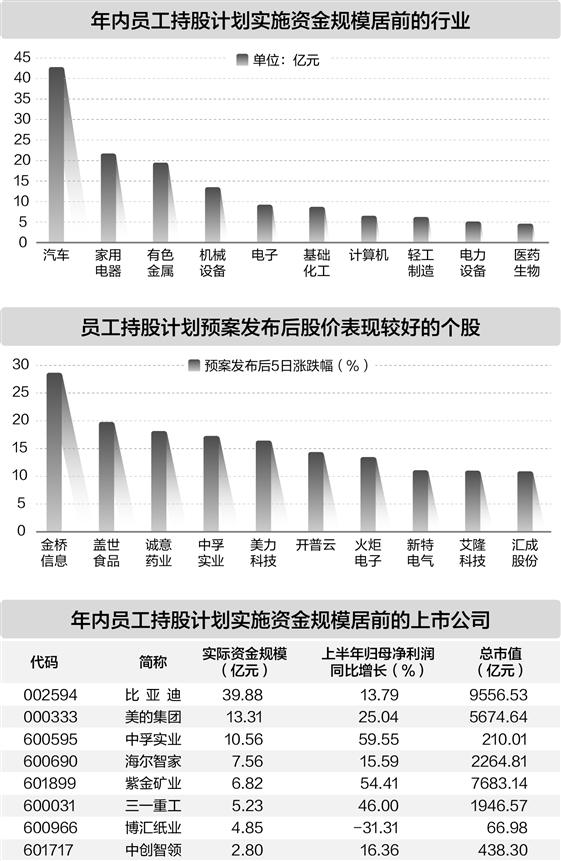
Core Viewpoint - The implementation of employee stock ownership plans (ESOPs) has gained popularity among listed companies, with the total amount exceeding last year's figures, indicating a stronger commitment to aligning employee interests with company growth [4][6]. Group 1: Implementation and Financial Data - As of September 29, 2023, 167 listed companies have implemented ESOPs, with 144 companies disclosing a total funding amount of 15.399 billion yuan, surpassing last year's total of 12.699 billion yuan [4]. - Among the companies, BYD has the highest investment in its ESOP at 3.988 billion yuan, followed by Midea Group at 1.331 billion yuan, and Zhongfu Industrial at 1.056 billion yuan [6]. - The automotive industry leads in ESOP funding with 4.277 billion yuan, followed by home appliances at 2.165 billion yuan, non-ferrous metals at 1.948 billion yuan, and machinery at 1.349 billion yuan [5]. Group 2: Stock Performance Post-Announcement - Following the announcement of ESOPs, 94 out of the 144 companies experienced stock price increases within five trading days, with 18 companies seeing price rises exceeding 10% [5]. - Zhongfu Industrial's stock price surged by 63.24% after the announcement of its ESOP, reflecting strong market confidence [6]. Group 3: Performance Targets and Governance - Some companies have set performance targets within their ESOPs to better align employee interests with company performance, enhancing governance [7]. - BYD's ESOP requires a minimum revenue growth rate of 10% for the years 2025-2027, while Midea Group aims for a weighted average return on equity of no less than 18% during the same period [7]. - A significant portion of companies with ESOPs reported positive profit growth, with 74.31% of the 144 companies showing an increase in net profit attributable to shareholders [8].




海尔智家(06690)9月29日斥资784.26万元回购31万股A股
Zhi Tong Cai Jing· 2025-09-29 13:17
(原标题:海尔智家(06690)9月29日斥资784.26万元回购31万股A股) 智通财经APP讯,海尔智家(06690)发布公告,于2025年9月29日,该公司斥资784.26万元回购31万股A 股。 ...
海尔智家9月29日斥资784.26万元回购31万股A股
Zhi Tong Cai Jing· 2025-09-29 12:38
海尔智家(600690)(06690)发布公告,于2025年9月29日,该公司斥资784.26万元回购31万股A股。 ...
海尔智家(06690.HK)9月29日耗资784万元回购31万A股
Ge Long Hui· 2025-09-29 12:30
Group 1 - The company Haier Smart Home (06690.HK) announced a share buyback on September 29, spending 7.84 million yuan to repurchase 310,000 A-shares [1]
海尔智家(06690) - 翌日披露报表
2025-09-29 12:25
FF305 翌日披露報表 (股份發行人 ── 已發行股份或庫存股份變動、股份購回及/或在場内出售庫存股份) 表格類別: 股票 狀態: 新提交 公司名稱: 海爾智家股份有限公司 呈交日期: 2025年9月29日 如上市發行人的已發行股份或庫存股份出現變動而須根據《香港聯合交易所有限公司(「香港聯交所」)證券上市規則》(「《主板上市規則》」)第13.25A條 / 《香港聯合交易所有限公司GEM證券 上市規則》(「《GEM上市規則》」)第17.27A條作出披露,必須填妥第一章節 。 | 第一章節 | | | | | | | | --- | --- | --- | --- | --- | --- | --- | | 1. 股份分類 | 普通股 | 股份類別 A | | 於香港聯交所上市 | 否 | | | 證券代號 (如上市) | 600690 | 說明 | 每股面值人民幣1元之普通股(A股) (於上海證券交易所上市) | | | | | A. 已發行股份或庫存股份變動 | | | | | | | | 事件 | | 已發行股份(不包括庫存股份)變動 | 佔有關事件前的現有已發 | 庫存股份變動 | 每股發行/出售價 ...
白电销量第一后发力电商,海尔东南亚购物节增长超3倍
Jin Tou Wang· 2025-09-29 09:48
Core Insights - The Southeast Asian e-commerce market is experiencing rapid growth driven by internet penetration and a young consumer base. Haier has capitalized on this trend, achieving significant online sales growth and leading the refrigerator category in the region [1][2]. Group 1: Sales Performance - Haier's e-commerce sales during the "99 Super Sale" event saw a remarkable 97% month-on-month increase and a 315% year-on-year increase. Key markets such as Thailand, Vietnam, the Philippines, Indonesia, and Malaysia all exceeded 100% completion rates, with Indonesia and Thailand achieving 100% month-on-month growth [1]. - Core product categories, including refrigerators, washing machines, air conditioners, and televisions, all experienced substantial growth, with completion rates surpassing 100% [1]. Group 2: Product Strategy - Haier Southeast Asia has tailored its product offerings to local consumer habits, introducing smart ice-making and Space Fit series refrigerators that align with local home decor styles while enhancing preservation performance and energy efficiency to meet the rising demand for mid-to-high-end products [2]. Group 3: Customer Engagement - The company has implemented a zero-distance user interaction strategy, inviting customers to co-create content and share experiences online, while also organizing offline activities such as cooking challenges and family interactions to enhance brand connection [2]. Group 4: Service and Digitalization - Haier has adopted a "5S service model" in Southeast Asia, replicating its domestic standards to address customer service concerns, achieving a 99% customer satisfaction rate. The company has also upgraded its processes digitally, ensuring a seamless experience for users throughout the entire purchasing journey [2]. - During the "99 Super Sale," the e-commerce customer service response rate was 100%, with over one million inquiries handled [2].
海尔智家跌0.66%,成交额12.00亿元,后市是否有机会?
Xin Lang Cai Jing· 2025-09-29 07:09
Core Viewpoint - Haier Smart Home's stock experienced a slight decline of 0.66% on September 29, with a trading volume of 1.2 billion yuan and a market capitalization of 239.733 billion yuan [1]. Company Overview - Haier Group, founded in 1984, has expanded from producing refrigerators to a wide range of sectors including home appliances, IT, logistics, finance, real estate, and biopharmaceuticals, becoming a global leader in providing solutions for a better life [2]. - The company holds a 10.2% share of the global retail volume in 2014, maintaining its position as the world's largest brand in major home appliances for six consecutive years [2]. Shareholder Structure - The top ten circulating shareholders include Central Huijin Asset Management Co., Ltd. and China Securities Finance Corporation [3]. - Haier Wireless, a subsidiary focused on wireless charging, has participated in setting national industry standards for electromagnetic compatibility and radiation, and has invested in Intel's wireless charging technology team [3]. Business Operations - Haier Smart Home's main business involves the research, production, and sales of home appliances, including refrigerators, kitchen appliances, air conditioners, washing machines, and smart home solutions [3]. - The revenue composition includes: refrigerators 27.17%, air conditioners 20.94%, washing machines 20.22%, kitchen appliances 13.10%, equipment and channel services 11.97%, water appliances 6.11%, and others 0.48% [7]. Financial Performance - For the first half of 2025, Haier Smart Home achieved a revenue of 156.494 billion yuan, representing a year-on-year growth of 15.39%, and a net profit attributable to shareholders of 12.033 billion yuan, up 15.48% year-on-year [7]. - The company has distributed a total of 46.155 billion yuan in dividends since its A-share listing, with 21.766 billion yuan distributed in the last three years [8]. Institutional Holdings - As of June 30, 2025, Hong Kong Central Clearing Limited is the fifth largest circulating shareholder with 450 million shares, a decrease of 131 million shares from the previous period [9]. - Huaxia SSE 50 ETF and Huatai-PineBridge CSI 300 ETF are also among the top ten circulating shareholders, with respective holdings of 73.637 million shares and 66.918 million shares [9].
行业聚焦:全球三筒洗衣机市场头部企业份额调研(附Top5 厂商名单)
QYResearch· 2025-09-29 01:56
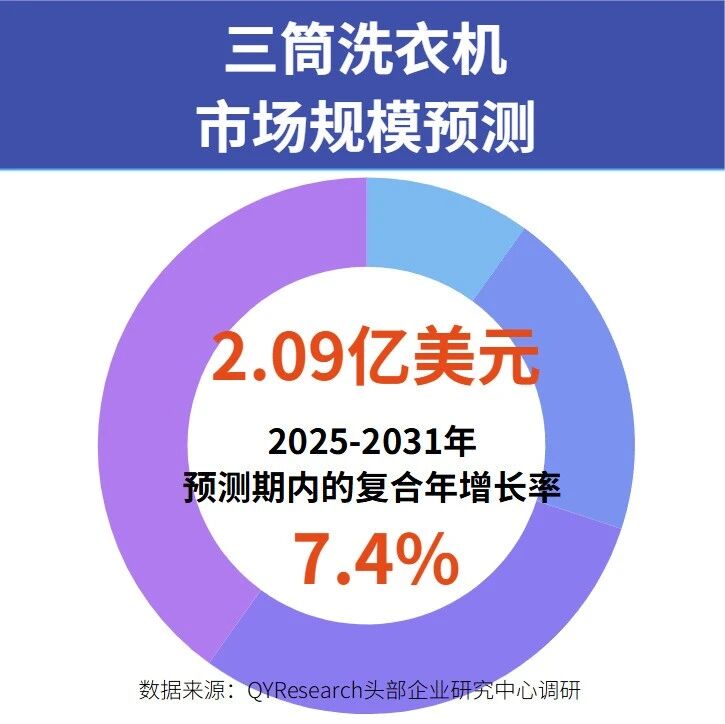
Core Viewpoint - The three-tub washing machine is an innovative high-end product in the global home appliance sector, designed for high-income households and tech-savvy consumers seeking efficiency and space optimization. It allows simultaneous washing of different types of clothing, significantly enhancing convenience and saving time [2][10]. Market Overview - The global market for three-tub washing machines is in its emerging stage, with a projected market size of $126 million in 2024, expected to grow to $209 million by 2031, reflecting a compound annual growth rate (CAGR) of 7.4% from 2025 to 2031 [2][10]. Industry Development Trends - **Continuous Technological Innovation**: The technology of three-tub washing machines is evolving, with features like independent operation of each tub, specialized water intake, drainage systems, and washing programs. High-end models also include drying functions, improving washing efficiency and reducing noise [7]. - **User-Centric Design Philosophy**: There is a growing demand for health-conscious washing solutions that prevent cross-contamination. The three-tub washing machine meets this need by allowing for categorized washing based on fabric type and dirt level [7]. - **Intensifying Market Competition**: The market is becoming increasingly competitive, with brands like Haier, Little Swan, and Hisense entering the fray, leading to heightened competition in technology, pricing, and marketing strategies [7]. Development Opportunities - **Growing Demand for Healthy Washing**: As consumer awareness of hygiene increases, the ability of three-tub washing machines to isolate different types of clothing presents a significant market opportunity [8]. - **Addressing Space Constraints in Small Homes**: The compact design of three-tub washing machines offers a solution for small households, combining washing and drying functions in a space-efficient manner [8]. - **Expansion into Commercial Applications**: Beyond residential use, there is potential for three-tub washing machines in commercial settings such as hotels and laundromats, further expanding market opportunities [8]. Challenges in the Industry - **High Production Costs**: The complexity of manufacturing three-tub washing machines results in higher production costs compared to single-tub models, which may limit market penetration, especially among price-sensitive consumers [8]. - **Intense Market Competition**: The market is characterized by fierce competition, with many products lacking genuine innovation beyond the additional tub feature, necessitating continuous improvement in service quality and product offerings [8]. - **Technological Limitations**: Current models face challenges related to noise reduction, vibration control, and space utilization, indicating a need for further technological advancements [8]. Future Outlook - The future development of three-tub washing machines is expected to be influenced by advancements in compact design, inverter and direct-drive motor technologies, AI-based washing cycle optimization, and eco-friendly water and energy-saving systems. The demand for smart, time-saving appliances in urban areas is likely to drive growth beyond the luxury market segment [10].