
HASCO(600741)

Search documents
华域汽车系统股份有限公司关于参加2025年上海辖区上市公司三季报集体业绩说明会的公告
Shang Hai Zheng Quan Bao· 2025-11-05 19:35
Core Viewpoint - Huayu Automotive Systems Co., Ltd. will participate in the 2025 Shanghai-listed companies' third-quarter collective performance briefing on November 13, 2025, to address investor concerns and provide insights into its operational results and financial status [2][3]. Group 1: Event Details - The performance briefing will be held online on November 13, 2025, from 15:00 to 16:30 [6][7]. - Investors can participate by logging into the Shanghai Stock Exchange Roadshow Center website [5][6]. - The company encourages investors to submit questions from November 6 to November 12, 2025, for discussion during the briefing [2][5]. Group 2: Participants - The briefing will include the company's General Manager, Independent Directors, Chief Financial Officer, and Board Secretary, with potential adjustments based on special circumstances [4]. Group 3: Contact Information - For inquiries, investors can contact the Board Office at +86 21 23102080 or via email at huayuqiche@hasco-group.com [8].

延锋汽车饰件(常州)有限公司成立
Zheng Quan Ri Bao· 2025-11-05 11:41
Core Viewpoint - Recently, a new company named Yanfeng Automotive Trim (Changzhou) Co., Ltd. was established with a registered capital of 25 million yuan, focusing on the manufacturing and research of automotive parts and accessories [1] Company Summary - Yanfeng Automotive Trim (Changzhou) Co., Ltd. is fully owned by Yanfeng International Automotive Technology Co., Ltd., a subsidiary of Huayu Automotive [1] - The company's business scope includes manufacturing automotive parts and accessories, research and development of automotive components, and wholesale of automotive spare parts [1]
华域汽车(600741) - 华域汽车关于参加2025年上海辖区上市公司三季报集体业绩说明会的公告
2025-11-05 08:15
证券代码:600741 证券简称:华域汽车 公告编号:临 2025-029 华域汽车系统股份有限公司 关于参加 2025 年上海辖区上市公司三季报 集体业绩说明会的公告 本公司董事会及全体董事保证本公告内容不存在任何虚假记载、误导性陈 述或者重大遗漏,并对其内容的真实性、准确性和完整性承担法律责任。 重要内容提示: 华域汽车系统股份有限公司(以下简称"公司")已于 2025 年 10 月 30 日发布公司 2025 年第三季度报告。为使投资者更加全面、深入 地了解公司的经营成果、财务状况,公司计划于 2025 年 11 月 13 日 (星期四)15:00-16:30 参加 2025 年上海辖区上市公司三季报集体业 绩说明会,就投资者关心的问题进行交流。 1 会议召开时间: 2025 年 11 月 13 日(星期四)15:00-16:30 会 议 召 开 地 点 : 上 海 证 券 交 易 所 上 证 路 演 中 心 ( 网 址 : http://roadshow.sseinfo.com/) 会议召开方式:上证路演中心网络互动 投资者可于 2025 年 11 月 6 日(星期四)至 11 月 12 日(星期三) ...
华域汽车在常州成立饰件公司,注册资本2500万
Xin Lang Cai Jing· 2025-11-05 03:41
Core Insights - A new company, Yanfeng Automotive Trim (Changzhou) Co., Ltd., has been established with a registered capital of 25 million RMB [1] - The company is fully owned by Yanfeng International Automotive Technology Co., Ltd., a subsidiary of Huayu Automotive [1] Company Overview - The legal representative of the new company is Ma Yanhua [1] - The business scope includes manufacturing and research of automotive parts and components, as well as wholesale of automotive spare parts [1]
红利策略仍具配置价值,300红利低波ETF(515300)逆市红盘冲击3连涨!
Sou Hu Cai Jing· 2025-11-05 03:04
Group 1 - The core viewpoint indicates that the "insurance capital + industrial capital" may become an important source of incremental funds for the banking sector in the future [2] - The banking sector's holdings are at a historical low, revealing investment value, and the dividend strategy continues to hold allocation value [2] - The dividend sector shows greater allocation value during low interest rate periods, with excess returns negatively correlated with government bond yields [2] Group 2 - As of October 31, 2025, the top ten weighted stocks in the CSI 300 Dividend Low Volatility Index include China Shenhua, Shuanghui Development, Sinopec, Gree Electric Appliances, and others, accounting for a total of 35.78% [2] - The CSI 300 Dividend Low Volatility ETF has seen a net value increase of 59.42% over the past five years, ranking 81 out of 1033 index equity funds [1] - The ETF's highest single-month return since inception was 13.89%, with the longest consecutive monthly gain being five months and a maximum increase of 14.56% [1]






2025Q3业绩综述:乘用车、零部件略有承压,商用车、摩托车表现更佳
Soochow Securities· 2025-11-03 11:58
Group 1: Overall Market Performance - The overall performance of the passenger car sector in Q3 2025 was below expectations, primarily due to a slowdown in industry growth and intensified competition across all price segments[3] - The passenger car industry saw a year-on-year growth rate of only 3% in retail sales, 23% in exports, and 13% in wholesale during Q3 2025, indicating a significant deceleration compared to previous quarters[27] - The inventory levels in the industry remain healthy, with a controlled increase in stock despite the overall market pressures[27] Group 2: Segment-Specific Insights - Heavy-duty trucks experienced a strong performance in Q3 2025, with wholesale, domestic, and export sales increasing by 58.1%, 64.5%, and 22.9% year-on-year, respectively[5] - The bus sector also performed well, with leading companies like Yutong achieving significant revenue growth, driven by robust demand from both domestic and international markets[6] - The motorcycle segment saw a 57.4% increase in large-displacement motorcycle exports, while domestic sales faced pressure, declining by 9.3% year-on-year[7] Group 3: Financial Metrics and Adjustments - The average selling price (ASP) for vehicles remained stable in Q3 2025, with some companies like BYD implementing price increases starting in July[3] - The gross profit margins for many companies showed slight recovery, attributed to stable sales and limited discounting in the market[3] - Several companies, including Great Wall Motors and Changan, reported a decline in net profit due to foreign exchange losses and inventory adjustments[4]


89家公司年内分红金额超10亿元,300红利低波ETF(515300)红盘蓄势,机构:红利板块或仍有演绎配置机会
Xin Lang Cai Jing· 2025-11-03 02:56
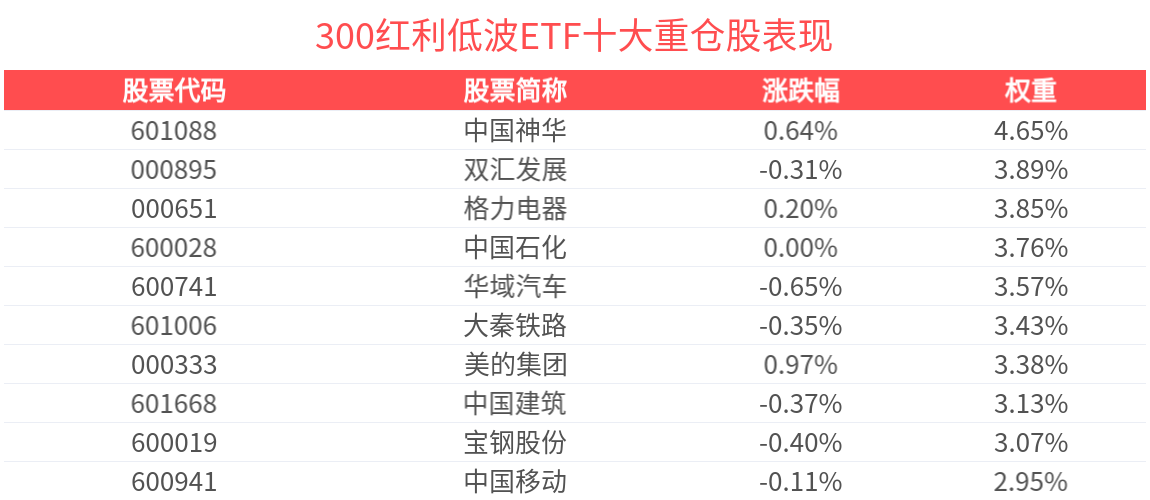
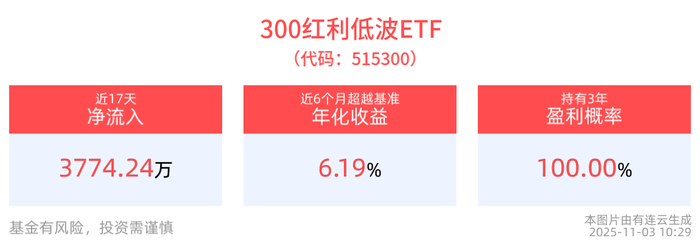
Core Insights - The CSI 300 Dividend Low Volatility Index has shown a positive performance with a 0.58% increase, driven by significant gains in stocks such as Baosteel and China Construction Bank [1][4] - The CSI 300 Dividend Low Volatility ETF (515300) has also increased by 0.45%, indicating strong investor interest and market activity [1][3] Market Performance - The CSI 300 Dividend Low Volatility ETF recorded a turnover rate of 0.92% with a transaction volume of 43.38 million yuan, reflecting active trading [3] - The ETF's latest scale reached 4.704 billion yuan, with a net inflow of 37.74 million yuan over the past 17 trading days, indicating a positive trend in investor sentiment [3] Dividend Distribution - As of October 31, 2025, a total of 1,033 listed companies have announced cash dividend plans, an increase of 141 companies compared to the previous year, with total cash dividends amounting to 734.9 billion yuan [3] - Notably, 89 companies have declared dividends exceeding 1 billion yuan within the year [3] Investor Sentiment - Market sentiment indicators have returned to a neutral zone, but there remains a willingness among investors to "buy the dip," suggesting that adjustments may present further investment opportunities [4] - The top ten weighted stocks in the CSI 300 Dividend Low Volatility Index account for 35.78% of the index, with companies like China Shenhua and Shuanghui Development leading the way [4][6] Stock Performance - The top performing stocks within the index include China Shenhua (up 1.93%), Shuanghui Development (up 1.59%), and China Petroleum (up 1.65%), while some stocks like Gree Electric and Huayu Automotive experienced declines [6] - Investors without stock accounts can access investment opportunities through the corresponding CSI 300 Dividend Low Volatility ETF linked fund (007606) [6]

华域汽车
2025-11-01 12:41
Summary of the Conference Call for Huayu Automotive's Q3 Financial Results Company Overview - **Company**: Huayu Automotive - **Event**: Q3 Financial Results Conference Call Key Financial Metrics - **Total Revenue**: 130.8 billion CNY, a year-on-year increase of 9.51% [5] - **Net Profit Attributable to Parent Company**: 4.688 billion CNY, a year-on-year increase of 4.79% [5] - **Basic Earnings Per Share**: 1.487 CNY [5] - **Net Cash Flow from Operating Activities**: 9.977 billion CNY, a year-on-year increase of 77.56% [5] - **Total Assets**: 198.244 billion CNY, a year-on-year increase of 7.16% [6] - **Equity Attributable to Parent Company**: 64.725 billion CNY, a year-on-year increase of 4.32% [6] - **Debt-to-Asset Ratio**: 65.41%, an increase of 1.15 percentage points from the previous year [6] Revenue Breakdown by Segment - **Interior and Exterior Trim**: Significant revenue growth due to recovery in vehicle production and sales [7] - **Metal Forming and Molds**: Revenue increased by 7.6% [7] - **Electronics and Electrical**: Slight decline of 2.6% [7] - **Heat Processing Components**: Decrease of 39.7% due to business restructuring and exit from high-energy consumption sectors [7] Profitability Insights - **Overall Profit Growth**: Approximately 5% increase in profit, slightly lower than revenue growth due to competitive pricing pressures in the automotive market [8] - **Investment Income Contribution**: 2.2 billion CNY increase in investment income compared to the previous year, primarily from joint ventures [9] Challenges and Market Conditions - **Increased Competition**: The automotive market is experiencing intensified competition, leading to pricing pressures [8] - **Impact of Price Wars**: Ongoing price wars in the vehicle market are affecting profit margins [8] - **Taxation Changes**: Anticipated increases in purchase tax for new energy vehicles may impact future profitability [28] Cash Flow and Working Capital Management - **Accounts Receivable**: Increased by 12.5% due to prolonged payment terms amid price negotiations [12] - **Inventory Management**: Inventory increased by only 2%, indicating effective control over working capital [13] - **Cash Flow Improvement**: Significant improvement in cash flow from operating activities, supported by enhanced collection efforts [14] Future Outlook - **Investment Plans**: Continued focus on investments in electric and lightweight technologies, with a cautious approach to capital expenditure [17] - **International Expansion**: Plans to leverage opportunities in North America and Europe, particularly in response to the growing demand for new energy vehicles [33][34] - **Product Development**: Ongoing discussions with European OEMs to expand product offerings, particularly in new energy vehicle segments [42] Analyst Questions and Management Responses - **Solid-State Battery Investment**: The impact of solid-state battery investments will be assessed in future reports as they are not yet included in current financials [22] - **Customer Payment Terms**: Challenges remain in achieving shorter payment terms, with ongoing negotiations to improve cash flow [24] - **Profitability by Customer Type**: Profitability varies significantly by product and customer type, with ongoing efforts to enhance product value and maintain margins [46] Conclusion - Huayu Automotive reported solid financial performance in Q3, with growth in revenue and net profit despite challenges from market competition and pricing pressures. The company is strategically positioning itself for future growth through investments in new technologies and international expansion.
华域汽车(600741):盈利能力同环比改善,收购上汽清陶股权布局固态电池业务
Orient Securities· 2025-11-01 09:13
Investment Rating - The report maintains a "Buy" rating for the company with a target price of 27.69 CNY, based on a comparable company PE average valuation of 13 times for 2025 [3][6]. Core Insights - The company has improved its profitability on a quarter-on-quarter basis and has acquired a 49% stake in SAIC Qingtao, positioning itself in the solid-state battery business [2][9]. - The company expects continued growth in revenue and profitability, driven by the recovery in sales from SAIC Group and an increase in revenue from external customers [9]. - The forecasted EPS for 2025-2027 is 2.13, 2.28, and 2.32 CNY respectively, with slight adjustments made to gross margin and expense ratios [3]. Financial Summary - **Revenue Forecast**: The company anticipates revenues of 168,594 million CNY in 2023, growing to 197,815 million CNY by 2027, reflecting a CAGR of approximately 5.2% [5][10]. - **Net Profit**: The net profit attributable to the parent company is projected to be 7,214 million CNY in 2023, with a slight increase to 7,316 million CNY by 2027 [5][11]. - **Profitability Ratios**: The gross margin is expected to improve from 13.1% in 2023 to 13.3% in 2026 and 2027, while the net margin is projected to decrease slightly from 4.3% in 2023 to 3.7% in 2027 [5][10]. - **Earnings Per Share (EPS)**: EPS is forecasted to be 2.29 CNY in 2023, slightly decreasing to 2.12 CNY in 2024, and then gradually increasing to 2.32 CNY by 2027 [5][11].
汽车行业“千亿元营收阵营”扩容 比亚迪前三季度以5662.66亿元营收稳居首位
Zheng Quan Ri Bao· 2025-10-31 15:59
Core Insights - The automotive industry in China is experiencing a significant transformation, with a total revenue of 3.23 trillion yuan and a net profit of 131.56 billion yuan for the first three quarters of 2023, reflecting a year-on-year growth of 8.19% and 3.36% respectively [1] - The new energy vehicle (NEV) sector continues to drive growth, with NEV production and sales reaching 11.24 million and 11.22 million units, marking a year-on-year increase of 35.2% and 34.9% [2] - The industry is witnessing a pronounced differentiation among companies, with some experiencing significant sales declines while others report substantial growth [3] Industry Performance - The overall automotive production and sales in China for the first three quarters reached 24.33 million and 24.36 million units, showing year-on-year growth of 13.3% and 12.9% respectively [2] - The passenger vehicle market outperformed the commercial vehicle market, with passenger vehicle production and sales at 21.24 million units, reflecting a growth of 13.9% and 13.7% [2] Company Performance - BYD led the industry with sales of 3.26 million units, a year-on-year increase of 18.64%, while SAIC Group followed closely with 3.19 million units, growing by 20.53% [3] - Some companies, such as GAC Group and JAC Motors, reported significant sales declines of 11.34% and 10.66% respectively [3] - BYD's revenue for the first three quarters was 566.27 billion yuan, a 12.75% increase, while SAIC Group reported 461.22 billion yuan, growing by 9.91% [4] Profitability Trends - BYD maintained its position as the industry's profit leader with a net profit of 23.33 billion yuan, although this represented a decline of 7.55% year-on-year [5] - Several traditional automakers, including GAC Group and BAIC Blue Valley, faced losses, indicating challenges during the industry's transition [5] - Commercial vehicle manufacturers like Foton Motor and China National Heavy Duty Truck reported significant profit recoveries, with Foton's net profit increasing by 1764.21% in the third quarter [5] Market Dynamics - The automotive industry is currently characterized by intense competition and price wars, which have pressured profit margins despite rising sales and revenue [6] - The demand for commercial vehicles has surged, contributing to the profitability of commercial vehicle manufacturers [6]



