
CNOOC(600938)

Search documents
中国海洋石油第一季度IFRS净利润365.6亿元 同比下降7.9%
news flash· 2025-04-29 08:39
Group 1 - The company reported a revenue of 106.854 billion RMB for the first quarter, representing a year-on-year decrease of 4.1% [1] - The net profit for the first quarter was 36.563 billion RMB, showing a year-on-year decline of 7.9% [1]
中国海洋石油(00883) - 2025 Q1 - 季度业绩
2025-04-29 08:32
Financial Performance - CNOOC Limited reported a revenue of RMB 106,854 million for Q1 2025, a decrease of 4.1% compared to RMB 111,468 million in the same period last year[6]. - The net profit attributable to shareholders was RMB 36,563 million, down 7.9% from RMB 39,719 million year-on-year[6]. - The cash flow from operating activities was RMB 57,274 million, reflecting a decline of 4.5% from RMB 59,978 million in the previous year[6]. - The company's oil and gas sales revenue for Q1 2025 was approximately RMB 88.27 billion, a decrease of 1.9% year-on-year due to falling oil prices[15]. - Operating profit for Q1 2025 was RMB 49,927 million, down 5.7% from RMB 52,597 million in Q1 2024[21]. - Net profit for Q1 2025 was RMB 36,601 million, a decline of 7.1% from RMB 39,726 million in Q1 2024[22]. Production and Sales - In Q1 2025, the company's total net production reached 188.8 million barrels of oil equivalent, an increase of 4.8% year-on-year[14]. - The company's net production in China was 130.8 million barrels of oil equivalent, up 6.2% year-on-year, primarily due to contributions from the Bozhong 19-6 oil and gas field[14]. - Natural gas sales increased by 15.8% to RMB 13,635 million, compared to RMB 11,774 million in the previous year[10]. Pricing and Costs - The average realized price for crude oil was USD 72.65 per barrel, a decrease of 7.7% from USD 78.75 per barrel in the same quarter last year[10]. - The average realized gas price was $7.78 per thousand cubic feet, an increase of 1.2% year-on-year[15]. - The Brent crude oil futures average price for Q1 2025 was $74.98 per barrel, down 8.3% year-on-year[14]. Assets and Liabilities - Total assets at the end of the reporting period were RMB 1,102,706 million, representing a 4.4% increase from RMB 1,056,281 million at the end of the previous year[6]. - Total liabilities as of March 31, 2025, amounted to RMB 316,922 million, up from RMB 306,845 million at the end of 2024[20]. - The total equity attributable to shareholders of the parent company increased to RMB 783,824 million as of March 31, 2025, from RMB 747,548 million at the end of 2024[20]. Cash Flow and Financing - Cash flow from investing activities for Q1 2025 was negative RMB 35,408 million, compared to negative RMB 33,884 million in Q1 2024[24]. - The company reported a basic earnings per share of RMB 0.77 for Q1 2025, down from RMB 0.84 in Q1 2024[23]. - Cash inflow from borrowings decreased significantly to $9 million in Q1 2025 from $1,331 million in Q1 2024, representing a decline of 99.32%[25]. - Total cash inflow from financing activities was $42 million in Q1 2025, down from $1,352 million in Q1 2024, a decrease of 96.91%[25]. - The net cash flow from financing activities was negative $1,794 million in Q1 2025, worsening from negative $1,156 million in Q1 2024[25]. Capital Expenditures and Discoveries - Capital expenditures totaled RMB 27,713 million, down 4.5% from RMB 29,014 million in the same period last year[10]. - The company made two new discoveries and successfully evaluated 14 oil and gas structures during the quarter[14]. Shareholder Information - The number of ordinary shareholders at the end of the reporting period was 233,407[12]. - The largest shareholder, China National Offshore Oil Corporation (BVI), holds 60.54% of the shares[12]. Leadership and Future Outlook - The company is set to implement new accounting standards starting in 2025, which may affect financial reporting[26]. - The board of directors includes key executives such as CEO Zhou Xinhui and CFO Mu Xiuping, indicating strong leadership continuity[26].
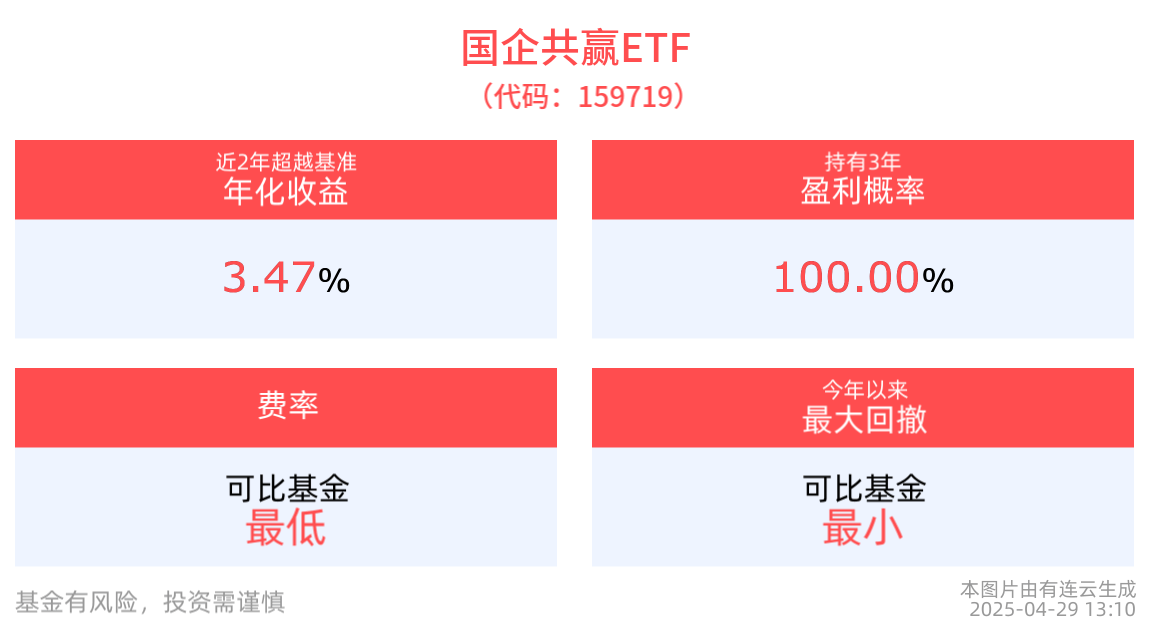
国企共赢ETF(159719短期震荡,大湾区ETF(512970)涨0.43%,机构:央国企企业是不确定性中的“确定性”
Sou Hu Cai Jing· 2025-04-29 05:58
Core Viewpoint - The news highlights the performance and potential of state-owned enterprises (SOEs) in China, particularly in the context of ongoing reforms and the integration of artificial intelligence in operations, which may enhance their competitiveness and market performance [2][4]. Group 1: ETF Performance - As of April 29, 2025, the National Enterprise Win-Win ETF (159719) decreased by 0.47%, with a latest price of 1.48 yuan. Over the past week, it has seen a cumulative increase of 0.54% [1]. - The National Enterprise Win-Win ETF had a turnover of 1.2% during the trading session, with a transaction volume of 2.3576 million yuan. The average daily transaction volume over the past year was 17.9394 million yuan [1]. - The Greater Bay Area ETF (512970) increased by 0.43%, with a latest price of 1.16 yuan. Over the past year, it has accumulated a rise of 13.72% [4]. Group 2: Index and Component Stocks - The National Enterprise Win-Win ETF closely tracks the FTSE China National Enterprise Open Win-Win Index, which consists of 100 constituent stocks, including 80 A-share companies and 20 Chinese companies listed in Hong Kong. The top ten constituent stocks are predominantly "China National" stocks [4][6]. - The top ten stocks in the index include China Petroleum, China Petrochemical, China Construction, and China Mobile, with respective weightings of 15.58%, 12.33%, and 8.89% [6]. - The Greater Bay Area Development Theme Index (931000) saw a slight increase of 0.06%, with notable performers including Keda Manufacturing and Weigao Medical, which rose by 6.95% and 4.54%, respectively [4]. Group 3: Policy and Market Outlook - The State-owned Assets Supervision and Administration Commission (SASAC) is actively promoting the "AI+" initiative, focusing on integrating artificial intelligence into enterprise operations to enhance efficiency [1]. - According to Galaxy Securities, SOEs are expected to play a crucial role in China's modernization process, with ongoing reforms aimed at improving core competitiveness and operational efficiency [2]. - The market-oriented operational mechanisms of SOEs are being refined, with plans to implement performance adjustments and exit strategies for underperforming entities by 2025, which may lead to improved profitability [2].







2025年中国海洋石油工程装备行业相关政策、产业链、发展现状、重点企业及前景研判:海洋石油工程装备需求持续强劲,装备利用率有望再创新高[图]
Chan Ye Xin Xi Wang· 2025-04-29 01:29
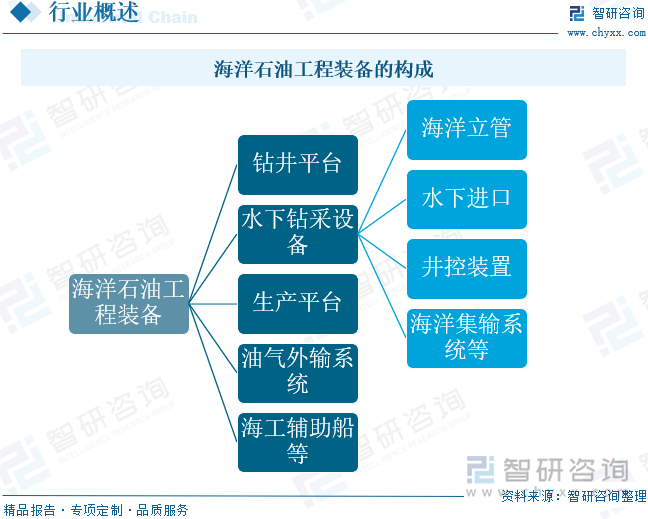
Core Viewpoint - The marine engineering equipment manufacturing industry in China is experiencing high-quality development, significantly supporting the marine economy and the construction of a maritime power. The industry is projected to achieve a value-added of 103.2 billion yuan in 2024, representing a growth of 9.1% compared to 2023 [1][20]. Group 1: Industry Overview - The marine oil and gas engineering equipment sector is crucial for the development of marine resources, with advancements in technology leading to the establishment of various standards and series of equipment [1][4]. - Recent achievements include the construction of significant marine equipment such as the FPSO "Ocean Oil 119" and the semi-submersible production and storage platform "Deep Sea No. 1" [1][20]. - The utilization rates of marine drilling equipment in China are notably higher than the global average, with mobile drilling equipment at 93% [1][20]. Group 2: Industry Development History - The marine oil and gas engineering equipment industry in China began in the 1960s, initially relying on imported technology and equipment. Over the decades, the industry has evolved, with significant advancements in domestic capabilities [6]. - The introduction of policies supporting equipment localization has led to breakthroughs in key technologies, particularly in deepwater and ultra-deepwater equipment [6][8]. Group 3: Industry Policies - The Chinese government has implemented various policies to support the marine engineering equipment sector, including plans to enhance the production capacity of marine engineering products and accelerate the development of new equipment [8][10]. - The Ministry of Industry and Information Technology has also promoted the integration of 5G technology in marine applications, enhancing operational efficiency [8][10]. Group 4: Industry Chain - The marine oil and gas engineering equipment industry chain consists of upstream design and raw material supply, midstream manufacturing, and downstream service provision to oil service companies and operators [11]. Group 5: Market Trends - The industry is expected to see continued demand growth, particularly in deepwater and unconventional resource development, driven by technological advancements and the push for sustainable practices [29][30][32]. - The focus on green technology and low-carbon solutions is becoming increasingly important, with a shift towards renewable energy equipment and environmentally friendly materials [30][32]. Group 6: Key Companies - Major players in the industry include CNOOC Engineering, CNOOC Services, and China Shipbuilding Industry Corporation, which dominate various segments of the marine oil and gas exploration and production equipment market [22][23]. - CNOOC Engineering is recognized as the largest marine oil and gas engineering contractor in the Asia-Pacific region, while CNOOC Services is a leading offshore drilling contractor [25][27].

石化化工交运行业日报第57期:稳就业稳经济,化工顺周期板块持续向好-20250428
EBSCN· 2025-04-28 15:30
Investment Rating - The report maintains an "Overweight" rating for the chemical industry, specifically for the petrochemical and transportation sectors [4]. Core Views - The macroeconomic recovery in China, driven by various government measures to stabilize employment and promote economic growth, is expected to positively impact the chemical industry, leading to a rebound in profitability for chemical products in 2025 [1][2]. - The report anticipates a recovery in cyclical sectors such as refining, MDI (Methylene Diphenyl Diisocyanate), agricultural chemicals, and vitamins, with overall chemical prices expected to rise from their current lows [2]. Summary by Sections 1. Industry Overview - The Chinese government has introduced several measures to stabilize employment and promote economic growth, which are expected to support the chemical industry [1]. - In Q1 2025, China's GDP grew by 5.4% year-on-year, surpassing the growth rate of 5% for the entire year of 2024 [1]. 2. Chemical Product Price Trends - Refining: Lower energy prices are expected to ease cost pressures for downstream refining companies, with a positive outlook for large refining and coal chemical enterprises [2]. - MDI: Major companies have increased MDI prices by €175 per ton in Europe and $100-$300 per ton in other regions, although the average industry price continues to decline [2]. - Agricultural Chemicals: Potash prices have rebounded due to seasonal demand and tariffs, while phosphate prices are also showing signs of recovery [2]. - Vitamins: Supply for certain vitamins is shifting towards China, with prices for Vitamin D3 rising significantly [2]. 3. Investment Recommendations - The report suggests focusing on undervalued, high-dividend companies in the oil sector, including China National Petroleum, Sinopec, and CNOOC [3]. - It also highlights opportunities in domestic material companies benefiting from the trend of domestic substitution, as well as in the agricultural chemicals and private refining sectors [3]. - Companies in the vitamin and methionine sectors are also recommended for investment [3].


石油石化行业今日净流入资金6693.31万元,中国海油等5股净流入资金超千万元
Zheng Quan Shi Bao Wang· 2025-04-28 09:04
Market Overview - The Shanghai Composite Index fell by 0.20% on April 28, with five sectors rising, led by banking and steel, which increased by 0.98% and 0.53% respectively [1] - The real estate and comprehensive sectors experienced the largest declines, down by 3.66% and 2.52% respectively [1] - The oil and petrochemical sector saw a slight decrease of 0.03% [1] Capital Flow Analysis - The main capital outflow from the two markets totaled 29.894 billion yuan, with only two sectors seeing net inflows: steel with 200 million yuan and oil and petrochemicals with 66.93 million yuan [1] - The electronics sector had the largest net outflow, totaling 3.104 billion yuan, followed by the automotive sector with a net outflow of 2.516 billion yuan [1] Oil and Petrochemical Sector Details - Within the oil and petrochemical sector, there are 48 stocks, with 9 rising and 36 falling, including one hitting the daily limit down [2] - The top net inflow stocks in this sector included China National Offshore Oil Corporation (CNOOC) with 53.071 million yuan, China Petroleum & Chemical Corporation (Sinopec) with 50.902 million yuan, and Huajin Chemical with 44.7347 million yuan [2] - The stocks with the largest net outflows included ST Xinchao with 39.0339 million yuan, Intercontinental Oil and Gas with 22.5732 million yuan, and Bohai Chemical with 17.033 million yuan [2][3]

中证香港300价值指数报2726.16点,前十大权重包含中国海洋石油等
Jin Rong Jie· 2025-04-28 08:08
Core Points - The China Securities Index Hong Kong 300 Value Index (HK300V) reported a decline of 3.40% over the past month, an increase of 4.61% over the past three months, and a year-to-date increase of 3.37% [1] - The index is composed of four indices: the China Securities Index Hong Kong 300 Growth Index, the China Securities Index Hong Kong 300 Value Index, the China Securities Index Hong Kong 300 Relative Growth Index, and the China Securities Index Hong Kong 300 Relative Value Index [1] - The top ten holdings of the HK300V index include HSBC Holdings (11.0%), China Construction Bank (10.45%), China Mobile (7.86%), Industrial and Commercial Bank of China (7.47%), Bank of China (5.71%), Ping An Insurance (5.39%), CNOOC (4.73%), China Merchants Bank (3.2%), Agricultural Bank of China (2.28%), and Bank of China Hong Kong (2.03%) [1] Industry Breakdown - The financial sector constitutes 59.06% of the index holdings, followed by communication services at 11.70%, energy at 10.51%, real estate at 8.19%, and industrials at 3.65% [2] - The index undergoes adjustments every six months, with sample adjustments implemented on the next trading day after the second Friday of June and December [2] - The weight factors are adjusted in accordance with the sample adjustments, and temporary adjustments occur when the underlying index samples are modified [2]
三氯乙烯、燃料油等涨幅居前,建议关注进口替代、纯内需、高股息等方向
Huaxin Securities· 2025-04-28 07:15
Investment Rating - The report maintains a "Buy" rating for several companies including Senqilin, Sinopec, Juhua, Yangnong Chemical, CNOOC, Sailun Tire, Tongkun, Zhenhua, and Guangxin [10]. Core Viewpoints - The report suggests focusing on import substitution, domestic demand, and high dividend opportunities in the chemical industry due to recent OPEC production cuts and stabilizing international oil prices [5][21]. - The report highlights that while some chemical products have seen price increases, the overall industry remains weak due to past capacity expansions and weak demand [21][32]. Summary by Sections Industry Tracking - International oil prices have shown mixed trends, with WTI at $63.02 per barrel and Brent at $66.87 per barrel as of April 25, 2025, reflecting a decline of 2.57% and 1.60% respectively [5][22]. - The domestic gasoline market has seen a slight decrease in prices, with average prices for gasoline and diesel dropping by 0.69% and 0.41% respectively [23]. Price Movements - Significant price increases were noted for products such as polymer MDI (up 7.64%) and diammonium phosphate (up 3.57%), while coal tar and sulfur saw declines of 11.11% and 9.72% respectively [20][21]. - The report indicates that the chemical industry is experiencing a mixed performance across different sectors, with some like the tire and lubricant industries performing better than expected [21][32]. Investment Opportunities - The report emphasizes the potential for investment in sectors benefiting from import substitution, such as lubricating oil additives and special coatings, as domestic products gain market share due to tariff impacts [8][21]. - It also highlights the resilience of the tire industry amid trade tensions, suggesting companies like Senqilin and Sailun Tire as potential investment opportunities [21][32]. Company Focus - Specific companies are highlighted for their strong dividend yields and market positions, including Sinopec, CNOOC, and others in the chemical sector with around 5% dividend yields [21][32].
中国海油:辽东湾油田群一季度累计生产油气当量创历史新高
Sou Hu Cai Jing· 2025-04-27 23:50
Core Viewpoint - China National Offshore Oil Corporation (CNOOC) has achieved a record high oil and gas production of over 3.2 million tons in the first quarter of this year from the Liaodong Bay oilfield group, marking a significant year-on-year increase [1] Group 1: Production and Infrastructure - The Liaodong Bay oilfield group, located in the northern Bohai Sea, has produced over 240 million tons of oil and gas since its first platform was launched in 1992, with a daily production equivalent exceeding 36,000 tons [3] - The oilfield group consists of 19 producing oil and gas fields, over 80 offshore platforms, 3 land terminals, and more than 1,500 production wells, maintaining an annual production of over 10 million tons for 15 consecutive years [3] Group 2: Technological Advancements - CNOOC has overcome various technical challenges in the region, including the development of conventional heavy oil fields and complex geological structures, achieving several "China firsts" in offshore oil development technology [3] - The company has pioneered integrated high-temperature injection and extraction technology for ultra-heavy oil and efficient development techniques for multi-layer heavy oil, leading to the successful production of China's first large-scale ultra-heavy oil field and multi-layer heavy oil field [4] Group 3: Future Development Strategy - CNOOC aims to stabilize production from old oilfields while accelerating the development of new oilfields and enhancing heavy oil extraction, with a target to increase daily crude oil production to over 2,200 tons from the Liaodong Bay oilfield group by 2024 [4] - The company is implementing the largest secondary adjustment project in China's offshore oil sector to boost production from aging oilfields, ensuring a solid foundation for stable production and enhancing energy supply capabilities [4]

石油化工行业周报:PDH装置存在降负预期,丙烯盈利存在较好支撑-20250427
Shenwan Hongyuan Securities· 2025-04-27 13:17
Investment Rating - The report maintains a positive outlook on the petrochemical industry, particularly regarding propylene profitability and the expected tightening of supply-demand dynamics [4][5]. Core Insights - The report highlights the anticipated reduction in operating rates for PDH units due to high costs associated with U.S. propane imports, which could lead to a significant drop in propylene supply [4][5]. - It emphasizes the potential for increased imports from Japan and South Korea, although these may not fully compensate for the domestic supply gap [4][5]. - The report suggests that the overall profitability of PDH units remains low, and future tariffs could delay or cancel planned new capacity [4][5]. Summary by Sections Upstream Sector - Brent crude oil prices closed at $66.87 per barrel, a decrease of 1.60% from the previous week, while WTI prices fell by 2.57% to $63.02 per barrel [4][22]. - U.S. commercial crude oil inventories increased by 244,000 barrels, while gasoline inventories decreased by 4.476 million barrels [25][22]. - The report notes a stable day rate for self-elevating drilling rigs, indicating a recovery trend in the oil service sector [4][22]. Refining Sector - The report indicates an increase in overseas refined oil crack spreads, with Singapore's refining margin rising to $10.75 per barrel [4][22]. - The profitability of domestic refining products is expected to improve gradually as economic recovery progresses [4][22]. Polyester Sector - PTA profitability has increased, while polyester filament profitability has decreased, indicating mixed performance within the polyester supply chain [4][22]. - The report suggests that the polyester industry may see improvements in the medium to long term as new capacity comes online [4][22]. Investment Recommendations - The report recommends focusing on leading refining companies such as Hengli Petrochemical, Rongsheng Petrochemical, and Dongfang Shenghong due to favorable competitive dynamics [4][17]. - It also highlights the potential for valuation recovery in companies like Satellite Chemical and Tongkun Co., given the expected improvements in the industry [4][17].


