CHINA MOBILE(600941)

Search documents
南向资金今日净卖出约15亿港元 中国移动遭净卖出居前


Xin Lang Cai Jing· 2026-01-15 09:52
转自:智通财经 【南向资金今日净卖出约15亿港元 中国移动遭净卖出居前】智通财经1月15日电,南向资金今日净卖出 15.15亿港元。其中,中国移动、小米集团-W分别遭净卖出7.91亿港元、4.91亿港元;阿里巴巴-W获净 买入约19.76亿港元。 ...
2025中国企业ESG“金责奖”年度可持续发展奖揭晓
Xin Lang Cai Jing· 2026-01-15 07:37
Core Viewpoint - The 2025 China Enterprise ESG "Golden Responsibility Award" aims to recognize companies that have made significant contributions to ESG (Environmental, Social, and Governance) practices, promoting sustainable development in China [1][4]. Group 1: ESG Services and Initiatives - Sina Finance ESG Rating Center offers 14 ESG services, including information, reports, training, and consulting, to help listed companies promote ESG concepts and enhance their sustainable development performance [1][4]. - In 2025, many quality enterprises in China are actively practicing their responsibilities in environmental, social, and governance areas, while domestic financial institutions are steadily advancing in ESG responsible investment [1][4]. Group 2: Award Selection and Winners - The 2025 China Enterprise ESG "Golden Responsibility Award" attracted over 5,000 participating companies since its launch in November, with winners selected based on comprehensive ESG performance, professional scoring, and online voting results [1][5]. - The winners of the 2025 China Enterprise ESG "Golden Responsibility Award" for the Annual Sustainable Development Award include China General Nuclear Power, Sungrow Power Supply, Kweichow Moutai, CATL, Zijin Mining, Hikvision, Yili, Baosteel, Chint Electric, and China Mobile [2][5]. Group 3: ESG Rating Center Overview - The Sina Finance ESG Rating Center is the first Chinese ESG professional information and rating aggregation platform, dedicated to promoting sustainable development and responsible investment [3][6]. - The center aims to establish ESG evaluation standards suitable for China's characteristics and enhance corporate ratings, while also launching multiple ESG innovation indices for investors [3][6].





2025年1-11月中国移动通信基站设备产量为475.5万射频模块 累计增长16.4%
Chan Ye Xin Xi Wang· 2026-01-15 03:42
Core Viewpoint - The report highlights the growth in China's mobile communication base station equipment production, indicating a positive trend in the telecommunications industry from 2025 to 2032 [1] Group 1: Industry Overview - In November 2025, the production of mobile communication base station equipment in China reached 530,000 RF modules, representing a year-on-year increase of 26.5% [1] - From January to November 2025, the cumulative production of mobile communication base station equipment totaled 4.755 million RF modules, showing a cumulative growth of 16.4% [1] Group 2: Companies Involved - Listed companies in the telecommunications sector include ZTE Corporation (000063), Datang Telecom (600198), Xinke Mobile (688387), FiberHome Technologies (600498), Shenglu Communications (002446), *ST Rihai (002313), and Chaoxun Communication (603322) [1] - The report is published by Zhiyan Consulting, a leading industry consulting firm in China, specializing in in-depth industry research and providing comprehensive consulting services [1]


巨头加速入局,AI眼镜2026年打响新一轮排位赛
2 1 Shi Ji Jing Ji Bao Dao· 2026-01-14 13:13
Core Insights - The Chinese AI glasses market is entering a new phase after the "Hundred Glasses War" in 2025, with significant developments expected in 2026 as major players like Baidu and ByteDance join the competition [1][2] - Global market dynamics are shifting, with Meta maintaining a dominant position, while Google and Apple are also making strategic moves to capture market share [1][6] Investment and Financing - Companies like Thunderbird Innovation and Flash Technology have recently secured significant funding, indicating strong investor interest in the AI glasses sector [3][4] - Thunderbird Innovation raised over 1 billion yuan, while Flash Technology completed a financing round of nearly 100 million yuan to support the development of new AI glasses [3] Market Dynamics - The AI glasses market is expected to experience explosive growth in 2026, driven by successful commercialization efforts from companies like Ray-Ban Meta and the anticipated entry of tech giants like Apple and Samsung [5][6] - The global AI smart glasses market is projected to grow from 6 million units in 2025 to 20 million units in 2026, with revenue increasing from $1.2 billion to $5.6 billion [9] Competitive Landscape - The entry of major internet and mobile companies is intensifying competition, leading to potential market share erosion for existing players while also creating opportunities for startups [8][9] - The current consumer base for AI glasses primarily consists of early adopters, and the market has yet to establish a strong "must-have" demand [4][5] Technological Advancements - The introduction of eSIM technology is seen as a significant step towards making AI glasses independent devices, enhancing their functionality beyond being mere accessories [3] - Improvements in product quality and user experience are critical for retaining customers, as many users currently engage with AI glasses primarily out of curiosity [4][5] Ecosystem Development - Google is actively working on building an Android XR ecosystem through partnerships with companies like Qualcomm and Samsung, aiming to create a robust hardware ecosystem for smart glasses [6][7] - The ongoing development of the Android XR ecosystem is expected to foster innovation and application expansion in the smart glasses market, although widespread adoption may take time [7][8]



【投融资动态】中科酷原D轮融资,融资额近亿人民币,投资方为中国移动
Sou Hu Cai Jing· 2026-01-14 11:35
Core Insights - Zhongke Kuyuan Technology (Wuhan) Co., Ltd. has completed a Series D financing round, raising nearly 100 million RMB, with China Mobile among the participating investors [1] - The company is the first in China to possess both atomic quantum computing and quantum precision measurement research and industrialization capabilities [1] - Zhongke Kuyuan is recognized as a "chain leader" in the quantum technology industry chain in Hubei Province, with a core team originating from the Chinese Academy of Sciences Precision Measurement Research Institute [1] - The team has over 20 years of experience in neutral atom quantum technology research, accumulating systematic technical capabilities in quantum computing and precision measurement applications [1]

资金动向 | 北水爆买腾讯超20亿港元,连续8日减持中国移动
Ge Long Hui· 2026-01-14 10:27
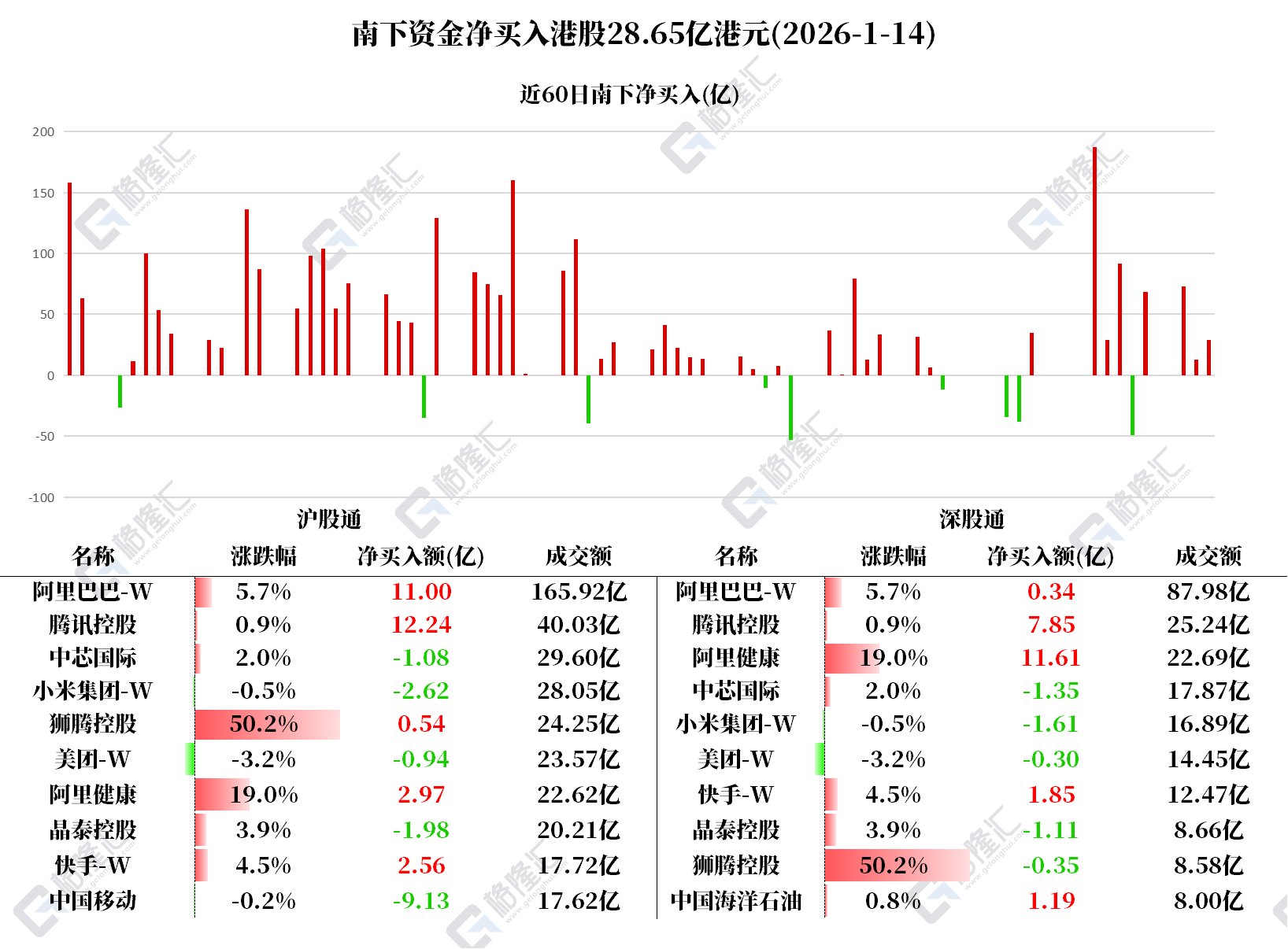
Group 1: Market Activity - Southbound funds net bought Hong Kong stocks worth 2.865 billion HKD on January 14, with significant purchases in Tencent Holdings (2.009 billion HKD), Alibaba Health (1.458 billion HKD), Alibaba Group-W (1.134 billion HKD), Kuaishou-W (441 million HKD), and China National Offshore Oil (119 million HKD) [1] - Notable net sales included China Mobile (913 million HKD), Xiaomi Group-W (423 million HKD), Crystal International (308 million HKD), SMIC (242 million HKD), and Meituan-W (123 million HKD) [1] Group 2: Stock Performance - Tencent Holdings saw a net buy of 12.24 billion HKD with a trading volume of 40.03 billion HKD, while Alibaba Group-W had a net buy of 11 billion HKD with a trading volume of 165.92 billion HKD [3] - China Mobile experienced a net sell of 9.13 billion HKD with a trading volume of 17.62 billion HKD, marking a continuous net sell for 8 days totaling 61.9702 billion HKD [3] Group 3: Company Announcements - Alibaba announced a product launch event for its AI model "Qianwen" on January 15, showcasing how AI can enhance operational efficiency [5] - Tencent repurchased 1 million shares for 636 million HKD and plans to introduce an AI mini-program growth initiative [5] - Kuaishou announced plans to issue USD and RMB senior notes, with net proceeds aimed at general corporate purposes, and projected an annual revenue run rate of 240 million USD by December 2025 [5] Group 4: Industry Insights - Citigroup reported that oil prices may soon exceed the previously predicted range of 55 to 65 USD per barrel due to rising supply disruption risks and geopolitical tensions involving Iran and Russia/Ukraine [6]
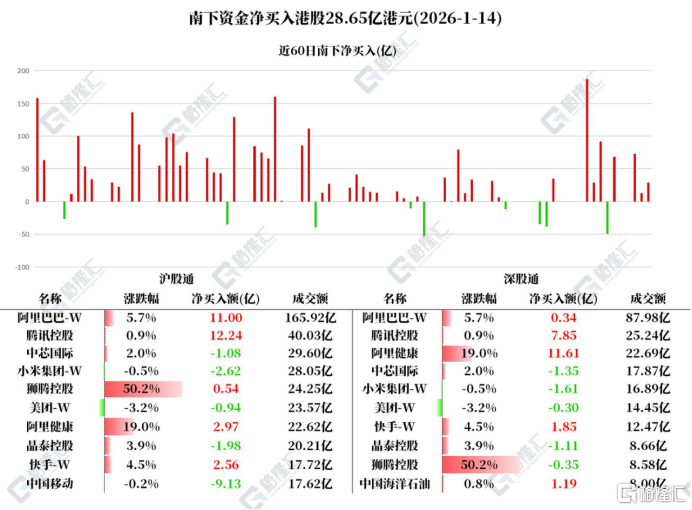
图解丨南下资金大幅净买入腾讯、阿里健康和阿里


Ge Long Hui A P P· 2026-01-14 10:06
Group 1 - Southbound funds net bought Hong Kong stocks worth 2.865 billion HKD today, with notable purchases including Tencent Holdings (2.009 billion HKD), Alibaba Health (1.458 billion HKD), Alibaba Group (1.134 billion HKD), Kuaishou (0.441 billion HKD), and CNOOC (0.119 billion HKD) [1] - Southbound funds have continuously net bought Tencent for 6 days, totaling 9.00777 billion HKD; Kuaishou for 4 days, totaling 3.53394 billion HKD; Alibaba for 3 days, totaling 2.40886 billion HKD; and have continuously net sold China Mobile for 8 days, totaling 6.19702 billion HKD [1] Group 2 - Alibaba Group saw a price increase of 5.7% with a net buy of 1.1 billion HKD and a transaction volume of 16.592 billion HKD [3] - Tencent Holdings experienced a price increase of 0.9% with a net buy of 1.224 billion HKD and a transaction volume of 40.03 billion HKD [3] - China Mobile had a price decrease of 0.2% with a net sell of 0.913 billion HKD and a transaction volume of 17.62 billion HKD [3]
行业研究|行业周报|通信设备Ⅲ:通信周观点:NV存储创新推升光互连需求,中国加速锁定频轨资源-20260114
Changjiang Securities· 2026-01-14 09:44
Investment Rating - The industry investment rating is "Positive" and is maintained [10] Core Insights - The communication sector rose by 1.50% in the first week of 2026, ranking 28th among primary industries in the Yangtze River region. Year-to-date, the sector has also increased by 1.50% [2][5] - NVIDIA launched the Rubin platform at CES 2026, which integrates computing, storage, and networking, enhancing the demand for high-speed optical interconnects. This is expected to increase optical connection density and bandwidth requirements [6][8] - Chinese enterprises and institutions have applied to the ITU for over 200,000 low-orbit satellites by the end of 2025, accelerating the layout of low-orbit satellite internet and securing scarce frequency resources [7][8] Summary by Sections Market Performance - In the first week of 2026, the communication sector's stock performance included significant gains for companies with market capitalizations over 8 billion yuan, with Nanjing Panda (+49.1%), Tongyu Communication (+42.3%), and Dawi Technology (+35.3%) leading the gains. Conversely, Hengbao Co. (-8.1%), Cambridge Technology (-8.0%), and Dingtong Technology (-7.6%) experienced the largest declines [5] NVIDIA Rubin Platform - The Rubin platform features a modular Superchip and full liquid cooling, significantly increasing computing density. The NVL72 unit integrates 72 Rubin GPUs, providing approximately 200 PFLOPS NVFP4 computing power, with internal bandwidth of 14.4TB/s and external bandwidth of 1.6Tb/s [6] - The platform introduces a POD-level context memory system that alleviates inference KV cache bottlenecks, allowing for low-latency sharing across GPUs and nodes, with a single GPU card capable of approximately 16TB of context storage [6] - The integrated architecture of the Rubin 576 Superpod enhances optical interconnect density, with a total bandwidth of approximately 260TB/s [6] Satellite Projects in China - The report highlights that the large-scale application for low-orbit satellite constellations by Chinese entities is aimed at securing limited space resources, thus accelerating the development of low-orbit satellite internet [7] Investment Recommendations - The report recommends several companies across various segments: - Telecom operators: China Mobile, China Telecom, China Unicom - Optical modules: Zhongji Xuchuang, Xinyi Sheng, Tianfu Communication - Liquid cooling: Yingweike - Hollow-core optical fibers: Fenghuo Communication, Hengtong Optic-Electric - Domestic computing: Runze Technology, Guanghuan New Network - AI applications: Bosijie, Heertai, Tuobang Co. - Satellite applications: Huace Navigation, Haige Communication [8]



史无前例,我国20万颗卫星申报背后的“大棋局”
3 6 Ke· 2026-01-14 07:25
Core Viewpoint - China's recent application to the International Telecommunication Union (ITU) for over 200,000 satellite frequency resources marks a record-breaking action in both the number of applications and the total scale of satellites, indicating a strategic move to secure orbital and frequency resources for future development [1][3][10]. Group 1: Record-Breaking Application - The application includes over 190,000 satellites from a newly registered entity called the "Radio Spectrum Development and Technology Innovation Research Institute," which significantly exceeds previous applications and is several times larger than the current largest constellation, SpaceX's Starlink with 72,000 satellites [1][4]. - In 2025, China submitted 73 frequency coordination applications to the ITU, with a peak of 34 applications in December alone, showcasing unprecedented activity in satellite frequency coordination [4][10]. Group 2: Strategic Intent - The large-scale application is viewed as a "resource positioning" action, aimed at ensuring China has a sufficient "resource pool" of orbital and frequency resources for the next decade or longer [3][10]. - The initiative reflects China's strategic determination to secure more orbital positions and frequencies, which are critical for the development of commercial space and the goal of integrated "space-ground" communication systems, particularly for 6G [3][6][13]. Group 3: Role of Key Institutions - The Radio Spectrum Innovation Institute, established by several key organizations, is positioned as a core research and technical support entity for satellite communication standards and resource management, indicating a strong national strategic intent [6][11]. - The collaboration between the Radio Spectrum Innovation Institute and China SatNet highlights a dual approach where one focuses on demand integration and the other on technological innovation and resource reserve [6][10]. Group 4: Involvement of Telecom Operators - Major telecom operators, including China Telecom and China Mobile, are also involved in the satellite application process, marking a significant step in their satellite internet business and indicating a shift towards integrated communication services [11][12]. - China Telecom aims to complement its existing geostationary satellite capabilities with low Earth orbit satellites to enhance its service offerings, while China Mobile seeks to establish its own satellite constellation to maintain competitive advantages in future communication technologies [11][12][13].
国泰海通|机械:20万颗“星海”压境,商业航天格局优化
国泰海通证券研究· 2026-01-13 13:20
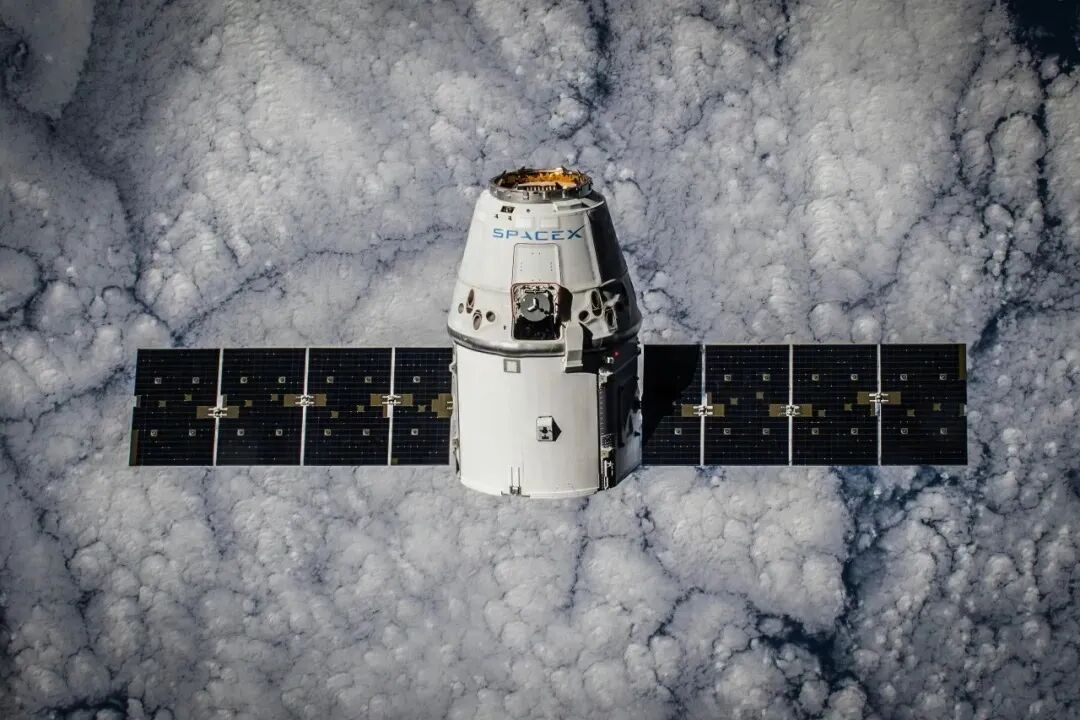
报告导读: 中国新增申请 20 万颗卫星覆盖 14 个星座,含中国移动、中国星网、垣信卫 星等。本轮申报数量激增近一个数量级,未来可能引发全球对太空战略资源的新一轮关注 事件: 近日,中国向国际电信联盟( ITU )提交了新增 20.3 万颗的卫星申请,此次申报涵盖 14 个卫星星座,其中 CTC-1 和 CTC-2 两个星座各自申请 96,714 颗,成为本轮申报的主力。除中国星网、垣信卫星等专业卫星运营商外,申报主体首次广泛包括无线电创新院、银河航天、国电高科等商业航天企 业,以及中国移动、中国电信等传统通信运营商。 申报超 20 万颗,抢占频轨资源 " 制高点 " 。 此次中国向 ITU 提交的 20.3 万颗卫星申报,规模远超此前 "GW 星座 " (约 1.3 万颗)与 " 千帆星座 " (约 1.5 万颗)的总和,标志着中国低轨星座建设从 " 千星 " 迈向 " 十万星 " 量级的新纪元。其中, CTC-1 与 CTC-2 两个超大星座合计申报近 19.3 万颗,成为绝对主力。在近地轨道( LEO )频轨资源日益拥挤的背景下,这种 " 饱和式申报 " 体现了国家级战略意志,旨在通过 " 占频保轨 ...