
Jointown(600998)

Search documents
医药商业板块8月22日涨0.05%,塞力医疗领涨,主力资金净流入3.63亿元
Zheng Xing Xing Ye Ri Bao· 2025-08-22 08:39
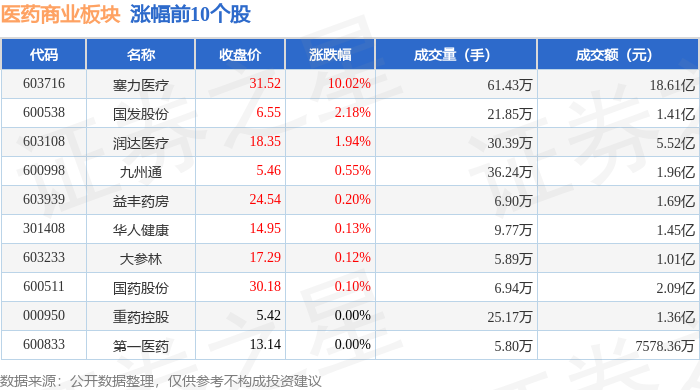
Core Insights - The pharmaceutical commercial sector experienced a slight increase of 0.05% on August 22, with Saily Medical leading the gains [1] - The Shanghai Composite Index closed at 3825.76, up 1.45%, while the Shenzhen Component Index closed at 12166.06, up 2.07% [1] Group 1: Stock Performance - Saily Medical (603716) saw a closing price of 31.52, with a significant increase of 10.02% and a trading volume of 614,300 shares, resulting in a transaction value of 1.861 billion yuan [1] - Guofang Co. (600538) closed at 6.55, up 2.18%, with a trading volume of 218,500 shares [1] - Runda Medical (603108) closed at 18.35, up 1.94%, with a trading volume of 303,900 shares [1] - Other notable stocks include Jiuzhoutong (600998) with a slight increase of 0.55% and Yifeng Pharmacy (603939) with a minimal increase of 0.20% [1] Group 2: Capital Flow - The pharmaceutical commercial sector saw a net inflow of 363 million yuan from main funds, while retail investors experienced a net outflow of 114 million yuan [2] - Speculative funds recorded a net outflow of 249 million yuan [2]





医药商业板块8月21日涨0.27%,国发股份领涨,主力资金净流出2.77亿元
Zheng Xing Xing Ye Ri Bao· 2025-08-21 08:30
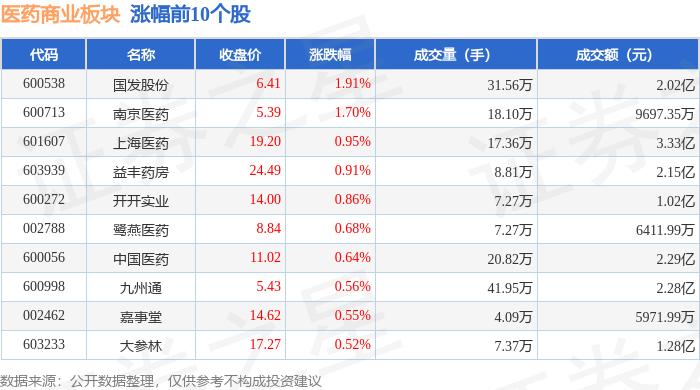
Market Overview - The pharmaceutical commercial sector increased by 0.27% on August 21, with Guofang Co., Ltd. leading the gains [1] - The Shanghai Composite Index closed at 3771.1, up 0.13%, while the Shenzhen Component Index closed at 11919.76, down 0.06% [1] Stock Performance - Guofang Co., Ltd. (600538) closed at 6.41, up 1.91% with a trading volume of 315,600 shares and a transaction value of 202 million yuan [1] - Nanjing Pharmaceutical (600713) closed at 5.39, up 1.70% with a trading volume of 181,000 shares and a transaction value of 96.97 million yuan [1] - Shanghai Pharmaceuticals (601607) closed at 19.20, up 0.95% with a trading volume of 173,600 shares and a transaction value of 333 million yuan [1] - Yifeng Pharmacy (603939) closed at 24.49, up 0.91% with a trading volume of 88,100 shares and a transaction value of 215 million yuan [1] Capital Flow - The pharmaceutical commercial sector experienced a net outflow of 277 million yuan from institutional investors, while retail investors saw a net inflow of 293 million yuan [2] - The data indicates that institutional investors are withdrawing capital, while retail investors are increasing their investments in the sector [2] Individual Stock Capital Flow - Nanjing Pharmaceutical saw a net inflow of 16.81 million yuan from institutional investors, while retail investors had a net outflow of 4.14 million yuan [3] - Yifeng Pharmacy experienced a net inflow of 15.49 million yuan from institutional investors, with a net outflow of 23.62 million yuan from retail investors [3] - China National Pharmaceutical (600056) had a net inflow of 8.93 million yuan from institutional investors, while retail investors had a negligible net inflow of 0.12 million yuan [3]



2025年中国医药流通行业商业模式 医药流通模式随着产业需求不断丰富
Qian Zhan Wang· 2025-08-20 10:03
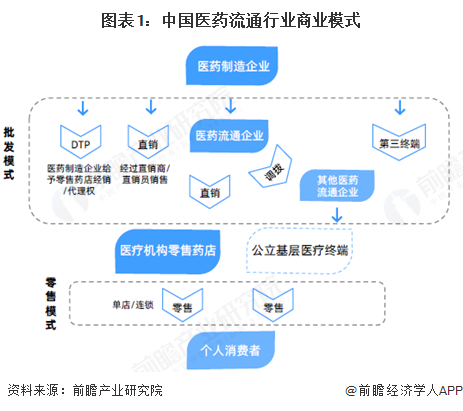
Core Viewpoint - The pharmaceutical distribution industry is characterized by three main business models: wholesale, retail, and various new distribution models, each with distinct operational dynamics and market implications [1]. Group 1: Wholesale Model - The wholesale model, also known as the distribution model, involves selling pharmaceuticals and medical devices in bulk to entities that directly interact with consumers, such as medical institutions and retail pharmacies [4]. - The third terminal in the wholesale model is increasingly favored by internet hospitals, indicating a shift towards digital integration in pharmaceutical distribution [4]. Group 2: Retail Model - The retail model involves retail pharmacies purchasing pharmaceutical products from manufacturers or other distributors and selling them to individual consumers, generating profit from the price difference [7]. - Although the retail model operates on a smaller scale compared to wholesale, it boasts higher profit margins, making it an attractive segment within the pharmaceutical distribution landscape [7]. Group 3: Internet Retail Model - The internet retail model encompasses various online platforms, including internet hospitals and pharmaceutical e-commerce, facilitating diagnosis and drug sales through digital channels [9]. - This model includes B2B, B2C, and O2O formats, reflecting the growing trend of digital transformation in the pharmaceutical sector [9]. Group 4: Third-Party Cold Chain Logistics - The "14th Five-Year Plan" emphasizes the need for a modern, intelligent pharmaceutical supply chain, focusing on enhancing networked, scaled, and specialized logistics services [12]. - Third-party cold chain logistics offer significant advantages, such as reducing initial investment costs for pharmaceutical companies and ensuring temperature-controlled transport, which is crucial for maintaining drug quality [12]. - These logistics providers can effectively manage reverse logistics and product recalls through advanced tracking and data exchange systems, thereby minimizing losses and ensuring compliance with quality standards [12].


2025年中国医药流通行业商业模式 医药流通模式随着产业需求不断丰富【组图】
Qian Zhan Wang· 2025-08-20 09:15
Core Viewpoint - The pharmaceutical distribution industry is categorized into three main business models: wholesale, retail, and various new distribution models, each with distinct characteristics and profit margins [1]. Group 1: Wholesale Model - The wholesale model, also known as the distribution model, involves selling pharmaceuticals and medical devices in bulk to entities that directly interact with consumers, such as medical institutions and retail pharmacies [3]. - The wholesale model can be further divided into categories such as hospital direct sales, commercial allocation, and third terminal distribution, with the third terminal being a key focus for internet healthcare companies [3]. Group 2: Retail Model - The retail model involves retail pharmacies purchasing pharmaceutical products from manufacturers or other distribution companies and selling them to individual consumers for profit [4]. - Although the retail model is smaller in scale compared to wholesale, it offers higher profit margins, and can be subdivided into single-store and chain models, with chain models further categorized into direct-operated and franchise operations [4]. Group 3: Internet Retail Model - The internet pharmaceutical new retail model encompasses various internet hospitals and pharmaceutical e-commerce platforms that conduct diagnosis and drug sales through online channels, including B2B, B2C, and O2O models [6]. Group 4: Third-Party Cold Chain Logistics - The pharmaceutical distribution industry is expected to build a modern smart pharmaceutical supply chain service system during the 14th Five-Year Plan period, focusing on enhancing networked, scaled, and specialized levels for safer and more efficient logistics [10]. - Third-party cold chain logistics provide significant advantages, such as reducing upfront investment for pharmaceutical companies, ensuring temperature control during transport, and optimizing the pharmaceutical supply chain through integrated information management [11].
医药商业板块8月20日涨0.05%,益丰药房领涨,主力资金净流出3.77亿元
Zheng Xing Xing Ye Ri Bao· 2025-08-20 08:41
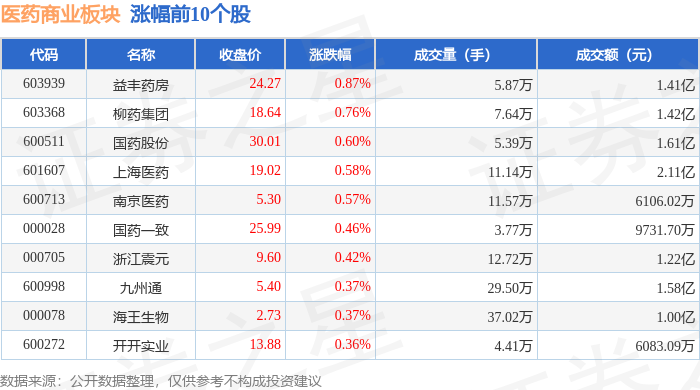
Market Overview - The pharmaceutical commercial sector increased by 0.05% on August 20, with Yifeng Pharmacy leading the gains [1] - The Shanghai Composite Index closed at 3766.21, up 1.04%, while the Shenzhen Component Index closed at 11926.74, up 0.89% [1] Stock Performance - Yifeng Pharmacy (603939) closed at 24.27, up 0.87% with a trading volume of 58,700 shares and a turnover of 141 million yuan [1] - Other notable performers include: - Liuyuan Group (603368) at 18.64, up 0.76% [1] - China National Pharmaceutical Group (600511) at 30.01, up 0.60% [1] - Shanghai Pharmaceuticals (601607) at 19.02, up 0.58% [1] - Nanjing Pharmaceutical (600713) at 5.30, up 0.57% [1] Capital Flow - The pharmaceutical commercial sector experienced a net outflow of 377 million yuan from institutional investors, while retail investors saw a net inflow of 367 million yuan [2] - Notable capital flows include: - Yifeng Pharmacy had a net outflow of 9.79 million yuan from institutional investors [3] - Heavy Drug Holdings (000950) saw a net inflow of 7.45 million yuan from institutional investors [3] - Drug Easy Purchase (300937) had a net inflow of 3.82 million yuan from institutional investors [3]


九州通(600998)8月19日主力资金净流入1184.48万元
Sou Hu Cai Jing· 2025-08-19 10:30
Group 1 - The core viewpoint of the news highlights the financial performance and market activity of Jiuzhoutong Pharmaceutical Group Co., Ltd. as of August 19, 2025, with a stock price of 5.38 yuan, reflecting a 0.56% increase [1] - The company reported total revenue of 42.016 billion yuan for Q1 2025, representing a year-on-year growth of 3.82%, while net profit attributable to shareholders reached 970 million yuan, showing a significant increase of 80.38% [1] - Jiuzhoutong's liquidity ratios include a current ratio of 1.262 and a quick ratio of 0.943, with a debt-to-asset ratio of 68.06% [1] Group 2 - Jiuzhoutong has made investments in 81 companies and participated in 1,170 bidding projects, indicating active engagement in the market [2] - The company holds 707 trademark registrations and 26 patents, along with 45 administrative licenses, showcasing its intellectual property portfolio [2]
九州通等在四川成立新公司,含电车销售业务
Qi Cha Cha· 2025-08-18 10:11
Group 1 - A new company named Sichuan Jiuzhoutong Borui Medical Technology Co., Ltd. has been established, with a registered capital of 20 million yuan [1] - The company's business scope includes sales of second-class medical devices, retail of protective equipment for medical personnel, sales of electronic measuring instruments, electric vehicle sales, and sales of artificial intelligence hardware [1] - The company is jointly held by Jiuzhoutong (600998) and Jiuzhoutong Medical Device Group Co., Ltd. [1]
城市“无形之战”白热化:京深沪杭凭什么领跑?
Mei Ri Jing Ji Xin Wen· 2025-08-16 23:52
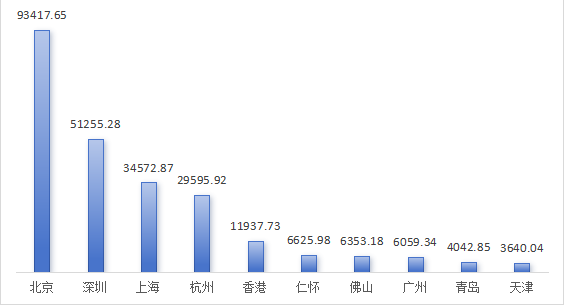
Core Insights - The competition among cities has evolved beyond tangible resources, focusing increasingly on intangible assets, particularly brand value, which is becoming a crucial lever in reshaping China's urban landscape [1][2] - The "2025 China Listed Company Brand Value Blue Book" has been released, ranking the brand values of listed companies across various cities, highlighting the importance of brand value in economic development [1][2] Group 1: Brand Value Rankings - The top three cities, Beijing, Shenzhen, and Shanghai, collectively hold a brand value of 17.9 trillion yuan, accounting for 62.8% of the total brand value of the top 100 cities [2][3] - The brand value of the top three cities has increased from 132,951.86 billion yuan in 2022 to 179,245.80 billion yuan in 2025, indicating a significant upward trend [7] - The brand value of Hangzhou, ranked fourth, is close to 3 trillion yuan, largely driven by Alibaba's contribution of over 18,335.42 billion yuan [7][21] Group 2: City Performance and Trends - Cities like Nanjing and Wuhan are facing challenges due to a lack of new listed companies, leading to a decline in brand value [2][15] - Ningde has shown remarkable growth, with its brand value soaring from 287.06 billion yuan in 2022 to 1,876.91 billion yuan in 2025, primarily due to the success of CATL [11][13] - Guangzhou's brand value has stagnated, with a slight increase from 5,751.10 billion yuan in 2022 to 6,059.34 billion yuan in 2025, reflecting a slow growth rate of 5.36% [8][21] Group 3: Industry Insights - The brand value of traditional industries in cities like Wuhan and Nanjing is declining, particularly in sectors such as real estate and retail, which are experiencing significant drops [15][19] - The automotive and pharmaceutical sectors in Wuhan have seen a substantial decrease in brand value, primarily due to the decline of major local companies [19][20] - The shift towards high-value industries such as digital economy and renewable energy is becoming essential for cities to maintain competitive brand value [2][11]





寿仙谷股价微涨0.72% 与九州通医药达成战略合作
Jin Rong Jie· 2025-08-15 19:58
Group 1 - The latest stock price of Shouxiangu is 22.29 yuan, an increase of 0.16 yuan from the previous trading day, with a daily high of 22.38 yuan and a low of 22.02 yuan, and a total trading volume of 28,060 hands amounting to 0.62 billion yuan [1] - The company specializes in the research, production, and sales of traditional Chinese medicine health products, with key products including precious Chinese medicinal materials such as Ganoderma and Dendrobium [1] - Shouxiangu has recently led the formulation of the ISO international standard for "Traditional Chinese Medicine - Broken Wall Ganoderma Spore Powder," marking its fourth ISO international standard for Zhejiang-produced famous medicines [1] Group 2 - On August 14, Shouxiangu signed a strategic cooperation agreement with Jiuzhoutong Pharmaceutical, focusing on comprehensive business collaboration in channel construction, supply chain coordination, and market promotion [1] - Jiuzhoutong Pharmaceutical has established 141 high-standard pharmaceutical warehousing and logistics facilities nationwide, providing a stable distribution network foundation for the partnership [1]

九州通:公司未对控股股东和实际控制人及其关联人提供担保
Zheng Quan Ri Bao Zhi Sheng· 2025-08-13 13:13
(编辑 任世碧) 证券日报网讯 8月13日晚间,九州通发布公告称,截至2025年7月31日,公司及其子公司对外提供担保 (被担保人主要为公司控股子公司(含全资子公司)及其下属企业)的余额合计2,811,709.72万元 (最高担保额度),占公司最近一期(截至2024年12月31日)经审计净资产的103.21%;公司未对控股 股东和实际控制人及其关联人提供担保。 ...