
CMS(600999)

Search documents
可立克: 招商证券股份有限公司关于深圳可立克科技股份有限公司变更部分募集资金用途的核查意见
Zheng Quan Zhi Xing· 2025-06-12 10:28
Summary of Key Points Core Viewpoint The company, Shenzhen Keli Technology Co., Ltd., is changing the use of part of the raised funds from its non-public offerings in response to market conditions and operational needs, aiming to enhance fund utilization efficiency and support new project investments. Group 1: Fundraising Overview - In the 2020 non-public offering, the company raised a total of RMB 489.31 million, with a net amount of RMB 480.06 million after deducting issuance costs [1][2] - The 2022 non-public offering raised RMB 225.43 million, with a net amount of RMB 216.71 million after costs [5][6] Group 2: Changes in Fund Usage - The company plans to adjust the investment amounts for the "Automotive Electronic Magnetic Component Production Line Construction Project," reducing the total investment by RMB 151.58 million, reallocating these funds to supplement working capital [3][4] - The "Power Production Automation Transformation Project" has been terminated, with remaining funds also redirected to working capital [4][5] Group 3: New Project Investments - The company intends to invest RMB 173.91 million from the adjusted funds into a new production base in Vietnam to meet increasing market demand and enhance operational efficiency [9][10] - The decision to terminate certain projects and invest in new ones is driven by the need to adapt to market changes and improve competitiveness [8][9] Group 4: Feasibility and Strategic Rationale - The new project in Vietnam is deemed necessary due to the growing demand from overseas clients and the need to diversify production locations to mitigate geopolitical risks [12][13] - Vietnam's favorable labor costs, tax incentives, and strategic location are expected to provide significant advantages for the company's operations [16][17] Group 5: Approval Process - The board of directors and the supervisory board have approved the changes in fund usage, emphasizing that the decision aligns with the company's long-term strategic goals and does not harm shareholder interests [18][19]

久日新材2年1期均亏 2019上市募18.5亿招商证券保荐
Zhong Guo Jing Ji Wang· 2025-06-12 06:54
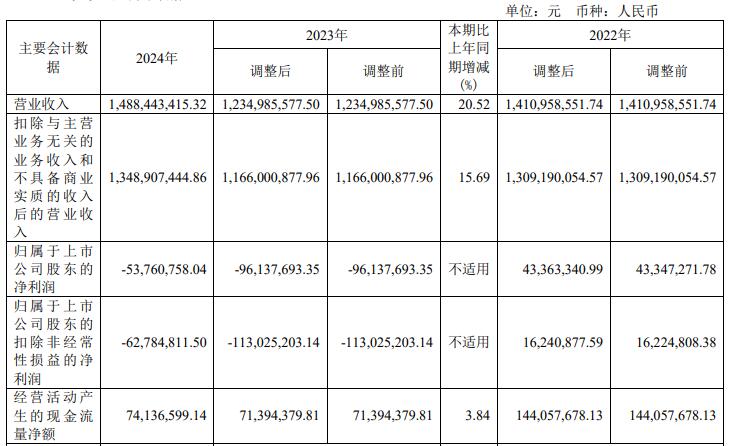
Core Viewpoint - Jiu Ri New Materials (688199.SH) reported a revenue of 1.488 billion yuan for 2024, marking a year-on-year increase of 20.52%, while the net profit attributable to shareholders was a loss of 53.76 million yuan, an improvement from the previous year's loss of 96.14 million yuan [1][2] Financial Performance Summary - **Revenue**: The company achieved an operating revenue of 1.488 billion yuan in 2024, up 20.52% from 1.234 billion yuan in 2023 [1][2] - **Net Profit**: The net profit attributable to shareholders was -53.76 million yuan, compared to -96.14 million yuan in the previous year, indicating a reduction in losses [1][2] - **Net Profit Excluding Non-Recurring Items**: The net profit excluding non-recurring items was -62.78 million yuan, an improvement from -113.03 million yuan year-on-year [1][2] - **Cash Flow**: The net cash flow from operating activities was 74.14 million yuan, reflecting a year-on-year increase of 3.84% [1][2] 2025 Q1 Performance Summary - **Revenue**: In the first quarter of 2025, the company reported an operating revenue of 356.04 million yuan, a slight decrease of 0.15% compared to 356.58 million yuan in the same period last year [3][4] - **Net Profit**: The net profit attributable to shareholders was -10.52 million yuan, worsening from -4.39 million yuan in the previous year [3][4] - **Net Profit Excluding Non-Recurring Items**: The net profit excluding non-recurring items was -11.00 million yuan, compared to -8.93 million yuan year-on-year [3][4] - **Cash Flow**: The net cash flow from operating activities was -48.20 million yuan, compared to -38.89 million yuan in the same period last year [3][4] Company Background - Jiu Ri New Materials was listed on the Shanghai Stock Exchange's Sci-Tech Innovation Board on November 5, 2019, with an issuance of 27.81 million shares at a price of 66.68 yuan per share [4] - The total amount raised from the issuance was 1.854 billion yuan, with a net amount of 1.709 billion yuan, exceeding the original plan by 113.87 million yuan [5] - The company plans to use the raised funds for the construction of a production project for 87,000 tons of light-curing materials and for working capital [5]


共享基经丨与AI一起读懂ETF(十八):4个券商板块主题指数,有何不同?
Mei Ri Jing Ji Xin Wen· 2025-06-11 10:41
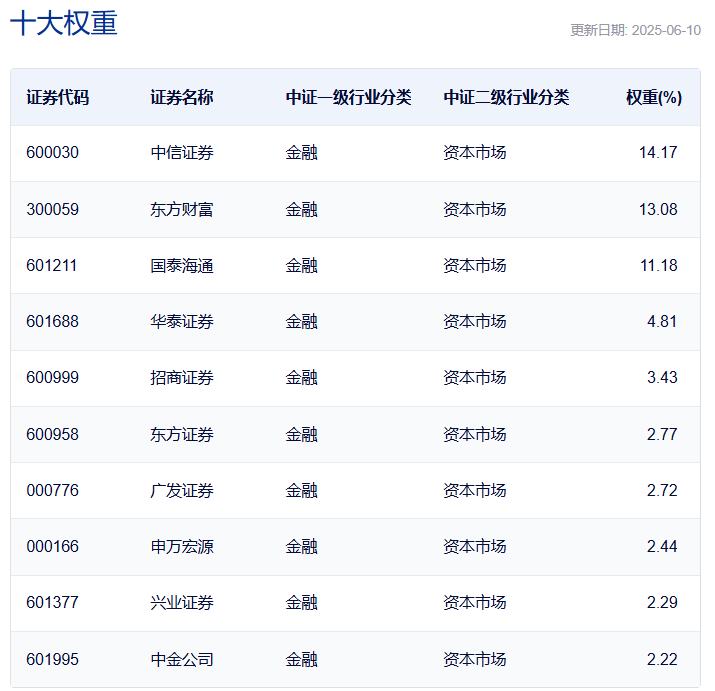
Core Viewpoint - The brokerage sector is experiencing a collective rise, influenced by recent news, with related ETFs showing significant gains. The market currently has multiple ETFs tracking four main indices related to the brokerage sector, each with distinct characteristics [1][2]. Group 1: Index Characteristics - The four indices include the CSI All Share Securities Companies Index, CSI Securities Company 30 Index, CSI Hong Kong Securities Investment Theme Index, and National Securities Leader Index, each differing in sample space and focus [3]. - The CSI All Share Securities Companies Index consists of 49 stocks from the securities industry, providing broad coverage [3]. - The CSI Securities Company 30 Index focuses on leading brokerage firms with high market capitalization and revenue, comprising 29 stocks [3]. - The CSI Hong Kong Securities Investment Theme Index includes 20 stocks primarily from Hong Kong-listed brokerages and the Hong Kong Stock Exchange [3]. - The National Securities Leader Index selects the top 30 stocks based on revenue from various securities-related businesses, emphasizing leading firms in the A-share market [3]. Group 2: Weighting and Performance - The top ten stocks in the CSI All Share Securities Companies Index account for 59.1% of the total weight, with CITIC Securities, East Money, and Guotai Junan each exceeding 10% [4][5]. - The CSI Securities Company 30 Index has a higher concentration, with its top ten stocks making up 67.76% of the index, also featuring CITIC Securities, Guotai Junan, and East Money [6]. - The CSI Hong Kong Securities Investment Theme Index has an even higher concentration, with its top ten stocks comprising 88% of the index, including Hong Kong Exchanges and Clearing, CITIC Securities, and Guotai Junan [7]. - The National Securities Leader Index's top ten stocks account for 80.15% of the index, with East Money and CITIC Securities each exceeding 10% [8]. Group 3: Return Performance - The CSI All Share Securities Companies Index reflects the overall development of the securities industry, providing risk diversification during market downturns, though it may not perform as well during bullish phases [9]. - The CSI Securities Company 30 Index tends to perform well in strong market conditions, particularly when leading brokerages excel, but may face significant pullbacks during market downturns [10][11]. - The CSI Hong Kong Securities Investment Theme Index's performance is closely tied to the Hong Kong market and related policies, with potential for high returns but also significant volatility due to currency fluctuations [12]. - The National Securities Leader Index is expected to perform well during bullish trends due to its focus on leading brokerages, but it may also experience substantial declines during market corrections [13]. Group 4: Valuation Levels - Current valuation levels indicate that the CSI All Share Securities Companies Index and the CSI Securities Company 30 Index have TTM P/E ratios below the historical 30th percentile, suggesting they are relatively undervalued [14]. - The National Securities Leader Index's TTM P/E ratio is slightly above the historical 30th percentile, indicating a low valuation level [14]. - The CSI Hong Kong Securities Investment Theme Index shows the most significant recovery in TTM P/E ratios, approaching the historical 80th percentile [14]. Group 5: Commonalities - All four indices are related to the securities industry, reflecting market performance and providing investment insights [21]. - Due to their focus on a single industry, there is considerable overlap among the top-weighted stocks across these indices [21].





券商股盘中走强,证券行业新一轮并购预期再起
Di Yi Cai Jing· 2025-06-11 03:03
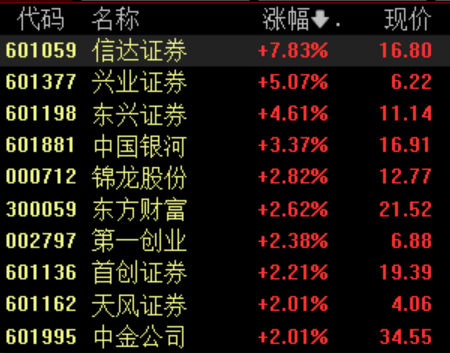
Group 1 - The core viewpoint is that the recent equity adjustments in "Huijin" brokerages are expected to drive a new wave of mergers and acquisitions in the securities industry, focusing on administrative and market-based mergers under the same controlling entity [1][3]. - As of June 11, broker stocks showed strong performance, with notable increases in shares such as Xinda Securities (+7.83%) and Industrial Securities (+5.07%) [2][1]. - The China Securities Regulatory Commission has approved Central Huijin Investment Co., Ltd. as the actual controller of several brokerages, including Changcheng Guorui Securities and Dongxing Securities, which has reignited market expectations for mergers [2][1]. Group 2 - Analysts believe that regulatory encouragement for industry consolidation, along with policies aimed at high-quality development, positions mergers and acquisitions as effective means for brokers to achieve external growth and enhance overall industry competitiveness [3]. - The focus is on two main areas: brokerages under the same controlling entity and those with high potential for market-based mergers, indicating a promising outlook for the brokerage and financial technology sectors [3]. - Positive policy signals since the beginning of the year, including interest rate cuts, are expected to support liquidity and boost market confidence, with a forecast for sustained high trading activity through 2025 [3].



港股中资券商股盘中强势,光大证券(06178.HK)涨超9%,弘业期货(03678.HK)涨超8%,广发证券(01776.HK)涨超6%,中金公司(03908.HK)、招商证券(06099.HK)、华泰证券(06886.HK)均涨超5%。
news flash· 2025-06-11 02:03
港股中资券商股盘中强势,光大证券(06178.HK)涨超9%,弘业期货(03678.HK)涨超8%,广发证券 (01776.HK)涨超6%,中金公司(03908.HK)、招商证券(06099.HK)、华泰证券(06886.HK)均涨超5%。 ...

招商证券国际:维持吉利汽车(00175)“增持”评级 目标价27.5港元
智通财经网· 2025-06-11 02:00
Core Viewpoint - The report from China Merchants Securities International indicates that Geely Automobile (00175) is expected to raise its annual sales target due to the launch of significant new models from Galaxy, Lynk & Co, and Zeekr in the second half of the year, which could act as a catalyst for the stock price [1] Group 1: Sales Performance - In May, Geely's total wholesale volume reached 235,000 units, marking a year-on-year increase of 46.4% and a month-on-month increase of 0.5%, setting a historical record [2] - The cumulative wholesale volume from January to May was 1.17 million units, up 49% year-on-year, achieving approximately 43% of the annual sales target of 2.71 million units, with potential for exceeding the target [2] - In May, the wholesale volume of new energy vehicles (NEVs) was 138,000 units, reflecting a year-on-year increase of 178% and a month-on-month increase of 9.9%, significantly outpacing the industry growth [2] - NEVs accounted for 58.7% of total sales in May, up 22.2 percentage points year-on-year [2] - Cumulative NEV wholesale from January to May reached 602,000 units, a year-on-year increase of 137%, representing 51% of total sales [2] - The high-end fuel vehicle, China Star, saw sales of 87,000 units in May, with the high-end series achieving a year-on-year growth of 21% [2] Group 2: Product Launches and Innovations - The company plans to launch multiple significant new models in the second half of the year, including the Galaxy A7 mid-size sedan and a rugged SUV, enhancing its product matrix [3] - The high-end flagship SUV Lynk & Co 900 had nearly 5,600 units delivered in May, with a strong order backlog, and the Lynk & Co hybrid Z10 is set to launch in the second half [3] - Zeekr's new model 007GT is performing well, with additional luxury SUVs set to launch in Q3 and Q4 [3] - The fuel vehicle Star series is leveraging the new energy platform for shared benefits, with the Star Yue L model performing well since its March launch [3] Group 3: International Expansion - The company is accelerating its overseas layout, with the first EX5 produced at the Indonesian KD factory and plans for a light asset model in Latin America and Central Asia [3] - The Galaxy E5 and Star Wish are set to enter multiple markets in the second quarter, with an acceleration of overseas expansion planned for the second half of the year [3]

招商证券迎新帅!
Zhong Guo Jing Ying Bao· 2025-06-09 11:33
Core Viewpoint - The appointment of Zhu Jiangtao as the new president of China Merchants Securities is expected to enhance resource integration and risk management within the company, leveraging his extensive banking experience [2][5]. Group 1: Leadership Changes - Zhu Jiangtao has been appointed as the president of China Merchants Securities, with his term starting from the board's approval until the end of the eighth board's term [2]. - Zhu previously served as an executive director and vice president at China Merchants Bank, where he was recognized for his contributions [2][4]. - The leadership transition follows the retirement of former president Wu Zongmin, aiming to minimize the impact of management changes [3]. Group 2: Zhu Jiangtao's Background - Zhu Jiangtao, born in 1972, has nearly 30 years of experience in the banking sector, with significant roles in risk management [4]. - His career includes positions at Industrial and Commercial Bank of China and various leadership roles at China Merchants Bank, culminating in his role as Chief Risk Officer [4]. Group 3: Management Structure - The new executive structure at China Merchants Securities includes one president and five vice presidents, with recent appointments to fill the vice president roles [6]. - Zhang Xing and Wang Zhijian have been appointed as vice presidents, focusing on compliance risk and investment business, respectively [8][7]. Group 4: Financial Performance - In 2024, China Merchants Securities reported a revenue of 20.891 billion yuan, a year-on-year increase of 5.4%, and a net profit of 10.386 billion yuan, up 18.51% [9]. - For Q1 2025, the company achieved a revenue of 471 million yuan, reflecting a 9.64% increase, with net profit reaching 231 million yuan, up 6.97% [9][10]. - The significant growth in commission income by 47.66% in Q1 2025 was driven by an increase in brokerage business, while investment income turned positive at 3.31 billion yuan [9][10].
4000亿满月答卷:银证保的科创债「暗战」
Hua Er Jie Jian Wen· 2025-06-09 10:58
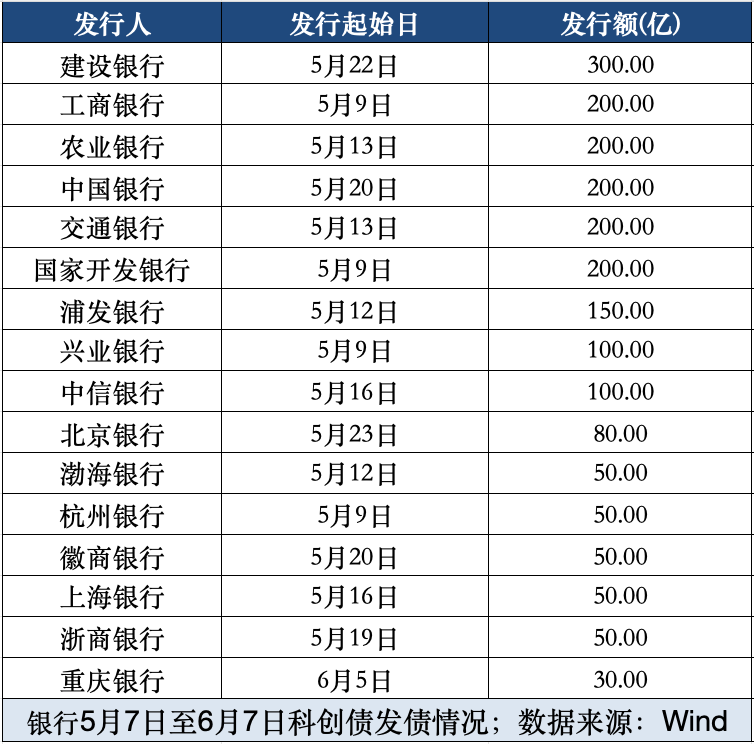
被视为债市"科技板"的科创债新政落地后,市场主体发行科创债的热度持续攀升。 以发行起始日计,5月7日新规落地后的首月(截至6月7日),已有221只科创债正式发行,募集资金规模超 4000亿元,同比增长3倍还多。 新获发行资质的银行、券商等金融机构共发行科创债2303亿元; 其中,16家银行发债超2000亿元,凭借五成以上的份额成为科创债的绝对主力与最大增量。 科创债起源于双创债实践,后为以科创公司债(交易所)与票据(银行间)为主要品种。 5月7日,央行、证监会联合提出丰富科创债产品体系的13条具体举措,通过金融机构与股权投资机构的双 重扩容,构建覆盖科创企业全生命周期的融资链条; 同日,交易商协会、银行间市场、三大交易所宣布优化科创债发行、交易等环节。 5月14日,科技部、央行等7个部门发布《加快构建科技金融体制有力支撑高水平科技自立自强的若干政策 举措》,再提建立债市"科技板"。 密集的新规推动下,科创债发行量持续走向高峰。 超3倍增量入市 科创债新政落地首月,新发科创债已达221只、募资4027亿元,两项数据同比增幅分别为130.21%、 322.12%。 科创债基于科创企业类、升级类、投资类、孵化类等属 ...



A股趋势与风格定量观察:内外情绪均有改善,短期转向中性乐观
CMS· 2025-06-08 13:03
- Model Name: Short-term Quantitative Timing Model; Model Construction Idea: The model aims to provide short-term market timing signals based on various market indicators; Model Construction Process: The model evaluates four main aspects: fundamentals, valuation, sentiment, and liquidity. Each aspect is assessed using specific indicators such as PMI, loan growth, M1 growth, PE and PB ratios, beta dispersion, trading volume sentiment, volatility, interest rates, exchange rate expectations, and financing amounts. The signals from these indicators are combined to generate an overall market timing signal. For example, the formula for the fundamental signal is based on the PMI and loan growth: $$ \text{Fundamental Signal} = \text{PMI} \times \text{Loan Growth} $$ where PMI represents the manufacturing PMI index and Loan Growth represents the year-on-year growth rate of medium and long-term loans in RMB. Model Evaluation: The model has shown significant improvement over the benchmark in terms of annualized returns and maximum drawdown reduction[19][22][23] - Model Name: Growth-Value Style Rotation Model; Model Construction Idea: The model aims to rotate between growth and value styles based on economic cycles and market conditions; Model Construction Process: The model uses a quantitative economic cycle analysis framework to assess the profitability cycle, interest rate cycle, and credit cycle. For example, the profitability cycle slope is calculated as: $$ \text{Profitability Cycle Slope} = \frac{\text{Current Profitability} - \text{Previous Profitability}}{\text{Time Period}} $$ The model also considers valuation differences (PE and PB ratios) and sentiment differences (turnover and volatility). The signals from these indicators are combined to generate a style rotation recommendation. Model Evaluation: The model has shown significant improvement over the benchmark in terms of annualized returns and maximum drawdown reduction[31][32][33] - Model Name: Small-Cap vs. Large-Cap Style Rotation Model; Model Construction Idea: The model aims to rotate between small-cap and large-cap styles based on economic cycles and market conditions; Model Construction Process: Similar to the Growth-Value Style Rotation Model, this model uses a quantitative economic cycle analysis framework to assess the profitability cycle, interest rate cycle, and credit cycle. It also considers valuation differences (PE and PB ratios) and sentiment differences (turnover and volatility). The signals from these indicators are combined to generate a style rotation recommendation. Model Evaluation: The model has shown significant improvement over the benchmark in terms of annualized returns and maximum drawdown reduction[35][36][37] - Model Name: Four-Style Rotation Model; Model Construction Idea: The model combines the Growth-Value and Small-Cap vs. Large-Cap Style Rotation Models to provide a comprehensive style rotation strategy; Model Construction Process: The model integrates the signals from the Growth-Value and Small-Cap vs. Large-Cap Style Rotation Models to recommend allocations across four styles: small-cap growth, small-cap value, large-cap growth, and large-cap value. The recommended allocation is based on the combined signals from the underlying models. Model Evaluation: The model has shown significant improvement over the benchmark in terms of annualized returns and maximum drawdown reduction[39][40][41] Model Backtest Results - Short-term Quantitative Timing Model: Annualized Return 16.27%, Annualized Volatility 14.73%, Maximum Drawdown 27.70%, Sharpe Ratio 0.9620, IR 0.5875[22][27] - Growth-Value Style Rotation Model: Annualized Return 11.35%, Annualized Volatility 20.89%, Maximum Drawdown 43.07%, Sharpe Ratio 0.5239, IR 0.2634[32][34] - Small-Cap vs. Large-Cap Style Rotation Model: Annualized Return 11.99%, Annualized Volatility 22.79%, Maximum Drawdown 50.65%, Sharpe Ratio 0.5241, IR 0.2367[36][38] - Four-Style Rotation Model: Annualized Return 12.90%, Annualized Volatility 21.64%, Maximum Drawdown 47.91%, Sharpe Ratio 0.5776, IR 0.2693[40][41]
ETF基金周度跟踪:创业板人工智能、港股通创新药ETF领涨-20250608
CMS· 2025-06-08 11:02
Report Industry Investment Rating The provided content does not mention the report industry investment rating. Core Viewpoints The report focuses on the performance of the ETF fund market, summarizing the performance and capital flows of the ETF fund market, different popular sub - type ETF funds, and innovative theme and sub - industry ETF funds in the past week (June 3 - June 6, 2025) to provide references for investors [1]. Summary by Relevant Catalogs ETF Market Overall Performance - Market performance: Most A - share - focused ETFs rose this week. TMT ETFs had the largest increase, with an average increase of 3.52% for funds above a certain scale, while consumer ETFs declined, with an average decline of 0.01% for funds above a certain scale [2][5]. - Capital flow: Capital continued to flow into bond ETFs significantly, with a net inflow of 14.418 billion yuan throughout the week. On the contrary, there was significant capital outflow from sectors such as Sci - tech Innovation/ChiNext related index ETFs, Hong Kong stock ETFs, and QDII - ETFs [3][9]. Different Popular Sub - type ETF Funds Market Performance - The report lists the performance of various sub - type ETFs, including broad - based index ETFs (such as ultra - large - cap, large - cap, small - and - medium - cap, etc.), industry - themed ETFs (TMT, mid - stream manufacturing, financial real estate, etc.), SmartBeta ETFs, bond ETFs, QDII ETFs, and commodity ETFs, presenting their latest scale, weekly capital flow, weekly return, weekly trading volume, recent 1 - month return, and year - to - date return [15][21][29]. Innovative Theme and Sub - industry ETF Funds Market Performance - The report shows the market performance of high - attention innovative theme and sub - industry ETFs, including TMT innovation themes, consumer sub - industries, pharmaceutical sub - industries, new energy themes, central and state - owned enterprise themes, stable - growth themes, Hong Kong - related sub - industries, etc., presenting the weekly return, year - to - date return, fund code, representative fund name, weekly return, and latest scale [33][34][35].