NJBK(601009)

Search documents
已有7家银行私银客户超10万户
2 1 Shi Ji Jing Ji Bao Dao· 2025-11-12 05:45
Core Insights - The private banking sector has seen significant growth in the first three quarters of this year, with seven listed banks reporting over 100,000 private banking clients as of September 30, 2023, indicating a rising demand for wealth management services among high-net-worth individuals [2][4][5] Group 1: Growth in Private Banking Clients - Multiple banks reported a client growth rate exceeding 10%, with Minsheng Bank, Beijing Bank, and Nanjing Bank showing increases over 15% [4] - Minsheng Bank had the fastest growth, reaching 73,409 private banking clients, an increase of 18.21% from the end of last year [5] - Beijing Bank reported 20,586 private banking clients, up 17.9%, and an asset under management (AUM) of 224 billion yuan, a 14.39% increase [5][6] Group 2: Market Position of Major Banks - State-owned banks continue to dominate the private banking market, with Agricultural Bank of China leading at 279,000 clients, followed by China Construction Bank and Bank of China [6] - China Merchants Bank and Ping An Bank have also joined the "100,000 club," with Ping An Bank reaching 103,300 clients, marking its first entry into this category [6][7] Group 3: Challenges and Opportunities in Wealth Management - The growth in private banking clients is attributed to the expanding base of high-net-worth individuals and the upgrading of banking services [9] - The Hu Run Wealth Report indicates that the total wealth of China's 6 million affluent families has reached 150 trillion yuan, with ultra-high-net-worth families holding 87 trillion yuan, an increase from 56% to 58% of total wealth [9] - The private banking sector is facing challenges such as economic shifts, declining risk-free returns, and reduced investor confidence, necessitating a transformation in wealth management services [10][11]








已有7家银行私银客户超10万户
21世纪经济报道· 2025-11-12 05:38
Core Insights - The private banking business has seen significant growth in the first three quarters of this year, with seven listed banks surpassing 100,000 private banking clients as of September 30, 2023, driven by the increasing number of high-net-worth individuals and evolving wealth management needs [1][3][6] Growth of Private Banking Clients - Several banks reported a client growth rate exceeding 10%, with Minsheng Bank, Beijing Bank, and Nanjing Bank showing increases over 15%. Minsheng Bank led with an 18.21% growth, reaching 73,409 clients [3][6] - Beijing Bank's private banking clients grew by 17.9% to 20,586, with total assets under management (AUM) increasing by 14.39% to 224 billion yuan [3][6] - Nanjing Bank also reported a 15.43% increase in private banking clients [3] Dominance of State-Owned Banks - State-owned banks continue to lead in absolute numbers, with Agricultural Bank of China having 279,000 clients, followed by China Construction Bank with 265,500 clients [4] - China Merchants Bank and Ping An Bank have also joined the "100,000 club," with Ping An Bank reaching 103,300 clients, marking its first time surpassing this threshold [4][6] Market Dynamics and Competition - The private banking market is characterized by a competitive landscape where state-owned banks leverage their scale, while joint-stock banks focus on differentiated services and operational efficiency [7] - The growth of high-net-worth individuals is expected to drive competition towards service quality and asset allocation capabilities [7] Challenges in Wealth Management - The wealth management sector faces three main challenges: economic growth slowdown, declining risk-free returns, and reduced investor confidence [10][11] - Banks are urged to upgrade their wealth management services to meet clients' real needs and utilize various financial tools for comprehensive solutions [11] Changing Client Demographics - The core client base for private banking is shifting from traditional business owners to new economy groups, with a notable increase in demand for comprehensive wealth management services [9] - Banks are redefining their target clients based on their strengths, with some focusing on family wealth transfer and others on retirement financial management [9]




银行“批量直供”房产,买家低价“捡漏”,专家:交易风险相对较小
Hua Xia Shi Bao· 2025-11-12 03:58
Core Insights - The surge in "direct sale" properties by banks, including Lanzhou Bank, Jilin Bank, and Tianjin Bank, has become a focal point in the real estate market, raising concerns about its impact on the second-hand housing market [2][4][8] Group 1: Market Dynamics - Banks are increasingly engaging in "direct sale" of properties, which are obtained through judicial processes, allowing them to sell properties with clear ownership [3][4] - The number of properties listed for direct sale has significantly increased, with Lanzhou Bank listing 1,779 properties and Jilin Bank over 2,000 properties for 2025 [4] - The direct sale properties are often priced 10% to 25% below market value, making them attractive to price-sensitive buyers [5][8] Group 2: Financial Implications - The rise in direct sale properties is seen as a response to the pressure of non-performing assets and a cooling auction market, prompting banks to adopt a direct sale model [7][8] - The overall non-performing loan rate for mortgages is currently manageable, but there is an upward trend in personal business loan defaults [7] - The auction market has seen a decline, with a 5.7% drop in the number of properties listed for auction in 2025 compared to the previous year [7] Group 3: Impact on Real Estate Market - The actual transaction volume of bank direct sale properties is low, typically accounting for only 1% to 3% of total second-hand home transactions, indicating limited long-term impact on overall housing prices [9] - The pricing strategy of direct sale properties may temporarily suppress buyer expectations and influence local pricing dynamics [9] - Future collaboration between banks and real estate agents is anticipated, where banks provide baseline pricing and risk control while agents handle customer interactions and transactions [8][9]


摩根士丹利中债1-5年政策性金融债指数证券投资基金基金份额发售公告
Shang Hai Zheng Quan Bao· 2025-11-11 19:10
Fund Overview - The fund is named Morgan Stanley China Government Bond Index Fund (1-5 Years) and is categorized as a bond-type open-ended fund [12] - The fund's initial share value is set at RMB 1.00, with no upper limit on the fundraising scale [12][16] - The fundraising period is from November 17, 2025, to January 15, 2026, with the possibility of adjustments based on subscription conditions [16] Subscription Details - The minimum initial subscription amount is RMB 10, and additional subscriptions must also be at least RMB 10 [25][41] - Investors can subscribe through designated sales institutions, and the fund management company may add new sales institutions during the fundraising period [5][12] - The fund offers two classes of shares: Class A, which incurs subscription fees, and Class C, which does not charge subscription fees but deducts service fees from the fund's assets after the contract takes effect [19][20] Investor Eligibility - The fund is open to individual investors, institutional investors, qualified foreign investors, and other investors permitted by laws and regulations [12][16] - Investors must ensure that their funds for subscription are legally sourced and free from any legal or contractual restrictions [3][8] Fund Management and Custody - The fund is managed by Morgan Stanley Fund Management (China) Co., Ltd., and the custodian is Nanjing Bank Co., Ltd. [12][50] - The fund management company is responsible for the overall management and operation of the fund assets [50] Fund Operation and Risk Management - The fund primarily invests in policy financial bonds, which may involve credit risks and liquidity risks associated with policy banks [8] - The fund's net asset value may fluctuate due to market conditions, and investors should be aware of the inherent risks of investing in securities [8][9] Fund Registration and Compliance - The fund's registration has been approved by the China Securities Regulatory Commission (CSRC), but this does not guarantee the fund's investment value or market prospects [1][12] - The fund's contract will take effect once it meets the regulatory requirements, including a minimum of 200 investors and a total subscription amount of at least RMB 20 million [16][49]
城商行板块11月11日跌0%,上海银行领跌,主力资金净流入2.41亿元
Zheng Xing Xing Ye Ri Bao· 2025-11-11 08:46
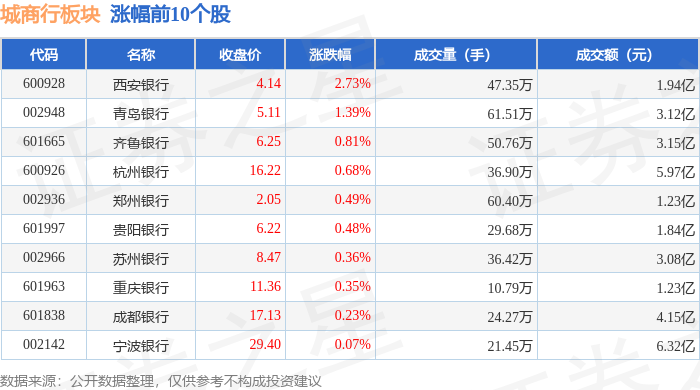
Market Overview - The city commercial bank sector experienced a slight decline of 0.0% on November 11, with Shanghai Bank leading the drop [1] - The Shanghai Composite Index closed at 4002.76, down 0.39%, while the Shenzhen Component Index closed at 13289.0, down 1.03% [1] Individual Bank Performance - Xi'an Bank saw the highest increase in share price, closing at 4.14 with a rise of 2.73% [1] - Qingdao Bank and Qilu Bank also reported positive performance, with increases of 1.39% and 0.81% respectively [1] - Shanghai Bank, on the other hand, closed at 10.13, down 0.98%, indicating a significant decline in its stock price [2] Trading Volume and Capital Flow - The city commercial bank sector recorded a net inflow of 241 million yuan from institutional investors, while retail investors saw a net outflow of 290 million yuan [2] - Jiangsu Bank attracted the highest net inflow from institutional investors at 113 million yuan, representing 11.75% of its trading volume [3] - In contrast, Zhengzhou Bank experienced a net outflow of 421,280 yuan from institutional investors, indicating a negative sentiment towards its stock [3]




“流量”如何变“留量”? 银行业借势“双11”发力零售业务
Jin Rong Shi Bao· 2025-11-11 02:03
Core Insights - The article highlights the increasing competition among banks during the "Double 11" shopping festival, with a focus on credit and debit card promotions to boost consumer spending and market share [1][2][3] - Banks are leveraging the shopping season to enhance customer loyalty and optimize revenue structures through targeted marketing strategies [1][3][6] Group 1: Bank Promotions and Strategies - Major banks, including state-owned banks, are launching various promotional activities for credit and debit cards during the "Double 11" event, such as discounts and cashback offers [2][3] - Specific promotions include "full reduction" offers on credit cards and random discounts on debit card transactions, aimed at increasing transaction volumes and customer engagement [2][3] - The promotional activities are seen as a response to the intensifying competition in retail banking and a strategy to activate dormant accounts [3][4] Group 2: Policy Support and Market Trends - The Chinese government has introduced policies to stimulate consumer spending, encouraging financial institutions to develop innovative financial products tailored to service consumption needs [1][6] - Data indicates a significant increase in the total number of bank cards, with a total of 10.068 billion cards issued by mid-2025, although the credit card market is nearing saturation [3][6] - The retail banking sector is undergoing a transformation from aggressive customer acquisition to a more refined approach focused on customer retention and engagement [3][6][7] Group 3: Future Outlook and Challenges - Banks are expected to face challenges in converting short-term promotional activities into long-term customer relationships, necessitating a shift from broad promotional strategies to more targeted, data-driven approaches [7] - The emphasis will be on creating differentiated membership systems and enhancing customer experiences to foster loyalty and increase the lifetime value of customers [7]



真金白银!年内十余家上市银行获股东、高管增持,银行“防御性板块”角色要变?
Xin Lang Cai Jing· 2025-11-10 12:57
Core Viewpoint - The recent surge in share buybacks by various banks, including Qilu Bank and Qingdao Bank, reflects strong confidence in the long-term value of the banking sector, with over 10 listed banks participating in this trend [1][9][10]. Group 1: Share Buybacks - Qilu Bank announced that its directors, supervisors, and senior executives have collectively increased their holdings by 3.15 million yuan, accounting for 90% of the planned buyback amount [1]. - Qingdao Bank's major shareholder, Qingdao Guoxin Financial Holdings, increased its holdings by 957 million yuan, raising its stake to 15.42%, making it the largest shareholder [4]. - Xiamen Bank's executives completed a buyback plan exceeding the minimum target, with total contributions reaching 1.6857 million yuan [5]. Group 2: Market Sentiment - The buyback activities are interpreted as a recognition of the banking sector's valuation, with a current price-to-book ratio of 0.72 and a dividend yield of 3.99%, attracting long-term capital [10][12]. - The banking sector has seen a collective "self-purchase" phenomenon, with various regional banks also engaging in buybacks, indicating a broader trend across the industry [6][8]. Group 3: Performance and Valuation - Despite a slight decline in revenue and net profit for 42 A-share listed banks in the first quarter, 24 banks reported growth in both metrics, particularly city and rural commercial banks [10]. - The net interest margin for listed banks is projected to stabilize, with a simulated net interest margin of 1.32% for Q3 2025, marking a potential turning point after four years of decline [12]. - Long-term capital, particularly from insurance funds, has been increasingly allocated to the banking sector, with a reported increase of 8.36 billion shares held by insurance funds in Q3 2025 [12][13].



本周在售最低持有期产品哪家强?
2 1 Shi Ji Jing Ji Bao Dao· 2025-11-10 08:44
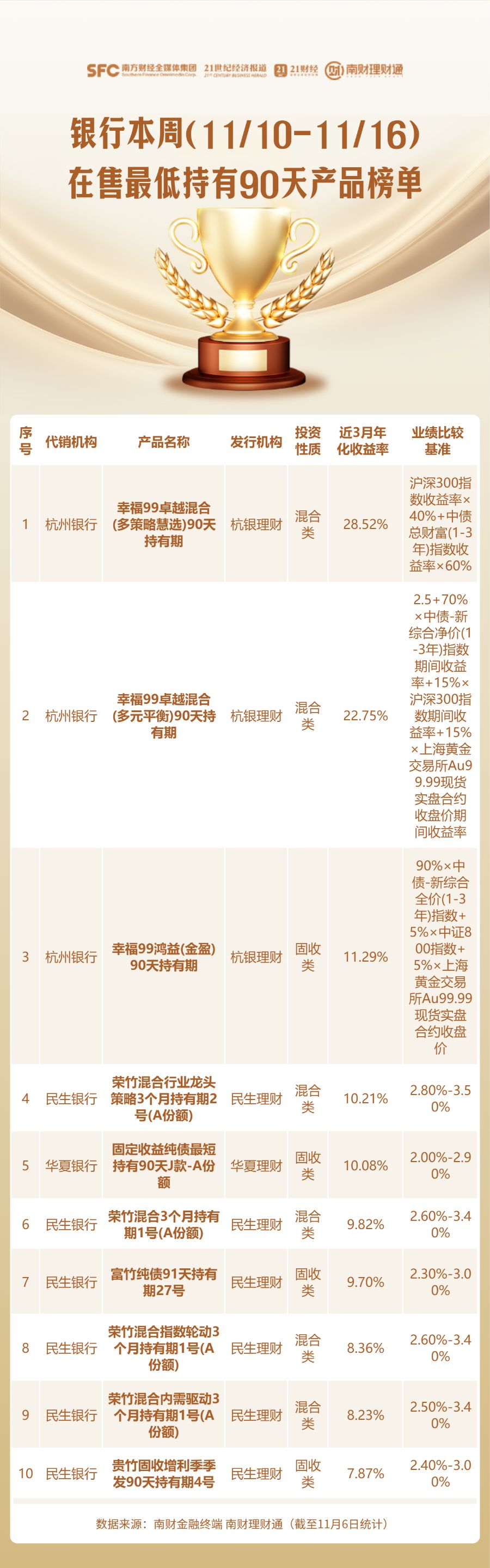
Core Insights - The article emphasizes the importance of distinguishing between various bank wealth management products, which often have similar names and vague characteristics, to help investors make informed choices [1] - The South Finance Wealth Management team compiles a weekly performance ranking of wealth management products available through different distribution channels, focusing on those with the best performance [1] Product Performance Summary - The report categorizes products based on minimum holding periods of 90 days, 180 days, and 365 days, calculating annualized returns for each category [1] - A total of 28 distribution institutions are involved in the ranking, including major banks such as Industrial and Commercial Bank of China, Bank of China, and Agricultural Bank of China [1] - The ranking is based on the assumption of the product's "on-sale" status, but actual availability may vary due to factors like sold-out quotas or differences in product listings for different customers [1] 90-Day Holding Period Products - The top-performing product for a 90-day holding period is from Hangzhou Bank, with an annualized return of 22.75% [4] - Other notable products include those from Minsheng Bank and Huaxia Bank, with returns of 10.21% and 10.08%, respectively [5] 180-Day Holding Period Products - For the 180-day holding period, Hangzhou Bank's product leads with a return of 14.04% [7] - Minsheng Bank also features prominently with products yielding 12.26% and 10.26% [7] 365-Day Holding Period Products - The report indicates that products with a 365-day holding period are also being evaluated, with specific performance data yet to be detailed in the provided excerpts [9]
从增量扩面到提质控险 银行业普惠金融迈向差异化精准服务
2 1 Shi Ji Jing Ji Bao Dao· 2025-11-10 04:21
Core Insights - The report highlights the significant growth and development of inclusive finance in China, particularly focusing on small and micro enterprises and rural areas, with a notable annual growth rate of over 20% in inclusive micro loans during the 14th Five-Year Plan period [1][2] - As of June 2025, the balance of inclusive micro loans reached 36 trillion yuan, which is 2.3 times that of the end of the 13th Five-Year Plan, with a decrease in interest rates by 2 percentage points [1][2] - The average interest rate for newly issued inclusive micro loans was 3.48% as of June 2025, reflecting a decrease of 66 basis points year-on-year [1][2] Group 1: Digital Empowerment - Digital technology has been a key driver for the development of inclusive finance, with banks utilizing big data and AI to enhance loan approval efficiency and reduce financing costs [2][7] - The market structure among banks is changing, with large commercial banks holding a 45.11% share of inclusive micro loans, while rural financial institutions have seen a decline in their market share [2][3] - The average growth rate of inclusive micro loans has been slowing down, with a decrease from 30.9% in 2020 to 12.3% by mid-2025 [2][3] Group 2: Performance of Listed Banks - Among listed banks, Agricultural Bank of China, Industrial and Commercial Bank of China, and Beijing Bank reported the highest growth rates in inclusive micro loans at 18.50%, 17.30%, and 17.27% respectively [3][4] - In contrast, some banks, including Shanghai Bank and Zhengzhou Bank, experienced negative growth rates of -3.97% and -2.06% [3][4] - The performance of different banks varies significantly, with state-owned banks generally showing stronger growth in inclusive micro loans compared to smaller banks [3][4] Group 3: Interest Rates and Risk Management - The interest rates for newly issued inclusive micro loans have decreased across various banks, with the highest rate at 4.20% and the lowest at 2.94% [7][8] - The gap in interest rates between large and small banks is narrowing, with some large banks' rates aligning closely with those of smaller banks [8][9] - The report emphasizes the importance of risk management in the inclusive finance sector, with several banks focusing on improving asset quality and managing non-performing loans [9][10]
中国区域性银行_2025 年第三季度回顾_核心盈利稳步复苏,我们偏好宁波银行和南京银行-China regional banks_ 3Q25 review_ Steady recovery in core earnings, we prefer BoNB and BoNJ
2025-11-10 03:34
Summary of China Regional Banks 3Q25 Review Industry Overview - The report focuses on the performance of China Regional Banks (CRBs) in the third quarter of 2025 (3Q25) - Overall profits for CRBs grew by 6% year-over-year (y/y), a decrease from 9% y/y in 2Q25, primarily due to a decline in non-fee income [1][3] Core Earnings and Profitability - CRBs demonstrated a core earnings recovery of 12% y/y, outperforming large banks which only saw a 1% y/y increase in core earnings [1][3] - Net Interest Income (NII) for CRBs grew by an average of 7% y/y, improving from 5% y/y in 2Q25, while large banks averaged only 0.4% growth [3][7] - Fee income increased by 16% y/y, reversing a contraction trend, supported by agency fee growth as market sentiment improved [3][7] - Non-fee income saw a significant decline of 32% y/y, primarily due to fair value losses in bond investments [3][7] Asset Quality - Asset quality remained stable, with the average Non-Performing Loan (NPL) ratio declining by 1 basis point (bps) q/q to 0.96% in 3Q25 [1][21] - The Special Mention Loan (SML) ratio increased by 3 bps q/q, indicating some pressure on asset quality compared to large banks [21] - The NPL coverage ratio decreased slightly by 1 bps q/q, suggesting a cautious approach to provision releases [21] Capital and Growth Constraints - The Common Equity Tier 1 (CET1) ratio for CRBs decreased by 11 bps q/q, raising concerns about growth constraints due to lower capital levels [3][21] - CRBs reported a 2% q/q loan growth, consistent with industry trends, but with significant variations among banks [20] - Deposit growth was flat on average, with BoNB experiencing the highest contraction at -1.4% q/q [20] Investment Recommendations - Top picks among regional banks include BoNB and BoNJ, both showing double-digit growth in core earnings and stable asset quality [1][3] - BoBJ's performance was the weakest, with a profit contraction of 2% y/y and a low CET1 ratio, although its high dividend yield of 5.8% provides some downside protection [1][3] - Caution is advised regarding CSRCB until clearer signs of improvement in SME asset quality are observed [1][3] Valuation Insights - The report includes a valuation comparison of various regional banks, highlighting differences in price-to-earnings (P/E) ratios, price-to-book (P/B) ratios, and return on equity (ROE) [5] - The average P/E for CRBs is projected at 6.1 for FY25E and 5.7 for FY26E, with an average dividend yield of 5.0% for FY25E [5] Conclusion - The overall performance of China Regional Banks in 3Q25 indicates a steady recovery in core earnings, although challenges remain in non-fee income and capital levels. The investment outlook is cautiously optimistic for select banks, particularly BoNB and BoNJ, while caution is warranted for others like CSRCB and BoBJ.