NJBK(601009)

Search documents
江苏前三季度2556户科技型企业首贷破冰
Zhong Guo Jing Ji Wang· 2025-11-07 14:53
Core Insights - Jiangsu Financial Regulatory Bureau, in collaboration with the provincial Science and Technology Department and Finance Department, has initiated a special action to expand the first loan support for technology-based enterprises, resulting in 2,556 companies receiving first loans totaling 14.14 billion yuan by the end of September [1][3] Group 1: Special Action Implementation - Jiangsu financial institutions have developed specific implementation plans to achieve the goals of the special action, with banks like Jiangsu Bank, Nanjing Bank, and Agricultural Bank of Jiangsu quickly establishing their action plans [2] - Nanjing Bank has set up reward policies focusing on customer visits, marketing implementation, and comprehensive services [2] - Bank of China Jiangsu Branch has created a "Digital Inclusive" service platform for automatic customer assignment to nearby branches [2] Group 2: Product and Service Optimization - Jiangsu financial institutions are continuously optimizing products and services to ensure that technology-based enterprises with reasonable financing needs can access loans [3] - Industrial and Commercial Bank of China Jiangsu Branch has introduced a "Value Evaluation System" for technology enterprises, facilitating the transition from "no loan" to "first loan" [3] - Nanjing Bank has launched a product for the transformation of scientific and technological achievements, and upgraded its online standardized product "Xin e Technology Enterprise" [3] Group 3: Loan Growth Metrics - By the end of September, the loan balance for technology-based enterprises in Jiangsu reached 27.7 trillion yuan, reflecting a growth of 16.17% since the beginning of the year, which is 7.33 percentage points higher than the overall loan growth rate [3]


私行业务成银行“香饽饽”?七家客户数破10万大关
Xin Lang Cai Jing· 2025-11-07 00:20
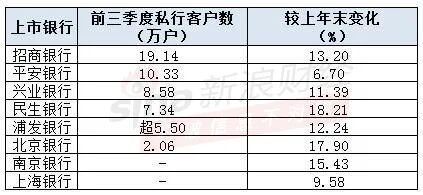
Core Insights - The private banking sector in China is experiencing significant growth, with several listed banks reporting an increase in private banking clients exceeding 10% [1][2][3] - Notably, Minsheng Bank, Beijing Bank, and Nanjing Bank have all reported client growth rates above 15% [1][2][3] - As of the end of September, the total number of private banking clients at Minsheng Bank reached 73,409, marking an 18.21% increase from the previous year [3][5] Private Banking Client Growth - Multiple banks have shown robust growth in private banking clients, with Minsheng Bank, Beijing Bank, and Nanjing Bank leading with growth rates over 15% [1][2][3] - As of September 30, 2023, the number of private banking clients at major banks is as follows: - China Merchants Bank: 191,418 clients, up 13.2% - Ping An Bank: 103,300 clients, up 6.7% - Minsheng Bank: 73,409 clients, up 18.21% - Beijing Bank: 20,586 clients, up 17.9% - Nanjing Bank: growth of 15.43% [3][5][6] Wealth Management Market Expansion - The wealth management market in China continues to expand, with listed banks reporting steady growth in wealth clients [8][9] - As of September 30, 2023, Ping An Bank reported 1.4911 million wealth clients, a 2.4% increase from the previous year [9] - Nanjing Bank's wealth clients grew by 16.31%, while Guiyang Bank's wealth clients increased by 7.77% [9] Asset Under Management (AUM) Growth - The total assets under management (AUM) for private banking clients at Minsheng Bank reached 1,014.72 billion yuan, an increase of 148.75 billion yuan, or 17.18% [3][5] - Beijing Bank's private banking AUM was 224 billion yuan, up 14.39% from the beginning of the year [4] Revenue from Wealth Management Services - Several banks reported positive growth in wealth management fee income, with many exceeding 15% growth [10][12] - For instance, China Merchants Bank's wealth management fee income reached 20.67 billion yuan, an 18.76% year-on-year increase [10] - Ping An Bank's wealth management fee income was 3.979 billion yuan, up 16.1% [10] Distribution and Sales Growth - The distribution of financial products has become a significant revenue source for banks, with many reporting substantial increases in sales [11][12] - For example, Ping An Bank's income from personal insurance sales grew by 48.7%, while its income from personal fund sales increased by 6.7% [12] - China Merchants Bank's income from fund sales rose by 38.76%, driven by increased sales and improved product structure [12]





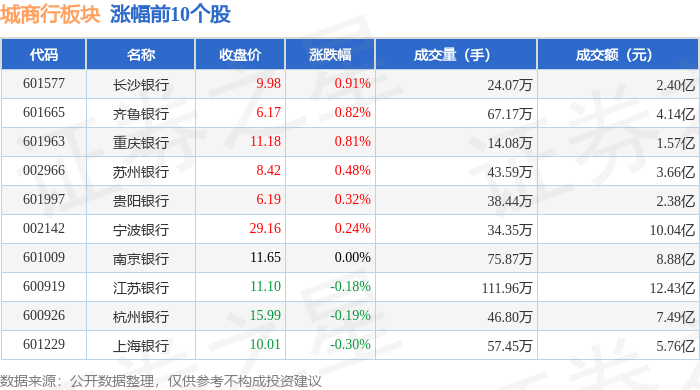
城商行板块11月6日跌0.11%,厦门银行领跌,主力资金净流出6.08亿元
Zheng Xing Xing Ye Ri Bao· 2025-11-06 08:51
Core Viewpoint - The city commercial bank sector experienced a slight decline of 0.11% on November 6, with Xiamen Bank leading the drop, while the overall market indices showed positive movements with the Shanghai Composite Index up by 0.97% and the Shenzhen Component Index up by 1.73% [1][2]. Group 1: Market Performance - The closing price of Xiamen Bank was 7.16, reflecting a decrease of 2.59% with a trading volume of 539,700 shares and a transaction value of 387 million yuan [2]. - Other notable banks included Changsha Bank, which closed at 9.98 with a rise of 0.91%, and Qilu Bank, which closed at 6.17 with an increase of 0.82% [1]. - The city commercial bank sector saw a net outflow of 608 million yuan from major funds, while retail investors contributed a net inflow of 473 million yuan [2][3]. Group 2: Individual Bank Performance - Beijing Bank had a net inflow from major funds of 20.80 million yuan, while it experienced a net outflow from retail investors of 30.79 million yuan [3]. - Chongqing Bank recorded a net inflow of 11.91 million yuan from major funds but faced a net outflow of 12.20 million yuan from retail investors [3]. - Jiangsu Bank had a net inflow of 202.55 million yuan from major funds, while retail investors contributed a net inflow of 3.33 million yuan [3].

江苏共有上市公司715家
Sou Hu Cai Jing· 2025-11-06 06:52
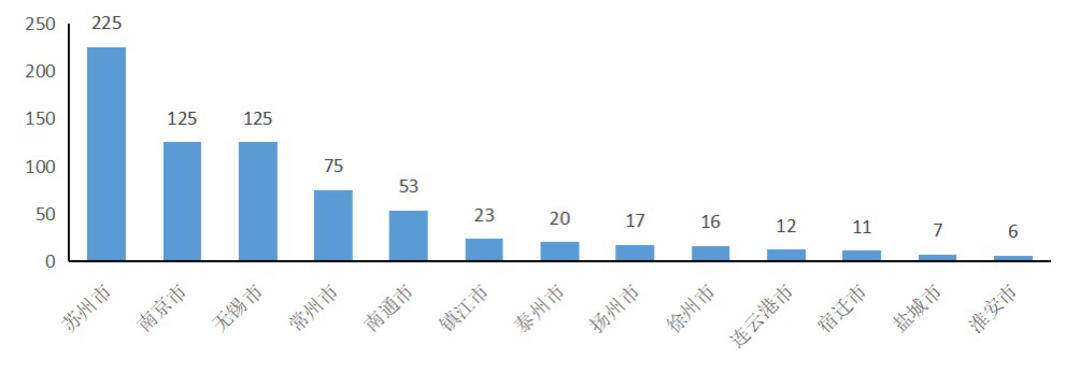
Group 1 - As of October 31, 2025, Jiangsu has a total of 715 listed companies, including 220 on the Shanghai Stock Exchange Main Board, 114 on the Sci-Tech Innovation Board, 125 on the Shenzhen Stock Exchange Main Board (including one pure B-share), 203 on the Growth Enterprise Market, and 53 on the Beijing Stock Exchange [1] - In October 2025, Jiangsu added one new listed company (Changjiang Nengke), bringing the total number of new listings in 2025 to 21 [1] - The total market capitalization of the 714 listed companies in Jiangsu is 85,985.35 billion yuan, accounting for 13.12% of the total number of A-share listed companies and 8.01% of their total market capitalization [3] Group 2 - As of October 31, 2025, the companies in Jiangsu with a market capitalization exceeding 100 billion yuan (excluding the Beijing Stock Exchange) include Hengrui Medicine, WuXi AppTec, Jiangsu Bank, Guodian Nari, Huatai Securities, Nanjing Bank, Huidian Co., S. Hengli Hydraulic, Dongshan Precision, Xugong Machinery, Tianfu Communication, and Yanghe Brewery [5] - The bottom ten ranked A-share listed companies in Jiangsu (excluding the Beijing Stock Exchange) are Yangzi New Materials, Nanwei Co., Guangge Technology, Xuelang Environment, Zhongshe Co., *ST Hengjiu, Ailong Technology, Jinpu Garden, *ST Tianlong, and *ST Suwu [7] - In October 2025, Jiangsu's A-share listed companies had a total of 3 financing events, raising a total of 1.269 billion yuan, while the total financing events for the year reached 49, raising a total of 61.438 billion yuan [7]






路博迈中债优选投资级信用债指数证券投资基金基金份额发售公告
Zhong Guo Zheng Quan Bao - Zhong Zheng Wang· 2025-11-06 03:28
Core Points - The fund, named "Loomis Sayles China Bond Select Investment Grade Credit Index Securities Investment Fund," has been approved for registration by the China Securities Regulatory Commission (CSRC) on July 21, 2025 [1] - The fund is a bond-type fund, expected to have a risk and return profile higher than money market funds but lower than mixed and equity funds [1][20] - The fund will be publicly offered from November 10, 2025, to February 9, 2026, through various sales channels [8][31] Fund Structure - The fund is categorized as a bond-type securities investment fund and operates as a contractual open-end fund [29] - The fund's share issuance price is set at RMB 1.00 per share [29] - The minimum total number of shares to be raised is 200 million, with a total fundraising amount of at least RMB 200 million [35] Subscription Details - The fund will accept subscriptions only from qualified institutional investors and qualified foreign investors, excluding individual investors [2][32] - The minimum initial subscription amount is RMB 1 for institutional investors and RMB 100 for subscriptions through the direct sales center [40] - The total subscription amount during the fundraising period is capped at RMB 6 billion, and if this limit is reached, the fundraising will close early [35] Investor Requirements - Investors must provide valid tax residency declarations and other necessary documentation to confirm their eligibility [5][26] - The fund management has the right to refuse subscriptions from non-qualified investors, including U.S. taxpayers and those on sanction lists [3][4][5] - Investors must ensure that the funds used for subscription are legally sourced and free from any legal or contractual encumbrances [10][12] Fund Management - The fund management is conducted by Loomis Sayles Fund Management (China) Co., Ltd., with Nanjing Bank as the custodian [1] - The fund will utilize sampling replication and dynamic optimization methods to track the performance of the underlying index [20] - The fund management retains the right to adjust the subscription process and investor qualifications as necessary [19][26]

债市成拖累?多家银行非息收入承压,央行重启国债买卖有何利好
Xin Lang Cai Jing· 2025-11-06 00:38
Core Viewpoint - The bond market's volatility has significantly impacted the non-interest income and overall revenue growth of listed banks in China during the first three quarters of the year [1][3][7]. Group 1: Non-Interest Income Decline - Among 42 A-share listed banks, 24 reported a year-on-year decline in non-interest income, with 8 banks experiencing a drop in net investment income [1][2]. - For instance, China Merchants Bank reported a 4.23% decrease in non-interest net income, primarily due to reduced bond and fund investment returns [3][4]. - Ping An Bank's revenue fell by 9.8%, influenced by declining loan rates and market volatility affecting non-interest income [3]. Group 2: Fair Value Changes - The significant drop in fair value changes has also been a major factor in revenue growth decline, with China Merchants Bank reporting a cumulative loss of 8.827 billion yuan in fair value changes for the first three quarters [4]. - Other banks like Everbright Bank and Huaxia Bank also reported losses in fair value changes, amounting to 4.982 billion yuan and 4.505 billion yuan, respectively [4]. - Analysts noted that fair value changes are highly influenced by bond market fluctuations, with smaller banks being more affected due to a higher proportion of FVTPL assets [4]. Group 3: Future Outlook and Central Bank Actions - The People's Bank of China announced the resumption of government bond trading operations, which is expected to help lower bond yields and benefit banks' non-interest income [11][12]. - Some bank executives expressed uncertainty about future non-interest income growth due to ongoing market volatility, suggesting that the bond market may remain in a fluctuating state [9][10]. - Analysts believe that the resumption of government bond trading will provide a safety net for the bond market, potentially stabilizing yields and supporting both bond and equity markets in the long term [12][13].



外资A股最新持仓曝光,行业龙头仍是“聪明钱”的最爱
Di Yi Cai Jing· 2025-11-05 23:49
Group 1 - The A-share market has significantly rebounded since the third quarter, with active trading and foreign capital continuing to buy aggressively [1][2] - Leading companies such as Kweichow Moutai, Ping An Insurance, and Wuliangye have attracted over 80 foreign institutional investors each, indicating strong foreign interest in industry leaders [1][2] - As of the end of September, the top three foreign-held A-shares by market value are CATL, Kweichow Moutai, and Midea Group, with values of 265.66 billion, 88.14 billion, and 71.65 billion respectively [1][2] Group 2 - Foreign investment is particularly focused on industry leaders, "Chinese state-owned enterprises," and bank stocks, with major banks holding significant foreign shares [2][3] - As of September 30, 2023, 32 foreign investors collectively held 2.36 billion shares of Nanjing Bank, while 42 foreign investors held 1.60 billion shares of Ningbo Bank [2] - A total of 42 A-shares have foreign holdings exceeding 10 billion, including Zijin Mining, Hengrui Medicine, BYD, and Fuyao Glass [2] Group 3 - The number of foreign investors in China Shipbuilding has increased by over 40% from the end of June, reaching 68 by the end of September [3] - Other companies such as Kweichow Moutai, BYD, and Yangtze Power have also seen an increase in foreign holdings compared to the end of June [3] Group 4 - Foreign investors have shown a preference for specific stocks, with UBS significantly increasing its stake in RuiNeng Technology, becoming the third-largest shareholder by the end of September [4][5] - UBS held 1.15 million shares of RuiNeng Technology, a 130.2% increase from the previous quarter, while Goldman Sachs, JPMorgan, and Merrill Lynch entered the top ten shareholders [5] Group 5 - RuiNeng Technology's stock has seen a significant rise, reaching a peak of 24.43 yuan, with a cumulative increase of over 40% since mid-October [7] - Despite a 12.95% year-on-year revenue growth, RuiNeng Technology's net profit decreased by 32.73% to 40.75 million [7] Group 6 - Foreign investors are optimistic about the long-term performance of the A-share market, with UBS forecasting a 6% year-on-year growth in total A-share earnings by 2025 [8] - UBS noted that 60% of industries recorded year-on-year profit growth in the third quarter, with sectors like non-ferrous metals and non-bank financials achieving over 30% growth [8] Group 7 - Goldman Sachs predicts a sustained upward trend in the Chinese stock market, expecting major indices to rise by about 30% by the end of 2027 [9] - Factors supporting this bullish outlook include favorable policy developments, accelerating earnings growth, and strong capital inflows [9] Group 8 - As the bull market unfolds, Goldman Sachs advises investors to shift their strategy from "selling on highs" to "buying on lows" [10]




五家银行跻身绿色信贷“万亿俱乐部” 绿色债券存量规模近2万亿
2 1 Shi Ji Jing Ji Bao Dao· 2025-11-05 23:42
Core Insights - Green finance has transitioned from an optional choice to a mandatory requirement for the banking industry, serving as a new engine for strategic transformation and a blue ocean market for future growth [1] - The balance of green financing at Industrial Bank has reached nearly 2.5 trillion yuan, with green loans exceeding 1 trillion yuan and a non-performing loan rate of only 0.57% [1] - The People's Bank of China and other departments have issued a unified policy framework for green finance, effective from October 1, 2025, to standardize various financial products [2] Group 1: Green Credit Growth - As of the end of 2024, the total balance of green credit among 42 A-share listed banks exceeded 27 trillion yuan, reflecting a year-on-year growth of approximately 20% [3] - State-owned banks dominate the green credit market, with the six major state-owned banks accounting for over 21 trillion yuan, representing 77.6% of the total [3] - Industrial Bank's green loan balance has risen to 1.08 trillion yuan, joining the "trillion club" [3] Group 2: Performance and Sector Focus - The average growth rate of green credit for A-share listed banks in 2024 was 20.6%, a slowdown from approximately 28% in 2023, yet leading institutions maintained strong growth [4] - The focus of green credit issuance is concentrated in four key areas: clean energy, green transportation, energy conservation and environmental protection, and green buildings [4] - The Yangtze River Delta, Guangdong-Hong Kong-Macau Greater Bay Area, and Chengdu-Chongqing Economic Circle are identified as core regions for green credit [4] Group 3: Product Innovation - A-share listed banks are deepening innovation in green financial products, creating a multi-dimensional product system that includes loans, bonds, asset securitization, insurance, and carbon finance [5] - Sustainable Development Linked Loans (SLL), carbon emission rights pledge financing, and environmental rights collateral loans are gaining traction [5] - Industrial Bank has launched the first green loan with biodiversity protection insurance, while Bohai Bank introduced a green loan linked to data center energy efficiency [6] Group 4: Broader Financial Tools - The issuance of green bonds has expanded, with the cumulative issuance of labeled green bonds in 2024 surpassing 4 trillion yuan [6] - Banks are actively participating in green wealth management and fund products, enhancing investor engagement through innovative offerings [6] - Carbon finance tools are transitioning from pilot programs to broader applications, with various banks introducing carbon emission rights pledge financing products [6] Group 5: Future Directions - The banking industry is expected to continue innovating green financial products to support sustainable economic development, moving beyond traditional green credit [7] - The development of ESG-linked loans and financing models using carbon emission rights as collateral will be explored [7] - These innovations will not only assist in achieving national carbon reduction goals but also cultivate new growth momentum for banks [7]


股票回购增持贷款业务落地一年 试点银行有望扩围
Zhong Guo Zheng Quan Bao· 2025-11-05 23:21
Core Viewpoint - The scope of institutions participating in stock repurchase and increase loan business is expected to expand to city commercial banks, which were previously limited to 21 national financial institutions [1] Group 1: Institutional Participation - Beijing Bank and Shanghai Bank have signed loan commitment letters with several listed companies regarding stock repurchase and increase loans [1] - Other banks such as Ningbo Bank, Jiangsu Bank, and Nanjing Bank are also expected to qualify for this loan business [1]


外资A股最新持仓曝光
Di Yi Cai Jing· 2025-11-05 11:55
Group 1 - The A-share market has significantly rebounded since the third quarter, with active trading and foreign capital continuing to buy aggressively [2][3] - Major industry leaders such as Kweichow Moutai, Ping An of China, and Wuliangye have attracted over 80 foreign institutional investors each, indicating strong foreign interest [2][3] - As of the end of September, the top three foreign-held A-shares by market value are CATL, Kweichow Moutai, and Midea Group, with values of 265.66 billion, 88.14 billion, and 71.65 billion respectively [2][3] Group 2 - Foreign investment is particularly focused on industry leaders, "Chinese state-owned enterprises," and bank stocks, with major banks holding significant foreign shares [3][4] - As of September 30, 2023, 68 foreign institutions held shares in China Shipbuilding, a 40% increase from the end of June [4][5] - The number of foreign investors in several A-share companies has increased, including Kweichow Moutai, BYD, and Yangtze Power [4] Group 3 - Foreign investors have shown a preference for certain stocks, with UBS significantly increasing its stake in RuiNeng Technology, becoming the third-largest shareholder [5][6] - UBS held 1.1464 million shares of RuiNeng Technology as of September 30, representing a 130.2% increase from the previous quarter [6] - Other major foreign investors in RuiNeng Technology include Goldman Sachs, JPMorgan, and Merrill Lynch, all newly entering the top ten shareholders [5][6] Group 4 - The overall outlook for the A-share market remains positive, with expectations of continued recovery in earnings and strong inflows of capital [9][10] - UBS forecasts a 6% year-on-year growth in total A-share earnings by 2025, driven by sectors like technology and non-financial industries [9][10] - Goldman Sachs predicts a 30% increase in major stock indices by the end of 2027, indicating a potential long-term bull market for A-shares [10][11]