
NJBK(601009)

Search documents
外资A股最新持仓曝光
第一财经· 2025-11-05 11:45
Core Viewpoint - The A-share market has shown significant recovery since the third quarter, with active trading and continued foreign investment, particularly in industry leaders and state-owned enterprises [3][5][14]. Group 1: Foreign Investment Trends - As of the end of September, major industry leaders such as Kweichow Moutai, China Ping An, and Wuliangye attracted over 80 foreign institutional investors each [6][5]. - The top three foreign-held A-shares by market value are CATL (265.66 billion), Kweichow Moutai (88.14 billion), and Midea Group (71.65 billion) [6][5]. - Foreign investment in "Chinese state-owned enterprises" has increased, with China Shipbuilding attracting 68 foreign investors, a rise of over 40% from the end of the first half [7][5]. Group 2: Sector Preferences - Foreign investors favor industry leaders, state-owned enterprises, and bank stocks, with seven of the top ten foreign-held A-shares being banks [6][5]. - Notable bank stocks include Nanjing Bank (2.36 billion shares held by 32 foreign investors) and Ningbo Bank (1.60 billion shares held by 42 foreign investors) [6][5]. Group 3: Individual Stock Movements - UBS significantly increased its stake in RuiNeng Technology, becoming the third-largest shareholder, while Goldman Sachs, JPMorgan, and Merrill Lynch entered the top ten shareholders [9][10]. - RuiNeng Technology's stock price has surged over 40% since mid-October, despite a 32.73% decline in net profit year-on-year [12][10]. Group 4: Market Outlook - UBS analysts remain optimistic about the medium-term outlook for the A-share market, citing a 12% year-on-year profit growth for all A-shares in the third quarter [15][14]. - Goldman Sachs predicts a 30% increase in major stock indices by the end of 2027, indicating a potential long-term bull market for A-shares [16][14].








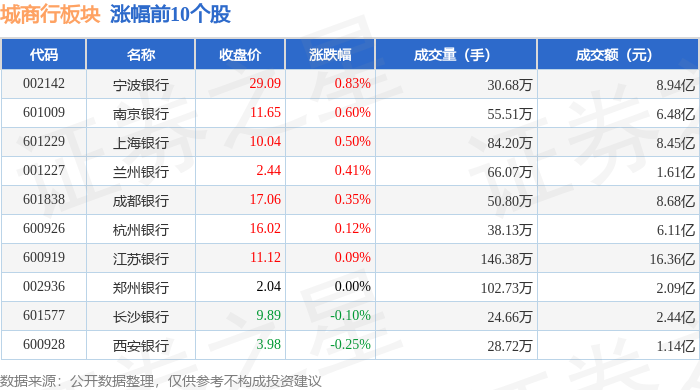
城商行板块11月5日涨0.12%,宁波银行领涨,主力资金净流入5236.36万元
Zheng Xing Xing Ye Ri Bao· 2025-11-05 08:55
Market Performance - The city commercial bank sector increased by 0.12% on November 5, with Ningbo Bank leading the gains [1] - The Shanghai Composite Index closed at 3969.25, up 0.23%, while the Shenzhen Component Index closed at 13223.56, up 0.37% [1] Individual Stock Performance - Ningbo Bank (002142) closed at 29.09, up 0.83% with a trading volume of 306,800 shares and a transaction value of 894 million [1] - Nanjing Bank (6000000) closed at 11.65, up 0.60%, with a trading volume of 555,100 shares and a transaction value of 648 million [1] - Shanghai Bank (601229) closed at 10.04, up 0.50%, with a trading volume of 842,000 shares [1] - Other notable performances include Chengdu Bank (601838) at 17.06, up 0.35%, and Hangzhou Bank (600926) at 16.02, up 0.12% [1] Capital Flow Analysis - The city commercial bank sector saw a net inflow of 52.36 million from institutional investors, while retail investors contributed a net inflow of 89.18 million [2] - The sector experienced a net outflow of 142 million from speculative funds [2] Detailed Capital Flow for Selected Banks - Jiangsu Bank (600919) had a net inflow of 63.74 million from institutional investors, while it faced a net outflow of 46.26 million from speculative funds [3] - Chengdu Bank (601838) reported a net inflow of 63.42 million from institutional investors, with a net outflow of 57.05 million from speculative funds [3] - Ningbo Bank (002142) had a net inflow of 5.72 million from institutional investors but a significant net outflow of 43.57 million from retail investors [3]




银行板块震荡上扬,工商银行盘中创历史新高
Mei Ri Jing Ji Xin Wen· 2025-11-05 02:24
Core Viewpoint - The banking sector experienced significant fluctuations, with notable gains in several banks, including historical highs for Industrial and Commercial Bank of China (ICBC) [1] Group 1: Market Performance - The banking sector saw a strong upward movement on November 5, with ICBC reaching a historical high during intraday trading [1] - Shanghai Pudong Development Bank (SPDB) increased by over 2%, indicating positive market sentiment [1] - Other banks such as Ningbo Bank, Nanjing Bank, and Industrial Bank also showed upward trends, contributing to the overall positive performance of the sector [1]


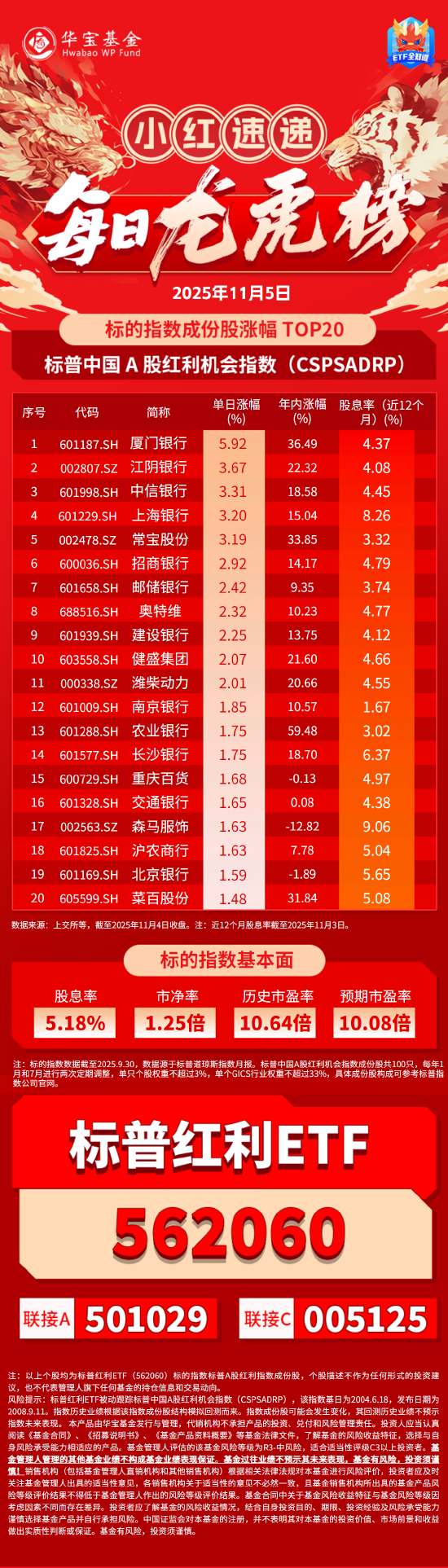
小红日报 | 银行再度领涨!标普红利ETF(562060)标的指数收跌0.06%显韧性
Xin Lang Ji Jin· 2025-11-05 00:50
Core Insights - The article highlights the top-performing stocks in the S&P China A-Share Dividend Opportunity Index, showcasing significant year-to-date gains and dividend yields for various companies [1]. Group 1: Stock Performance - Xiamen Bank (601187.SH) leads with a 5.92% increase in the latest trading session and a 36.49% year-to-date gain, along with a dividend yield of 4.37% [1]. - Jiangyin Bank (002807.SZ) follows with a 3.67% daily increase and a 22.32% year-to-date gain, offering a dividend yield of 4.08% [1]. - CITIC Bank (601998.SH) shows a 3.31% rise today and an 18.58% increase year-to-date, with a dividend yield of 4.45% [1]. - Shanghai Bank (601229.SH) has a daily increase of 3.20% and a year-to-date gain of 15.04%, boasting a high dividend yield of 8.26% [1]. - Other notable performers include Changbao Co. (002478.SZ) with a 3.19% daily increase and a 33.85% year-to-date gain, and China Merchants Bank (600036.SH) with a 2.92% daily rise and a 14.17% year-to-date increase [1]. Group 2: Dividend Yields - Shanghai Bank (601229.SH) offers the highest dividend yield at 8.26%, indicating strong returns for investors [1]. - Other companies with notable dividend yields include Semei Clothing (002563.SZ) at 9.06% and Changsha Bank (601577.SH) at 6.37% [1]. - The average dividend yield among the top 20 stocks reflects a trend towards higher returns for dividend-seeking investors [1].

上市银行三季报透视:营业收入合计超4.3万亿元
Zhong Guo Zheng Quan Bao· 2025-11-04 23:25
Core Insights - The overall performance of A-share listed banks in the first three quarters of 2025 exceeded expectations, with a total operating income surpassing 4.3 trillion yuan, and over 60% of banks reporting year-on-year growth in operating income [1][2] - The stabilization of net interest margin (NIM) is identified as a key factor supporting the revenue growth of listed banks, despite being in a downward trend [1][3] Revenue Performance - As of the end of Q3 2025, the total assets of listed banks grew by 9.3% year-on-year, indicating steady expansion [2] - The overall operating income of listed banks increased by 0.9% year-on-year, while net profit rose by 1.5% [2] - More than 25 out of 42 listed banks achieved year-on-year growth in operating income, with Xi'an Bank, Chongqing Bank, and Nanjing Bank leading with growth rates of 39.11%, 10.40%, and 8.79% respectively [2] - Nanjing Bank reported an operating income of 41.949 billion yuan, with net interest income accounting for 60.09% and non-interest income for 39.91% [2] Net Interest Margin Trends - The net interest margin for listed banks in Q3 2025 was 1.33%, remaining stable compared to the first half of 2025 [3] - The decline in funding costs and the stable LPR contributed to the stabilization of NIM, with banks optimizing their asset and liability structures [3] - Changshu Bank led the industry with a net interest margin of 2.57% [3] - Despite a 10 basis point decrease in NIM for Industrial Bank to 1.72%, the decline was relatively small compared to peers [3] Non-Interest Income Challenges - The volatility in the bond market has pressured non-interest income, with many banks reporting significant declines in fair value changes [4] - Nanjing Bank's non-interest income fell by 11.63% year-on-year, with a fair value loss of 334 million yuan in Q3 2025 compared to a profit of 4.676 billion yuan in the same period last year [4] - China Merchants Bank reported a slight decline in operating income by 0.51% year-on-year, with non-interest income down by 4.23% [5] - The decline in non-interest income is attributed to reduced returns from bond and fund investments, with China Merchants Bank reporting a fair value loss of 8.827 billion yuan in the first three quarters [5]

上市银行三季报透视:营业收入合计超4.3万亿元 息差释放企稳信号
Zhong Guo Zheng Quan Bao· 2025-11-04 22:30
Core Insights - The overall performance of A-share listed banks in the first three quarters of 2025 exceeded expectations, with a total operating income of over 4.3 trillion yuan, and more than 60% of banks reporting year-on-year growth in operating income [1][2] - The stabilization of net interest margin (NIM) is considered a key factor supporting the revenue growth of listed banks, with signs of stabilization observed despite being in a downward trend [1][3] Revenue Performance - As of the end of Q3 2025, the total assets of listed banks grew by 9.3% year-on-year, indicating steady expansion [2] - The overall operating income of listed banks increased by 0.9% year-on-year, while net profit rose by 1.5% [2] - Over 25 of the 42 listed banks reported year-on-year growth in operating income, with Xi'an Bank, Chongqing Bank, and Nanjing Bank leading with growth rates of 39.11%, 10.40%, and 8.79% respectively [2] Net Interest Margin - The net interest margin for listed banks was 1.33% in Q3 2025, remaining stable compared to the first half of 2025 [3] - Factors contributing to the stabilization of NIM include a controlled negative impact from monetary policy adjustments and a coordinated adjustment of deposit rates alongside LPR cuts [3] - Changshu Bank reported the highest NIM at 2.57% among the listed banks [3] Non-Interest Income Challenges - Despite positive growth in operating income and net profit, fluctuations in the bond market have led to a decline in non-interest income, particularly in fair value changes [4][5] - Nanjing Bank reported a significant drop in fair value changes, with a loss of 334 million yuan in Q3 2025 compared to a profit of 4.676 billion yuan in the same period last year [4] - China Merchants Bank's non-interest income also declined, with a 4.23% drop in non-interest income, primarily due to reduced returns from bond and fund investments [5]
上市银行三季报透视: 营业收入合计超4.3万亿元 息差释放企稳信号
Zhong Guo Zheng Quan Bao· 2025-11-04 20:39
Core Insights - The overall performance of A-share listed banks in the first three quarters of 2025 exceeded expectations, with a total operating income of over 4.3 trillion yuan, and more than 60% of banks reporting year-on-year growth in operating income [1][2] - The stabilization of net interest margin (NIM) is considered a key factor supporting the revenue growth of listed banks [1][3] Revenue Performance - As of the end of Q3 2025, the total assets of listed banks grew by 9.3% year-on-year, indicating steady expansion [2] - The overall operating income of listed banks increased by 0.9% year-on-year, while net profit rose by 1.5% [2] - Over 25 out of 42 listed banks reported year-on-year growth in operating income, with Xi'an Bank, Chongqing Bank, and Nanjing Bank leading with growth rates of 39.11%, 10.40%, and 8.79% respectively [2] Net Interest Margin Trends - The net interest margin for listed banks was 1.33% in Q3 2025, remaining stable compared to the first half of 2025 [3] - The decline in liability costs and the narrowing of asset yield reductions contributed to the stabilization of NIM [3] - Changshu Bank reported the highest NIM at 2.57% among the listed banks [3] Non-Interest Income Challenges - Despite positive growth in operating income and net profit, fluctuations in the bond market have pressured non-interest income, leading to significant declines in fair value changes [5][6] - Nanjing Bank reported a 28.52% increase in net interest income but an 11.63% decrease in non-interest income, with a fair value loss of 334 million yuan in Q3 2025 [5] - China Merchants Bank experienced a 0.51% decline in operating income, with non-interest income down by 4.23%, primarily due to reduced returns from bond and fund investments [6]

营业收入合计超4.3万亿元 息差释放企稳信号
Zhong Guo Zheng Quan Bao· 2025-11-04 20:17
Core Insights - The overall performance of A-share listed banks in the first three quarters of 2025 exceeded expectations, with total operating income surpassing 4.3 trillion yuan, and over 60% of banks reporting year-on-year growth in operating income [1][2] - The stabilization of net interest margin (NIM) is identified as a key factor supporting the revenue growth of listed banks, with several bank executives indicating signs of stabilization despite being in a downward trend [1][2] Revenue Performance - As of the end of Q3 2025, listed banks' total assets grew by 9.3% year-on-year, maintaining steady expansion [1] - The overall operating income of listed banks increased by 0.9% year-on-year, while net profit rose by 1.5% [1] - More than 25 out of 42 listed banks achieved year-on-year growth in operating income, with Xi'an Bank, Chongqing Bank, and Nanjing Bank leading with growth rates of 39.11%, 10.40%, and 8.79% respectively [1] Net Interest Margin Trends - The net interest margin for listed banks was reported at 1.33% in Q3 2025, remaining stable compared to the first half of 2025 [2] - The decline in liability costs is expected to continue, which may support the improvement of NIM [2] - The stability in NIM is attributed to the unchanged Loan Prime Rate (LPR) and a significant decrease in the cost of liabilities [2] Non-Interest Income Challenges - Despite positive growth in operating income and net profit, fluctuations in the bond market have led to a decline in non-interest income for many banks [3][4] - For instance, Nanjing Bank reported a year-on-year decrease of 11.63% in non-interest income, with a significant loss in fair value changes of financial assets [3] - Similarly, China Merchants Bank experienced a decline in non-interest income by 4.23%, primarily due to reduced earnings from bond and fund investments [4]
银行业2025年三季报综述:业绩稳健性凸显,引领银行价值回归
Shenwan Hongyuan Securities· 2025-11-04 14:41
Investment Rating - The report maintains a positive outlook on the banking sector, indicating a potential return to a valuation of 1 times net asset value [4][7]. Core Insights - The banking sector has demonstrated steady performance, with a year-to-date revenue growth of 0.8% and a net profit growth of 1.5% for the first nine months of 2025, reflecting a stable regulatory environment supporting bank profitability [10][14]. - The report highlights a shift in focus from scale to balance in credit growth, with banks increasingly pursuing a "quantity-price balance" strategy [4][7]. - The cost of liabilities has improved more significantly than the decline in asset pricing, leading to a stabilization of net interest margins, which is expected to continue into the next year [4][7]. - Asset quality remains stable but shows signs of divergence, particularly with rising risks in small and micro businesses [4][7]. - The report suggests that the current dividend yield of the banking sector has returned to an attractive range, indicating a significant disconnect between stable earnings and stock holdings, which could lead to a value recovery [4][7]. Summary by Sections Performance Overview - The banking sector's performance has been characterized by a steady increase in revenue and profit, with state-owned banks showing better-than-expected stability and regional banks leading in performance [11][12][15]. - The report notes that the revenue growth of state-owned banks has turned positive, with non-interest income contributing significantly to this growth [12][15]. Credit Growth and Strategy - The report indicates a gradual abandonment of scale-driven growth, with banks focusing on achieving a balance between volume and pricing in their lending practices [4][7]. - The credit growth rate for listed banks decreased by 0.3 percentage points to 7.7% in Q3 2025, with state-owned banks maintaining a growth rate of approximately 8.5% [4][7]. Profitability and Asset Quality - The net interest margin for listed banks remained stable at 1.5%, with a slight quarter-on-quarter increase of 3 basis points in Q3 2025 [4][7]. - The overall non-performing loan ratio remained stable at 1.22%, indicating manageable risk levels across the sector [4][7]. Investment Recommendations - The report recommends focusing on leading banks and undervalued regional banks as key investment opportunities, suggesting that the recovery in valuations is supported by stable earnings and attractive dividend yields [4][7].


长三角城商行扩表进行时:对公信贷狂飙,财富业务回暖
2 1 Shi Ji Jing Ji Bao Dao· 2025-11-04 11:57
Core Insights - The banking sector in the Yangtze River Delta is experiencing a different trend compared to the overall slowdown in loan growth, with several city commercial banks showing double-digit asset growth [1][3] Group 1: Loan Growth - As of the end of Q3, several city commercial banks in the Yangtze River Delta reported significant asset growth: Jiangsu Bank at 4.93 trillion yuan (up 24.68%), Ningbo Bank at 3.58 trillion yuan (up 14.50%), and Nanjing Bank at 2.96 trillion yuan (up 14.31%) [1] - The overall loan growth for all A-share listed banks was 7.70% year-on-year, with city commercial banks leading at 12.86% [1][2] - Specific banks like Jiangsu Bank and Ningbo Bank reported loan growth rates exceeding 17% in Q3, driven primarily by corporate loans [3][5] Group 2: Corporate Loans - Corporate loans have significantly increased, with Ningbo Bank's corporate loan growth reaching 32.10% in Q3, the highest among peers [5] - The proportion of corporate loans in total loans has risen for many banks, with Jiangsu Bank's corporate loans making up 67.38% and Nanjing Bank's at 76.03% [4][5] - The focus on corporate loans, particularly in technology sectors, has been emphasized by several banks, with notable increases in technology-related loan disbursements [6][8] Group 3: Revenue and Profitability - The total revenue for six city commercial banks in the Yangtze River Delta reached 243.6 billion yuan in Q3, a year-on-year increase of 6.41%, while net profit grew by 8.36% to 111.2 billion yuan [7] - Jiangsu Bank reported a revenue of 67.18 billion yuan and a net profit of 30.58 billion yuan, both showing positive growth [7] - Wealth management and retail banking segments are showing signs of recovery, contributing to the overall revenue growth [8] Group 4: Investment Income - Investment income has been under pressure due to rising interest rates and market volatility, with the fair value changes of financial assets showing negative results [9][10] - Shanghai Bank reported the highest investment income at 16.77 billion yuan, but also faced significant losses in fair value changes [11]

