NJBK(601009)

Search documents
银行业2025年三季报综述:业绩稳健性凸显,引领银行价值回归
Shenwan Hongyuan Securities· 2025-11-04 14:41
Investment Rating - The report maintains a positive outlook on the banking sector, indicating a potential return to a valuation of 1 times net asset value [4][7]. Core Insights - The banking sector has demonstrated steady performance, with a year-to-date revenue growth of 0.8% and a net profit growth of 1.5% for the first nine months of 2025, reflecting a stable regulatory environment supporting bank profitability [10][14]. - The report highlights a shift in focus from scale to balance in credit growth, with banks increasingly pursuing a "quantity-price balance" strategy [4][7]. - The cost of liabilities has improved more significantly than the decline in asset pricing, leading to a stabilization of net interest margins, which is expected to continue into the next year [4][7]. - Asset quality remains stable but shows signs of divergence, particularly with rising risks in small and micro businesses [4][7]. - The report suggests that the current dividend yield of the banking sector has returned to an attractive range, indicating a significant disconnect between stable earnings and stock holdings, which could lead to a value recovery [4][7]. Summary by Sections Performance Overview - The banking sector's performance has been characterized by a steady increase in revenue and profit, with state-owned banks showing better-than-expected stability and regional banks leading in performance [11][12][15]. - The report notes that the revenue growth of state-owned banks has turned positive, with non-interest income contributing significantly to this growth [12][15]. Credit Growth and Strategy - The report indicates a gradual abandonment of scale-driven growth, with banks focusing on achieving a balance between volume and pricing in their lending practices [4][7]. - The credit growth rate for listed banks decreased by 0.3 percentage points to 7.7% in Q3 2025, with state-owned banks maintaining a growth rate of approximately 8.5% [4][7]. Profitability and Asset Quality - The net interest margin for listed banks remained stable at 1.5%, with a slight quarter-on-quarter increase of 3 basis points in Q3 2025 [4][7]. - The overall non-performing loan ratio remained stable at 1.22%, indicating manageable risk levels across the sector [4][7]. Investment Recommendations - The report recommends focusing on leading banks and undervalued regional banks as key investment opportunities, suggesting that the recovery in valuations is supported by stable earnings and attractive dividend yields [4][7].



长三角城商行扩表进行时:对公信贷狂飙,财富业务回暖
2 1 Shi Ji Jing Ji Bao Dao· 2025-11-04 11:57
Core Insights - The banking sector in the Yangtze River Delta is experiencing a different trend compared to the overall slowdown in loan growth, with several city commercial banks showing double-digit asset growth [1][3] Group 1: Loan Growth - As of the end of Q3, several city commercial banks in the Yangtze River Delta reported significant asset growth: Jiangsu Bank at 4.93 trillion yuan (up 24.68%), Ningbo Bank at 3.58 trillion yuan (up 14.50%), and Nanjing Bank at 2.96 trillion yuan (up 14.31%) [1] - The overall loan growth for all A-share listed banks was 7.70% year-on-year, with city commercial banks leading at 12.86% [1][2] - Specific banks like Jiangsu Bank and Ningbo Bank reported loan growth rates exceeding 17% in Q3, driven primarily by corporate loans [3][5] Group 2: Corporate Loans - Corporate loans have significantly increased, with Ningbo Bank's corporate loan growth reaching 32.10% in Q3, the highest among peers [5] - The proportion of corporate loans in total loans has risen for many banks, with Jiangsu Bank's corporate loans making up 67.38% and Nanjing Bank's at 76.03% [4][5] - The focus on corporate loans, particularly in technology sectors, has been emphasized by several banks, with notable increases in technology-related loan disbursements [6][8] Group 3: Revenue and Profitability - The total revenue for six city commercial banks in the Yangtze River Delta reached 243.6 billion yuan in Q3, a year-on-year increase of 6.41%, while net profit grew by 8.36% to 111.2 billion yuan [7] - Jiangsu Bank reported a revenue of 67.18 billion yuan and a net profit of 30.58 billion yuan, both showing positive growth [7] - Wealth management and retail banking segments are showing signs of recovery, contributing to the overall revenue growth [8] Group 4: Investment Income - Investment income has been under pressure due to rising interest rates and market volatility, with the fair value changes of financial assets showing negative results [9][10] - Shanghai Bank reported the highest investment income at 16.77 billion yuan, but also faced significant losses in fair value changes [11]





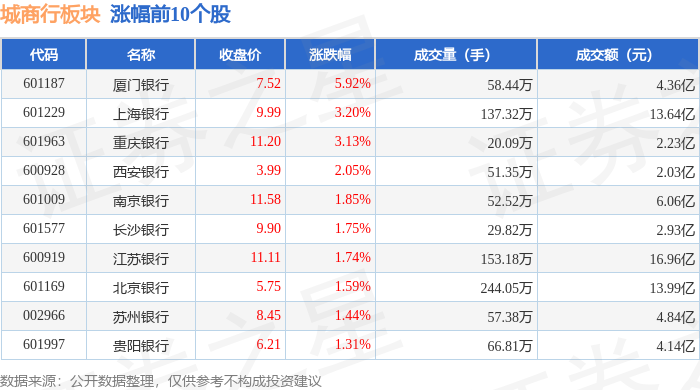
城商行板块11月4日涨1.62%,厦门银行领涨,主力资金净流入2.8亿元
Zheng Xing Xing Ye Ri Bao· 2025-11-04 08:48
Market Performance - The city commercial bank sector increased by 1.62% on November 4, with Xiamen Bank leading the gains [1] - The Shanghai Composite Index closed at 3960.19, down 0.41%, while the Shenzhen Component Index closed at 13175.22, down 1.71% [1] Individual Bank Performance - Xiamen Bank's closing price was 7.52, up 5.92% with a trading volume of 584,400 shares and a transaction value of 4.36 billion [1] - Shanghai Bank closed at 66.6, up 3.20%, with a trading volume of 1,373,200 shares and a transaction value of 1.364 billion [1] - Chongqing Bank closed at 11.20, up 3.13%, with a trading volume of 200,900 shares and a transaction value of 223 million [1] - Other notable banks include Xi'an Bank, Nanjing Bank, and Changsha Bank, with respective increases of 2.05%, 1.85%, and 1.75% [1] Fund Flow Analysis - The city commercial bank sector saw a net inflow of 280 million from main funds, while retail funds experienced a net outflow of 89.43 million [1] - Beijing Bank had a main fund net inflow of 1.47 billion, but retail funds saw a net outflow of 55.81 million [2] - Xiamen Bank recorded a main fund net inflow of 49.44 million, with retail funds experiencing a net outflow of 54.06 million [2]

投顾晨报:震荡整固,交易占优-20251104
Orient Securities· 2025-11-04 08:42
Core Insights - The report indicates that the A-share market is in a slow bull phase, currently experiencing a typical consolidation period, with the index expected to fluctuate around 3900 points within a range of 100 points [9] - There is a notable shift in capital flow from mid-risk technology growth stocks to high-dividend and micro-cap stocks, suggesting a return to a "barbell strategy" [9] - The macroeconomic backdrop shows a temporary truce in trade disputes, leading to a transitional and rebalancing phase in the market, where trading factors are gaining importance [9] Market Strategy - Emphasis is placed on trading factors and capturing the rhythm of market fluctuations, particularly in the context of the current consolidation phase [3] - The report suggests that cyclical and consumer sectors are expected to outperform in the short term, driven by supply-side optimization and cost reductions [9] Industry Strategy - The banking sector shows positive fundamental signals, with improvements in net interest margins and asset quality, indicating a favorable environment for investment [5] - The report highlights the resilience of state-owned banks and the potential of high-quality, high-elasticity small and medium-sized banks as investment targets [9] Thematic Strategy - The upcoming COP30 climate conference is expected to act as a catalyst for the clean energy sector, with significant opportunities in energy transition areas such as photovoltaics, energy storage, and carbon trading [6][9] - The report identifies specific investment opportunities in companies related to clean energy and environmental protection, anticipating that these sectors will benefit from the outcomes of the climate summit [9]
5分钟,300062直线20%封板!A股这一赛道,突现涨停潮
Zheng Quan Shi Bao· 2025-11-04 04:38
Group 1: A-Share Market Overview - The A-share market experienced slight fluctuations, with the ChiNext Index losing and regaining the 3200-point mark, while the Sci-Tech Innovation 50 Index fiercely contested around 1400 points [1] - The overall market showed more declining stocks than advancing ones, with trading volume continuing to shrink [1] Group 2: Electric Grid Equipment Sector - The electric grid equipment sector saw significant strength, with the sector index rising nearly 3%, reaching a 10-year high since June 2015 [2] - Companies like Zhongneng Electric and Sanbian Technology hit their upper limits within minutes of trading, indicating strong market interest [2] - The growth in AI data center construction and computing infrastructure upgrades is reshaping the power equipment and grid industry, with major investments from Alibaba and Tencent expected to drive order increases [2] - The China Electricity Council forecasts a 5% year-on-year growth in total electricity consumption, reaching 10.4 trillion kilowatt-hours in 2025 [2] - Fixed asset investments by the State Grid are projected to exceed 270 billion yuan in the first half of 2025, marking an 11.7% year-on-year increase [2] - Transformer exports from China saw a significant increase of 51.42% year-on-year from January to August 2025, totaling 29.711 billion yuan [2] Group 3: Banking Sector Performance - The banking sector index surged over 2%, reaching a historical high after a three-month adjustment period [4] - Institutional investors, including insurance and QFII, significantly increased their holdings in bank stocks during the third quarter, with a total increase of 8.36 billion shares [4] - Notable increases in holdings were observed in banks like Postal Savings Bank and Nanjing Bank, with QFII holding substantial market values in several banks [4] - Citigroup indicated that covered Chinese banks' third-quarter performance met expectations, with a positive outlook for the fourth quarter of 2025 and the first quarter of the following year [4] - Huatai Securities anticipates a stabilization of interest margins for listed banks by 2026, with a recovery in intermediate business income [4]



银行25Q3综述:韧性好于预期
HTSC· 2025-11-04 02:19
Investment Rating - The report maintains an "Overweight" rating for the banking sector [2] Core Viewpoints - The banking sector shows resilience better than expected, with a focus on strong fundamentals and quality dividends driving core profit improvement [6][15] - The annualized non-performing loan generation rate for listed banks is 0.55%, down 13 basis points from Q2 2025, indicating a marginal decline in non-performing loan generation across all types of banks [6] - The report suggests focusing on two main directions for investment: high-quality fundamentals that may recover valuation premiums as market risk appetite increases, and stable high-dividend stocks [6][15] Summary by Sections Operating Overview - In the first nine months of 2025, listed banks' revenue and net profit grew by 0.9% and 1.5% year-on-year, respectively, with revenue growth slightly declining due to bond market volatility affecting non-interest income [15][24] - The net interest margin for listed banks was 1.41%, remaining stable compared to the first half of 2025, driven by a continuous decline in funding costs [15][25] Profitability Breakdown - The net interest income of listed banks decreased by 0.6% year-on-year, but various types of banks showed improvement in net interest income, particularly city commercial banks [25] - Non-interest income from wealth management and commission fees increased by 4.6% year-on-year, reflecting a recovery in capital markets [16][25] Asset and Liability Insights - Total assets and liabilities of listed banks grew by 9.3% year-on-year, maintaining steady expansion [17] - Loan growth remained stable, with a year-on-year increase of 7.8%, while deposits grew by 7.8%, indicating a slight decline in deposit growth rate [10][17] Risk Perspective - The overall non-performing loan ratio for listed banks was stable at 1.23%, with a provision coverage ratio of 236%, indicating solid asset quality [11][15] Market Outlook - The report anticipates a gradual recovery in bank performance, with a focus on quality banks that exhibit strong resilience [6][15]
银行股全线上涨
第一财经· 2025-11-04 02:16
Core Viewpoint - The banking sector continues to show positive momentum, with several banks experiencing significant stock price increases on November 4th, indicating a bullish trend in the market [1]. Group 1: Stock Performance - Shanghai Bank, CITIC Bank, Industrial Bank, China Merchants Bank, Xiamen Bank, and Postal Savings Bank all saw stock price increases of over 2% [1]. - Specific stock performance data includes: - CITIC Bank: +2.29%, current price 8.04 [2] - Industrial Bank: +2.24%, current price 21.02 [2] - Shanghai Bank: +2.27%, current price 9.90 [2] - China Merchants Bank: +2.23%, current price 42.72 [2] - Xiamen Bank: +2.11%, current price 7.25 [2] - Postal Savings Bank: +2.08%, current price 5.90 [2] - Other banks also showed positive performance, with Agricultural Bank up by 1.87% and Industrial and Commercial Bank up by 1.65% [2].



前三季度江苏科技型企业首贷扩面专项行动取得实效
Nan Jing Ri Bao· 2025-11-03 23:52
Core Insights - The special action for expanding the first loan for technology-based enterprises in Jiangsu has shown significant results, with 2,556 tech companies receiving a total of 14.14 billion yuan in new loans in the first three quarters of the year [1] Group 1: Implementation of the Special Action - The primary step of the special action involves solid visits and engagement with technology-based enterprises to assess their financing needs [2] - Jiangsu financial institutions have developed implementation plans in response to the special action, with banks like Jiangsu Bank, Nanjing Bank, and Agricultural Bank of China Jiangsu Branch quickly establishing their own action plans [2] - Nanjing Bank has set up reward policies for customer visits and marketing efforts, while Bank of China Jiangsu Branch has created a digital service platform for efficient client management [2] Group 2: Financial Products and Services Optimization - Financial institutions are continuously optimizing their products and services to ensure that technology-based enterprises with reasonable financing needs can access loans [3] - Industrial and Commercial Bank of China Jiangsu Branch has introduced a value evaluation system for tech enterprises, facilitating the transition from "no loan" to "first loan" [3] - Nanjing Bank has launched a product for the transformation of technological achievements, and its online product "Xin e Tech Enterprise" has served 450 first-loan tech companies, with 186 companies receiving a pre-loan credit of 352 million yuan [3] Group 3: Loan Growth Statistics - As of the end of September, the loan balance for technology-based enterprises in Jiangsu reached 27.7 trillion yuan, reflecting a growth of 16.17% since the beginning of the year, which is 7.33 percentage points higher than the overall loan growth rate [3]
机遇“金闪闪” 银行贵金属业务规模大增
Shang Hai Zheng Quan Bao· 2025-11-03 18:11
Core Viewpoint - The strong international gold prices and rising global risk aversion are driving the growth of banks' precious metals businesses, with significant year-on-year increases reported in the third-quarter financial results of listed banks. However, the recent fluctuations in gold prices present new challenges for these banking operations [1]. Group 1: Growth in Precious Metals Business - The precious metals business of banks has rapidly expanded due to the sustained rise in gold prices, with smaller banks showing particularly impressive growth. As of the end of September, Nanjing Bank's precious metals business reached 7.201 billion yuan, a staggering increase of 11,914.36% compared to the end of 2024. Hangzhou Bank's precious metals business grew to 1.217 billion yuan, up 1,523.57% from the end of 2024 [2]. - Joint-stock banks also experienced significant growth in their precious metals business. By the end of September, compared to the end of 2024, the precious metals business of Shanghai Pudong Development Bank increased by over 350%, while China CITIC Bank saw an increase of over 200%. Other banks like Zhejiang Commercial Bank, Industrial Bank, China Merchants Bank, and Minsheng Bank all reported growth exceeding 100% [2]. - Major banks maintained steady growth from a high base, with the precious metals business of Bank of China, China Construction Bank, and Agricultural Bank of China all increasing by over 10% compared to the end of 2024 [2]. Group 2: Strategic Focus on Precious Metals - The precious metals business combines wealth management and increased intermediary income, potentially becoming a significant factor in banks' intermediary income. Precious metals, especially gold, are seen as irreplaceable in banks' wealth management offerings and are crucial for customer asset allocation [3]. - Analysts note that the demand for gold as a hedge and a store of value is rising among residents. Banks, as key channels for gold bar sales and coin distribution, are well-positioned to meet this demand through the continued popularity of online investment products like account gold and gold accumulation [3]. - The decline in gold jewelry consumption may lead banks to reduce reliance on traditional jewelry sales and instead focus on innovation and promotion of their precious metals business [3]. Group 3: Risk Management Amid Price Volatility - Despite the growth, the high volatility of precious metals, particularly gold and silver, poses challenges for banks. Since October, these metals have entered a period of high volatility, prompting banks to enhance their risk management strategies [4]. - In response to market fluctuations, banks have adjusted trading rules and increased the minimum purchase thresholds for gold accumulation products to a range of 950 to 1,200 yuan, compared to around 500 yuan last year. Additionally, some banks have modified their precious metals wallet services to align with real-time gold price fluctuations [4]. - Looking ahead, institutions expect gold to retain its upward potential, maintaining its importance in asset allocation. The profitability of banks' precious metals business will increasingly depend on their internal capabilities, including the establishment of robust risk management systems to mitigate price volatility risks and the optimization of asset allocation for stable returns [4].


冲刺!前三季长三角头部城商行营收、净利润双增,前三甲洗牌
Nan Fang Du Shi Bao· 2025-11-03 11:44
Core Viewpoint - The performance of the five major city commercial banks listed in the A-share market in the Yangtze River Delta region shows significant differentiation in growth rates, business structures, and asset quality as of the third quarter of 2025. Asset Scale - As of September 30, 2025, Jiangsu Bank leads with total assets of 4.93 trillion yuan, a year-on-year growth of 27.8% [2] - Ningbo Bank's total assets surpassed 3.5 trillion yuan for the first time, ranking second among city commercial banks [2] - Shanghai Bank continues to lag with a year-on-year asset growth of only 2% [2][13] Revenue and Profit - All five banks achieved year-on-year growth in both revenue and net profit in the first three quarters of 2025 [3] - Jiangsu Bank (67.18 billion yuan), Ningbo Bank (54.98 billion yuan), and Nanjing Bank (41.95 billion yuan) ranked in the top three for revenue [3][4] - Jiangsu Bank's net profit reached 31.9 billion yuan, leading the group with an 8.9% increase [4][5] Interest Income - Nanjing Bank reported a remarkable 28.5% year-on-year increase in net interest income, reaching 25.21 billion yuan [6][7] - Jiangsu Bank and Ningbo Bank also showed strong growth in net interest income, with increases of 19.6% and 11.8%, respectively [8] Non-Interest Income - In the first three quarters of 2025, Ningbo Bank's fee and commission income grew by 29.3% to 4.85 billion yuan, surpassing Jiangsu Bank [9] - Shanghai Bank experienced a decline in non-interest income, with a 6.9% drop [9] Financial Investment Performance - Shanghai Bank's investment income increased by 58.5% to 16.78 billion yuan, the highest among the five banks, with investment income accounting for 40.77% of its revenue [10][11] - All banks faced losses in fair value changes, with Shanghai Bank reporting the highest loss of 3.26 billion yuan [10] Asset Quality - As of September 30, 2025, the non-performing loan ratio for Jiangsu Bank, Ningbo Bank, and Nanjing Bank remained stable between 0.76% and 0.84% [14][15] - Jiangsu Bank's non-performing loan ratio decreased by 0.05 percentage points compared to the end of the previous year [14] Capital Adequacy - Jiangsu Bank's core Tier 1 capital adequacy ratio fell to 8.61%, the lowest among the five banks, and is less than one percentage point above the regulatory line [16] - Shanghai Bank maintained the highest core Tier 1 capital adequacy ratio at 10.52%, showing a slight increase [16]