NJBK(601009)

Search documents
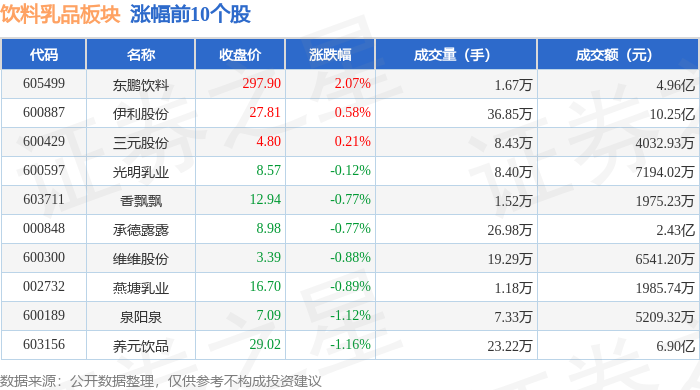
饮料乳品板块10月16日涨0.32%,东鹏饮料领涨,主力资金净流出1.79亿元
Zheng Xing Xing Ye Ri Bao· 2025-10-16 08:20
Core Insights - The beverage and dairy sector experienced a slight increase of 0.32% on October 16, with Dongpeng Beverage leading the gains [1] - The Shanghai Composite Index closed at 3916.23, up 0.1%, while the Shenzhen Component Index closed at 13086.41, down 0.25% [1] Sector Performance - Dongpeng Beverage (605499) closed at 297.90, with a rise of 2.07% and a trading volume of 16,700 shares, amounting to a transaction value of 496 million yuan [1] - Yili Group (600887) saw a closing price of 27.81, up 0.58%, with a trading volume of 368,500 shares and a transaction value of 1.025 billion yuan [1] - Other notable performances include Sanyuan Foods (600429) at 4.80 (+0.21%), and Bright Dairy (600597) at 8.57 (-0.12%) [1] Individual Stock Movements - The beverage and dairy sector saw significant declines in some stocks, such as Pinuo Food (300892) which fell by 4.52% to 34.87, with a trading volume of 55,100 shares and a transaction value of 195 million yuan [2] - Knight Dairy (920786) decreased by 4.40% to 10.00, with a trading volume of 106,800 shares and a transaction value of 109 million yuan [2] - Other stocks like Zhuangyuan Pasture (002910) and Yiming Food (605179) also experienced declines of 3.86% and 3.20%, respectively [2] Capital Flow Analysis - The beverage and dairy sector saw a net outflow of 179 million yuan from major funds, while retail investors contributed a net inflow of 193 million yuan [2] - The overall capital flow indicates a mixed sentiment within the sector, with institutional investors pulling back while retail investors showed interest [2]







9月金融数据点评:社融增速继续下探,资金活化进程延续
Orient Securities· 2025-10-16 04:06
Investment Rating - The report maintains a "Positive" outlook for the banking sector [5] Core Viewpoints - The external environment's uncertainty has increased, leading to a temporary decline in market risk appetite. This, combined with the insurance sector entering a peak season, has heightened demand for dividend allocation, creating opportunities for portfolio adjustments. The report is optimistic about the relative performance of the banking sector in Q4 2025 [3][22] - The report identifies two main investment themes: 1. High-quality small and medium-sized banks with stable fundamentals, including Chongqing Rural Commercial Bank (601077, Buy), Chongqing Bank (601963, Not Rated), Nanjing Bank (601009, Buy), and Hangzhou Bank (600926, Buy) 2. Large state-owned banks with solid fundamentals and good defensive value, including Industrial and Commercial Bank of China (601398, Not Rated), China Construction Bank (601939, Not Rated), and Agricultural Bank of China (601288, Not Rated) [3][22] Summary by Sections Social Financing and Credit Growth - In September 2025, social financing grew by 8.7% year-on-year, with a monthly increase of 3.53 trillion yuan, exceeding market expectations. However, this represents a year-on-year decrease of 2.3 billion yuan [8][9] - The structure of social financing shows a year-on-year decrease in RMB loans by 366.2 billion yuan, indicating weak credit demand and the ongoing impact of debt restructuring [9][10] - Government bonds also saw a year-on-year decrease of 347.1 billion yuan, although their issuance has accelerated this year [9] - Direct financing for enterprises increased by 240.3 billion yuan year-on-year, with bond financing up by 203.1 billion yuan, largely due to a low base effect from last year [9] Loan Growth Trends - Total RMB loans grew by 6.6% year-on-year in September 2025, with new loans of 1.29 trillion yuan, slightly below expectations and a year-on-year decrease of 300 billion yuan [13] - Residential loans decreased by 107.9 billion yuan year-on-year, while corporate loans increased by 200 billion yuan [13][14] - The report notes a significant decline in bill financing, which decreased by 471.2 billion yuan year-on-year, indicating a shift in corporate financing dynamics [14] Monetary Supply and Deposits - M1 growth improved significantly, rising by 7.2% year-on-year, while M2 grew by 8.4% [19] - In September, new RMB deposits totaled 2.21 trillion yuan, a year-on-year decrease of 1.53 trillion yuan, with household deposits increasing by 760 billion yuan [19][21] - The report highlights a trend of funds moving back to banks, with corporate deposits increasing by 149.4 billion yuan, while fiscal deposits decreased by 604.2 billion yuan [19]




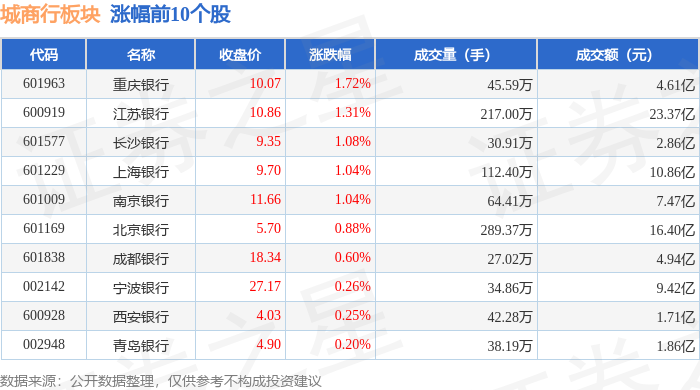
城商行板块10月15日涨0.62%,重庆银行领涨,主力资金净流出3.01亿元
Zheng Xing Xing Ye Ri Bao· 2025-10-15 08:37
Market Performance - The city commercial bank sector rose by 0.62% on October 15, with Chongqing Bank leading the gains [1] - The Shanghai Composite Index closed at 3912.21, up 1.22%, while the Shenzhen Component Index closed at 13118.75, up 1.73% [1] Individual Stock Performance - Chongqing Bank (601963) closed at 10.07, up 1.72% with a trading volume of 455,900 shares and a transaction value of 461 million [1] - Jiangsu Bank (616009) closed at 10.86, up 1.31% with a trading volume of 2.17 million shares and a transaction value of 2.337 billion [1] - Other notable performers include Changsha Bank (601577) at 9.35 (+1.08%), Shanghai Bank (601229) at 9.70 (+1.04%), and Nanjing Bank (600109) at 11.66 (+1.04%) [1] Capital Flow Analysis - The city commercial bank sector experienced a net outflow of 301 million from institutional investors, while retail investors saw a net inflow of 136 million [2] - The overall capital flow indicates a mixed sentiment, with institutional investors withdrawing funds while retail investors are increasing their positions [2] Detailed Capital Flow for Selected Banks - Qilu Bank (601665) had a net outflow of 38.24 million from institutional investors, while retail investors contributed a net inflow of 3.55 million [3] - Ningbo Bank (002142) saw a net outflow of 18.51 million from institutional investors, with retail investors contributing a net inflow of 1.63 million [3] - Beijing Bank (601169) experienced a net outflow of 6.04 million from institutional investors, but retail investors added 35.47 million [3]

东方证券:预计25Q3银行利润增速预期稳定 板块间分化或有加剧
智通财经网· 2025-10-15 08:17
Core Viewpoint - The report from Dongfang Securities indicates that the recent adjustments in LPR and deposit rates have a neutral to positive impact on banks' net interest margins, with expectations for stable interest income performance in the near term [1][2]. Group 1: Net Interest Margin and Income - The net interest margin is expected to stabilize, supporting stable interest income performance. The LPR and deposit rate adjustments are projected to have a neutral to positive effect on net interest margins, with new loan rates remaining relatively firm [1][2]. - For Q3 2025, the growth rate of interest income for listed banks is forecasted to decline by 0.8% year-on-year, but will increase by 0.5 percentage points quarter-on-quarter, with state-owned banks showing a growth of 0.8 percentage points [2]. Group 2: Non-Interest Income Performance - Non-interest income is expected to show differentiation, with state-owned banks likely performing better due to significant growth in equity fund products and a shift in deposits from general to interbank deposits [3]. - The forecast for Q3 2025 indicates a 3.4% year-on-year growth in net fee income for listed banks, with state-owned banks expected to see a growth of 0.3 percentage points [3]. Group 3: Asset Quality and Credit Costs - Asset quality is anticipated to remain stable, with credit costs potentially returning to a downward trend. Despite a decline in loan growth, the write-off rate remains steady, which may support stable non-performing loan indicators [4]. - For Q3 2025, the forecast for impairment losses is a year-on-year decrease of 1.2%, with net profit growth of 0.7% year-on-year for listed banks [4]. Group 4: Investment Recommendations - The report suggests focusing on two investment themes: high-quality small and medium-sized banks with stable fundamentals, and large state-owned banks with good defensive value [5].

A股上市银行25Q3业绩前瞻:利润增速预期稳定,板块间分化或有加剧
Orient Securities· 2025-10-15 07:19
Investment Rating - The report maintains a "Positive" outlook for the banking sector [7] Core Viewpoints - The net interest margin is expected to stabilize, supporting stable interest income performance. Loan growth is projected to decline slightly, while financial investments remain a key driver for asset expansion [2][13] - The report highlights a potential divergence in performance among different banking segments, with state-owned banks showing relative strength compared to city and rural commercial banks [3][4] Summary by Sections 1. Net Interest Margin Stabilization - The net interest margin is anticipated to remain stable, with interest income growth expected to improve slightly. The projected year-on-year growth rate for interest income in Q3 2025 is -0.8%, with a quarter-on-quarter increase of 0.5 percentage points [19][21] - Loan growth is expected to face downward pressure, with a slight decline in growth rate to 7.93% by the end of September 2025 [16][13] 2. Non-Interest Income Performance - There is an expected divergence in non-interest income performance, with state-owned banks likely to outperform. The projected year-on-year growth rate for non-interest income in Q3 2025 is 7.1%, despite a quarter-on-quarter decline of 3.7 percentage points [26][33] - The report notes a trend of deposit migration from general deposits to interbank deposits, benefiting state-owned banks due to their traditional custodial roles [24][22] 3. Asset Quality and Credit Costs - Asset quality is expected to remain stable, with a projected year-on-year decline in the growth rate of impairment losses by 1.2% in Q3 2025. The report anticipates a slight decrease in credit costs as banks manage their loan portfolios effectively [39][37] - The report indicates that the overall credit cost for listed banks is expected to show a downward trend, providing a positive contribution to profit performance [34][39] 4. Investment Recommendations - The report suggests focusing on two main investment lines: high-quality small and medium-sized banks and state-owned banks with solid fundamentals. Recommended stocks include Chongqing Rural Commercial Bank (601077, Buy), Nanjing Bank (601009, Buy), and Industrial and Commercial Bank of China (601398, Not Rated) [5][41][42]
小红日报|标普红利ETF(562060)标的指数收涨0.49%,银行板块涨幅靠前
Xin Lang Ji Jin· 2025-10-15 02:02
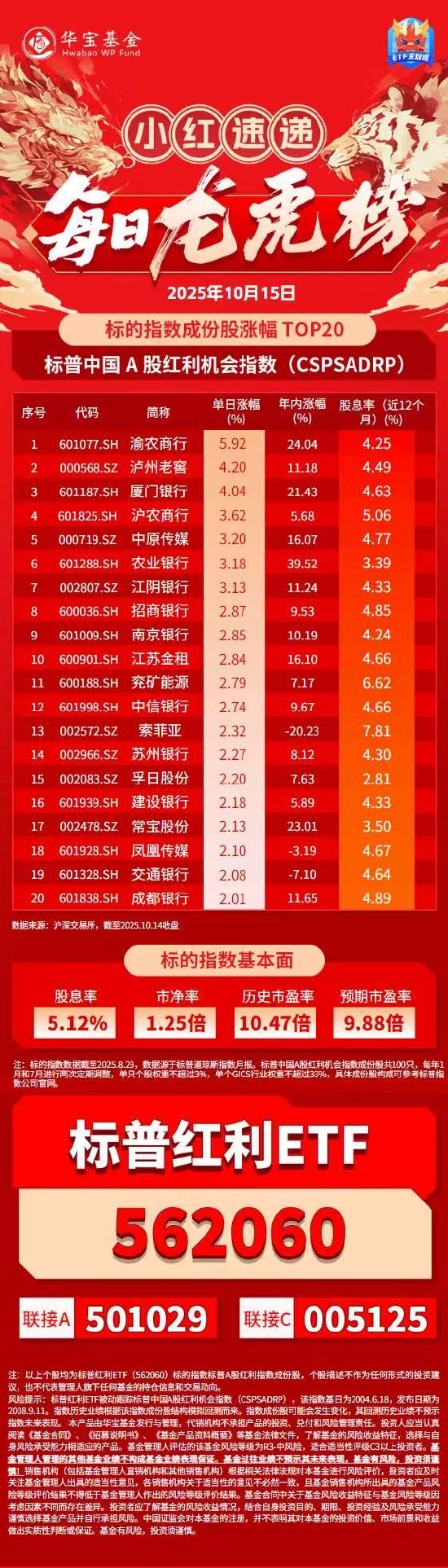
Core Insights - The article highlights the top-performing stocks in the S&P China A-Share Dividend Opportunity Index, showcasing significant price increases and dividend yields for various companies [1]. Group 1: Stock Performance - The top stock, 渝农商行 (601077.SH), experienced a price increase of 5.92% and a year-to-date increase of 24.04%, with a dividend yield of 4.25% [1]. - 泸州老窖 (000568.SZ) saw a 4.20% increase, with an 11.18% year-to-date rise and a dividend yield of 4.49% [1]. - 厦门银行 (601187.SH) recorded a 4.04% increase, a 21.43% year-to-date rise, and a dividend yield of 4.63% [1]. Group 2: Dividend Yields - The article lists several companies with notable dividend yields, including 家非亚 (002572.SZ) at 7.81%, and 究矿能源 (600188.SH) at 6.62% [1]. - 农业银行 (601288.SH) has a year-to-date increase of 39.52% and a dividend yield of 3.39% [1]. - 招商银行 (600036.SH) shows a year-to-date increase of 9.53% with a dividend yield of 4.85% [1].



资金增持潮起 银行股迎久违普涨
Bei Jing Shang Bao· 2025-10-14 15:49
Core Viewpoint - The banking sector has become a focal point in the A-share market, with all 42 listed banks experiencing gains on October 14, driven by defensive capital inflows and improved valuations after a period of correction [1][3]. Group 1: Market Performance - On October 14, all 42 banking stocks rose, with Chongqing Bank and Chongqing Rural Commercial Bank leading the gains at 6.68% and 5.92%, respectively [3]. - Year-to-date, 19 banking stocks have increased over 10%, with Agricultural Bank of China leading at 39.52% [3]. - The banking sector had previously faced a downturn, with 41 banks experiencing declines after reaching their peak prices in July [3][4]. Group 2: Reasons for Recent Performance - The recent rally in banking stocks is attributed to a shift towards defensive investments amid increased market volatility and declining risk appetite among investors [5]. - The sector's previous downturn was influenced by a preference for technology and growth stocks, leading to capital outflows from banks [4][5]. - The "dividend arbitrage" effect, where investors buy before dividends and sell afterward, contributed to the earlier corrections, but this negative impact has largely dissipated [4]. Group 3: Increased Stakeholder Confidence - There has been a notable trend of share buybacks by major shareholders and management in various banks, indicating confidence in the long-term value of banking stocks [6][7]. - For instance, Suzhou Bank reported significant share purchases by its major shareholder and management, reflecting a commitment to the bank's future [6]. - The banking sector's fundamentals remain strong, with a reported total operating income of 2.92 trillion yuan and a net profit of approximately 1.1 trillion yuan for the first half of 2025 [7]. Group 4: Investment Recommendations - Conservative investors are advised to focus on state-owned banks for stable dividends, while those with a moderate risk appetite may consider joint-stock banks for a balance of dividends and growth [8]. - Aggressive investors might look into high-quality city commercial banks to leverage regional economic advantages [8]. - For less experienced investors, ETFs in the banking sector are recommended to capture market trends [8].


A股突发!这一板块全线飘红
Zhong Guo Jing Ying Bao· 2025-10-14 12:06
Core Viewpoint - The banking sector is experiencing a strong rebound due to its defensive characteristics amid increased market volatility, with a notable rise in stock prices for various banks as of October 14 [2][3]. Group 1: Market Performance - As of October 14, Chongqing Bank saw a price increase of 6.68%, with 42 listed banks showing positive performance and the banking index rising by 2.54% [2]. - Following the National Day and Mid-Autumn Festival holidays, the banking sector has shown an upward trend, with the China Securities Banking Index increasing by 0.75% on October 13, led by Shanghai Pudong Development Bank with a 5.66% rise [3]. Group 2: Reasons for Bank Stock Increase - The current market environment has created a demand for defensive asset allocation, providing opportunities for investment in bank stocks [3]. - Positive policy signals from the government are expected to improve the asset quality outlook for banks [3][4]. - The ongoing urban renewal and the establishment of a new real estate development model are anticipated to enhance credit and asset quality for banks [4]. Group 3: Investment Opportunities - The banking sector has been in a correction phase since July 11, presenting a potential for a rebound as the market adjusts [5]. - The banking index has seen a cumulative decline of 14% since July 10, underperforming compared to the CSI 300 index, which has risen by 15% [5]. - The upcoming dividend distribution period and stable earnings expectations for banks may lead to a catch-up rally in the banking sector [5][6]. Group 4: Future Outlook - Analysts suggest that the banking sector's low valuation and high dividend yield make it attractive for risk-averse investors [6]. - The sustainability of the upward trend in bank stocks will depend on the strength of economic recovery and improvements in corporate credit demand [6].


全线飘红,银行股又“香”了?
Bei Jing Shang Bao· 2025-10-14 12:06
Core Viewpoint - The banking sector has become a focal point in the A-share market, with all 42 listed banks experiencing gains on October 14, driven by a combination of defensive capital inflow, valuation advantages after corrections, and strong fundamentals [1][2][4]. Group 1: Market Performance - On October 14, all 42 bank stocks rose, with Chongqing Bank and Chongqing Rural Commercial Bank leading the gains at 6.68% and 5.92%, respectively [1][2]. - Year-to-date, 19 bank stocks have increased by over 10%, with Agricultural Bank of China leading at 39.52% [2]. - The banking sector had previously experienced a correction, with 41 banks seeing declines after reaching their yearly highs in early July [2][3]. Group 2: Reasons for Recent Performance - The recent rally in bank stocks is attributed to a "defensive switch" by investors amid increased market volatility and a decline in risk appetite due to renewed trade tensions between China and the U.S. [4][6]. - The sector's recovery follows a period of deep correction, making bank stocks attractive for risk-averse investors [4][6]. Group 3: Insider Buying Trends - There has been a notable trend of insider buying among banks, with major shareholders and management teams increasing their stakes, indicating confidence in the long-term value of bank stocks [5][6]. - For instance, Suzhou Bank reported significant insider purchases totaling approximately 2.98 billion yuan [5]. Group 4: Future Outlook - The banking sector is expected to see continued growth, supported by improved asset quality and profitability, as well as favorable government policies encouraging diversified operations [6][7]. - Investment strategies vary, with conservative investors advised to focus on state-owned banks for stable dividends, while more aggressive investors may consider high-performing regional banks for potential higher returns [7].

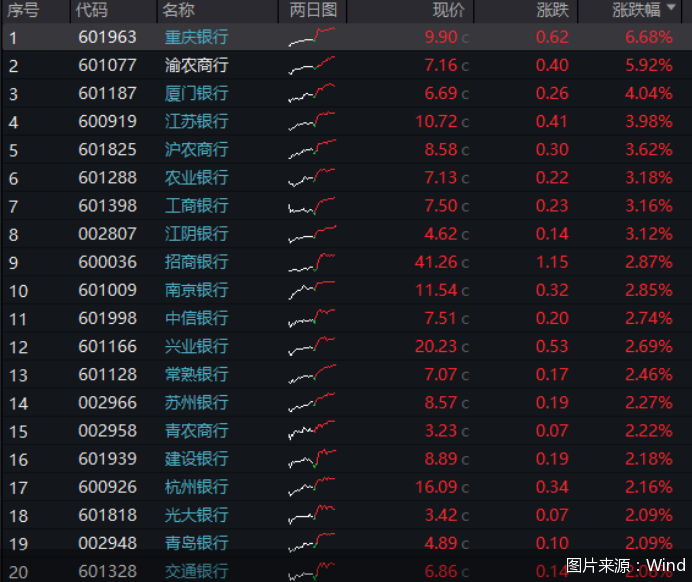
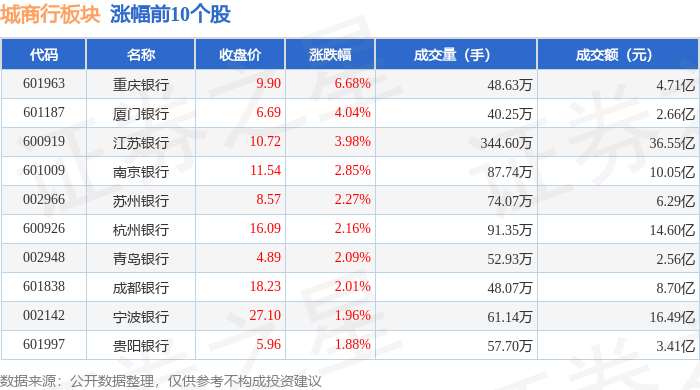
城商行板块10月14日涨2.39%,重庆银行领涨,主力资金净流出2867.55万元
Zheng Xing Xing Ye Ri Bao· 2025-10-14 08:41
Market Performance - The city commercial bank sector increased by 2.39% on October 14, with Chongqing Bank leading the gains [1] - The Shanghai Composite Index closed at 3865.23, down 0.62%, while the Shenzhen Component Index closed at 12895.11, down 2.54% [1] Individual Stock Performance - Chongqing Bank's stock price rose by 6.68% to 9.90, with a trading volume of 486,300 shares and a transaction value of 471 million [1] - Xiamen Bank increased by 4.04% to 6.69, with a trading volume of 402,500 shares and a transaction value of 266 million [1] - Jiangsu Bank's stock rose by 3.98% to 10.72, with a trading volume of 3,446,000 shares and a transaction value of 3.655 billion [1] - Other notable performances include Nanjing Bank (+2.85%), Suzhou Bank (+2.27%), and Hangzhou Bank (+2.16%) [1] Capital Flow Analysis - The city commercial bank sector experienced a net outflow of 28.68 million from institutional investors, while retail investors saw a net inflow of 15.82 million [1] - Chongqing Bank had a net inflow of 32.99 million from retail investors but a net outflow of 33.67 million from institutional investors [2] - Xiamen Bank and Beijing Bank also saw mixed capital flows, with varying net inflows and outflows from different investor types [2]