CSEC,China Shenhua(601088)

Search documents
煤炭行业2026年投资策略:十五五开局,供需重构,价值凸显
GF SECURITIES· 2025-12-31 04:54
Core Insights - The report indicates that the coal industry is entering a new cycle with a significant increase in value, driven by supply-demand restructuring and improved market conditions [1][4]. Group 1: Cycle Review - The coal price center has significantly increased during the 14th Five-Year Plan, and the 15th Five-Year Plan is expected to usher in a new cycle [4][15]. - The report reviews four cycles of the coal industry, highlighting that the current cycle may see a recovery from the bottom in the second half of 2025 [15][16]. - The average price of Qinhuangdao port 5500 kcal thermal coal reached 718 RMB/ton in the second half of 2025, reflecting a 6% increase compared to the first half [20][21]. Group 2: Supply Restructuring - Coal production from 2020 to 2024 increased by 23% to 4.78 billion tons, but growth is expected to slow significantly in 2025, with production growth in Xinjiang only at 2.6% [4][33]. - The report anticipates that coal production will enter a peak and decline phase, with growth rates expected to be between 0.5% and 1.0% from 2026 to 2028 [4][33]. - Regulatory policies are expected to impact coal production, potentially leading to negative growth in certain periods [4][33]. Group 3: Demand Restructuring - The demand for coal is expected to maintain resilience, with electricity consumption projected to grow at around 5% over the next five years, driven by new manufacturing and increased electrification [4][33]. - The report notes that while coal consumption is expected to decline in the short term due to electricity demand pressures, it is likely to recover as macroeconomic policies strengthen in 2026 [4][33]. - Chemical demand is projected to grow at approximately 5%, while declines in steel and construction materials are expected to narrow [4][33]. Group 4: Global and Commodity Perspectives - The report highlights that global coal production is expected to decline, while Southeast Asian demand is projected to grow by 3-5% from 2025 to 2030 [4][33]. - Compared to other commodities, coal has shown weaker performance, with the copper-coal ratio and gold-coal ratio at historical highs [4][33]. - The coal industry's share of industrial profits has dropped to historical lows, while the electricity sector's profit share has reached a high of 10% [4][33]. Group 5: Overall Viewpoint - The report concludes that the coal price center is expected to rise to around 750 RMB/ton in 2026, with leading companies offering dividend yields of 4-6% [4][33]. - Key companies identified include China Shenhua, Yanzhou Coal, and Shaanxi Coal, which are expected to maintain stable profitability [4][33]. - The report emphasizes that after a pessimistic outlook on coal prices is reversed, valuation elasticity is likely to become apparent [4][33].



煤炭开采板块12月30日跌0.04%,淮河能源领跌,主力资金净流出2.01亿元
Zheng Xing Xing Ye Ri Bao· 2025-12-30 09:08
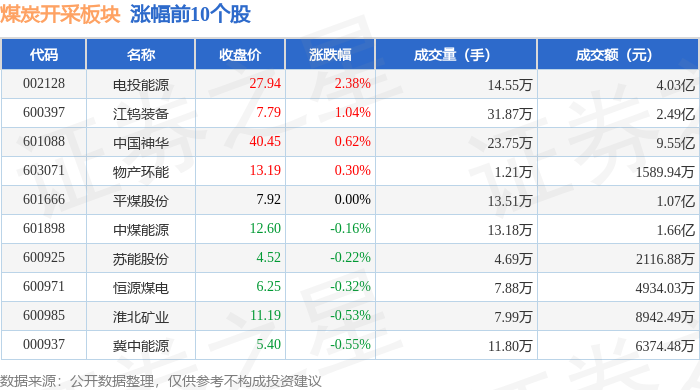
Group 1 - The coal mining sector experienced a slight decline of 0.04% on December 30, with Huaihe Energy leading the drop [1] - The Shanghai Composite Index closed at 3965.12, showing no change, while the Shenzhen Component Index rose by 0.49% to 13604.07 [1] - Key stocks in the coal mining sector showed mixed performance, with notable gainers including Electric Power Investment Energy (+2.38%) and Jiangxi Tungsten Industry (+1.04%) [1] Group 2 - Huaihe Energy saw a significant decline of 2.60%, closing at 3.37, with a trading volume of 624,400 shares and a turnover of 212 million yuan [2] - The coal mining sector faced a net outflow of 201 million yuan from major funds, while retail investors contributed a net inflow of 163 million yuan [2] - The stock performance of various companies indicated a trend of net outflows from major funds, with Shaanxi Coal and Chemical Industries showing a net inflow of 99.04 million yuan [3]


申万宏源证券晨会报告-20251230
Shenwan Hongyuan Securities· 2025-12-30 00:45
Group 1: Key Insights on Xingfu Electronics - The company is backed by Xingfa Group, a leading player in the phosphate chemical and fine chemical industry, ensuring strong supply chain support [8] - It focuses on semiconductor applications, with a complete wet electronic chemical product system, including 60,000 tons of electronic-grade phosphoric acid and 100,000 tons of electronic-grade sulfuric acid, leading the domestic market [8] - The company aims to become a world-class electronic materials enterprise, with ongoing internationalization and diversification strategies [8] Group 2: Key Insights on JD Industrial - JD Industrial is a leading provider of industrial supply chain technology and services in China, with a projected revenue of 20.398 billion yuan and an adjusted net profit of 909 million yuan for 2024 [10] - The company has established a comprehensive digital infrastructure for supply chain management, covering 80 product categories and serving over 11,100 key enterprise clients [10] - The industrial supply chain market in China is vast, with a size of 11.4 trillion yuan in 2024, and JD Industrial holds a market share of 4.1% in the industrial supply chain technology and services market [10] Group 3: Insights on the Coal Industry - The coal industry is experiencing a restructuring due to stricter safety regulations, with a cumulative coal production of 4.402 billion tons from January to November, showing a year-on-year increase of 1.4% [14] - The demand for coal remains stable, with a projected increase in coal consumption in the chemical industry, and the overall coal demand is expected to grow slightly [14] - Investment recommendations include stable high-dividend stocks like China Shenhua and Shaanxi Coal, as well as growth stocks such as TBEA and Huaihe Energy [14] Group 4: Insights on MEMS Sensor Industry - The company is a leading player in high-performance MEMS inertial sensors, with a revenue and net profit CAGR exceeding 38% from 2019 to 2024 [15] - The MEMS technology market is expanding, with applications in consumer electronics, automotive, industrial, and aerospace sectors [16] - The company is actively pursuing new market opportunities, including partnerships in autonomous driving and low-altitude aviation [16] Group 5: Insights on Automotive Industry - The automotive market is seeing a shift towards intelligent and high-end vehicles, with a focus on new energy vehicles and the potential for significant growth in the second-hand car market [24] - Recent data indicates a 9% month-on-month increase in retail sales of passenger vehicles, despite a year-on-year decline [26] - Investment recommendations include companies with strong alpha potential and those benefiting from the ongoing reforms in state-owned enterprises [27]


中国神华(601088.SH):清远二期3号机组通过168小时试运行
Ge Long Hui· 2025-12-29 11:21
Core Viewpoint - China Shenhua (601088.SH) announced that its subsidiary, Guoneng Qingyuan Power Co., Ltd., successfully completed the 168-hour trial operation of the No. 3 generator unit of the Qingyuan Phase II expansion project, officially commencing commercial operations [1] Group 1: Project Details - The Qingyuan Phase II project is located in Yingde City, Qingyuan, Guangdong Province, and involves the construction of two 1 million kilowatt ultra-supercritical reheat coal-fired power generation units [1] - The project is a key energy security initiative under Guangdong's "14th Five-Year Plan" [1] - The project utilizes efficient and clean coal power technology, with a designed coal consumption of 262.23 grams per kilowatt-hour, achieving ultra-low emissions of air pollutants and zero wastewater discharge [1] Group 2: Future Developments - The construction of the No. 4 generator unit is progressing steadily, with plans for it to be operational by February 2026 [1] - Once fully operational, the project will significantly alleviate energy supply pressure in the region and ensure energy security for the Guangdong-Hong Kong-Macao Greater Bay Area [1]
中国神华(601088) - 中国神华关于清远二期3号机组通过168小时试运行的公告
2025-12-29 11:15
证券代码:601088 证券简称:中国神华 公告编号:临 2025-082 特此公告。 承中国神华能源股份有限公司董事会命 总会计师、董事会秘书 宋静刚 2025 年 12 月 30 日 中国神华能源股份有限公司 关于清远二期 3 号机组通过 168 小时试运行的公告 本公司董事会及全体董事保证本公告内容不存在任何虚假记载、误导性陈述 或者重大遗漏,并对其内容的真实性、准确性和完整性承担法律责任。 近日,中国神华能源股份有限公司("本公司")持股 67%的控股子公司国 能清远发电有限责任公司二期扩建工程项目("清远二期")3 号发电机组顺利 通过 168 小时试运行,正式投入商业运营。 清远二期位于广东省清远市英德市沙口镇,规划建设 2 台 100 万千瓦超超临 界二次再热燃煤发电机组,是广东省"十四五"规划能源保障重点工程。项目采 用高效清洁煤电技术,设计供电煤耗 262.23 克/千瓦时,可实现大气污染物超低 排放及废水零排放。 目前,清远二期 4 号发电机组建设工作稳步推进,计划于 2026 年 2 月投运。 项目全部投运后,将有效缓解所在区域能源供应压力,为粤港澳大湾区能源安全 提供保障。 ...
狂飙近2000单!A股并购潮涌,半导体成热门赛道
Bei Jing Shang Bao· 2025-12-29 10:55
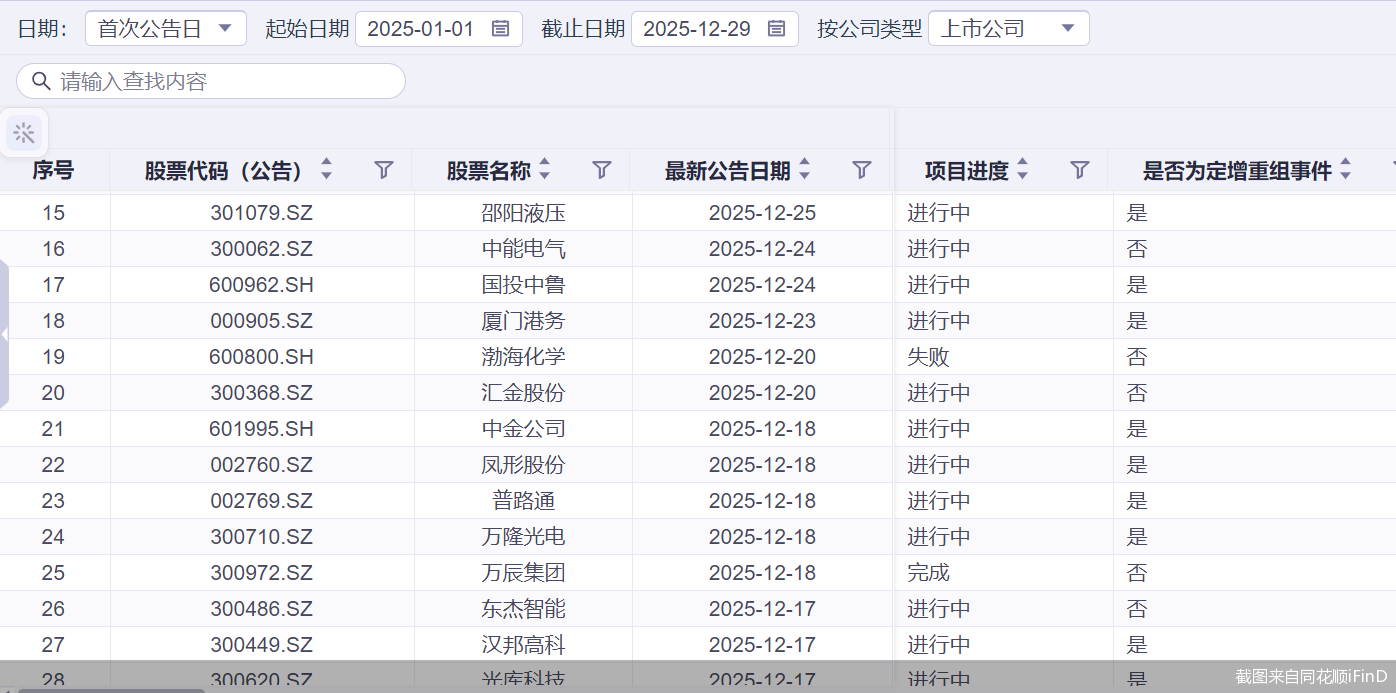
Group 1 - The A-share merger and acquisition (M&A) market is experiencing a significant surge in 2025, driven by policy support and industry demand, with nearly 1,500 companies disclosing M&A transactions by year-end [1][3][4] - The semiconductor sector stands out as the most active area in this M&A wave, with 165 reported cases involving semiconductor-related assets, highlighting the industry's integration and cross-industry attempts [1][10][11] - Major transactions include China Shenhua's acquisition valued at approximately 1,335.98 billion yuan, setting a record for the highest transaction scale in A-share history, followed by China International Capital Corporation's merger involving around 1,142.75 billion yuan [9][10] Group 2 - The market's vibrancy is supported by ongoing policy reforms, including the "New National Nine Articles" and subsequent measures aimed at enhancing M&A efficiency and encouraging industry consolidation [5][6] - A total of 905 M&A projects have been completed, while 68 have been declared unsuccessful, indicating a mix of successful and challenging transactions in the market [4][5] - The trend of cross-industry mergers is also notable, with companies like Meike Home aiming to acquire leading firms in other sectors, such as high-speed copper cable technology [7][10] Group 3 - Despite the active M&A environment, there are concerns regarding integration challenges and the rising number of terminated transactions, with 65 companies announcing the cessation of their restructuring efforts by year-end [1][18][19] - The semiconductor sector's M&A activity is characterized by high technical barriers and long investment cycles, leading to some companies facing difficulties in meeting performance commitments and achieving successful integrations [14][19] - Experts suggest that companies should adopt a rational approach to M&A, focusing on industry fundamentals and aligning acquisitions with their strategic goals to avoid pitfalls associated with speculative cross-industry ventures [19][20]

中国神华:清远二期3号发电机组通过168小时试运行
Zhi Tong Cai Jing· 2025-12-29 10:53
Core Viewpoint - China Shenhua Energy Co., Ltd. has successfully put its subsidiary, Guoneng Qingyuan Power Co., Ltd.'s Phase II expansion project into commercial operation, marking a significant step in energy supply for the Guangdong-Hong Kong-Macao Greater Bay Area [1] Group 1: Project Details - The Phase II project, located in Qingyuan City, Guangdong Province, includes the construction of two 1 million kilowatt ultra-supercritical reheat coal-fired power generation units [1] - The project is a key energy security initiative under Guangdong's "14th Five-Year Plan" [1] - The designed coal consumption for power generation is 262.23 grams per kilowatt-hour, ensuring ultra-low emissions of air pollutants and zero wastewater discharge [1] Group 2: Future Developments - The construction of the fourth generator unit is progressing steadily, with plans for it to be operational by February 2026 [1] - Once fully operational, the project will significantly alleviate energy supply pressure in the region [1]
中国神华(01088):清远二期3号发电机组通过168小时试运行
智通财经网· 2025-12-29 10:53
Core Viewpoint - China Shenhua Energy Co., Ltd. has successfully put its subsidiary, Guoneng Qingyuan Power Co., Ltd.'s Phase II expansion project into commercial operation, marking a significant step in energy supply for the Guangdong-Hong Kong-Macao Greater Bay Area [1] Group 1: Project Details - The Phase II project, located in Qingyuan City, Guangdong Province, includes the construction of two 1 million kilowatt ultra-supercritical reheat coal-fired power generation units [1] - The project is a key energy security initiative under Guangdong's 14th Five-Year Plan, utilizing efficient and clean coal power technology [1] - The designed coal consumption for power generation is 262.23 grams per kilowatt-hour, achieving ultra-low emissions of air pollutants and zero wastewater discharge [1] Group 2: Future Developments - The construction of the fourth generator unit is progressing steadily, with plans for it to be operational by February 2026 [1] - Once fully operational, the project will significantly alleviate energy supply pressure in the region [1]
中国神华(01088) - 海外监管公告
2025-12-29 10:45
香港交易及結算所有限公司及香港聯合交易所有限公司對本公告之 內容概不負責,對其準確性或完整性亦不發表任何聲明,並明確表示 概不就因本公告全部或任何部份內容而產生或因倚賴該等內容而引 致之任何損失承擔任何責任。 ( 在中華人民共和國註冊成立的股份有限公司 ) (股份代碼:01088) 中国神华能源股份有限公司 关于清远二期 3 号机组通过 168 小时试运行的公告 本公司董事会及全体董事保证本公告内容不存在任何虚假记载、误导性陈述 或者重大遗漏,并对其内容的真实性、准确性和完整性承担法律责任。 海外監管公告 本公告乃根據香港聯合交易所有限公司證券上市規則第 13.10B 條而 做出。 茲載列中國神華能源股份有限公司於 2025 年 12 月 30 日在上海證券 交易所網站(www.sse.com.cn)刊登的「關於清遠二期 3 號機組通過 168 小時試運行的公告」文件,僅供參閱。 承董事會命 中國神華能源股份有限公司 總會計師、董事會秘書 宋靜剛 北京,2025 年 12 月 29 日 於本公告日期,董事會成員包括執行董事張長岩先生,非執行董事康 鳳偉先生及李新華先生,獨立非執行董事袁國強博士、陳漢文博士及 ...
能源矿产 | 2025年全球煤炭上市公司财报解码:周期之巅与价值重塑
Sou Hu Cai Jing· 2025-12-29 10:16
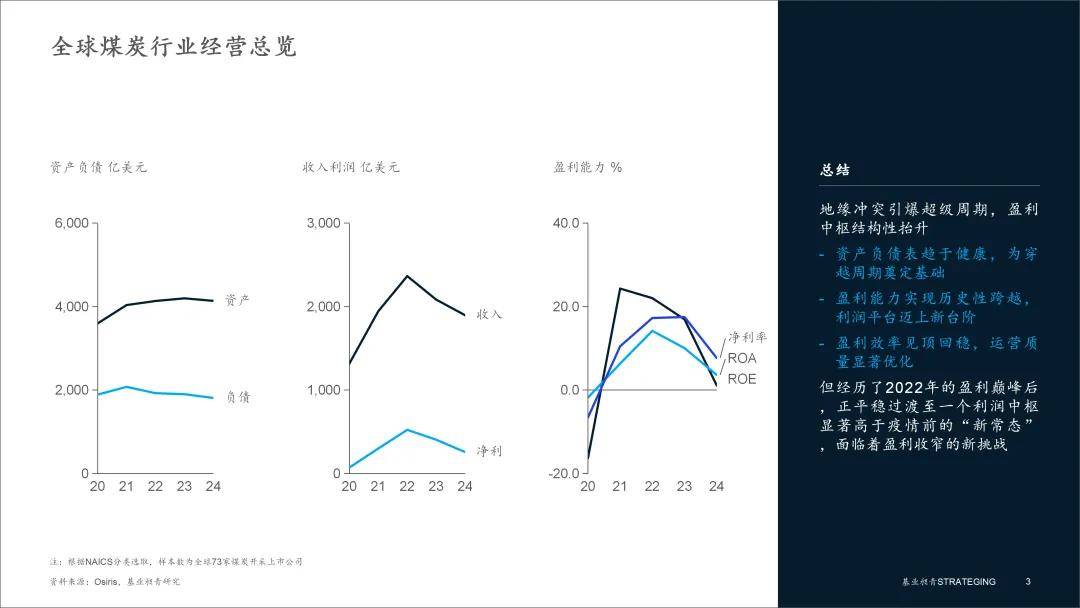
Core Insights - The global coal industry has transitioned from a peak profit phase to a new normal characterized by value reconstruction, where profit elasticity and capital operations have become key to success in a differentiated landscape [1][2]. Industry Overview - The global coal mining industry is experiencing a significant economic cycle driven by external shocks and supply-demand mismatches from 2020 to 2024, with a notable profit center established above pre-pandemic levels, despite facing new challenges of profit contraction [2]. - The industry reached a record profit peak of $52.4 billion in 2022, driven by geopolitical conflicts and a surge in international coal prices, following a brief downturn in 2020 due to the pandemic [2][3]. - The average net profit margin improved dramatically from a loss of $7.2 billion in 2020 to a peak of 17.27% in 2022, indicating a fundamental reversal in profitability [3]. Profitability and Efficiency - The coal industry's net profit is projected to normalize at $25.7 billion in 2024, still significantly higher than pre-pandemic levels, reflecting a structural elevation in overall profitability [3]. - The average net profit margin is expected to decline to 7.66% by 2024, indicating a departure from the peak profit phase and highlighting the cyclical nature of profitability [5]. Global Landscape - Asia, particularly China, India, and Indonesia, dominates the global coal industry, with these countries playing pivotal roles in shaping the market dynamics [8]. - China serves as the largest producer and consumer, ensuring energy security with stable profitability, while India experiences robust domestic demand growth, achieving an average net profit margin of 26.69% [8]. - Indonesia and Australia benefit significantly from international coal price surges, with average net profit margins of 19.05% and 15.64%, respectively [8]. Company Comparisons - Major players like China Shenhua and Indian Coal exhibit strong integrated advantages, showcasing resilience and stable profitability amid cyclical fluctuations [11]. - Emerging companies, such as Stanmore in Australia, have capitalized on acquisition opportunities during the cycle, achieving a remarkable compound annual growth rate of 118.56% [11]. - Export-oriented firms in Indonesia, like Golden Energy, have maximized profits from price elasticity, with average returns on equity reaching 71.67% [11]. Strategic Recommendations - The coal industry must transition from being mere fuel suppliers to comprehensive energy service providers, focusing on enhancing energy security and integrating renewable energy solutions [17][20]. - Companies should extend their value chains by developing high-end coal chemical products and exploring synergies with renewable energy projects [20]. - Emphasizing ESG management can transform perceived costs into competitive advantages, enabling firms to secure lower financing costs and enhance their public image [21]. - Maintaining prudent capital discipline is essential, focusing investments on core business areas and ensuring a healthy balance sheet to navigate future economic cycles [22].