INDUSTRIAL BANK(601166)

Search documents
首次!消费贷“国补”,来了!(附指南)
Sou Hu Cai Jing· 2025-09-02 23:12
Core Viewpoint - The implementation of the personal consumption loan interest subsidy policy aims to reduce borrowing costs for consumers and stimulate consumption in the economy [1][2]. Group 1: Policy Implementation - The personal consumption loan interest subsidy policy officially took effect on September 1, 2025, and will be in place until August 31, 2026 [1]. - The policy covers personal consumption loans issued by banks, excluding credit card transactions, and is applicable to loans used for specific consumption categories [1][4]. - Major banks, including the "Big Four" (Industrial and Commercial Bank of China, Agricultural Bank of China, Bank of China, and China Construction Bank), have committed to implementing the subsidy without charging service fees [1][3]. Group 2: Subsidy Details - The subsidy applies to consumption loans of less than 50,000 yuan and loans of 50,000 yuan or more for key areas such as home appliances, education, and healthcare [1][4]. - For loans above 50,000 yuan, the subsidy is capped at the first 50,000 yuan of consumption [1]. Group 3: Application Process - Banks have simplified the application process for consumers, allowing automatic identification of eligible transactions for the subsidy [3][5]. - Consumers must sign a supplementary agreement and authorize banks to access their loan transaction information to qualify for the subsidy [5][6]. Group 4: Consumer Guidance - Consumers are advised that cash withdrawals for consumption will not qualify for the subsidy, as banks cannot verify the use of funds [4][6]. - If a consumer does not receive the subsidy due to unrecognized transactions, they can submit receipts to the bank for reimbursement [6].



消费贷“国补”无需操作
Shen Zhen Shang Bao· 2025-09-02 23:05
Group 1 - The personal consumption loan interest subsidy policy officially started on September 1, with financial institutions prepared to implement it smoothly for consumers [1][2] - The subsidy allows automatic identification of consumer information during loan applications, eliminating the need for customer intervention [1][2] - Major banks, including Agricultural Bank, Bank of China, and others, have confirmed they will not charge service fees for processing these subsidies [1][2] Group 2 - The subsidy rate is set at an annualized 1%, with a maximum limit of 50% of the loan contract interest rate [2][4] - Consumers can benefit from the subsidy on multiple loans, with a maximum subsidy of 3000 yuan available from the same lending institution [4] - Eligible consumption areas for the subsidy include home appliances, education, healthcare, and more, with specific limits on single transaction amounts [4]



西部利得消费精选混合型证券投资基金分红公告
Shang Hai Zheng Quan Bao· 2025-09-02 20:22
Group 1 - The company announced a cash dividend distribution, with the final amount to be confirmed based on actual allocation [1] - Investors choosing cash dividends will receive their payments on September 8, 2025, while those opting for reinvestment will see their shares credited on September 5, 2025 [2][3] - The record date for dividend entitlement is September 4, 2025, and any purchases or transfers after this date will not qualify for the dividend [3][11] Group 2 - The company is convening a communication-based meeting for fund shareholders to discuss the termination of the fund contract and the liquidation of fund assets [9][35] - The voting period for the meeting is from September 5, 2025, to October 15, 2025, with specific instructions for submitting votes [9][10] - The meeting's resolution requires a two-thirds majority of the voting rights represented to be effective [28] Group 3 - The fund will enter liquidation procedures immediately after the resolution is passed, ceasing all redemption and transfer requests [36] - A fund liquidation team will be established to manage the process, which includes asset evaluation and distribution [36][44] - The liquidation process is expected to take up to six months, with all reasonable expenses prioritized from the remaining fund assets [39][40] Group 4 - The company has ensured legal and technical feasibility for the termination of the fund contract, with necessary preparations made for the meeting [42][45] - The company has communicated with shareholders to gather feedback and ensure the proposal aligns with their interests [46] - In case of a significant redemption request, the company is prepared to manage liquidity effectively [47]

上市银行竞逐移动端 加速迭代提升服务质效
Zheng Quan Ri Bao Zhi Sheng· 2025-09-02 16:39
Core Insights - Mobile banking has evolved from a simple financial tool to a comprehensive service platform, emphasizing banks' overall service capabilities [1][3] - The competition for customer acquisition on mobile platforms is intensifying, with major state-owned banks leading in personal mobile banking user numbers [1][2] Group 1: Personal Mobile Banking Performance - As of June 2023, Industrial and Commercial Bank of China (ICBC) leads with 600 million personal mobile banking users, followed by Agricultural Bank of China (ABC) with 586 million, and China Construction Bank (CCB) with 432 million [1] - Postal Savings Bank of China (PSBC) has 386 million personal mobile banking customers, while Bank of China (BOC) has over 302 million signed customers [1] - Among joint-stock banks, Ping An Bank's mobile app has 17.8 million registered users, a 2% increase from the end of 2022 [1] Group 2: Corporate Mobile Banking Development - Corporate mobile banking is focusing on enhancing payment, cross-border finance, and foreign exchange services, with ICBC reporting 17.87 million corporate mobile banking clients and 7.59 million monthly active users [2] - Agricultural Bank of China's corporate mobile banking registered clients increased by 960,000 to 9.7 million [2] - BOC is promoting a multi-version service system for corporate mobile banking, enhancing features for cross-border finance [2] Group 3: Digital Transformation and Ecosystem Development - The trend in mobile banking development is characterized by "dual-core driving and ecological integration," with personal banking focusing on user scale and experience, while corporate banking emphasizes specialized services [3] - Banks are deepening AI applications and exploring various mobile banking scenarios to enhance online service quality [4] - The adaptation to the HarmonyOS system is becoming standard, with banks like PSBC and CCB launching features that improve user experience and operational efficiency [4][5] Group 4: User Experience and Future Directions - Banks are encouraged to build sustainable user experience management systems and enhance customer experience through AI-driven solutions [6] - The focus is on creating personalized financial solutions and improving service delivery through advanced technology [6]

股份行零售排位“争夺赛”:亮眼增速下,座次有何变化?
Nan Fang Du Shi Bao· 2025-09-02 11:26
Core Viewpoint - The retail banking sector is experiencing intensified competition, with significant growth in retail assets under management (AUM) and private banking clients among major banks, despite previous challenges in the market [2][4][7]. Retail AUM - The top three banks in retail AUM are China Merchants Bank (CMB) with 16.03 trillion yuan, Industrial Bank with 5.52 trillion yuan, and CITIC Bank with 4.99 trillion yuan [6][5]. - CMB's AUM growth is 7.39%, while Industrial Bank and CITIC Bank have growth rates of 8.00% and 6.52%, respectively [6]. - Notably, the AUM of several banks has increased significantly, with Zhejiang Commercial Bank and Pudong Development Bank showing growth rates of 12.48% and 10.55% [4][6]. - CMB's AUM surpasses that of its competitors by over 10 trillion yuan, establishing a substantial lead in the retail banking sector [4][5]. Private Banking Clients - The number of private banking clients has also seen substantial growth, with Zhejiang Commercial Bank leading at 15.52% growth, followed by Huaxia Bank, Minsheng Bank, and Pudong Development Bank with growth rates of 13.79%, 12.84%, and 10.15%, respectively [7]. - CMB, CITIC Bank, and Industrial Bank also reported increases in private banking clients, all exceeding 8% growth [7]. Wealth Management Revenue - Wealth management income has shown significant increases, with CMB reporting an 11.89% growth in fees and commissions, marking the first positive growth in three years [8]. - CITIC Bank's wealth management income growth reached a four-year high at 10.3%, while Industrial Bank's retail wealth income grew by 13.45% [8]. Retail Loan Quality - Retail loan non-performing ratios vary significantly among banks, with Bohai Bank having the highest at 4.43%, while CMB and Industrial Bank maintain the lowest at 1.03% and 1.22%, respectively [11][9]. - Despite CMB's strong performance, its non-performing ratio increased by 0.07 percentage points compared to the previous year [11]. Retail Strategy - The introduction of consumer loan interest subsidies is expected to enhance the competitive landscape, shifting focus from price wars to technology, service, and quality differentiation [12][13]. - Banks are emphasizing asset allocation and the application of AI models in their retail strategies, with CMB planning to integrate AI assistants to improve efficiency and workflow [14][15].



中国银行业风险边际改善 兴业银行行长陈信健:三大领域新发生不良峰值已过
Jing Ji Guan Cha Wang· 2025-09-02 09:19
Core Viewpoint - The Chinese banking industry demonstrates strong operational resilience in a complex environment characterized by low interest rates and narrow interest margins, with overall stability maintained in the first half of 2025 [1] Group 1: Risk Areas and Management - The risk peaks in the three major areas of real estate, local government financing platforms, and credit cards have passed, as indicated by a significant year-on-year decline in new non-performing loans [2][3] - As of June 30, the non-performing loan ratio for the bank remained stable at 1.08%, with a notable 45.72% decrease in new non-performing loans in the corporate real estate sector and a 7.5% decline in credit card non-performing loans [2][3] - The bank's proactive response to national debt reduction policies and its continuous improvement in risk management capabilities have contributed to this positive trend [1][6] Group 2: Risk Management Reforms - The improvement in risk conditions is attributed to systematic enhancements in comprehensive risk management capabilities, including the establishment of a clear risk management framework [4][5] - The bank has restructured its risk management departments to enhance the independence and authority of risk reviews, ensuring a clear division of responsibilities [5] - Digital risk management tools have been developed to improve efficiency and accuracy in risk monitoring and management processes [5] Group 3: Industry Context and Outlook - The risk reduction observed in the bank reflects a broader trend in the Chinese banking industry, with effective control over financial risks, particularly in local government debt and real estate markets [6][7] - The average price-to-book ratio (PB) for listed banks has increased from 0.52 at the end of 2023 to 0.67, indicating a market shift in risk expectations [7] - The bank's assessment that the risk peak has passed suggests a potential transition for the Chinese banking sector, moving towards greater stability and reduced systemic risk [7][8]
金工定期报告20250902:预期高股息组合跟踪
Soochow Securities· 2025-09-02 09:04
Quantitative Models and Construction Methods - **Model Name**: Expected High Dividend Portfolio **Model Construction Idea**: The model aims to construct a portfolio with high expected dividend yield by leveraging historical dividend data, fundamental indicators, and short-term factors like reversal and profitability[5][10][16] **Model Construction Process**: 1. **Dividend Yield Calculation**: - Phase 1: Calculate dividend yield based on annual report profit distribution announcements - Phase 2: Predict and calculate dividend yield using historical dividend data and fundamental indicators[5][10] 2. **Screening Process**: - Exclude suspended and limit-up stocks from the CSI 300 constituents[15] - Remove the top 20% of stocks with the highest short-term momentum (21-day cumulative return)[15] - Exclude stocks with declining profitability (quarterly net profit YoY growth < 0)[15] 3. **Final Selection**: - Rank the remaining stocks by expected dividend yield - Select the top 30 stocks with the highest expected dividend yield and construct an equally weighted portfolio[11] **Model Evaluation**: The model demonstrates strong historical performance with significant excess returns and controlled drawdowns, making it a robust strategy for high-dividend stock selection[13] Model Backtesting Results - **Expected High Dividend Portfolio**: - Cumulative Return: 358.90% - Cumulative Excess Return (vs CSI 300 Total Return Index): 107.44% - Annualized Excess Return: 8.87% - Maximum Rolling 1-Year Drawdown of Excess Return: 12.26% - Monthly Excess Win Rate: 60.19%[13] Quantitative Factors and Construction Methods - **Factor Name**: Expected Dividend Yield Factor **Factor Construction Idea**: Predict future dividend yield by combining historical dividend data, fundamental indicators, and short-term influencing factors[5][16] **Factor Construction Process**: 1. Calculate historical dividend yield based on profit distribution announcements[5][10] 2. Predict future dividend yield using fundamental indicators and historical dividend patterns[5][10] 3. Incorporate two short-term factors: - **Reversal Factor**: Accounts for short-term price reversals - **Profitability Factor**: Reflects the company's earnings performance[5][16] **Factor Evaluation**: The factor effectively identifies high-dividend stocks and serves as a reliable input for portfolio construction[16] - **Factor Name**: Red Dividend Timing Framework (Composite Signal) **Factor Construction Idea**: Combines multiple single-factor signals to assess the market's outlook on dividend stocks[25][28] **Factor Construction Process**: 1. Evaluate five single-factor signals: - **Inflation**: PPI YoY (High/Low) - **Liquidity**: M2 YoY (High/Low) - **M1-M2 Gap**: Scissors Difference (High/Low) - **Interest Rate**: US 10-Year Treasury Yield (High/Low) - **Market Sentiment**: Dividend Stock Turnover Ratio (Up/Down)[28] 2. Assign binary signals (1 for bullish, 0 for bearish) to each factor 3. Aggregate the signals into a composite indicator[28] **Factor Evaluation**: The framework provides a systematic approach to timing dividend stock investments, though the September 2025 signal suggests a cautious stance[25][28] Factor Backtesting Results - **Expected Dividend Yield Factor**: - August 2025 Portfolio Average Return: 5.69% - Excess Return (vs CSI 300 Index): -4.80% - Excess Return (vs CSI Dividend Index): +4.70%[5][16] - **Red Dividend Timing Framework (Composite Signal)**: - Latest Signal (September 2025): 0 (Neutral)[25][28]





兴业银行(601166):业绩增长改善,零售不良压力减轻
Tianfeng Securities· 2025-09-02 08:11
Investment Rating - The investment rating for the company is "Accumulate" [8] Core Views - The company's revenue and profit have shown improvement, with a slight increase in net profit of 0.21% year-on-year for the first half of 2025, despite a revenue decline of 2.29% [2][5] - The bank's asset quality is improving, with a non-performing loan ratio of 1.08% and a provision coverage ratio of 228.54% [4][27] - The bank is experiencing increased pressure on net interest margins, which recorded 1.75% in the first half of 2025, down 5 basis points from the first quarter of 2025 and 7 basis points from 2024 [2][17] Financial Performance Summary - In the first half of 2025, the bank achieved revenue of approximately 1104.58 billion yuan, with net interest income of 737.55 billion yuan, accounting for 66.77% of total revenue [2][13] - Non-interest income decreased by 3.80% year-on-year to 367.03 billion yuan, but the decline was less severe than in the previous quarter [3][20] - The bank's total assets grew by 2.55% year-on-year, with loans and financial investments increasing by 4.3% and 9.6%, respectively [21][24] Asset and Liability Analysis - Total liabilities increased by 2.42% year-on-year, with deposits growing by 8.9% [4][26] - The bank's deposit structure has improved, with the proportion of deposits in interest-bearing liabilities rising to 63% [4][26] - The bank's non-performing loan ratio for retail improved to 1.22%, down 13 basis points from the end of 2024, while corporate non-performing loans increased to 1.08% [27][29] Profitability Forecast - The bank's net profit is expected to grow by 0.72%, 2.69%, and 3.12% for the years 2025, 2026, and 2027, respectively [5][33] - The projected earnings per share for 2025 is 3.67 yuan, with a price-to-earnings ratio of 5.94 [7][33]
珠海冠宇、富临精工等目标价涨幅超40%,中仑新材获“买入”评级
2 1 Shi Ji Jing Ji Bao Dao· 2025-09-02 07:19
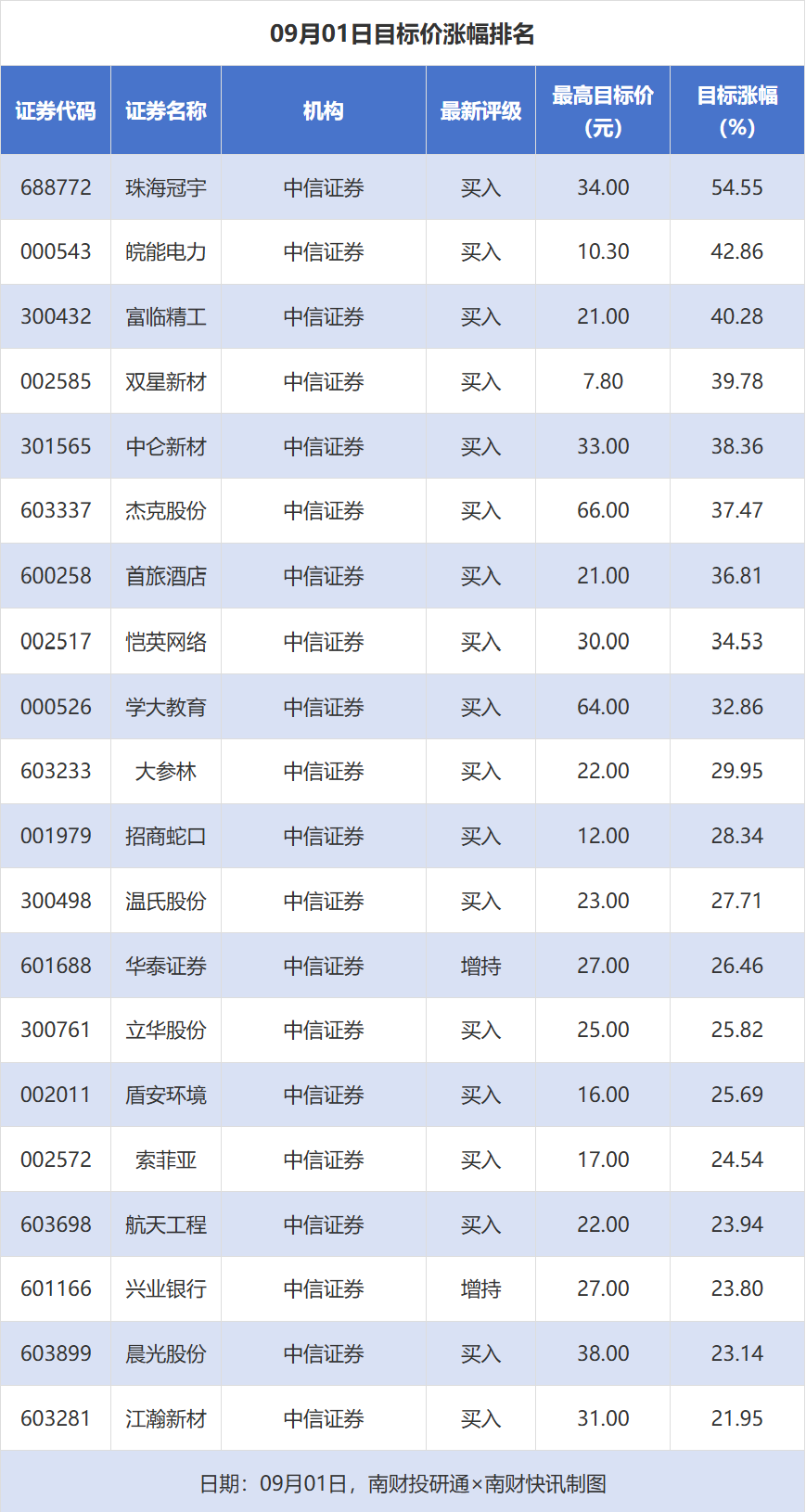
Core Insights - On September 1, 2023, brokerage firms provided target prices for listed companies, with significant increases noted for Zhuhai Gree, Anhui Energy, and Fulian Precision, showing target price increases of 54.55%, 42.86%, and 40.28% respectively, all within the battery and power sectors [1]. Group 1: Target Price Increases - Zhuhai Gree (688772) received a target price of 34.00 yuan, reflecting a 54.55% increase [2]. - Anhui Energy (000543) has a target price of 10.30 yuan, indicating a 42.86% increase [2]. - Fulian Precision (300432) was assigned a target price of 21.00 yuan, showing a 40.28% increase [2]. Group 2: Additional Companies with Notable Increases - Double Star New Materials (002585) has a target price of 7.80 yuan, with a 39.78% increase [3]. - Zhonglun New Materials (301565) received a target price of 33.00 yuan, reflecting a 38.36% increase [3]. - Jack Shares (603337) has a target price of 66.00 yuan, indicating a 37.47% increase [3]. Group 3: Brokerage Recommendations - A total of 39 listed companies received brokerage recommendations on September 1, 2023, with Double Star New Materials, China National Freight, and Postal Savings Bank each receiving one recommendation [3]. - Zhonglun New Materials was given a "Buy" rating in its first coverage by Citic Securities [3].




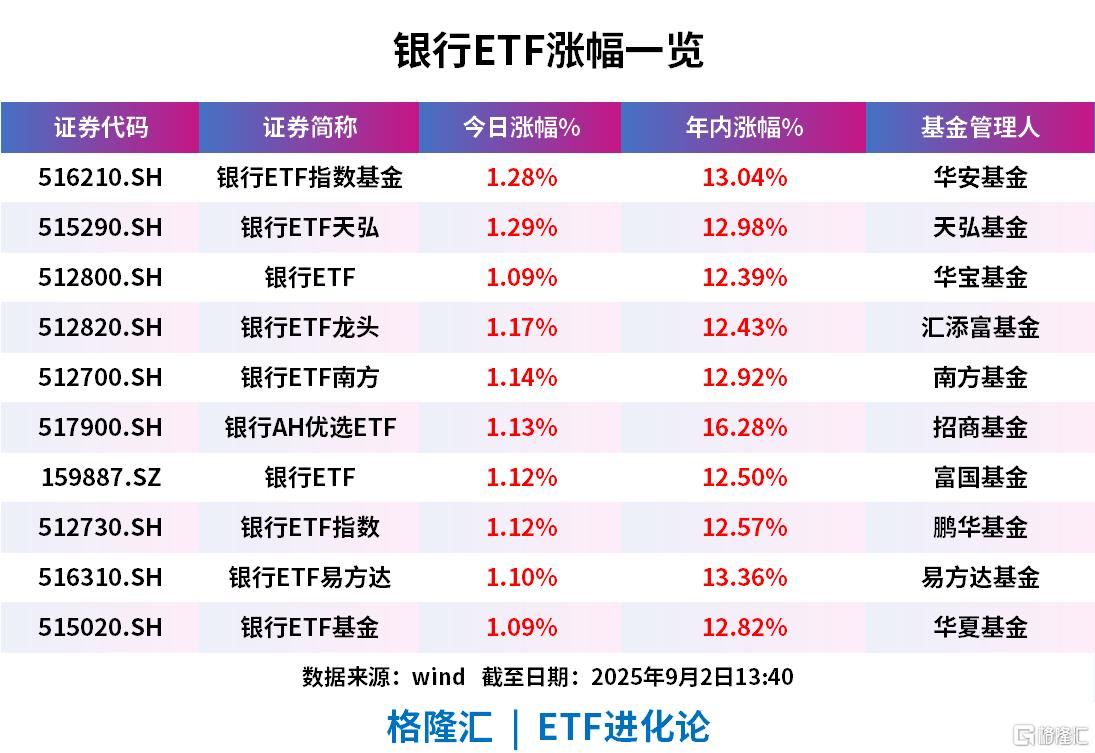
银股逆势上涨,银行ETF天弘、银行ETF、银行AH优选ETF上涨
Ge Long Hui A P P· 2025-09-02 05:59
Core Viewpoint - The banking sector is showing signs of recovery with improved financial metrics and a favorable investment environment, particularly for bank ETFs that track the performance of listed banks in China [4][5][6]. Group 1: Bank ETFs Performance - The Bank ETFs are designed to passively track the CSI Bank Index, which includes 42 listed banks in A-shares, with nearly 30% of the portfolio allocated to major state-owned banks like ICBC, ABC, and CCB, capturing high dividend opportunities [4]. - Approximately 70% of the portfolio focuses on high-growth joint-stock banks and city commercial banks, making it an efficient investment tool for tracking the overall banking sector [4]. - The Bank AH Preferred ETF tracks the Bank AH Index, which consists of securities listed in both A-shares and Hong Kong, employing a monthly security category conversion strategy [4]. Group 2: Financial Performance of Banks - In the first half of the year, 42 A-share listed banks achieved total operating income exceeding 2.9 trillion yuan, a year-on-year increase of over 1%, and a net profit attributable to shareholders of 1.1 trillion yuan, up 0.8% year-on-year [4]. - Major state-owned banks reported net profits exceeding 100 billion yuan each in the first half of the year, with non-performing loan ratios remaining low across the six major commercial banks [4]. Group 3: Sector Analysis and Outlook - The performance of state-owned banks has improved beyond expectations, with significant recovery in fee and other non-interest income growth compared to Q1, driving overall performance [5]. - Joint-stock banks are experiencing a rebound in revenue and profit growth due to stable asset quality and improved non-interest income [5]. - The banking sector is expected to see a rotation and rebound, with the overall performance of banks in the mid-year report indicating a recovery in ROE [5]. - The ranking of bank sub-sectors is as follows: joint-stock banks > city commercial banks = state-owned banks > rural commercial banks, with a strong outlook for joint-stock banks due to financial clearing and valuation recovery [5]. Group 4: Long-term Valuation Recovery - The long-term logic for systemic valuation recovery of bank stocks remains unchanged, with marginal improvements in the banking sector helping to boost market confidence [6]. - The easing of loan rate declines and continuous improvement in deposit costs are expected to support the stabilization of the banking sector's fundamentals [6]. - The attractiveness of bank stocks to medium- and long-term funds remains strong, with low interest rates and an "asset shortage" environment enhancing dividend yield and valuation advantages [6].