
INDUSTRIAL BANK(601166)

Search documents
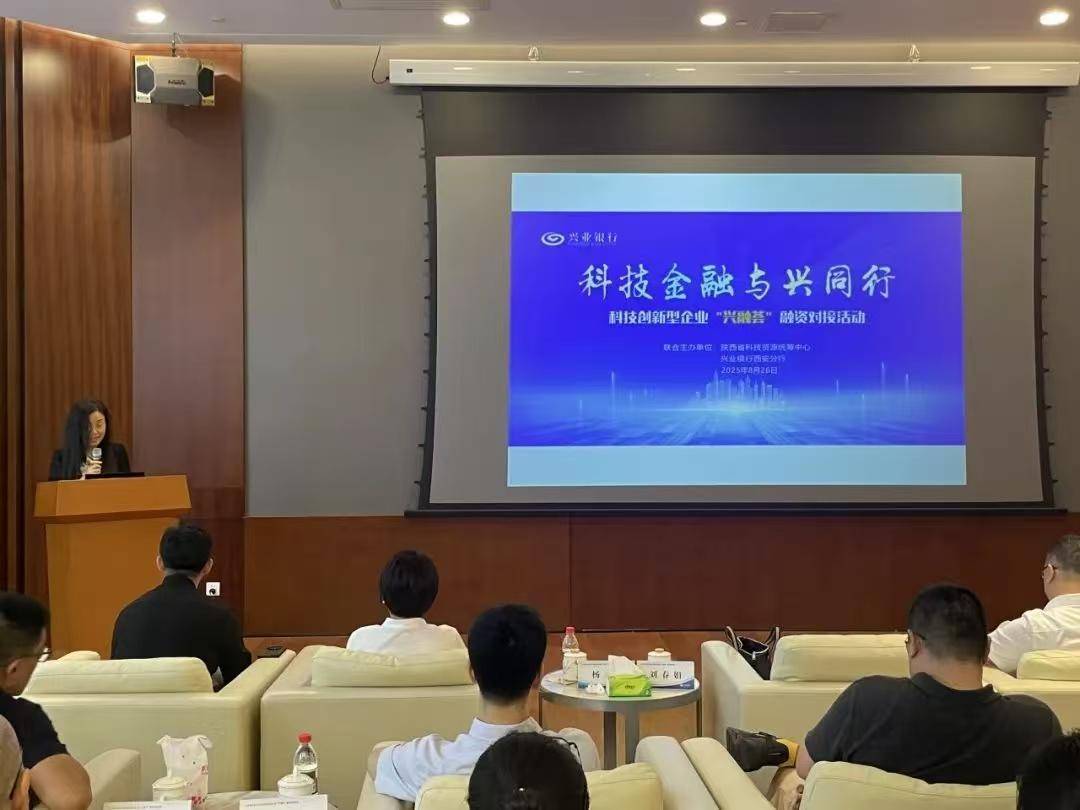
兴业银行西安分行科技创新型企业“兴融荟”融资对接会顺利举行
Sou Hu Cai Jing· 2025-09-04 05:43
Core Viewpoint - The event "Technology Finance • Walking with Xing" organized by Industrial Bank Xi'an Branch aims to address the financing challenges faced by technology innovation enterprises by building an efficient collaboration bridge between banks and enterprises [1][3]. Group 1: Event Overview - The event was co-hosted by Industrial Bank Xi'an Branch and the Shaanxi Provincial Technology Resource Coordination Center, focusing on creating a financial service ecosystem for technology innovation enterprises [1][3]. - The initiative aims to inject financial momentum into the development of technology innovation enterprises and enhance the construction of the technology financial ecosystem [1][3]. Group 2: Financial Services Offered - Industrial Bank Xi'an Branch provides tailored financial service solutions for technology innovation enterprises, including specialized financial products covering credit and equity financing to address financing pain points [3][4]. - The bank also interprets private banking and trust products to meet the wealth management needs of high-net-worth individuals in technology innovation enterprises, facilitating the synergy between enterprise development and wealth growth [3][4]. Group 3: Legal and Tax Advisory - The professional team from Shaanxi Jiaxuan Law Firm shared insights on legal risks and tax optimization for technology innovation enterprises, covering key legal points in intellectual property protection and equity structure design [3][4]. - The discussion included practical strategies for tax planning to help enterprises navigate compliance and ensure stable growth [3][4]. Group 4: Project Roadshow and Networking - During the project roadshow, representatives from technology innovation enterprises presented their project backgrounds, core technological advantages, market application prospects, and financing plans, attracting the attention of investment institutions [4]. - The event facilitated direct communication among enterprises, banks, investment institutions, and law firms, focusing on business models and financing challenges, leading to preliminary agreements on customized financing solutions [4]. Group 5: Future Directions - Industrial Bank Xi'an Branch plans to continue integrating "policy, capital, industry, talent, and innovation" to deepen technology financial service models and promote a virtuous cycle among technology, industry, and finance [4]. - The bank aims to track enterprise needs continuously and iterate financial products and services to support the development of technology innovation enterprises and contribute to the high-quality development of technology finance in Shaanxi [4].


私人银行半年新增15万高净值客户
21世纪经济报道· 2025-09-04 05:24
Core Viewpoint - The private banking sector has shown remarkable growth in the first half of 2025, becoming a standout area within the wealth management segment of banks, despite a complex economic environment [1]. Group 1: Growth Metrics - As of June 2025, the total number of private banking clients across 15 banks exceeded 1.63 million, with an increase of nearly 150,000 clients, representing a growth rate of over 10% [1]. - Major banks like Agricultural Bank, Bank of China, and China Construction Bank reported AUM exceeding 3 trillion yuan, with Agricultural Bank's AUM reaching 3.5 trillion yuan, a growth of 11.11% year-on-year [3]. - The AUM of Industrial Bank surpassed 1 trillion yuan for the first time, joining the "trillion club" among joint-stock banks [1][3]. Group 2: Client Quality and Strategy - Despite high growth in scale, the average asset per client has generally declined, indicating a shift from rapid expansion to a focus on deeper client engagement and service quality [4]. - Banks are increasingly targeting ultra-high-net-worth clients and enhancing services such as family trusts and retirement financial planning to differentiate themselves in a competitive market [1][5]. Group 3: Service Innovations - Private banks are moving beyond traditional product sales to more refined customer operations, focusing on precise segmentation and embedding services into clients' daily lives [6]. - For instance, China CITIC Bank has launched a dedicated service brand for ultra-high-net-worth clients, achieving a 40.96% increase in this segment [6]. - Family trusts have become a key area of focus, with several banks reporting significant growth in this service, such as Everbright Bank's family trust business growing by 56.12% year-on-year [7]. Group 4: Revenue Generation - The private banking sector is increasingly contributing to banks' intermediary income, with Beijing Bank reporting a 16.89% increase in product sales, directly boosting its intermediary income by 17.77% [9]. - Construction Bank's net income from fees and commissions reached 65.218 billion yuan in the first half of the year, reflecting a year-on-year growth of 4.02% [10].




A股近六成上市银行上半年中间业务收入同比增长
Zheng Quan Ri Bao Zhi Sheng· 2025-09-03 16:40
Core Viewpoint - The intermediary business income of A-share listed banks in China has shown improvement in the first half of 2025, becoming a crucial area for banks to transform and develop amid narrowing net interest margins [1][4]. Group 1: Overall Performance - In the first half of 2025, the total net income from fees and commissions of 42 listed banks reached 409.53 billion yuan, an increase of 3.06% compared to the same period last year [1]. - Out of the 42 listed banks, 25 reported positive growth in net income from fees and commissions, with three banks experiencing growth rates exceeding 100% and nine banks exceeding 10% [2]. Group 2: Performance by Bank Type - Among the six major state-owned banks, Bank of China and China Construction Bank both saw their fee and commission income grow by over 4%, while Agricultural Bank of China and Postal Savings Bank of China reported growth exceeding 10% [2]. - In the joint-stock banks category, four out of nine banks reported positive growth in net income from fees and commissions, with CITIC Bank achieving 16.91 billion yuan (up 3.38%), Industrial Bank at 13.08 billion yuan (up 2.59%), Huaxia Bank at 3.10 billion yuan (up 2.55%), and Minsheng Bank at 9.69 billion yuan (up 0.41%) [2]. Group 3: Notable Performers - Some city commercial banks and rural commercial banks exhibited significant growth in their fee and commission income, with Changshu Bank reporting a remarkable increase of 637.77% to 142 million yuan, followed by Ruifeng Bank with a 274.07% increase to 54 million yuan, and Zhangjiagang Bank with a 140% increase to 61 million yuan [3]. Group 4: Future Outlook - Analysts predict that the growth trend in intermediary business income is likely to continue in the second half of 2025, driven by supportive macroeconomic policies and increasing demand for high-yield products among residents [4]. - The focus for banks will be on expanding non-interest income, particularly in wealth management and other light-capital businesses, to optimize their income structure [4][6].

信用卡业务“跑马圈地”退潮后,转型创新路在何方?
Bei Jing Shang Bao· 2025-09-03 15:01
Core Insights - The credit card business in China's banking sector is undergoing a significant adjustment, shifting from an era of aggressive expansion to a focus on optimizing existing customer bases and asset quality [1][2][3] Group 1: Credit Card Business Performance - In the first half of 2025, 11 out of 15 listed banks reported a decline in credit card loan balances, with China Bank showing the most significant reduction of 13.89% to 510.97 billion yuan [2] - The total credit card loan balance for the 15 banks showed a mixed trend, with only four banks, including Industrial and Agricultural Banks, experiencing growth [2] - Credit card transaction volumes also declined, with a notable drop of 8.54% for China Merchants Bank, despite leading the sector with a transaction amount of 2.02 trillion yuan [3] Group 2: Bad Debt and Risk Management - The total bad credit card loans across 11 banks reached 162.69 billion yuan, an increase of 5.88 billion yuan from the beginning of the year, with notable increases in bad loans for banks like China Communications Bank and Industrial Bank [4] - Only three banks managed to improve their bad loan ratios, while eight banks, including China Merchants Bank and Industrial Bank, saw increases in their bad loan ratios [4] - The overall credit card market is experiencing a contraction, with the total number of credit cards decreasing to 715 million by Q2 2025, down from 727 million in Q4 2024 [5] Group 3: Strategic Adjustments and Future Directions - Banks are actively working to optimize asset quality and manage bad debts, with nearly a thousand bad loan transfer announcements made in 2025 [6] - The focus is shifting towards product innovation and differentiated competition, emphasizing quality over quantity in credit card offerings [6][7] - Strategies include targeting high-end customers and meeting basic customer needs, with an emphasis on enhancing customer experience and integrating credit cards with other retail banking services [7]





金融中报观|银行零售业务梯队格局背后,谁在领跑,谁在补课
Bei Jing Shang Bao· 2025-09-03 14:17
Core Insights - The competitive landscape of retail banking in A-shares is becoming clearer as the 2025 mid-year reports are disclosed, revealing a distinct tiered structure in retail AUM (Assets Under Management) [1][2] - The first tier consists of major state-owned banks and China Merchants Bank, all exceeding 16 trillion yuan in retail AUM, while the second tier includes joint-stock banks and some leading city commercial banks [1][2] - The retail business performance is mixed, with many banks facing pressure on retail revenue and net profit, highlighting a structural issue of profit growth without revenue increase [1][6] Tiered Structure of Retail AUM - The first tier banks, including Industrial and Commercial Bank of China (ICBC) and Agricultural Bank of China (ABC), lead with AUM exceeding 16 trillion yuan, with ICBC at over 24 trillion yuan and ABC at 23.68 trillion yuan [2][3] - China Construction Bank (CCB) and Postal Savings Bank of China also show strong performance, with CCB managing over 22 trillion yuan and Postal Savings Bank at 17.67 trillion yuan [2] - China Merchants Bank, known as the "king of retail," has a retail AUM of 16.03 trillion yuan, reflecting a 7.39% increase from the previous year [2] Second Tier Performance - The second tier banks have retail AUM ranging from 1 trillion to 6 trillion yuan, with notable growth from banks like Bank of Communications at 5.79 trillion yuan and Industrial Bank at 5.52 trillion yuan [3] - Joint-stock banks are active in this tier, with CITIC Bank and Shanghai Pudong Development Bank also showing significant growth in retail AUM [3] Third Tier Characteristics - The third tier banks have retail AUM mostly below 1 trillion yuan, with Nanjing Bank and Shanghai Rural Commercial Bank showing notable growth rates of 14.25% and 3.99% respectively [4] - Regional banks are leveraging local advantages to deepen market penetration, but face challenges in competing with larger banks [5] Retail Profitability Challenges - The retail banking sector is undergoing significant adjustments, with a shift in customer demand towards diversified financial solutions, which raises the bar for product innovation and service customization [6] - Leading banks like ICBC and China Merchants Bank are showing resilience, with ICBC's net profit rising by 46.05% despite a slight revenue decline [6][7] - However, some banks, including ABC and Ping An Bank, are experiencing declines in both revenue and net profit, indicating a challenging environment [7] Asset Quality Concerns - The retail banking sector is facing challenges in asset quality, particularly in personal loans, with rising non-performing loan (NPL) ratios reported by several banks [9][10] - For instance, China Merchants Bank's retail loan NPL ratio increased to 1.04%, while Chongqing Rural Commercial Bank's rose to 2.04% [9] - Some banks, like Ping An Bank and Industrial Bank, have managed to improve their asset quality through refined risk management practices [10] Strategic Recommendations - Analysts suggest that banks, especially smaller ones, should focus on enhancing their support for small and micro enterprises and optimizing financial resource allocation to uncover new growth points [8] - There is a call for banks to improve their digital capabilities and customer experience to better compete with larger institutions [8]


兴业银行(601166):新拐点、新目标,价值银行启新篇
Shenwan Hongyuan Securities· 2025-09-03 13:45
Investment Rating - The investment rating for the company is "Buy" and is maintained [2][8]. Core Views - The report emphasizes that the market's previous concerns regarding the company's risks and performance have been alleviated, indicating a clearer outlook for the bank's fundamentals and asset structure transformation [7][9]. - The bank's management has effectively addressed risks in key areas, leading to a significant reduction in non-performing loans, particularly in the real estate sector, with a 46% year-on-year decrease in new non-performing loans in the first half of 2025 [22][25]. - The bank is expected to achieve stable profit growth, with projected net profit growth rates of 1.7%, 4.8%, and 5.9% for 2025 to 2027, respectively [9][32]. Summary by Sections Financial Data and Profit Forecast - Total operating revenue is projected to be 210,831 million in 2023, with a slight increase to 212,493 million by 2025, reflecting a year-on-year growth rate of 0.13% [6]. - The bank's net profit attributable to shareholders is expected to reach 78,532 million in 2025, with a year-on-year growth of 1.72% [6]. - The bank's return on equity (ROE) is projected to be 9.37% in 2025, with a non-performing loan ratio stabilizing at around 1.07% [6]. Risk Management and Performance Improvement - The bank has effectively managed risks associated with real estate and local government financing platforms, reducing their exposure significantly from 10% of total assets in 2021 to approximately 7.5% in the first half of 2025 [22]. - The management team has demonstrated a commitment to improving operational quality, which has resulted in a positive turnaround in profit growth, with the first half of 2025 showing a profit increase ahead of expectations [32][33]. Dividend and Investment Appeal - The bank has a consistent history of increasing its dividend payout ratio, which is expected to reach 30.2% in 2024, making it attractive to long-term investors seeking stable returns [6][9]. - The current price-to-book (PB) ratio is only 0.57, indicating that the bank is undervalued compared to its peers, which enhances its appeal to institutional investors [8][10].
半年新增15万高净值客户 私人银行成中收增长动力
2 1 Shi Ji Jing Ji Bao Dao· 2025-09-03 11:10
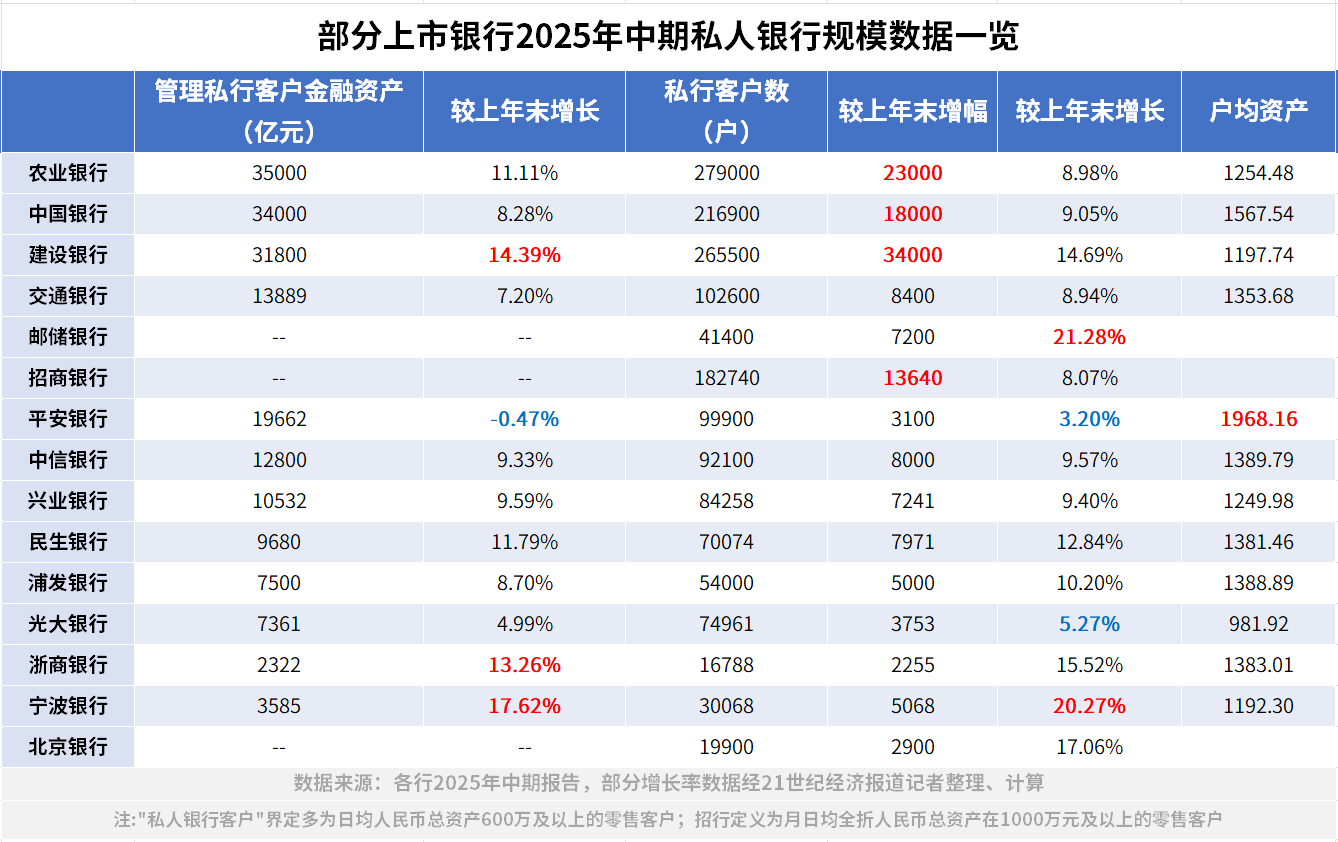
Core Insights - The private banking sector has shown robust growth in the first half of 2025, with many banks reporting double-digit increases in both client numbers and assets under management (AUM) despite a complex economic environment [1][2][5] - The total number of private banking clients across 15 banks exceeded 1.63 million, with an increase of nearly 150,000 clients, reflecting a growth rate of over 10% [1] - Major banks like Agricultural Bank and China Bank have maintained significant AUM, with Agricultural Bank reaching 3.5 trillion yuan, marking an 11.11% increase year-on-year [2][4] Private Banking Growth - The private banking industry is experiencing steady expansion, with major banks leading the market due to their strong client bases and resource networks [2][5] - Agricultural Bank's AUM reached 3.5 trillion yuan, with a client increase of 23,000 to 279,000, while China Bank followed closely with 3.4 trillion yuan AUM and 216,900 clients [2][4] - Construction Bank reported a 14.39% increase in AUM, reaching 3.18 trillion yuan, and a 14.69% rise in client numbers [2][4] Client Quality and Asset Management - Despite the growth in client numbers and AUM, average assets per client have generally declined, indicating a shift from rapid expansion to a focus on deeper client engagement [5][6] - Only Agricultural Bank and Industrial Bank reported increases in average client assets, while other banks experienced varying degrees of decline [5] Strategic Focus Areas - Banks are increasingly focusing on high-net-worth clients, family trusts, retirement finance, and enhancing private banking centers to differentiate themselves in a competitive market [1][6][8] - For instance, Citic Bank is enhancing its services for ultra-high-net-worth clients, while Everbright Bank is targeting family-oriented and female clients [7][8] Family Trusts and Lifecycle Services - Family trusts have become a key area for private banking, with significant growth reported in this segment; Everbright Bank's family trust assets grew by 56.12% year-on-year [8] - Agricultural Bank has launched a retirement finance management center, adding 12,000 clients and managing 1.3 trillion yuan in assets [8] Private Banking Centers and Revenue Generation - The establishment of private banking centers has accelerated, with Construction Bank setting up 248 centers and China Bank 205 centers, contributing to improved client retention and AUM [9][10] - Private banking is increasingly driving middle-income revenue, with Beijing Bank reporting a 16.89% increase in product sales, boosting its middle-income revenue by 17.77% [10]
半年新增15万高净值客户,私人银行成中收增长动力
2 1 Shi Ji Jing Ji Bao Dao· 2025-09-03 11:01
Core Insights - The private banking sector has shown robust growth in the first half of 2025, with many banks reporting double-digit increases in both client numbers and assets under management (AUM) despite a complex economic environment [1][2][5] - The total number of private banking clients across 15 banks exceeded 1.63 million, with an increase of nearly 150,000 clients, reflecting a growth rate of over 10% [1] - Major banks like Agricultural Bank and China Bank have AUM exceeding 3 trillion yuan, while Industrial Bank has crossed the 1 trillion yuan mark for the first time [1][4] Client and AUM Growth - Agricultural Bank's AUM reached 3.5 trillion yuan, growing by 11.11%, with client numbers increasing by 23,000 to 279,000 [2][4] - China Bank's AUM stood at 3.4 trillion yuan with 216,900 clients, while Construction Bank reported a 14.39% increase in AUM, reaching 3.18 trillion yuan and 265,500 clients [2][4] - The overall expansion of private banking clients and AUM indicates a strong performance among large banks, which continue to dominate the market [2][5] Performance of Listed Banks - Among listed banks, the performance varied, with some banks like Ping An Bank experiencing a slight decline in AUM by 0.47% [4] - Industrial Bank reported a significant increase in private banking clients, reaching 92,100, with AUM at 1.28 trillion yuan [5] - Regional banks like Ningbo Bank and Beijing Bank also showed impressive growth, with Ningbo Bank's AUM increasing by 17.62% [5][4] Focus on High-Net-Worth Clients - The industry is shifting from rapid expansion to a more refined approach, focusing on high-net-worth clients and family trusts [1][8] - Banks are implementing differentiated services for ultra-high-net-worth clients, with some banks reporting a 40.96% increase in such clients [8][9] - Family trusts have become a key area of development, with banks like Everbright Bank and China Bank reporting significant growth in this segment [9] Wealth Management and Revenue Growth - Private banking is increasingly contributing to banks' middle-income revenue, with Beijing Bank reporting a 16.89% increase in product sales, boosting its middle-income revenue by 17.77% [10] - Construction Bank noted that over 60% of its fee income comes from wealth management and related services, indicating a strategic focus on enhancing its advisory capabilities [11] - The establishment of private banking centers is accelerating, with banks like Construction Bank and China Bank expanding their networks to improve client retention and service quality [10]
信用卡失速消费贷补位,上市银行零售信贷的“跷跷板”能稳吗
Nan Fang Du Shi Bao· 2025-09-03 04:01
Core Viewpoint - The retail credit market is experiencing a significant divergence between traditional credit card business contraction and the expansion of personal loans, driven by consumer demand and policy support [2][11]. Credit Card Business - The total number of credit cards and credit card loans has declined for 11 consecutive quarters, with a reduction of 12 million cards compared to the end of last year [2]. - Among 15 listed banks, 11 reported a decrease in credit card loan balances compared to the end of last year, highlighting a pronounced industry-wide contraction [3]. - The most significant decline in credit card loan balances was observed at Bank of China, with a drop of 13.89%, followed by Postal Savings Bank at 5.67% [4]. - Credit card transaction volumes have also decreased, leading to a decline in non-interest income, with some banks reporting drops exceeding 15% [2][6]. Personal Loans - In contrast to the credit card sector, personal loans, particularly consumer loans, have seen robust growth, with several banks reporting increases exceeding 10% [11]. - Among state-owned banks, personal loans and consumer loans have both shown positive growth, with Agricultural Bank leading at 5.60% [12]. - The consumer loan segment has become a key growth driver for banks, with many institutions launching tailored products to stimulate demand [2][11]. Asset Quality - The asset quality of retail credit is under pressure, with rising non-performing loan (NPL) ratios for personal loans and credit cards across many banks [16]. - State-owned banks generally exhibit higher NPL ratios, with notable increases in personal loan NPLs for several institutions [17]. - Credit card NPL ratios have also risen, particularly at Industrial and Commercial Bank of China, which reported a rate of 3.75% [18][20]. Market Dynamics - The decline in credit card usage reflects a broader shift in consumer spending patterns, with an increase in smaller, more frequent transactions [6][8]. - The overall market for credit cards is facing significant challenges, with many banks reporting double-digit declines in credit card income [9][10].



天风证券晨会集萃-20250903
Tianfeng Securities· 2025-09-02 23:42
Group 1 - The report highlights that the performance of various sectors such as electronics, home appliances, non-bank financials, machinery, non-ferrous metals, computers, food and beverage, defense, telecommunications, media, and agriculture is improving [3][25]. - From the perspective of earnings surprises, industries with the highest upward revisions in net profit forecasts from June 30, 2025, to August 30, 2025, include steel, non-ferrous metals, beauty care, non-bank financials, and banks [3][27]. - The report identifies a phenomenon of profit discontinuity, where the lowest price on the first trading day after earnings announcements is higher than the highest price on the previous trading day, particularly in sectors like food and beverage, beauty care, non-bank financials, banks, and transportation [3][27]. Group 2 - In August, major equity indices in the A-share market continued to rise, with the ChiNext index increasing by 24.13% [4][31]. - The central bank's net fund injection in August was 446.6 billion yuan, indicating a slight tightening of liquidity towards the end of the month [4][31]. - The report notes a rebound in non-ferrous metals, while oil prices have slightly declined, and pork prices remain low [4][31]. Group 3 - The global semiconductor industry is experiencing structural prosperity driven by rapid growth in AI computing demand, accelerated terminal intelligence, recovery in automotive electronics, and deepening domestic substitution [11][25]. - In Q2 2025, the semiconductor sector reported revenues of 133.66 billion yuan and a net profit of 10.63 billion yuan, indicating a clear trend of profit recovery [11][25]. - The report suggests focusing on sectors such as storage, power, foundry, ASIC, and SoC for their earnings elasticity, as well as equipment materials and domestic substitution in computing chips [11][25]. Group 4 - The U.S. fixed income market is the largest globally, with a market size of 58.2 trillion USD in 2024, accounting for 40.10% of the global total [9][38]. - As of Q1 2025, the U.S. fixed income market's outstanding amount reached 47.44 trillion USD, with U.S. Treasury bonds making up over 60% of this figure [9][38]. - The report indicates that the issuance volume in the U.S. fixed income market for the first half of 2025 was 5.70 trillion USD, reflecting a 14.21% increase compared to the same period in 2024 [9][38]. Group 5 - The report emphasizes the importance of AI applications across various sectors, including gaming, healthcare, marketing, education, finance, and office productivity, highlighting the ongoing integration of AI technologies [6][34]. - The AI sector is expected to see significant growth driven by government policies promoting the integration of AI into key industries [6][34]. - The satellite internet industry is also noted for its rapid development, with low-orbit satellites driving innovation across the supply chain [6][34].


