GAC GROUP(601238)

Search documents
广汽集团2025年第三季度报告|合并总营收243.18亿元
2 1 Shi Ji Jing Ji Bao Dao· 2025-10-27 09:47
Core Points - GAC Group reported a consolidated revenue of 24.318 billion yuan for Q3 2025, a quarter-on-quarter increase of 6.98%, with total vehicle sales reaching 428,400 units, up 11.49% from the previous quarter [1] - The "Panyu Action" integration reform has shown positive progress, contributing to consecutive quarter-on-quarter growth in revenue and vehicle sales [1] - GAC's overseas terminal sales increased by 36.5% year-on-year in the first nine months of the year, with operations covering 85 countries and regions [12] Financial Performance - In Q3, GAC's total revenue was 24.318 billion yuan, with a year-to-date total of 66.929 billion yuan [1] - Vehicle sales for the first three quarters reached 1.1837 million units [1] Market Expansion - GAC accelerated entry into key European markets, including the UK, Poland, Portugal, and Finland, with plans to deliver two global strategic models in Europe by Q1 2026 [12] - The company aims for full coverage of the European market by 2028, focusing on local production and technology R&D [12] Product Development and Innovation - GAC's self-developed ADiGO GSD intelligent driving assistance system now covers 99.9% of roads [13] - The company plans to invest over 10 billion yuan in R&D in 2025, focusing on smart driving, smart cockpits, and electronic architecture [12][13] Strategic Partnerships - GAC is enhancing its "circle of friends" by collaborating with major companies like Huawei, JD.com, and CATL in various fields [21] - The "启境" brand, developed in partnership with Huawei, has completed its first vehicle design and is set to launch in mid-2026 [21] New Product Launches - GAC's AION V Home model has contributed to the growth of AION V series sales [1] - The "国民好车" AION UT super, developed in collaboration with JD.com and CATL, is set to launch during the 2025 Double Eleven shopping festival [28]


乘用车板块10月27日跌0.27%,长城汽车领跌,主力资金净流出8.44亿元
Zheng Xing Xing Ye Ri Bao· 2025-10-27 08:25
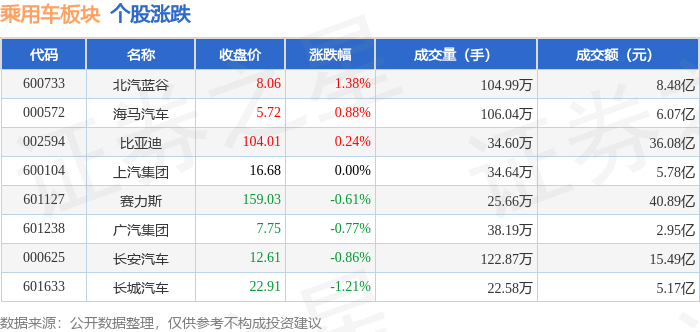
Core Insights - The passenger car sector experienced a decline of 0.27% on October 27, with Great Wall Motors leading the drop [1] - The Shanghai Composite Index closed at 3996.94, up 1.18%, while the Shenzhen Component Index closed at 13489.4, up 1.51% [1] Passenger Car Sector Performance - The closing prices and performance of key stocks in the passenger car sector are as follows: - BAIC Blue Valley: 8.06, +1.38%, volume 1.0499 million, turnover 848 million [1] - BYD: 104.01, +0.24%, volume 346,000, turnover 3.608 billion [1] - SAIC Motor: 16.68, 0.00%, volume 346,000, turnover 578 million [1] - Great Wall Motors: 22.91, -1.21%, volume 225,800, turnover 517 million [1] Fund Flow Analysis - The passenger car sector saw a net outflow of 844 million from main funds, while retail investors contributed a net inflow of 446 million [1] - The detailed fund flow for selected companies includes: - SAIC Motor: Main fund net inflow of 46.56 million, retail net outflow of 46.32 million [2] - Great Wall Motors: Main fund net inflow of 30.91 million, retail net outflow of 62.42 million [2] - BYD: Main fund net outflow of 246 million, retail net inflow of 130 million [2]



港股异动丨广汽集团跌4% 第三季业绩逊预期 遭美银下调评级和目标价
Xin Lang Cai Jing· 2025-10-27 08:17
Core Insights - GAC Group reported a significant decline in revenue and a net loss for Q3 2025, indicating challenges in the current market environment [1] - Bank of America downgraded GAC Group's rating from "Neutral" to "Underperform" due to disappointing Q3 performance and anticipated profit margin compression in the competitive landscape [1] Financial Performance - Revenue for Q3 2025 was approximately 24.106 billion RMB, a year-on-year decrease of 14.62% [1] - The net loss for the period was around 1.773 billion RMB, with basic earnings per share reported at -0.17 RMB [1] Analyst Ratings and Valuation - Bank of America adjusted the target price for GAC Group from 3.6 HKD to 3.1 HKD, reflecting concerns over future profitability [1] - The current price corresponds to a projected P/E ratio of 29 times for 2026, which is considered overvalued by analysts [1]

广汽发布2025年第三季度报告
Huan Qiu Wang· 2025-10-27 06:12
Core Insights - GAC Group's R&D investment is projected to exceed 10 billion yuan in 2025, focusing on key areas such as intelligent assisted driving, smart cockpits, and electronic electrical architecture [1] - The self-developed ADiGO GSD intelligent driving assistance system covers 99.9% of road scenarios and over 99.5% of parking types [1] Group 1: Intelligent Driving and Safety - GAC has established the GAC Star Spirit Safety Guardian System, which includes a comprehensive safety R&D system, all-domain safety technology, and all-time safety assurance [3] - The L3 system's failure rate is reported at 1 FIT, with eight key systems employing dual redundancy design [3] - GAC is involved in the "Vehicle-Road-Cloud Integration" collaborative development testing initiative, demonstrating cloud-supported applications such as C-AEB and C-GLOSA [3] Group 2: Electric Vehicle Technology - GAC launched the "Star Source Range Extender" technology to address range anxiety and power depletion issues for electric vehicle users, achieving an oil-electric conversion rate of 3.73 kWh/L and an electric drive system efficiency of 93% [3] - The V2G demonstration project has been established, with over 250,000 kWh of discharge and 11,260 cumulative orders as of October 19 [3] Group 3: Advanced Technology Exploration - GAC's multi-rotor flying car, GOVY AirCab, has completed prototype deliveries in Hong Kong and Beijing in Q3 [4] - The company has introduced three embodied intelligent robots, planning to demonstrate applications in healthcare and security [4] - GAC is transitioning from a traditional automobile manufacturer to a technology-driven mobility company through systematic technological layout [4]
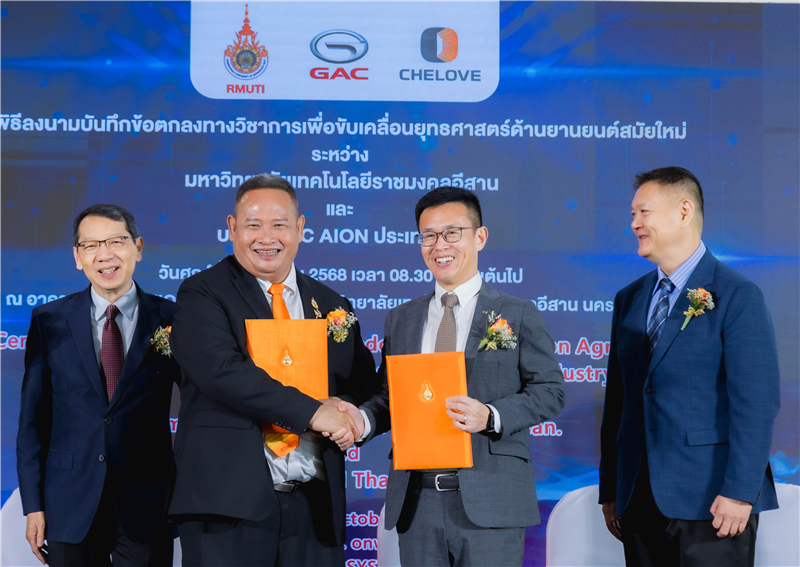
中泰加强新能源汽车技术与人才培养合作
人民网-国际频道 原创稿· 2025-10-27 03:36
Core Viewpoint - The collaboration between Thailand's Northeast Royal Polytechnic University and GAC International Thailand aims to enhance the development of the electric vehicle (EV) industry in Thailand, aligning with the country's goal of having 30% of total vehicle production be electric by 2030 [2][4]. Group 1: Collaboration Details - The signing of the academic cooperation agreement will focus on deepening collaboration in EV technology and talent development, contributing to the green transformation and modernization of Thailand's automotive industry [1][4]. - The partnership will facilitate student internships at companies and related institutions, promoting joint training and capacity building in the EV technology sector [4][6]. Group 2: Educational and Industrial Integration - The collaboration aims to create a "full-chain integration" model that combines educational initiatives with industrial needs, leveraging China's technological advantages in the EV sector and Thailand's manufacturing base [6]. - A "New Energy Vehicle Training and Testing Center" will be established to provide an international learning and practical platform for students and industry professionals [6]. Group 3: Policy Alignment and Future Directions - The initiative aligns with Thailand's "3030" target, which aims for 30% of the country's vehicle production to be electric by 2030, and supports the policy direction of promoting EV adoption and industrial upgrades [2]. - Representatives from government, academia, and industry agree on the need to build practical training bases and improve curriculum systems and vocational certification standards to enhance talent development in the EV sector [6].
港股异动 | 广汽集团(02238)跌超3% 前三季度亏损约43.12亿元 同比盈转亏
智通财经网· 2025-10-27 01:43
Core Viewpoint - GAC Group reported a significant decline in revenue and a net loss for the first three quarters of 2025, attributed to intense competition in the domestic automotive industry and rapid changes in demand structure [1] Financial Performance - Revenue for the first three quarters of 2025 was approximately 66.272 billion yuan, a year-on-year decrease of 10.49% [1] - The net loss attributable to shareholders was about 4.312 billion yuan, marking a shift from profit to loss compared to the previous year [1] - In the third quarter, GAC Group achieved revenue of 24.106 billion yuan, down 14.62% year-on-year, with a net loss of 1.774 billion yuan [1] Market Conditions - The decline in performance is primarily due to fierce competition within the domestic automotive sector and a rapid upgrade in demand structure, leading to decreased vehicle sales and profitability [1] - The previous year's performance was also impacted by the valuation premium from the listing of GAC's subsidiary, Qiche Chuxing Technology Co., Ltd., on the Hong Kong Stock Exchange [1]
广汽集团前三季每卖一辆车亏3643元 力争2027年自主品牌销量达200万辆
Chang Jiang Shang Bao· 2025-10-27 01:41
Core Viewpoint - GAC Group reported a decline in performance for the first three quarters of 2025, with revenue of 66.929 billion yuan, a year-on-year decrease of 10.45%, and a net loss of 4.312 billion yuan [1][5][6] Financial Performance - In the first three quarters of 2025, GAC Group's automotive sales reached 1.1837 million units, down 11.34% year-on-year [2][8] - The company incurred a loss of 3,643 yuan for each vehicle sold during this period [2][10] - GAC Group's net profit has declined for two consecutive years, with revenues of 129.706 billion yuan in 2023 and 107.784 billion yuan in 2024, reflecting a year-on-year growth of 17.62% and a decline of 16.90%, respectively [6] Sales Breakdown - GAC Honda sold 223,900 units, down 27.58%, while GAC Toyota sold 543,200 units, up 4.89%, together accounting for 64.81% of total sales [8] - GAC's own brand, GAC Trumpchi, sold 233,100 units, down 15.84%, and GAC Aion sold 181,400 units, down 19.99% [8] - Other subsidiaries saw a significant decline in sales, with a total of 2,057 units sold, down 51.82% [8] Strategic Initiatives - GAC Group is accelerating its internationalization strategy, viewing overseas markets as key to overcoming current challenges [12] - The company aims to achieve a sales target of 2 million units for its self-owned brands by 2027, focusing on technology, safety, and high-quality products [3][14] - GAC Group plans to invest over 10 billion yuan in R&D in 2025 to enhance its capabilities in smart driving, smart cockpits, and electronic architecture [12] Partnerships and New Developments - GAC Group has partnered with Huawei to create a new high-end smart electric vehicle brand called "Qijing," with the first model expected to launch in mid-2026 [13][14] - The company is building a robust ecosystem around its automotive business, including investments in parts, energy, and financial services to support its growth [11]
2025年全国汽车以旧换新补贴申请量突破1000万份,欣旺达推出新一代固态电池 | 投研报告
Zhong Guo Neng Yuan Wang· 2025-10-27 01:27
Group 1 - The automotive sector underperformed the broader market this week, with the CSI 300 index rising by 3.24% while the automotive sector increased by 2.92%, ranking 10th among A-share Shenwan first-level industries [2] - The SW passenger vehicle index rose by 0.63%, with Jianghuai Automobile and BAIC Blue Valley leading the gains [2] - The SW commercial vehicle index increased by 3.00%, with King Long Automobile and Dongfeng Motor leading the gains [2] - The SW automotive parts index saw a rise of 4.04%, with Biaobang Co. and Aolian Electronics leading the gains [2] Group 2 - Key industry news includes: 1. The number of applications for the national vehicle trade-in subsidy exceeded 10 million by 2025 [2] 2. In September, the monthly delivery volume of functional unmanned vehicles in Shenzhen surpassed 1 million [2] 3. Xinwangda launched a new generation solid-state battery with an energy density of 400 Wh/kg [2] 4. New Stone Technology completed over $600 million in Series D financing [2] 5. The "Energy-saving and New Energy Vehicle Technology Roadmap 3.0" was released [2] 6. SAIC Volkswagen and Neura Robotics are developing cognitive robotic systems for automotive manufacturing [2] 7. CATL plans to establish over 2,500 chocolate battery swap stations by 2026 [2] 8. Qijing's first model is scheduled for launch in mid-next year [2] 9. Meituan's unmanned vehicles have achieved large-scale deployment in Shenzhen [2] 10. Pony.ai and Stellantis are collaborating to develop L4 autonomous vehicles for promotion in Europe next year [2] 11. Leju Robotics completed nearly 1.5 billion yuan in Pre-IPO financing [2] Group 3 - Recommendations for vehicle manufacturers include: BYD, Great Wall Motors, Leap Motor, Seres, BAIC Blue Valley, Jianghuai Automobile, Li Auto-W, Xpeng Motors-W, Geely, GAC Group, and Changan Automobile [3] - For commercial vehicles, recommended companies include China National Heavy Duty Truck Group, FAW Jiefang, Weichai Power, Tianrun Industrial, and Foton Motor [3] - In the automotive parts sector, recommended companies include Songyuan Safety, Senqilin, Aikedi, Junsheng Electronics, Zhejiang Xiantong, Fuyao Glass, Bertley, Weichai Power, Wuxi Zhenhua, China Automotive Research, Desay SV, Huguang Co., Shuanghuan Transmission, Songyuan Co., Top Group, Best, Sanhua Intelligent Control, Debang Lighting, Changshu Automotive Trim, New Spring Co., Baolong Technology, Jingzhu Technology, Kabeiyi, Jifeng Co., Shanghai Yanpu, Tenglong Co., Mingxin Xuteng, and Longsheng Technology [3]




中国汽车行业:2025 年三季度前瞻及 2026 年展望-China Auto Industry_ 3Q25 preview and expectations into 2026
2025-10-27 00:31
Summary of China Auto Industry Conference Call Industry Overview - **Industry**: China Auto Industry - **Focus**: 3Q25 preview and expectations into 2026 Key Points and Arguments 1. **Sales Forecasts**: - Total Passenger Vehicle (PV) sales are projected to reach 30.59 million units in 2025 and 31.43 million units in 2026, reflecting a year-over-year growth of 7% and 3% respectively [5][6][89] - The sales of New Energy Vehicles (NEVs) are expected to grow significantly, with wholesales reaching approximately 19.06 million units by 2027, representing a compound annual growth rate (CAGR) of 16% from 2023 to 2030 [6][89] 2. **Market Dynamics**: - The market share of Chinese brands in the overall PV industry is anticipated to increase from 65% in 2024 to 80% in the long term, driven by gains in the NEV segment and the adoption of advanced driver-assistance systems (ADAS) [75] - The export of vehicles is projected to continue growing, with a record level of approximately 5.9 million units exported in 2024, and an expected increase to around 6.6 million units in 2025 [83][84] 3. **Pricing Environment**: - Pricing discounts have risen to record highs since Q1 2022, although they have narrowed slightly due to government initiatives aimed at reducing market competition [44][52] - The average discount for domestically made models is around 8%, while imported models see an average discount of 13% [52] 4. **OEM Performance**: - Key OEMs such as BYD, Geely, and SAIC are expected to maintain strong sales volumes, with BYD projected to sell approximately 1.14 million units in 3Q25, despite a slight decline of 3% from the previous quarter [90][91] - Leapmotor is expected to show significant growth, with a 30% increase in sales volume to 174,000 units in 3Q25 [90] 5. **Policy Implications**: - There is a 50% probability that subsidies or some form of stimulus will continue into 2026, with a focus on energy efficiency for NEVs [88] - Historical cycles indicate that government policies, such as tax cuts, have previously led to significant rebounds in auto sales [19][23] Additional Important Insights - **Segment Analysis**: - The NEV segment is expected to dominate future sales, with wholesales projected to reach 12.29 million units by 2025, indicating a strong shift towards electric vehicles [6] - The penetration rate of NEVs in the overall market is expected to rise to 60% by 2030 [6] - **Market Share Trends**: - The top 10 OEMs currently hold 86% of the market share, indicating a highly concentrated market [30][32] - The market share of NEVs is expected to grow significantly, with domestic brands leading the charge [37] - **Challenges**: - The industry faces challenges such as fluctuating demand and pricing pressures, which could impact profitability for some OEMs [54][56] This summary encapsulates the key insights and forecasts regarding the China auto industry as discussed in the conference call, highlighting the expected growth in sales, market dynamics, and the implications of government policies on the sector.


重磅|刚刚,汽车零部件行业发生一件大事
汽车商业评论· 2025-10-26 23:07
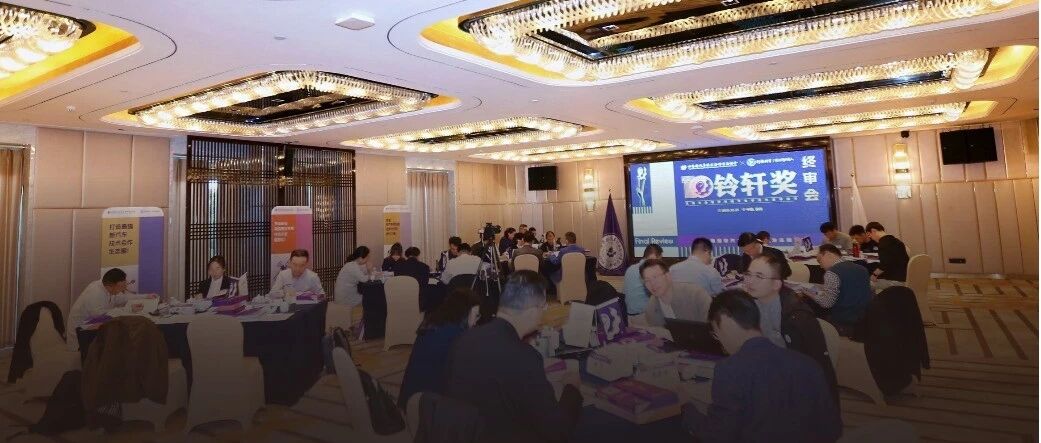
Core Viewpoint - The article discusses the significance of the Lingxuan Award in recognizing innovation in the Chinese automotive parts industry, highlighting its evolution over the past decade and its role in shaping the supply chain amidst the trends of electrification and intelligence in the automotive sector [10][12][50]. Group 1: Overview of the Lingxuan Award - The Lingxuan Award is an annual recognition for contributions in the automotive parts sector, evaluated by procurement and R&D leaders from major automotive companies in China [12][20]. - The award has evolved from filling a gap in the industry to becoming a core reference for supply chain choices among major automotive manufacturers [17][50]. - The award aims to discover cost-effective supply chains, enhance local industry security, and promote the transition to "new automobiles" in the era of electrification and intelligence [17][49]. Group 2: Evaluation Process - The evaluation process for the Lingxuan Award has shifted to a more immersive workshop format, allowing for in-depth discussions among judges from procurement and R&D backgrounds [25][30]. - The final evaluation involved 127 cases, with judges discussing and voting on the most innovative and applicable technologies across various categories [10][38]. - The award ceremony will take place during the WNAT-CES 2025 event in December, showcasing the winners and their contributions [10][20]. Group 3: Industry Trends and Insights - The evaluation revealed that 58% of the cases focused on intelligent cockpits, intelligent driving, automotive software, and chips, indicating a shift towards "software-defined vehicles" [38][41]. - Key trends identified include the emergence of new enterprises as vital players in the supply chain, the need for systematic upgrades in cost, safety, and international adaptability, and the growing importance of "emotional value" in user experience [39][41][48]. - The judges emphasized that cost control is paramount in product evaluation, with a focus on integrated architecture to balance cost reduction and intelligent features [44][45]. Group 4: Future Directions - The Lingxuan Award serves as a platform for self-reflection and collaborative evolution within the automotive supply chain, fostering connections between parts manufacturers and automotive companies [50]. - The participation of new enterprises, which accounted for over 20% of the cases, highlights the infusion of fresh energy and innovative technologies into the local supply chain [49][50]. - The award's ongoing mission aligns with the industry's pressing needs, ensuring that it remains relevant and impactful in the face of rapid technological advancements [49][50].