
GAC GROUP(601238)

Search documents
今日新闻丨长城汽车、广汽集团发布三季度财报!文远知行在沙特运营Robotaxi!
电动车公社· 2025-10-25 17:29
Group 1: Great Wall Motors Q3 Financial Report - Great Wall Motors reported a revenue of 61.25 billion yuan for Q3 2025, a year-on-year increase of 20.51%, marking the best Q3 revenue performance in its history [2][3] - The net profit for the same period was 2.30 billion yuan, a decrease of 31.23% compared to the previous year [2][3] - The company sold 353,600 new vehicles in Q3, a year-on-year increase of 20.20%, with 118,000 of those being new energy vehicles, which saw a growth of 49.21% [2][3][6] Group 2: GAC Group Q3 Financial Report - GAC Group reported a revenue of 24.31 billion yuan for Q3, a decrease of 14.63% year-on-year, with a net loss of 1.77 billion yuan, down 27.02% from the previous year [6][10] - The total vehicle sales for GAC Group in Q3 were 428,400 units, reflecting a decline of 9.7% year-on-year [8][10] Group 3: Robotaxi Service Launch - WeRide has partnered with Uber to launch Robotaxi services in Riyadh, Saudi Arabia, marking a significant milestone in the deployment of autonomous vehicles [11][12] - The initial phase of the service will include safety drivers in the vehicles to ensure passenger safety, paving the way for fully autonomous operations in the future [14][16] - This launch is part of a broader trend of Chinese tech companies expanding their global footprint in autonomous driving, with WeRide now operating in 11 countries and 30 cities [16]




泰国东北皇家理工大学推动新能源汽车领域产教融合合作
Zhong Guo Xin Wen Wang· 2025-10-25 09:52
Core Viewpoint - The collaboration between Thailand's Northeast Royal Polytechnic University and GAC International Thailand aims to enhance the development of the electric vehicle (EV) industry in Thailand, aligning with the country's goal of having 30% of total vehicle production be electric by 2030 [1][2]. Group 1: Strategic Collaboration - The signing of the academic cooperation agreement focuses on deepening collaboration in EV technology and talent development, contributing to the green transformation and modernization of Thailand's automotive industry [1][2]. - The partnership will create an international talent training system and an EV training base, integrating Chinese technological advantages with local industry scenarios to position Thailand as a regional EV industry hub [1][2]. Group 2: Educational and Industrial Integration - The agreement includes initiatives for student internships at related enterprises and joint training in EV technology, aimed at enhancing the professional skills of students, faculty, and the public [2]. - The collaboration seeks to establish a "full-chain integration" cooperation model that encompasses education, internships, research, and industrial ecosystem development, including the creation of an EV training and testing center [2]. Group 3: Talent Development - A roundtable discussion on high-level EV talent cultivation highlighted the need for building training bases, improving curriculum systems, and establishing vocational certification standards to align talent development with international standards [2].
广汽:三季度合并总营收243亿元,销量连续两季度环比增长
Nan Fang Du Shi Bao· 2025-10-25 09:11
Core Viewpoint - GAC Group reported a significant increase in revenue and vehicle sales for Q3 2025, indicating positive growth trends and successful integration reforms within the company [1][5]. Financial Performance - The consolidated operating revenue for GAC Group reached 24.318 billion yuan in Q3, a quarter-on-quarter increase of 6.98% [1]. - Total vehicle sales for the group amounted to 428,400 units, reflecting a quarter-on-quarter rise of 11.49% [1]. - For the first three quarters of the year, GAC Group sold 1.1837 million vehicles, with a cumulative consolidated operating revenue of 66.929 billion yuan [1]. Brand Performance - All brands under GAC experienced quarter-on-quarter sales growth in Q3 [3]. - GAC's self-owned brands, including GAC Trumpchi, GAC Aion, and GAC Haobo, saw sales exceed 159,500 units, a quarter-on-quarter increase of 15.09% [3]. - GAC Trumpchi sold 86,805 units, up 12.63% quarter-on-quarter, while GAC Aion's sales reached 72,739 units, marking an 18.13% increase [3]. - Joint venture brands also performed well, with GAC Honda and GAC Toyota achieving sales of 69,258 units (up 11.85%) and 198,511 units (up 8.43%) respectively [3]. International Expansion - GAC's overseas terminal sales grew by 36.5% year-on-year from January to September, with operations in 85 countries and regions [4]. - The company plans to deliver two global strategic models, AION V and AION UT, in Europe by Q1 2026, aiming for full market coverage by 2028 [4]. Technological Advancements - GAC is increasing investment in key areas such as intelligent driving assistance and electronic architecture, with R&D spending expected to exceed 10 billion yuan in 2025 [4]. - The GAC ADiGO GSD intelligent driving assistance system has been implemented on 99.9% of roads, and the company has established the largest V2G demonstration project in the country [4]. Integration Reforms - The "Panyu Action" integration reform has shown positive progress, contributing to consecutive quarter-on-quarter growth in revenue and vehicle sales this year [5].
国内汽车行业竞争加剧,广汽集团Q3亏损17.74亿元
Ju Chao Zi Xun· 2025-10-25 04:06
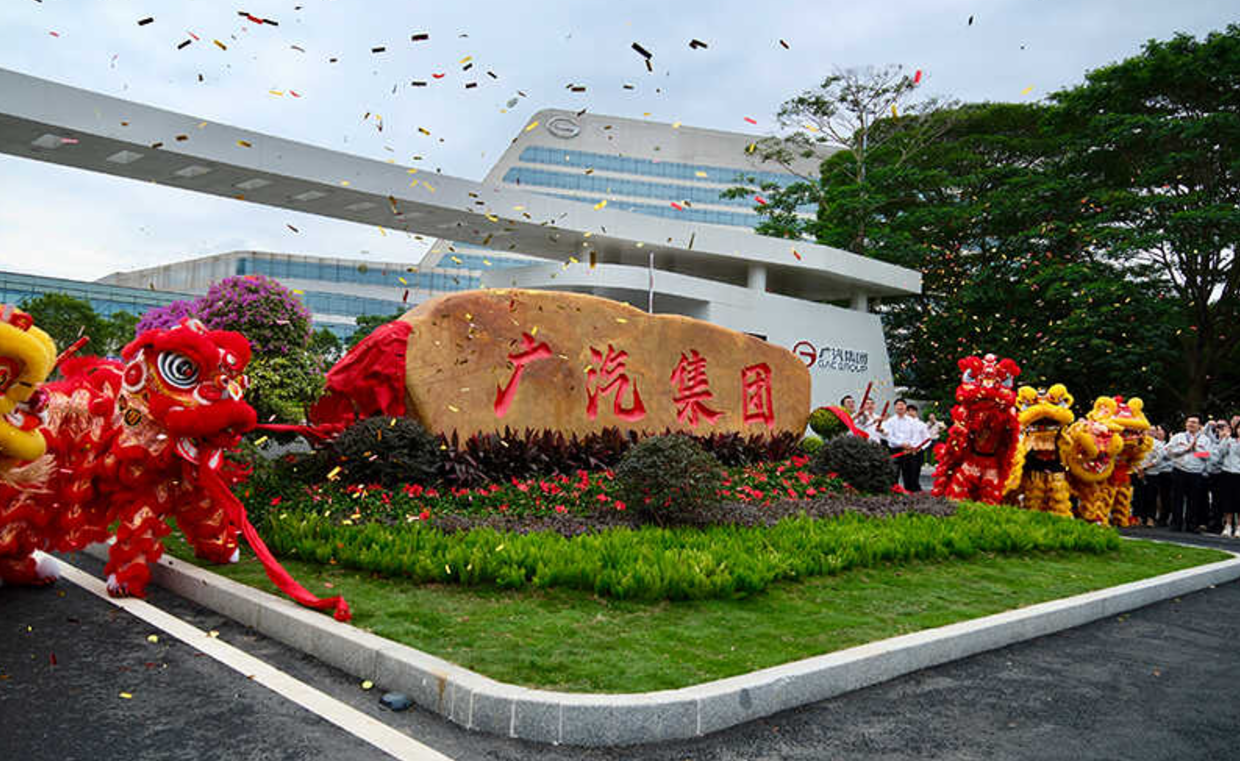
Core Insights - GAC Group reported a significant decline in both revenue and net profit for Q3 2025, with revenue at 24.1 billion yuan, down 14.62% year-on-year, and a net loss of approximately 1.77 billion yuan, a decrease of 27.02% compared to the previous year [2][3] Financial Performance - For the first nine months of 2025, GAC Group's total revenue was 66.27 billion yuan, reflecting a 10.49% year-on-year decline [3][4] - The net profit attributable to shareholders was a loss of approximately 4.31 billion yuan, a drastic decrease of 3691.33% compared to a profit of 120 million yuan in the same period last year [3][4] - The net cash flow from operating activities turned negative at -10.83 billion yuan, a decline of 1201.2% from the previous year's positive cash flow [3][4] Earnings Per Share - Basic and diluted earnings per share for Q3 2025 were both -0.17 yuan, down 30.77% year-on-year [5] - For the first nine months, the earnings per share were -0.42 yuan, a staggering decline of 4300.00% compared to 0.01 yuan in the same period last year [5] Asset and Equity Position - As of September 30, 2025, GAC Group's total assets were approximately 212.91 billion yuan, down 8.41% from the end of the previous year [5] - The equity attributable to shareholders was about 110.44 billion yuan, a decrease of 3.42% compared to the previous year-end [5] Industry Context - The decline in performance is attributed to intensified competition in the domestic automotive market and a rapid upgrade in consumer demand towards high-end and intelligent vehicles, leading to decreased sales and profitability [4] - The previous year's high base, particularly from non-recurring gains such as the IPO of Qiji Mobility, also contributed to the significant drop in net profit this year [4]
汽车早报|广汽集团第三季度净亏损17.74亿元 北汽蓝谷第三季度净亏损11.18亿元
Xin Lang Cai Jing· 2025-10-25 00:41
Group 1: Automotive Industry Performance - In the first nine months of the year, the top ten MPV manufacturers accounted for 77.5% of total MPV sales, with a total of 681,000 units sold [1] - Great Wall Motors reported a third-quarter net profit of 2.298 billion yuan, a year-on-year decrease of 31.23%, with a revenue of 61.247 billion yuan, up 20.51% [2] - GAC Group announced a third-quarter net loss of 1.774 billion yuan, with a revenue of 24.106 billion yuan, down 14.62% [3] - BAIC Blue Valley reported a third-quarter net loss of 1.118 billion yuan, with a revenue of 5.867 billion yuan, down 3.45% [4] Group 2: Technological Developments - Xiaomi Auto has published a patent for a method and system for switching driving modes in electric vehicles, aimed at enhancing driver experience and acceleration efficiency [5] - XPeng Motors has received authorization for a patent related to the control method of biped robots, addressing control effectiveness issues in existing technologies [6] Group 3: Company Initiatives and Collaborations - Weinan Energy has established a battery technology company in Hefei with a registered capital of 60 million yuan, focusing on battery leasing and recycling [7] - Pony.ai announced the production of its 300th Robotaxi, marking a significant milestone in its mass production phase, with plans to scale up to over 1,000 vehicles by year-end [8][9] - Didi has launched 500 electric vehicles on its ride-hailing platform in Mexico, marking its first standardized ride-hailing service in Latin America [9] - Rivian has agreed to pay $250 million to settle a class-action lawsuit related to its stock, allowing the company to focus on the upcoming launch of its R2 model [10] - NVIDIA is collaborating with Uber to advance autonomous vehicle technology, leveraging large-scale real-world driving data for model training [11]


广州汽车集团股份有限公司 2025年第三季度报告
Zheng Quan Ri Bao· 2025-10-24 22:48
Core Points - The company guarantees the authenticity, accuracy, and completeness of the quarterly report, and assumes legal responsibility for any false records or misleading statements [2][3][6] Financial Data - The financial statements for the third quarter are not audited [3] - The report period refers to the three months from the beginning to the end of the quarter [3] - The company has not identified any non-recurring gains or losses that are significant [3] Shareholder Information - Guangzhou Automobile Industry Group Co., Ltd. holds 5,206,932,069 A-shares, accounting for approximately 70.52% of the company's A-share capital [4] - The same entity also holds 301,228,000 H-shares through its wholly-owned subsidiary, representing about 10.71% of the company's H-share capital [4] - The total shares held by Guangzhou Automobile Industry Group Co., Ltd. in both A and H shares amount to 5,508,160,069, which is approximately 54.02% of the total share capital [4] Other Information - There are no additional important reminders regarding the company's operational situation during the reporting period [5][6]
陆家嘴财经早餐2025年10月25日星期六
Wind万得· 2025-10-24 22:43
Group 1 - President Xi Jinping will attend the APEC informal leaders' meeting in South Korea from October 30 to November 1, with potential discussions on a meeting between the Chinese and U.S. leaders [1] - The Central Committee emphasizes addressing "three rural issues" as a priority, projecting an estimated market space of around 10 trillion yuan over the next five years [1] - The focus on new urbanization is expected to require over 5 trillion yuan in investment for underground infrastructure during the 14th Five-Year Plan [1] Group 2 - The U.S. September CPI rose 3% year-on-year, the highest since January, but below market expectations of 3.1% [2] - The market has fully priced in two 25 basis point rate cuts by the Federal Reserve for the remainder of the year [2] Group 3 - Premier Li Qiang will attend multiple ASEAN meetings in Malaysia from October 27 to 28 [3] - The central bank aims to enhance the effectiveness of monetary policy and maintain stability in financial markets [3] - The State Administration of Foreign Exchange emphasizes the need for high-level opening in the foreign exchange sector and promoting the internationalization of the renminbi [3] Group 4 - The central bank will conduct a 900 billion yuan MLF operation on October 27, marking a net injection of 200 billion yuan for the month [4] - Various provinces have reported GDP data for the first three quarters, with Guangdong's GDP reaching 10.52 trillion yuan, a 4.1% increase [4] Group 5 - The China Securities Regulatory Commission emphasizes risk prevention and high-quality development in capital markets [5] - A-shares saw significant gains, with the Shanghai Composite Index rising 0.71% to 3950.31 points [5] - Hong Kong's Hang Seng Index closed up 0.74%, with notable strength in the semiconductor sector [5] Group 6 - 712 listed companies have disclosed share repurchase or increase loan plans, totaling a maximum loan amount of 152.48 billion yuan [6] - Domestic GPU leader Muxi Co. successfully passed IPO approval on the Sci-Tech Innovation Board, aiming to raise 3.904 billion yuan for R&D [6] Group 7 - The China Logistics and Purchasing Federation initiated an "anti-involution" campaign to combat low-quality competition in the warehousing industry [8] - The China Nonferrous Metals Industry Association stressed the importance of maintaining industry confidence and preventing "involution" [9] Group 8 - The People's Bank of China reported a decline in real estate loans, with a balance of 52.83 trillion yuan, down 0.1% year-on-year [10] - Hangzhou is implementing "home purchase + consumption voucher" subsidy activities to stimulate the housing market [10] Group 9 - JD.com, Meituan, and other companies are under investigation by market regulators for food safety and operational compliance issues [11] - The narrow passenger car retail market is expected to reach around 2.2 million units in October, with a projected 60% penetration rate for new energy vehicles [11] Group 10 - Morgan Stanley plans to allow institutional clients to use actual holdings of Bitcoin and Ethereum as loan collateral [12] - Xiaomi Auto announced a tax subsidy plan for customers who complete orders by November 30 [13] Group 11 - Ford's Q3 adjusted EPS was 45 cents, with sales up 9.3% to a record $50.5 billion, exceeding expectations [21] - Procter & Gamble reported Q1 adjusted EPS of $1.99, with revenue of $22.39 billion, both surpassing market expectations [21]




上市公司动态 | 中国神华前三季度净利降10%,东方财富前三季度净利增51%,沐曦股份科创板IPO过会
Sou Hu Cai Jing· 2025-10-24 17:19
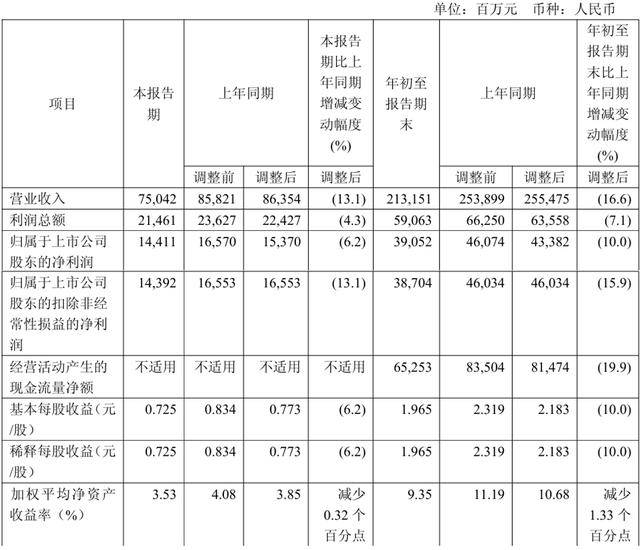
Group 1 - China Shenhua's net profit for the first three quarters decreased by 10% year-on-year, with total revenue of 213.15 billion yuan, down 16.6% [1][2] - Dongfang Caifu reported a 51% increase in net profit for the first three quarters, reaching 90.97 billion yuan, a 50.57% year-on-year growth [3][4] - Geer Co. achieved a net profit growth of 10.33% year-on-year, totaling 25.87 billion yuan, despite a 2.21% decline in revenue [5][6] Group 2 - Changan Automobile's net profit fell by 14.66% year-on-year, with total revenue of 1,149.27 billion yuan, up 3.58% [7][8] - Zhinanzhen reported a significant net profit increase of 205% year-on-year, reaching 1.16 billion yuan, driven by growth in financial information services [9] - Dongpeng Beverage's net profit grew by 42% year-on-year, totaling 37.61 billion yuan for the first three quarters [10][11] Group 3 - Ping An Bank's net profit decreased by 2.8% year-on-year, with total revenue of 1,006.68 billion yuan, down 9.8% [12][13] - Goldwind Technology reported a 171% increase in net profit for the third quarter, reaching 25.84 billion yuan for the first three quarters [15] - Yilong Co. achieved a net profit growth of 113.97% year-on-year, totaling 19.88 billion yuan in the third quarter [16][17] Group 4 - Tongwei Co. reported a net loss of 5.27 billion yuan for the first three quarters, with total revenue of 646 billion yuan, down 5.38% [18][19] - CITIC Securities' net profit increased by 52% year-on-year, reaching 231.59 billion yuan for the first three quarters [20] - Wanhua Chemical's net profit decreased by 17.45% year-on-year, totaling 91.57 billion yuan for the first three quarters [21] Group 5 - Luoyang Molybdenum's net profit increased by 96.4% year-on-year, reaching 142.80 billion yuan for the first three quarters [22] - Xiamen Tungsten's net profit grew by 41.54% year-on-year, totaling 5.52 billion yuan for the first three quarters [44] - Huazhong Cement's net profit increased by 76% year-on-year, reaching 20.04 billion yuan for the first three quarters [41]



广汽集团发布前三季度业绩,归母净亏损43.12亿元
智通财经网· 2025-10-24 17:09
Core Viewpoint - GAC Group reported a significant decline in revenue and net profit for the first three quarters of 2025, indicating financial challenges ahead [1] Financial Performance - The company achieved a revenue of 66.272 billion yuan, representing a year-on-year decrease of 10.49% [1] - The net profit attributable to shareholders was a loss of 4.312 billion yuan [1] - The non-recurring net profit also showed a loss of 4.775 billion yuan [1] - Basic earnings per share were reported at -0.42 yuan [1]
广汽集团(601238.SH)发布前三季度业绩,归母净亏损43.12亿元
智通财经网· 2025-10-24 17:08
Core Viewpoint - GAC Group reported a significant decline in revenue and net profit for the first three quarters of 2025, indicating financial challenges ahead [1] Financial Performance - The company achieved a revenue of 66.272 billion yuan, representing a year-on-year decrease of 10.49% [1] - The net profit attributable to shareholders was a loss of 4.312 billion yuan [1] - The non-recurring net profit also showed a loss of 4.775 billion yuan [1] - Basic earnings per share were reported at -0.42 yuan [1]