AGRICULTURAL BANK OF CHINA(601288)

Search documents
农业银行洛阳分行:数字赋能普惠金融 资金流平台为小微企业注入“活水”
Xin Lang Cai Jing· 2025-12-11 04:16
Core Insights - The People's Bank of China and Agricultural Bank of China launched a joint initiative to promote the "Small and Micro Enterprises Fund Flow Credit Information Sharing Platform" to local small and micro enterprises, receiving positive feedback from government and business leaders [1][3] Group 1: Platform Overview - The platform aims to address the financing difficulties faced by small and micro enterprises by analyzing account transaction data to facilitate credit approvals without the need for collateral [1][4] - As of the end of November, the Agricultural Bank of China in Luoyang has processed 253 inquiries through the platform and provided credit support to 98 enterprises, with a total loan approval amount exceeding 760 million yuan [4] Group 2: Impact on Local Economy - The promotional activities have increased awareness and willingness to use the platform among small and micro enterprises in the county, helping them to showcase their operational strength and improve access to financing [4] - The bank's representative emphasized the commitment to integrating platform promotion with financing services to enhance the financing capabilities of small and micro enterprises, thereby supporting sustainable economic development [4]

中期分红潮来了,上市公司年内分红有望首破2.6万亿元!红利主题ETF同步官宣分红
Sou Hu Cai Jing· 2025-12-11 03:43
Group 1 - A total of 3,762 A-share listed companies in China have distributed dividends amounting to 2.46 trillion yuan this year, setting a new historical record [1] - 36 companies have announced real-time dividend distributions, with a total proposed dividend amount of 151.8 billion yuan, indicating that the total annual dividend is expected to exceed 2.6 trillion yuan for the first time [1] - Major companies such as China Mobile and Industrial and Commercial Bank of China have distributed over 50 billion yuan in mid-term dividends, while several others, including China Construction Bank and Kweichow Moutai, have distributed over 30 billion yuan [1] Group 2 - The Hong Kong Dividend Low Volatility ETF (520550) has announced a dividend of 0.04 yuan per ten shares, with a distribution ratio of 0.32%, marking its eighth dividend distribution since inception [2] - The China Securities Dividend Quality ETF (159209) has a distribution ratio of 0.26% for its sixth dividend distribution, with both ETFs having a dividend rights registration date of December 12 [1][2] - Recent data shows that the Hong Kong Dividend Low Volatility ETF has seen a net subscription of 119 million yuan in the last ten days and 186 million yuan in the last twenty days, while the China Securities Dividend Quality ETF has experienced a net inflow of 64 million yuan in the last twenty days [2] Group 3 - Huachuang Securities anticipates a rebound in industry rotation strength, with a shift from technology to dividend and anti-involution assets, indicating a recovery in rotation intensity to the 52nd percentile since 2021 [3] - The Producer Price Index (PPI) has shown a narrowing of inflation levels from -3.6% to -2.1% in October, suggesting that cyclical assets with high weight in dividend stocks may benefit from this trend [3] - Recent policies have focused on capital market and consumption, with an emphasis on domestic demand and new industries, indicating a favorable environment for dividend sectors as traditional investment windows for insurance funds approach [3]




中国农业银行大小额支付系统将在12月13日进行系统维护升级
Jin Tou Wang· 2025-12-11 03:23
敬请您妥善安排业务办理时间。由此给您带来的不便,中国农业银行深表歉意,并将尽快恢复对您的相 关服务。如需进一步咨询,请拨打中国农业银行客户服务热线95599。 2025年12月10日,中国农业银行(601288)发布公告称,中国农业银行大小额支付系统计划于2025年12 月13日20:00至22:50进行系统维护升级。升级期间,客户在2025年12月12日20:00至12月13日22:50时段 内,通过中国农业银行个人掌银、个人网银、超级柜台渠道发起的延时24小时跨行转账交易;或在2025 年12月13日18:00至22:50时段内,通过中国农业银行个人掌银、个人网银、超级柜台渠道发起的延时2 小时跨行转账交易,将无法在2025年12月13日20:00至22:50时段内进行撤销。其他大小额支付系统业务 不受此次系统维护升级影响。 ...
一场金融服务,如何盘活一个集市?
Jin Rong Shi Bao· 2025-12-11 02:34
作为临沭县特色产业,柳编制品以其环保、耐用的特点深受消费者喜爱。产品名气提升后,随之而 来的销量增长让荣华文创有了扩大生产的想法,却因资金缺口让企业犯了难。 农业银行山东临沭支行工作人员了解到情况后,主动上门对接,为企业提供了500万元的贷款支 持。如今,该企业的柳编花篮、收纳筐等产品不仅在曹洼大集的摊位上供不应求,还通过电商平台销往 全国各地,带动了周边200多名村民就业。 清晨的鲁南大地,薄雾尚未散尽,但山东省临沂市临沭县的曹洼大集已被此起彼伏的吆喝声唤醒。 放眼望去,豫皖苏等外地牌照车辆排起长龙。集市内,刚出锅的羊肉汤冒着热气,柳编簸箕、藤编花篮 等手工艺品在阳光下泛着自然光泽,已准备好接待这些四方来客。 穿过曹洼大集的非遗区,蒸汽氤氲、香气弥漫的向城全羊馆摊位出现在记者眼前。这里的羊肉汤以 肉质鲜嫩、汤汁浓郁而闻名,随着集市的爆火而成为了曹洼大集的"网红美食"。上午,羊肉汤摊位前排 着长长的队伍,全是等待尝鲜的食客。 在曹洼大集东南角的非遗专区,沭河水滋养的杞柳在手艺人精巧的技艺中,化作了精美的花篮、屏 风和"临沭有礼"的文创摆件。这些承载着1400多年技艺的手工艺品,成为大集上最亮眼的"文化名片"。 ...
超2600亿元!四大行即将派发中期“红包” 有望强化估值修复
Zhong Guo Jin Rong Xin Xi Wang· 2025-12-10 23:50
Core Viewpoint - The mid-term dividend distribution by major state-owned banks in 2025 is characterized by an increase in quantity, faster pace, and stable strength, which may serve as a catalyst for the valuation recovery of the banking sector [1][5][6]. Group 1: Dividend Distribution Characteristics - The timing of mid-term dividends has advanced by nearly a month compared to last year, with 26 A-share listed banks announcing dividend plans totaling over 260 billion yuan, reflecting a 2.55% increase from last year [2][3]. - The total cash dividend amount from the six major state-owned banks is expected to exceed 200 billion yuan, maintaining a payout ratio of 30% of net profit attributable to shareholders [1][2]. - Industrial and Commercial Bank of China leads with a cash dividend of 1.414 yuan per 10 shares, totaling 50.396 billion yuan [1][2]. Group 2: Participation of Other Banks - Several joint-stock banks and regional banks have joined the dividend distribution, with notable participation from banks like Industrial Bank and China CITIC Bank, which have increased their dividend amounts compared to last year [4]. - A total of 32 listed banks have announced mid-term dividends, with 9 banks planning to implement dividends for the first time [2][4]. Group 3: Market Impact and Investor Sentiment - The stable dividend policies of state-owned banks are closely linked to regulatory guidance, and the implementation of mid-term dividends is expected to enhance the valuation recovery of bank stocks [3][6]. - The average dividend yield for listed banks is 4.48%, with 12 banks yielding over 5%, indicating strong investor interest in high-dividend stocks [2][6]. - Recent stock buybacks by major shareholders and executives signal positive market sentiment and confidence in the long-term investment value of certain banks [8].




金融活水润沃土 精准助力“百千万工程”
Jing Ji Ri Bao· 2025-12-10 22:21
Core Insights - The article highlights the achievements of Agricultural Bank of China, Jieyang Branch in supporting rural revitalization through innovative mechanisms, resource allocation, and technology empowerment since 2025 [1][2] Group 1: Financial Performance - As of the end of November, Jieyang Agricultural Bank's farmer loan balance reached 4.18 billion yuan, with a net increase of 960 million yuan since the beginning of the year, marking five consecutive years of receiving "excellent" ratings from regulatory authorities for financial services in rural revitalization [1] Group 2: Mechanism Innovation - The bank established a leadership group for financial services under the "Hundred-Thousand-Million Project," with a four-level linkage to connect major policies and projects, optimizing loan processes for rural personal production and operation [1] - The introduction of the "Renew e-loan" policy has provided relief to 73 struggling farmers this year, alongside a comprehensive action plan with 15 support measures to enhance financing supply for farmers [1] Group 3: Community Engagement - The bank focuses on three major projects: "Strong Villages, Benefiting People, and Profiting People," collaborating with local government and village committees to implement a "Party Building + Finance + Technology" model, resulting in the establishment of 192 "credit villages" and the completion of information registration for 40,000 farmers [1] - The bank has set up 666 agricultural service points covering key towns and plans to establish rural revitalization financial service stations in 13 economically strong towns this year [1] Group 4: Service Accessibility - The "Thousand People Stationed in Hundred-Thousand-Million" initiative has deployed 5 personnel to the project command office and 41 financial assistants across the city, addressing the financing needs of specific industries with various credit products [2] - Utilizing the "Agricultural Bank's Agricultural Cloud" platform, the bank has developed smart park scenarios and promoted online products like "Huinong e-loan," facilitating a one-stop process for loan applications, fund usage, and repayments [2]
信用债异常成交跟踪:12月10日信用债异常成交跟踪
SINOLINK SECURITIES· 2025-12-10 15:27
Report Summary 1. Industry Investment Rating No information about the industry investment rating is provided in the report. 2. Core Viewpoints - Among the bonds with discounted transactions, "25 Yungang Y4" had a large deviation in the valuation price. Among the bonds with rising net prices, "25 Datong C3" had a relatively high deviation in the valuation price. Among the Tier 2 and perpetual bonds with rising net prices, "22 Bank of Communications Tier 2 Capital Bond 02B" had a large deviation in the valuation price; among the commercial financial bonds with rising net prices, "25 Agricultural Bank of China TLAC Non - capital Bond 02C(BC)" had a relatively high deviation in the valuation price. Among the bonds with a transaction yield higher than 5%, real - estate bonds ranked high [2]. - The changes in the valuation yield of credit bonds were mainly distributed in the [-5,0) interval. The transaction terms of non - financial credit bonds were mainly distributed between 2 and 3 years, with the highest proportion of discounted transactions for varieties within 0.5 years. The transaction terms of Tier 2 and perpetual bonds were mainly distributed between 4 and 5 years, with the highest proportion of discounted transactions for varieties within 1 year. In terms of industries, bonds in the national defense and military industry had the largest average deviation in valuation prices [2]. 3. Summary by Relevant Charts Chart 1: Discounted Transaction Tracking - The table listed 30 bonds with large discounts, including "25 Yungang Y4", "25 Dongfang K1", etc., with information on the remaining term, valuation price deviation, valuation net price, valuation yield deviation, and transaction scale. The industries involved included transportation, non - financial finance, and urban investment [4]. Chart 2: Tracking of Bonds with Rising Net Prices - The table showed 43 bonds with large positive deviations, such as "25 Datong C3", "25 Raofa 02", etc. It provided details on the remaining term, valuation price deviation, valuation net price, valuation yield deviation, and transaction scale. The industries included non - financial finance, comprehensive, and public utilities [6]. Chart 3: Tracking of Tier 2 and Perpetual Bond Transactions - The table presented 40 Tier 2 and perpetual bonds, including "22 Bank of Communications Tier 2 Capital Bond 02B", "22 Industrial and Commercial Bank of China Tier 2 Capital Bond 04B", etc., with information on the remaining term, valuation price deviation, valuation net price, valuation yield deviation, bank classification, and transaction scale [7]. Chart 4: Tracking of Commercial Financial Bond Transactions - The table listed 29 commercial financial bonds, such as "25 Agricultural Bank of China TLAC Non - capital Bond 02C(BC)", "24 Agricultural Bank of China TLAC Non - capital Bond 01B(BC)", etc., providing details on the remaining term, valuation price deviation, valuation net price, valuation yield deviation, bank classification, and transaction scale [8]. Chart 5: Bonds with a Transaction Yield Higher than 5% - The table showed 20 bonds with a high - yield transaction, including "21 Vanke 06", "23 Vanke 01", etc., with information on the remaining term, valuation price deviation, valuation net price, valuation yield deviation, and transaction scale. The industries involved included real estate, steel, and non - financial finance [10]. Chart 6: Distribution of Valuation Deviations in Credit Bond Transactions on the Day - The chart showed the distribution of changes in the valuation yield of credit bonds on the day, with the intervals [-10,-5), [-5,0), (0,5], and (5,10], and the number of bonds and transaction scale in each interval [13]. Chart 7: Distribution of Transaction Terms of Non - financial Credit Bonds on the Day - The chart presented the distribution of transaction terms of non - financial credit bonds on the day, including intervals such as within 0.5 years, 0.5 - 1 year, etc., and the corresponding transaction scale [15]. Chart 8: Distribution of Transaction Terms of Tier 2 and Perpetual Bonds on the Day - The chart showed the distribution of transaction terms of Tier 2 and perpetual bonds on the day, including intervals such as within 1 year, 1 - 1.5 years, etc., and the corresponding transaction scale [18]. Chart 9: Discounted Transaction Ratio and Transaction Scale of Non - financial Credit Bonds in Each Industry - The chart displayed the average valuation price deviation and transaction scale of non - financial credit bonds in various industries, including petroleum and petrochemicals, real estate, etc. The national defense and military industry had the largest average valuation price deviation [20].

工行、农行、中行、建行、交行、汇丰中国、花旗中国等率先落地!
Jin Rong Shi Bao· 2025-12-10 13:41
Core Viewpoint - The implementation of the "Shanghai Free Trade Zone Free Trade Account Function Upgrade Implementation Measures (Trial)" on December 5 aims to enhance the cross-border trade and investment liberalization and facilitation levels in the Shanghai Free Trade Zone [1] Group 1: Bank Participation - Major Chinese banks including Industrial and Commercial Bank of China, Agricultural Bank of China, Bank of China, China Construction Bank, and Bank of Communications, along with foreign banks like HSBC China and Citibank China, successfully completed business operations on the same day the trial measures were implemented [1] - Industrial and Commercial Bank of China processed its first cross-border RMB loan for an advanced manufacturing enterprise using the upgraded free trade account, facilitating cross-border fund flow [2] - Agricultural Bank of China completed two upgraded free trade account transactions for a leading semiconductor manufacturing enterprise, significantly improving fund transfer efficiency by allowing transactions based solely on payment instructions [3] Group 2: Business Operations - Bank of China assisted five enterprises in directly processing various transactions under the upgraded free trade account, covering industries such as semiconductor, petrochemical, and automotive [4] - China Construction Bank enabled multiple key enterprises to upgrade their free trade account functions, enhancing cross-border payment efficiency and supporting global operations [5] - Bank of Communications focused on selecting multinational corporate groups for the trial, ensuring compliance and assessing the overall operational capabilities of the enterprises involved [6] Group 3: Foreign Bank Initiatives - HSBC China opened an upgraded free trade account for a multinational enterprise in the Shanghai Free Trade Zone, emphasizing the multiplier effect of the new policy on cross-border trade and investment [8] - Citibank China established upgraded free trade accounts for four corporate clients, highlighting its commitment to supporting China's financial market opening [8]
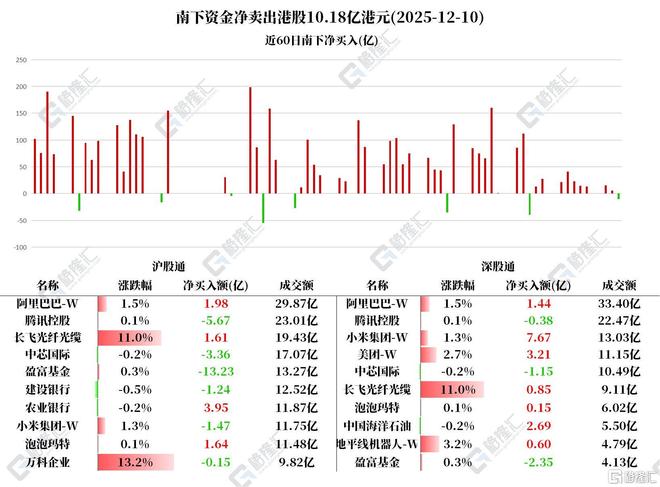
资金动向 | 北水卖出腾讯逾6亿港元,连续9日加仓小米!
Ge Long Hui· 2025-12-10 13:21
Group 1 - Southbound funds recorded a net sell of HKD 1.018 billion on December 10, with notable net buys in Xiaomi Group (HKD 619 million), Agricultural Bank (HKD 394 million), Alibaba (HKD 342 million), Meituan (HKD 320 million), China National Offshore Oil Corporation (HKD 269 million), and Pop Mart (HKD 179 million) [1] - The net sell included significant amounts in the Tracker Fund (HKD 1.559 billion), Tencent Holdings (HKD 605 million), China Construction Bank (HKD 123 million), and SMIC (HKD 118 million) [1] Group 2 - Southbound funds have continuously net bought Xiaomi for 9 days, totaling HKD 7.39843 billion, and Agricultural Bank for 3 days, totaling HKD 993.02 million [3] - In November, the sales volume of new energy passenger vehicles reached 1.321 million units, a year-on-year increase of 4.2% and a month-on-month increase of 3.0%; Xiaomi's automotive sales reached 46,249 units, with a year-on-year increase of 99.7% [4] - Morgan Stanley highlighted concerns regarding the asset quality risk related to Vanke's bond extension, noting that Vanke's bank loans account for only 0.10% of total loans in China's banking sector [4] Group 3 - Alibaba has established a new C-end business group, aiming to develop a super app as the primary entry point for users in the AI era [4] - Tencent repurchased approximately 1.06 million shares for about HKD 636 million, with repurchase prices ranging from HKD 595.5 to HKD 603 [4] - China Construction Bank announced a capital increase from RMB 250.011 billion to RMB 261.6 billion through a specific issuance of approximately 11.589 billion A-shares [5] - SMIC's monthly wafer production capacity is expected to exceed 1 million pieces by Q3 2025, with a utilization rate increase of 3.3 percentage points to 95.8%, indicating strong industry demand [5]



不良处置 “质量”赶考之路
Bei Jing Shang Bao· 2025-12-10 12:00
Core Viewpoint - The expansion of inclusive finance has led to increased pressure on asset quality, particularly for small and micro enterprises and individual borrowers, prompting banks and consumer finance institutions to focus on maintaining asset quality while ensuring sustainable development [1][3]. Group 1: Asset Quality Challenges - Small and micro enterprises face operational instability and lack effective collateral, making them vulnerable to economic fluctuations, which in turn affects the asset quality of consumer loans and business loans [3]. - The asset quality of inclusive finance is under pressure, with banks and consumer finance institutions actively engaging in an "asset quality defense war" to manage non-performing assets [3][4]. Group 2: Non-Performing Asset Disposal - Since 2025, there has been a notable increase in the transfer of non-performing assets related to small and micro enterprises and personal loans, with banks frequently listing these assets on platforms like the Silver Registration Center [3]. - Banks such as Ping An Bank and Zhongyuan Bank have announced significant non-performing asset transfer projects, with amounts reaching 7.62 billion yuan and 5.22 billion yuan respectively [3]. - Consumer finance institutions are also urgently addressing non-performing assets, with some assets being auctioned at extremely low starting prices, indicating a pressing need for risk resolution and asset optimization [4]. Group 3: Regulatory and Strategic Responses - Financial institutions are encouraged to enhance their asset disposal and capital replenishment efforts, as highlighted by regulatory authorities [7]. - Institutions are exploring innovative disposal methods, leveraging financial technology to improve risk management and operational efficiency [7][8]. - The emphasis on early identification and management of credit risks is becoming a priority for banks, with a focus on improving the efficiency of non-performing asset recovery [8]. Group 4: Long-term Sustainability - Effective management of non-performing assets is crucial for the sustainability of inclusive finance, as delays in disposal can erode profits and capital, limiting the ability to extend further inclusive credit [6]. - The relationship between the management of non-performing assets and the goals of inclusive finance is highlighted, with potential negative impacts on operational costs and credit pricing if not addressed properly [6]. - The need for collaboration between banks, consumer finance institutions, and asset management companies is emphasized to optimize resource allocation and enhance the recovery of non-performing assets [8].