PING AN OF CHINA(601318)

Search documents
第十九届华夏机构投资者典型案例揭晓
Hua Xia Shi Bao· 2025-12-15 10:39
Core Insights - The 19th Huaxia Institutional Investor Annual Conference and Huaxia Financial (Insurance) Technology Forum was successfully held in Beijing, focusing on the theme "Vitality and Resilience, Innovation and Empowerment" [1] Group 1: Awards and Recognitions - Institutions awarded the "2025 Annual Green Finance Practice Typical Case" include Agricultural Bank of China, Bank of China Beijing Branch, Industrial Bank, China International Capital Corporation, Xinwang Bank, and Huatai Securities [3] - Institutions recognized for the "2025 Annual Financial Assistance for the Disabled Typical Case" are Agricultural Bank of China and Yunnan Trust [3] - Institutions awarded the "2025 Annual Smart Elderly Care Financial Typical Case" include China Minsheng Bank, CITIC Bank, Agricultural Bank of China Wealth Management, New China Life Insurance, Harmony Health, Beijing Bank, and others [3] - Institutions recognized for the "2025 Annual Green Finance Innovation Typical Case" include Agricultural Bank of China Credit Card, People's Insurance Company of China, and Ping An Group [3] - Institutions awarded the "2025 Annual ESG Practice Typical Case" include Yirun Zhike, Dajia Investment Holdings, China Life, and others [3] - Institutions recognized for the "2025 Annual Institutional Investor Education Content Creative Communication Typical Case" include Minsheng Jianyin Fund, Zhejiang Merchants Securities, and others [3] - Institutions awarded the "2025 Annual Financial Empowerment for Rural Revitalization Typical Case" include China Post Insurance, Tianjin Bank Beijing Branch, and others [3] - Institutions recognized for the "2025 Annual Inclusive Finance Digital Transformation Typical Case" include CITIC Baixin Bank, Lexin, and others [3] - Institutions awarded the "2025 Annual Intelligent Risk Control Technology Innovation Application Typical Case" include Foreign Trade Trust, Orange Data Science, and others [3][4] - Institutions recognized for the "2025 Annual Community Elderly Service Typical Case" include Industrial and Commercial Bank of China, ICBC-AXA Life Insurance, and Tianjin Binhai Rural Commercial Bank [5] - Institutions awarded the "2025 Annual Internet Medical Innovation Practice Case" include ZhongAn Insurance [5] - Institutions recognized for the "2025 Annual Technology Financial Typical Practice Case" include Changjiang Securities, Yixin, and others [5] - Institutions awarded the "2025 Annual Listed Company Board of Directors Typical Practice Case" include Annai'er, Bailian Co., Hai Liang Co., and Tianqi Lithium [5]





站在商业逻辑与社会价值的交汇点上,中国平安的共振之路
Nan Fang Du Shi Bao· 2025-12-15 10:12
Core Insights - The article emphasizes the importance of addressing population aging and developing a coordinated policy mechanism for elderly care as a key task in China's 14th Five-Year Plan [1] - Ping An has become the first brand in China to receive a five-star rating for home elderly care services, reflecting its commitment to social value and innovative integration [1] - The company is leveraging a vast system connecting nearly 250 million customers through finance, healthcare, elderly care, and AI technology, balancing commercial logic with social benefits [1] Group 1: Value Creation and Strategic Innovation - Ping An has redefined its role from a "risk bearer" to a "value co-creator," moving beyond traditional insurance models to address social needs [3] - The insurance industry is evolving into a 3.0 era focused on "protection, inclusive coverage, technology-driven, and service-oriented" contracts between the state and the people [3][5] - Ping An's "Red and Green Light" public welfare initiative has improved road safety in rural areas, demonstrating a shift from reactive to proactive risk management [5][7] Group 2: Strategic Pathways and Dual-Driven Model - The company’s dual-driven strategy of "comprehensive finance + healthcare and elderly care" addresses the structural imbalance in supply for the aging population [10] - This strategy integrates wealth management and health care needs, creating a synergistic effect that enhances customer engagement and service delivery [10][12] - Ping An's model transforms healthcare resources into financial service entry points, enhancing customer experience and loyalty [12][13] Group 3: Technological Empowerment and Social Impact - Technology is central to Ping An's strategy, with AI being utilized to address common social pain points and enhance operational efficiency [14][15] - The introduction of AI-driven services like "AI Super Customer Service" and "AI Family Doctor" aims to streamline financial, healthcare, and elderly care services [15] - Ping An's AI systems have significantly reduced claims processing times and improved accuracy, demonstrating a commitment to social responsibility and customer service [16] Group 4: Long-term Vision and Market Position - Ping An's approach integrates social value into its business model, positioning it for sustainable growth and resilience against market cycles [21][22] - The company has received positive evaluations from financial institutions, highlighting its strategic alignment with growth opportunities in wealth management and healthcare [22] - Ping An's commitment to ESG principles has led to high ratings, reflecting its leadership in responsible business practices and social governance [22]

北水动向|北水成交净买入36.54亿 北水抢筹大金融板块 全天加仓中国平安近12亿港元
Zhi Tong Cai Jing· 2025-12-15 10:05
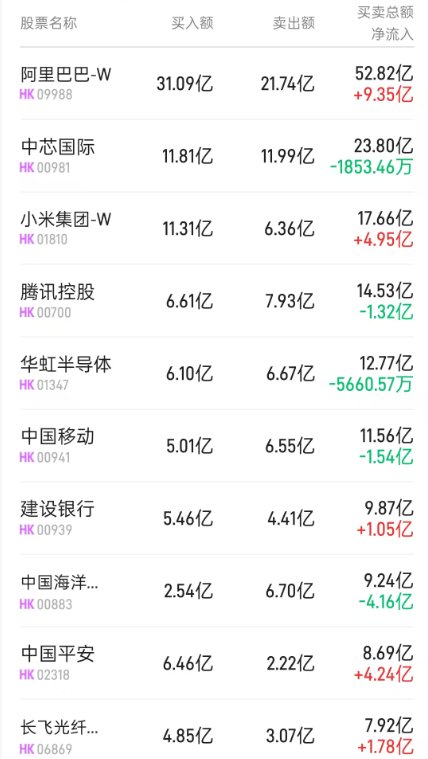
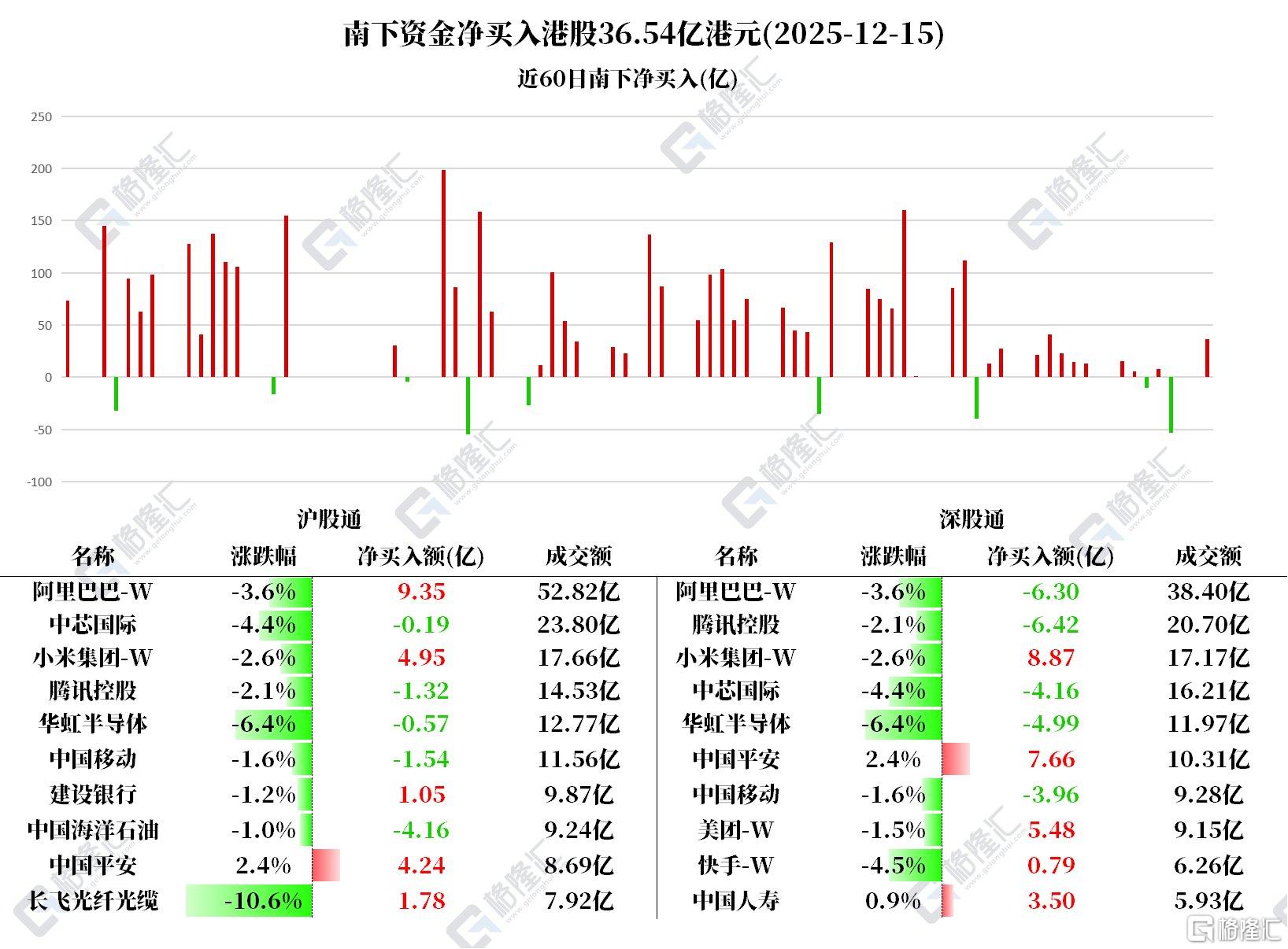
Group 1 - The core point of the news is that the Hong Kong stock market saw significant net buying from northbound capital, totaling HKD 36.54 billion, with Xiaomi Group, Ping An of China, and Meituan being the most bought stocks, while Tencent, Hua Hong Semiconductor, and China Mobile were the most sold [1][4]. Group 2 - Xiaomi Group (01810) received a net inflow of HKD 13.81 billion, driven by the completion of its first major home appliance factory in Wuhan, marking a key milestone in its smart home strategy [4]. - Ping An of China (02318) attracted a net inflow of HKD 11.89 billion, supported by positive research reports from major financial institutions and a recent regulatory easing that allows insurance companies to invest more long-term funds [4]. - Alibaba Group (09988) saw a net inflow of HKD 3.04 billion, with news of Meta using Alibaba's technology to optimize its AI models and the launch of a new cloud computing service [4]. - Kuaishou Technology (01024) gained a net inflow of HKD 790.3 million, with analysts predicting strong revenue growth due to its focus on user growth over immediate profitability [5]. - Semiconductor companies, including SMIC (00981) and Hua Hong Semiconductor (01347), faced net outflows of HKD 4.34 billion and HKD 5.55 billion respectively, influenced by regulatory changes regarding chip sales to China [5].
南向资金今日净买入36.54亿港元
Xin Lang Cai Jing· 2025-12-15 10:03
Group 1 - Alibaba-W and Xiaomi Group-W received net purchases of HKD 9.35 billion and HKD 4.95 billion respectively through the Hong Kong Stock Connect (Shanghai) [1] - China National Offshore Oil Corporation (CNOOC) had the highest net sell amount at HKD 4.16 billion [1] - Through the Hong Kong Stock Connect (Shenzhen), Xiaomi Group-W and China Ping An received net purchases of HKD 8.87 billion and HKD 7.66 billion respectively [1] Group 2 - Tencent Holdings had the highest net sell amount at HKD 6.42 billion through the Hong Kong Stock Connect (Shenzhen) [1]

南向资金丨小米集团获净买入13.82亿港元


Di Yi Cai Jing· 2025-12-15 10:03
Core Viewpoint - Southbound funds recorded a net purchase of 36.54 billion HKD, with Xiaomi Group-W, China Ping An, and Meituan-W leading the net purchases at 13.82 billion HKD, 11.90 billion HKD, and 5.48 billion HKD respectively [1] Group 1 - Xiaomi Group-W received a net purchase of 13.82 billion HKD [1] - China Ping An saw a net purchase of 11.90 billion HKD [1] - Meituan-W had a net purchase of 5.48 billion HKD [1] Group 2 - Tencent Holdings experienced a net sell of 7.74 billion HKD [1] - Hua Hong Semiconductor faced a net sell of 5.55 billion HKD [1] - China Mobile recorded a net sell of 5.50 billion HKD [1]
资金动向 | 北水单日流入港股逾36亿港元,连续12日扫货小米
Ge Long Hui· 2025-12-15 10:01
Group 1: Market Activity - Net inflows into Xiaomi Group reached HKD 1.382 billion, China Ping An HKD 1.19 billion, Meituan HKD 547 million, China Life HKD 350 million, Alibaba HKD 304 million, Yangtze Optical HKD 177 million, and China Construction Bank HKD 104 million [1] - Net outflows included Tencent Holdings at HKD 774 million, Hua Hong Semiconductor HKD 555 million, China Mobile HKD 550 million, SMIC HKD 434 million, and CNOOC HKD 416 million [1] - Southbound funds have continuously net bought Xiaomi for 12 days totaling HKD 12.15043 billion and Meituan for 4 days totaling HKD 4.62952 billion [1] Group 2: Company Developments - Xiaomi Group's first major appliance factory in Wuhan has officially commenced production, with the first self-produced appliance, "Mijia Central Air Conditioning Pro Dual Fan," set to launch soon [3] - China Ping An is responding to the recent regulatory changes aimed at encouraging long-term capital, enhancing market sentiment, and focusing on healthcare management services through AI innovations [4] - Meituan has decided to suspend its "Tuan Hao Huo" business to focus on exploring new retail formats [5]

北水动向|北水成交净买入36.54亿 北水抢筹大金融板块 全天加仓中国平安(02318)近12亿港元
智通财经网· 2025-12-15 10:01
Summary of Key Points Core Viewpoint - The Hong Kong stock market experienced significant net inflows from northbound capital, with a total net buy of HKD 36.54 billion on December 15, 2023, indicating strong investor interest in certain stocks while others faced net selling pressure [1]. Group 1: Stock Performance - The top net bought stocks included Xiaomi Group-W (01810), China Ping An (02318), and Meituan-W (03690) [1]. - The stocks with the highest net selling included Tencent (00700), Hua Hong Semiconductor (01347), and China Mobile (00941) [1]. - Xiaomi Group-W received a net buy of HKD 13.81 billion, marking a significant milestone with the opening of its first major home appliance factory in Wuhan [4]. - China Ping An and China Life received net buys of HKD 11.89 billion and HKD 3.5 billion, respectively, supported by favorable reports from major financial institutions [4]. Group 2: Market Trends - The banking sector is experiencing a mid-term dividend wave, with major banks expected to distribute over HKD 200 billion in cash dividends [4]. - Alibaba-W (09988) saw a net buy of HKD 3.04 billion, bolstered by news of Meta utilizing Alibaba's technology for AI model optimization [5]. - Kuaishou-W (01024) received a net buy of HKD 790.3 million, with analysts projecting strong revenue contributions from its AI initiatives [5]. Group 3: Sector Analysis - Semiconductor stocks like SMIC (00981) and Hua Hong Semiconductor (01347) faced net selling of HKD 4.34 billion and HKD 5.55 billion, respectively, amid regulatory changes allowing NVIDIA to sell chips to approved Chinese clients [5]. - The insurance sector is expected to benefit from regulatory adjustments that lower risk factors for insurance companies, allowing for increased long-term investment [4].
数据看盘银行ETF连续两周份额大减 7.76亿元资金抢筹雷科防务
Sou Hu Cai Jing· 2025-12-15 09:57
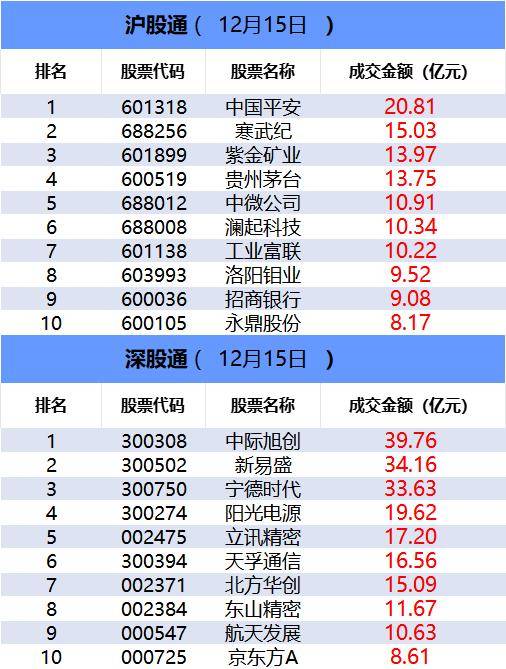
Group 1 - The total trading volume of the Shanghai and Shenzhen Stock Connect today reached 212.06 billion, with China Ping An and Zhongji Xuchuang leading in individual stock trading volume [1][2] - The defense and military industry sector saw the highest net inflow of funds, indicating strong investor interest [1][5] - The bank ETF (512800) experienced a significant reduction in shares, decreasing by 2.6 billion shares last week and 1.9 billion shares in the first week of December [1][12] Group 2 - The top ten stocks by trading volume in the Shanghai Stock Connect included China Ping An at 20.81 billion, followed by Cambricon Technologies and Zijin Mining [3] - In the Shenzhen Stock Connect, Zhongji Xuchuang led with a trading volume of 39.76 billion, followed by Xinyi Solar and CATL [3] - The sectors with the highest gains included dairy, insurance, retail, and precious metals, while sectors like CPO, film and television, and semiconductors saw declines [4][6] Group 3 - The top five stocks with the highest net inflow of funds included Leike Defense at 14.14 billion, followed by Aerospace Electronics and Yiwei Communication [7] - The stocks with the highest net outflow included Changying Precision at -1.46 billion and Luxshare Precision at -1.31 billion [7] - The top ten ETFs by trading volume were led by the Hong Kong Securities ETF (513090) with 10.39 billion, followed by A500 ETF Huatai Baichuan [9] Group 4 - The ETFs with the highest week-on-week share growth included A500 ETF Huatai Baichuan, which increased by 3.276 billion shares, and A500 ETF Southern, which grew by 3.102 billion shares [11] - The bank ETF (512800) saw a significant reduction in shares for two consecutive weeks, indicating a bearish sentiment in the banking sector [12]


图解丨南下资金净买入小米、中国平安
Ge Long Hui A P P· 2025-12-15 09:52
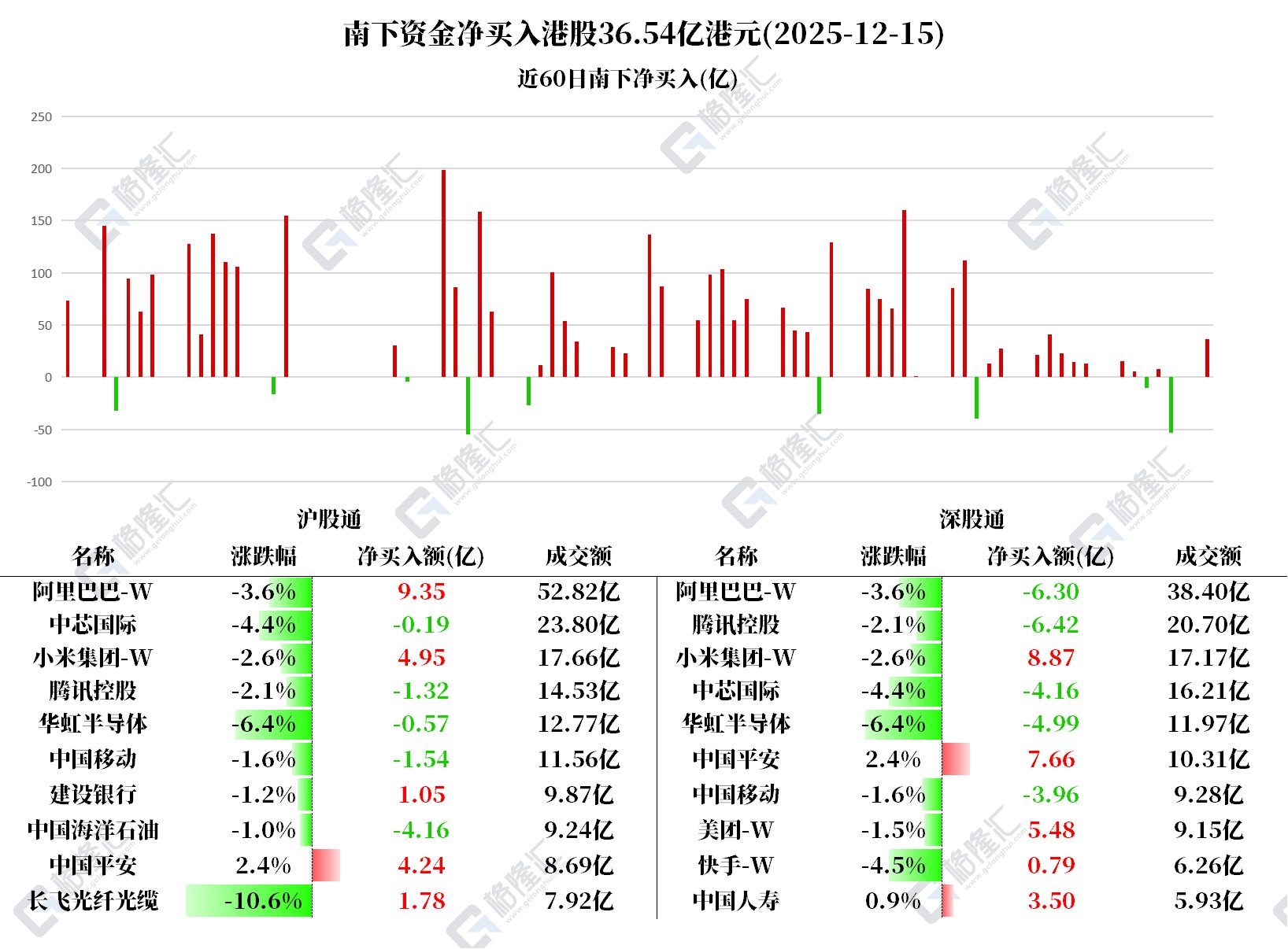
Group 1 - Southbound funds net bought Hong Kong stocks worth 36.54 billion HKD today [1] - Notable net purchases include Xiaomi Group-W (13.82 billion HKD), China Ping An (11.9 billion HKD), and Meituan-W (5.47 billion HKD) [1] - Continuous net buying trends observed for Xiaomi (12 days, total 121.5043 billion HKD) and Meituan (4 days, total 46.2952 billion HKD) [1] Group 2 - Significant net selling includes Tencent Holdings (7.74 billion HKD), Hua Hong Semiconductor (5.55 billion HKD), and China Mobile (5.5 billion HKD) [1] - Continuous net selling trends noted for SMIC (5 days, total 19.8564 billion HKD) and Tencent (4 days, total 24.9089 billion HKD) [1] - Other companies with net selling include China National Offshore Oil (4.16 billion HKD) and Hua Hong Semiconductor (15.4751 billion HKD) [1] Group 3 - Alibaba-W experienced a decline of 3.6% with a net buy of 9.35 million HKD [1] - SMIC saw a drop of 4.4% with a net sell of 0.19 million HKD [1] - China Ping An increased by 2.4% with a net buy of 4.24 million HKD [1]
利好!消费板块,集体拉升!
Zheng Quan Shi Bao· 2025-12-15 09:21
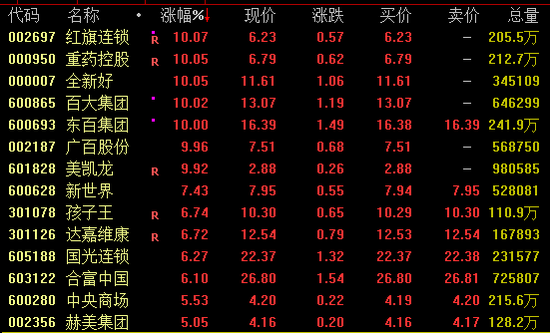
炒股就看金麒麟分析师研报,权威,专业,及时,全面,助您挖掘潜力主题机会! 15日,A股主要股指集体下挫,创业板指、科创50指数午后加速下探;港股亦走低,恒生指数跌超 1%,恒生科技指数跌超2%。 具体来看,沪指盘中震荡回落,午后加速下行;创业板指、科创50指数等大幅下挫。截至收盘,沪指跌 0.55%报3867.92点,深证成指跌1.1%,创业板指跌1.77%,科创50指数跌2.22%,沪深北三市合计成交 17945亿元,较此前一日减少逾3200亿元。 全A股近3000股飘绿,半导体板块回调,芯原股份跌近12%,江波龙跌超8%,摩尔线程跌超6%;AI产 业链股跳水,腾景科技、仕佳光子跌超10%;保险板块逆市拉升,市值超万亿元的中国平安涨约5%, 创逾4年来新高;零售板块强势,百大集团连续3日涨停,东百集团7日斩获6板;乳业股集体走高,欢乐 家、皇氏集团(维权)、阳光乳业等涨停;商业航天概念热度不减,航天电子、通宇通讯等涨停。 港股方面,华虹半导体跌超6%,中芯国际跌逾4%,阿里巴巴等跌超3%。 保险板块强势 保险板块盘中大幅拉升,中国平安涨约5%,创逾4年来新高,全日成交超100元。此外,中国太保涨 3.5%, ...