PING AN OF CHINA(601318)

Search documents
利好!消费板块,集体拉升!
证券时报· 2025-12-15 09:18
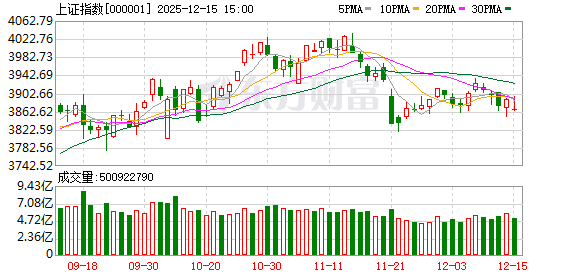
Market Overview - A-shares experienced a collective decline on the 15th, with major indices such as the ChiNext and Sci-Tech 50 Index falling sharply. The Shanghai Composite Index closed down 0.55% at 3867.92 points, while the Shenzhen Component Index fell 1.1%, and the ChiNext Index dropped 1.77% [1] - The total trading volume in the Shanghai and Shenzhen markets was 17,945 billion yuan, a decrease of over 3,200 billion yuan compared to the previous day [1] Sector Performance Insurance Sector - The insurance sector showed strong performance, with China Ping An rising approximately 5%, reaching a new high not seen in over four years. Other companies like China Pacific Insurance and China Life Insurance also saw gains of around 3% [4][5] - Analysts suggest that the insurance sector is entering a recovery phase, supported by regulatory policies that alleviate pressure on profit margins and improve asset performance. The sector is expected to see a positive growth cycle in new policies and profitability [5] Retail Sector - The retail sector was notably active, with several companies such as Hongqi Chain and Dongbai Group hitting the daily limit up. Dongbai Group achieved six consecutive limit-up days [7][9] - The retail sales total for January to November showed a year-on-year growth of 4%, indicating a faster pace than the previous year [9] - The Ministry of Commerce plans to enhance support for the retail industry, focusing on quality-driven and service-driven development during the 14th Five-Year Plan period [10] Dairy Industry - The dairy sector also performed well, with companies like Huanlejia and Huangshi Group reaching their daily limit up. The overall dairy industry is expected to benefit from policy stimuli aimed at improving population issues and increasing demand [11][12] AI Industry - The AI industry saw a significant pullback, with companies like Tengjing Technology and Shijia Photon dropping over 10%. The overall sentiment in the AI sector remains cautious despite ongoing demand for computing power [13][14] - Analysts from CITIC Securities remain optimistic about the AI computing power sector, highlighting the potential for domestic companies to enhance their capabilities and infrastructure [16]




创四年新高!中国平安引领保险股估值修复
Huan Qiu Wang· 2025-12-15 09:17
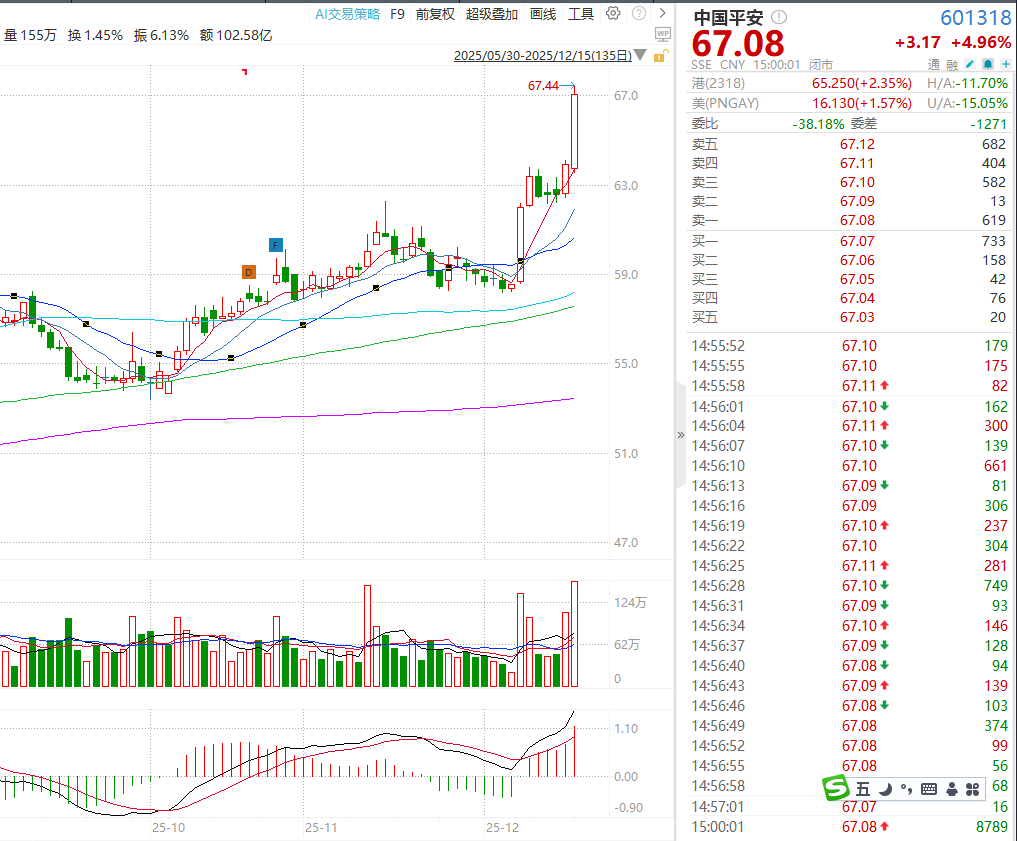
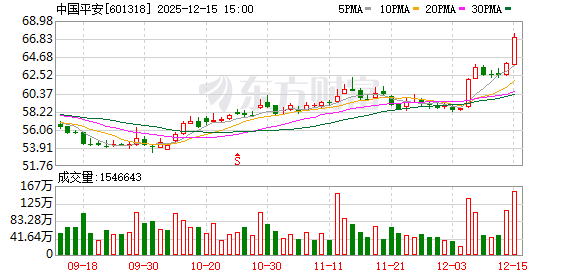
Core Viewpoint - China Ping An Insurance (Group) Co., Ltd. has seen a significant rise in both A and H shares, reaching four-year highs, driven by multiple favorable factors including policy support and market sentiment [1][4]. Group 1: Stock Performance - On December 15, China Ping An's A shares surged by 4.96% to 67.08 yuan, with a trading volume of 10.3 billion yuan, while H shares increased by 2.51% [1]. - This follows a previous increase of 5.88% on December 5, indicating strong market momentum [1]. Group 2: Policy Support - The National Financial Regulatory Administration has lowered risk factors for certain insurance company operations, particularly reducing the risk factor for long-term assets from 0.3 to 0.27, which allows insurers to invest more capital [1]. - This policy change is expected to support the cultivation of "patient capital" and provide substantial long-term benefits to insurance companies [1]. Group 3: Industry Trends - The insurance industry is entering a synchronized expansion phase, with low interest rates driving the popularity of dividend insurance products, leading to stable premium income growth [2]. - China Ping An has proactively increased its equity investment, with over 800 billion yuan in secondary market equity investments, enhancing its investment performance amid a slowly rising stock market [2]. Group 4: Company Fundamentals - China Ping An's management emphasizes the importance of "operating profit" as a long-term quality indicator, excluding short-term investment fluctuations [3]. - The company has significant unrealized gains from stock investments, which bolster its net assets and ensure stable future dividends, maintaining a dividend yield above 4% [3]. Group 5: Market Sentiment and Analyst Views - Major investment firms like Morgan Stanley have included China Ping An in their recommended lists, raising target prices for A and H shares, indicating a shift in market sentiment as previous concerns dissipate [4]. - Analysts suggest that the current rise in stock prices reflects a re-evaluation of the core value of the insurance industry, moving from a focus on short-term risks to recognizing long-term operational value [4].
摩根大通(JPMorgan)对中国平安的多头持仓比例增至7.93%
Xin Lang Cai Jing· 2025-12-15 09:14
据香港交易所披露,摩根大通(JPMorgan)对中国平安保险(集团)股份有限公司 - H股的多头持仓比例 于2025年12月9日从7.87%增至7.93%。 ...

保险板块12月15日涨3%,中国平安领涨,主力资金净流入6.11亿元
Zheng Xing Xing Ye Ri Bao· 2025-12-15 09:08
以上内容为证券之星据公开信息整理,由AI算法生成(网信算备310104345710301240019号),不构成投资建议。 从资金流向上来看,当日保险板块主力资金净流入6.11亿元,游资资金净流入3.42亿元,散户资金净流 出9.53亿元。保险板块个股资金流向见下表: 证券之星消息,12月15日保险板块较上一交易日上涨3.0%,中国平安领涨。当日上证指数报收于 3867.92,下跌0.55%。深证成指报收于13112.09,下跌1.1%。保险板块个股涨跌见下表: ...

不超过200亿元!平安人寿获批发行资本补充债券
Bei Jing Shang Bao· 2025-12-15 08:53
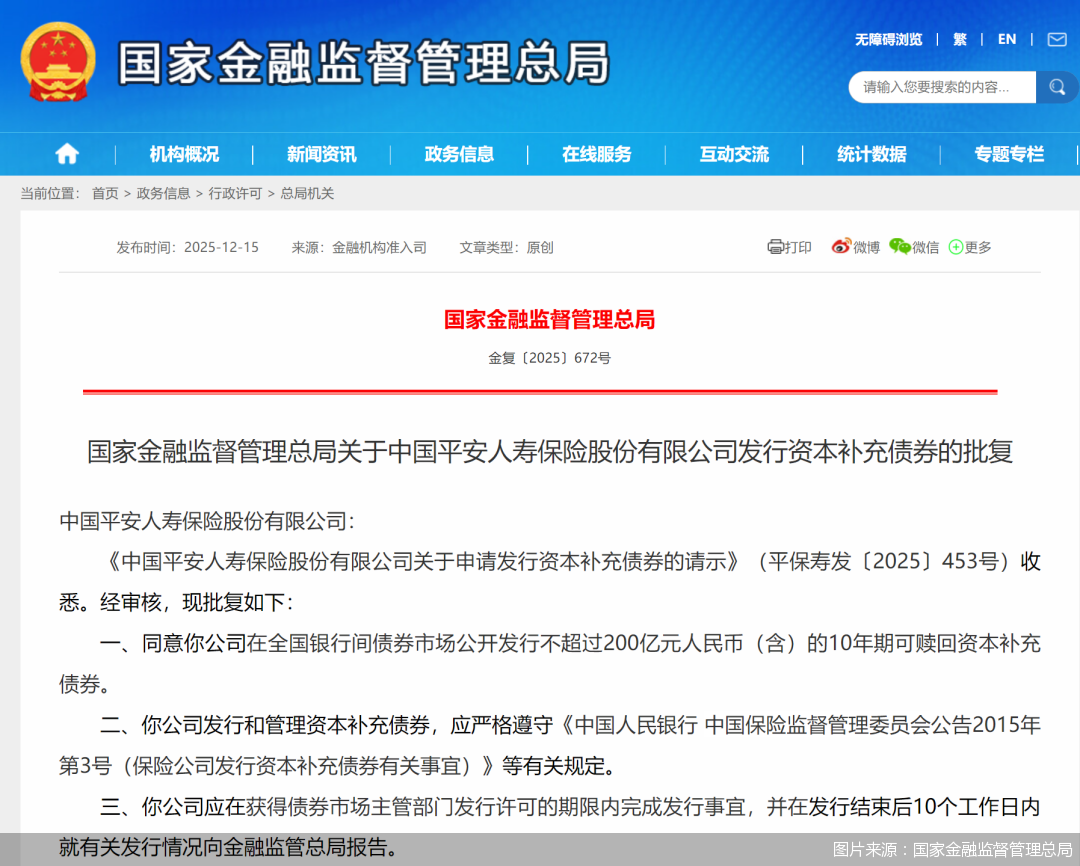
Core Viewpoint - The National Financial Regulatory Administration has approved China Ping An Life Insurance Co., Ltd. to issue up to 20 billion RMB of 10-year redeemable capital supplement bonds in the national interbank bond market [1] Group 1 - The approval allows Ping An Life to strengthen its capital base through the issuance of bonds [1] - The bonds will be redeemable, providing flexibility for the company in managing its capital structure [1] - The issuance is part of a broader strategy to enhance financial stability and support growth initiatives within the company [1]

港股收盘 | 恒指收跌1.34% 科技股普遍承压 黄金、保险股逆市走高
Zhi Tong Cai Jing· 2025-12-15 08:53
Market Overview - The Hong Kong stock market faced downward pressure, with the Hang Seng Index and the Hang Seng China Enterprises Index both declining over 1%, and the Hang Seng Tech Index dropping over 2% [1] - The Hang Seng Index closed down 1.34% or 347.91 points at 25,628.88 points, with a total trading volume of HKD 204.29 billion [1] - Dongwu Securities believes that the Hong Kong stock market is still in the pre-rebound phase, indicating attractive long-term positioning despite ongoing risks [1] Blue-Chip Stocks Performance - Li Ning (02331) led the blue-chip stocks, rising 5.43% to HKD 18.64, contributing 3.53 points to the Hang Seng Index [2] - Other notable blue-chip performances included New Oriental-S (09901) up 2.81%, China Ping An (02318) up 2.35%, while Hansoh Pharmaceutical (03692) fell 7.58% and SMIC (00981) dropped 4.43% [2] Sector Performance - Major technology stocks generally declined, with Alibaba down 3.57% and Tencent down 2.11%, amid renewed concerns over an AI bubble following disappointing earnings from leading AI companies [3] - Gold stocks saw significant gains, with Zijin Mining (02259) up 7.76% and Chifeng Jilong Gold Mining (06693) up 5.59%, as international gold prices approached historical highs [3][4] - The insurance sector performed well, with China Ping An reaching a four-year high, supported by regulatory changes that allow for more long-term investment funds [5][6] Notable Stock Movements - Cloudtop New Horizon (01952) saw a rise of 4.55% to HKD 46.88, with significant share purchases by key executives [7] - Sanhua Intelligent Control (002050) faced pressure, dropping 7.25% to HKD 33.78, ahead of a significant cornerstone investor lock-up expiration [8]
为何今天市场表现不佳!原因找到了
Zhong Guo Ji Jin Bao· 2025-12-15 08:40
Market Performance Summary - The A-share market experienced a decline on December 15, with the Shanghai Composite Index falling by 0.55%, the Shenzhen Component Index dropping by 1.1%, and the ChiNext Index decreasing by 1.77% [2] - A total of 2,314 stocks rose, with 65 hitting the daily limit, while 2,968 stocks fell [3] Sector Performance - The consumer sector showed resilience, with companies like Yangguang Dairy and Dongbai Group reaching their daily limit [3] - The commercial aerospace concept stocks remained active, with companies such as Leike Defense and Tongyu Communication also hitting their daily limit [4] - The insurance sector strengthened, with China Ping An's stock price increasing by nearly 5%, reaching a four-year high [5] - Conversely, computing hardware stocks weakened, with Changfei Optical Fiber and Yueling Co. hitting their daily limit down [6] Market Influences - The market's decline was influenced by negative sentiment from AI-related stocks in the US, where major tech companies like Nvidia, Oracle, and Broadcom experienced significant drops, reigniting concerns over the AI bubble and infrastructure prospects [7] - The overall risk appetite was further pressured by simultaneous declines in Japanese and South Korean markets, attributed to the spillover effect from the US tech stock downturn [7] - Economic data released on December 15 indicated a slowdown in retail sales growth, with November's total at 43,898 billion yuan, reflecting a year-on-year increase of only 1.3%, down from 2.9% previously [8] - Additionally, real estate development investment for January to November totaled 78,591 billion yuan, marking a year-on-year decrease of 15.9%, with residential investment down by 15.0% [8]
中国平安12月15日收盘涨4.96% 股价创下近4年新高
Zheng Quan Ri Bao· 2025-12-15 08:40
(文章来源:证券日报) 本报讯 (记者丁蓉)12月15日收盘,保险股集体飘红。作为保险龙头股之一,中国平安保险(集团) 股份有限公司(以下简称"中国平安")当日涨幅4.96%。收盘报67.08元/股,股价创下近4年新高。 中国平安坚守金融主业,推动高质量发展。该公司2025年三季报显示,整体业绩稳健增长。前三季度, 中国平安实现归属于母公司股东的营运利润1162.64亿元,同比增长7.2%。归属于母公司股东的净利润 1328.56亿元,同比增长11.5%,第三季度当季同比大幅增长45.4%;营业收入8329.40亿元,同比增长 7.4%。截至9月30日,中国平安归属于母公司股东权益9864.06亿元,较年初增长6.2%。 ...
12月15日主题复盘 | 指数缩量调整,航天板块继续强势,大消费持续活跃,福建自贸再度表现
Xuan Gu Bao· 2025-12-15 08:35
Market Overview - The market experienced fluctuations with the Shenzhen Component Index and ChiNext Index both declining over 1% while the consumer sector saw significant gains, with companies like Sunshine Dairy and Dongbai Group hitting the daily limit [1] - The commercial aerospace sector remained active, with stocks such as Reco Defense and Tongyu Communication also reaching the daily limit [1] - The insurance sector strengthened, with China Ping An rising nearly 5%, marking a four-year high [1] - In contrast, computing hardware stocks weakened, with Changfei Optical Fiber and Yueling Co. hitting the daily limit down [1] - Approximately 3,000 stocks in the Shanghai and Shenzhen markets declined, with a total trading volume of 1.79 trillion [1] Aerospace Sector - The aerospace sector continued its strong performance, with companies like Reco Defense achieving an 8-day consecutive rise and Tongyu Communication hitting the daily limit [4] - Shanghai Jiao Tong University signed an agreement with Guoxing Aerospace to establish the first space computing joint laboratory in China, aimed at developing a space computing industry cluster [4][7] - The Shenyang Municipal Committee proposed plans to enhance the aerospace industry, including the development of a comprehensive aerospace industrial base [4] - The market is witnessing a shift towards mass production of satellites, moving from custom manufacturing to assembly line production [7] Consumer Sector - The consumer sector saw a notable increase, with companies like Baida Group and Meikailong hitting the daily limit [8][10] - An important article in the "Qiushi" magazine emphasized the strategic importance of expanding domestic demand [9][11] - The price of high-end liquor, such as the 25-year-old Feitian Moutai, has seen significant increases, with a 6% rise over two days [9][11] Fujian Free Trade Zone - The Fujian Free Trade Zone sector was active, with stocks like Sun Cable and Huaying Technology reaching the daily limit [12][13] - The development of the "Fudao" project in Fujian is expected to enhance the region's infrastructure and economic growth [13] Key Stock Performances - Reco Defense: Latest price 9.98, up 10.03%, market cap 12.905 billion [6] - Tongyu Communication: Latest price 32.01, up 10.00%, market cap 10.672 billion [6] - Baida Group: Latest price 13.07, up 10.02%, market cap 4.917 billion [10] - Meikailong: Latest price 2.88, up 9.92%, market cap 10.407 billion [10]



似曾相识?科技主线“换挡” 今天这个板块再度补位 能否持续?
Mei Ri Jing Ji Xin Wen· 2025-12-15 08:35
A股三大指数今日集体回调,截至收盘,沪指跌0.55%,深证成指跌1.1%,创业板指跌1.77%。沪深两市成交额接近1.8万亿元,较上一交易日缩量逾3000 亿元。 个股方面,上涨股票数量超过2300只,逾60只股票涨停。保险、商业百货、食品饮料、化纤行业、贵金属板块涨幅居前,船舶制造、能源金属、半导体、 生物制品、消费电子板块跌幅居前。 A股又过了一个不温不火的周一。三大指数均小幅下跌,成交也出现萎缩。 这种不温不火,更多原因在于前期市场共识主线科技板块表现疲软。毕竟,在2025年大部分时间里,科技板块凭借产业政策利好与技术突破预期,吸引了 大量资金关注,成为引领市场行情的核心主线。当科技板块进入阶段性休整,资金出现短暂分流,市场自然也就少了一份强势拉升的动力。 与科技板块形成鲜明对比的是,消费板块今日悄然扛起了承接资金的大旗。更重要的是,在科技休息的换挡期,关于消费的重磅利好出台,又恰好弥补了 科技板块消息真空期的空档。 12月14日,商务部、中国人民银行、金融监管总局联合发布《关于加强商务和金融协同更大力度提振消费的通知》,强化商务和金融系统协作,引导金融 机构聚焦消费重点领域加大支持力度,助力提振和扩大 ...