
PING AN OF CHINA(601318)

Search documents
电力设备掀涨停潮!A股下周怎么走?
Guo Ji Jin Rong Bao· 2025-12-12 14:49
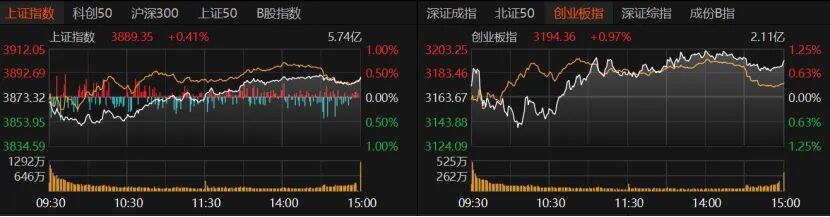
Core Viewpoint - The A-share market experienced a significant increase in trading volume, driven by positive signals from the Central Economic Work Conference, although there remains notable sector differentiation in performance [1][9]. Market Performance - The trading volume reached 2.12 trillion yuan, an increase of 233.7 billion yuan from the previous day, with the Shanghai Composite Index rising by 0.41% to 3889.35 points and the ChiNext Index increasing by 0.97% to 3194.36 points [2]. - A total of 2683 stocks rose, with 83 hitting the daily limit up, while 2612 stocks fell, with 26 hitting the daily limit down [6][7]. Sector Analysis - Technology stocks, particularly in power equipment, communication, and defense industries, saw strong performance, with 21 out of 31 sectors rising, including notable gains in non-ferrous metals, electronics, and power equipment [4][9]. - The power equipment sector experienced a surge, with 19 stocks hitting the daily limit up, indicating strong investor interest [7]. Investment Trends - The Central Economic Work Conference emphasized support for technology innovation and new energy sectors, which has led to increased investment in related stocks, particularly in power equipment and communication sectors [9][10]. - The market sentiment is expected to remain positive, with potential for a "slow bull" market trend, driven by continued policy support and sector performance [10][11]. Future Outlook - Analysts suggest that the market may continue to experience fluctuations, with a focus on sectors that align with policy support, particularly technology and cyclical industries [11][12]. - The upcoming spring market is anticipated to focus on sectors with significant growth potential, such as communication equipment benefiting from AI infrastructure and semiconductor industries supported by domestic substitution policies [12].



平安的新高 | 谈股论金
水皮More· 2025-12-12 10:14
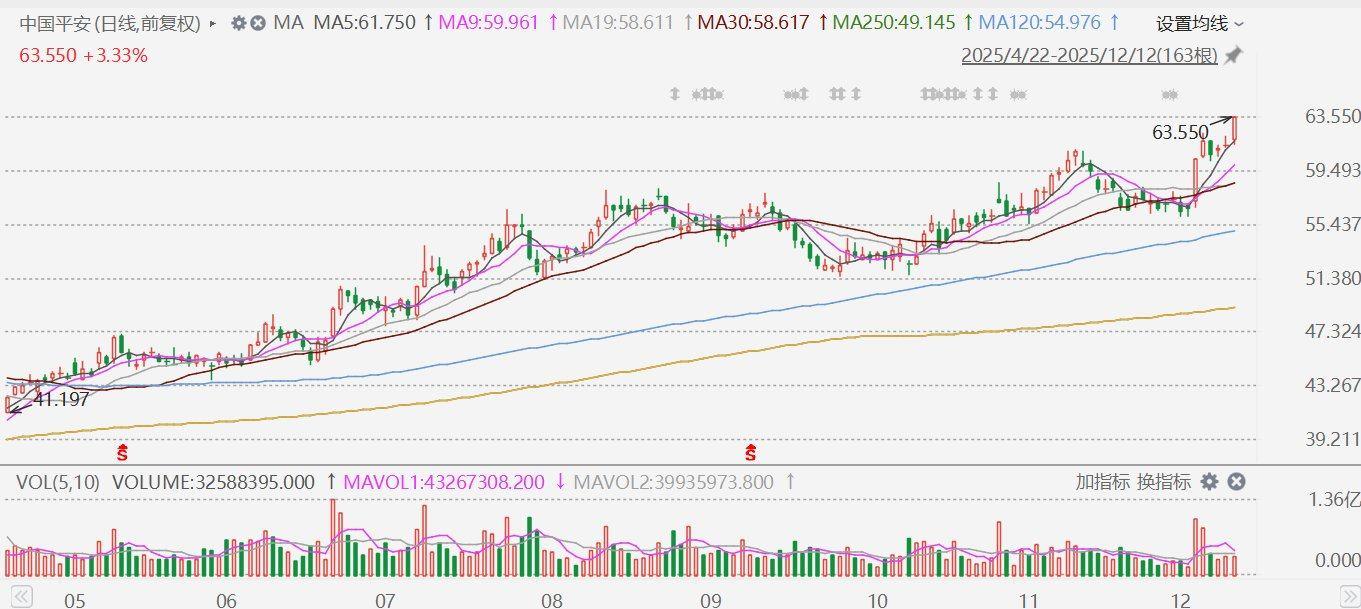
盘面消息 A股三大指数今日集体上涨,截止收盘,沪指涨0.41%,收报3889.35点;深证成指涨 0.84%,收报13258.33点;创业板指涨0.97%,收报3194.36点。 沪深两市成交额达到 20922亿,较昨日放量2351亿。 水皮杂谈 一家之言 兼听则明 偏听则暗 借力打力 老水看盘 中国平安再度创下新高。 今天盘中,平安最高价达 64.09 元/股,收盘价为 63.91 元 /股 ,不仅盘中创新高,收盘 价亦刷新纪录,涨幅约 2.2%。其稳健上涨直接带动保险板块走强,保险板块今天在金融板块 中表现最佳,涨幅达 1.55%,位居涨幅榜前列。值得关注的是,中国平安对上证指数的拉动 作用显著,一度成为上证指数的最大贡献股。事实上,上周五中国平安就已表现亮眼,直接推 动上证指数走出大幅反弹行情,连续两周助力指数走强,其表现值得关注。 中国平安之所以能有如此表现,主要有三方面原因:其一,行业获投行看好,某机构上周专门 发布研报予以肯定;其二,金融监管总局下调保险资金投资大蓝筹的风险因子,这为保险资金 入市提供了有力支撑,也让市场对保险公司的业绩增长抱有期待;其三,中国平安在保险板块 中今年涨幅不大,当前存 ...


「数据看盘」北向、游资“爆买”联特科技 量化资金激烈博弈摩尔线程
Sou Hu Cai Jing· 2025-12-12 10:05
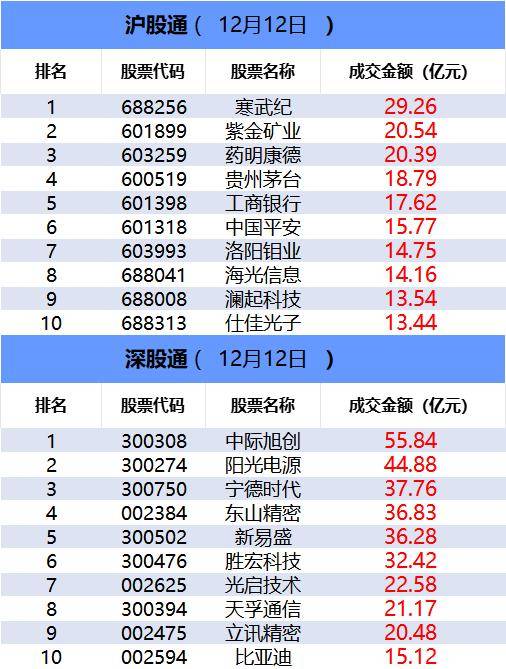
从沪股通前十大成交个股来看,寒武纪位居首位;紫金矿业和药明康德分居二、三位。 二、板块个股主力大单资金 一、沪深股通前十大成交 今日沪股通总成交金额为1498.83亿,深股通总成交金额为1598亿。 | | | 沪股通( 12月12日 ) | | | --- | --- | --- | --- | | 排名 | 股票代码 | 股票名称 | 成交金额(亿元) | | 1 | 688256 | 寒武纪 | 29.26 | | 2 | 668109 | 三十四年 | 20.54 | | 3 | 603259 | 约明康德 | 20.39 | | 4 | 600519 | 贵州茅台 | 18.79 | | 5 | 601398 | 工商银行 | 17.62 | | 6 | 601318 | 中国平安 | 15.77 | | 7 | 603993 | 洛阳铜V | 14.75 | | 8 | 688041 | 海光信息 | 14.16 | | 9 | 688008 | 測起科技 | 13.54 | | 10 | 688313 | 仕佳光子 | 13.44 | | | 一環證 | 12月12日 ) | | | 排名 | ...




数据看盘北向、游资“爆买”联特科技 量化资金激烈博弈摩尔线程
Sou Hu Cai Jing· 2025-12-12 09:59
Core Viewpoint - The total trading volume of the Shanghai and Shenzhen Stock Connect reached 309.68 billion, with significant trading activity in specific stocks and sectors, indicating a dynamic market environment [1]. Trading Volume Summary - The total trading amount for the Shanghai Stock Connect was 149.88 billion, while the Shenzhen Stock Connect totaled 159.8 billion [2]. - The top traded stocks included Cambricon (29.26 billion) and Zhongji Xuchuang (55.84 billion) for Shanghai and Shenzhen respectively [3]. Sector Performance - The leading sectors in terms of net inflow of funds were power grid equipment (48.52 billion) and electric new industry (26.91 billion) [6]. - Sectors with the highest gains included controllable nuclear fusion, precious metals, and commercial aerospace, while retail and real estate sectors saw declines [5]. ETF Trading Activity - The top ETF by trading volume was A500ETF Huatai Baichuan with 105.91 billion, followed by Hong Kong Securities ETF at 99.49 billion [9]. - The China Securities 500 ETF (159922) experienced a remarkable trading volume increase of 258% compared to the previous trading day [10]. Stock Specific Activity - Notable stocks with significant net inflow included Dongshan Precision (11.51 billion) and BYD (8.28 billion) [7]. - Conversely, stocks with the highest net outflow included Sunshine Power (-21.87 billion) and Changying Precision (-14.64 billion) [7]. Institutional and Retail Activity - Institutional trading was active, with notable purchases in Guocera Materials (1.86 billion) and Zhongneng Electric (1.24 billion) [12]. - Retail investors showed high activity, particularly in stocks like Lian Te Technology, which saw significant net buying from various brokerage firms [14]. Quantitative Fund Activity - Quantitative funds were notably active, with significant trading in stocks like Moer Thread, which saw a net inflow of 2.07 billion from Morgan Stanley and outflows from multiple firms [15].
中国平安今日大宗交易平价成交25.11万股,成交额1604.78万元
Xin Lang Cai Jing· 2025-12-12 09:44
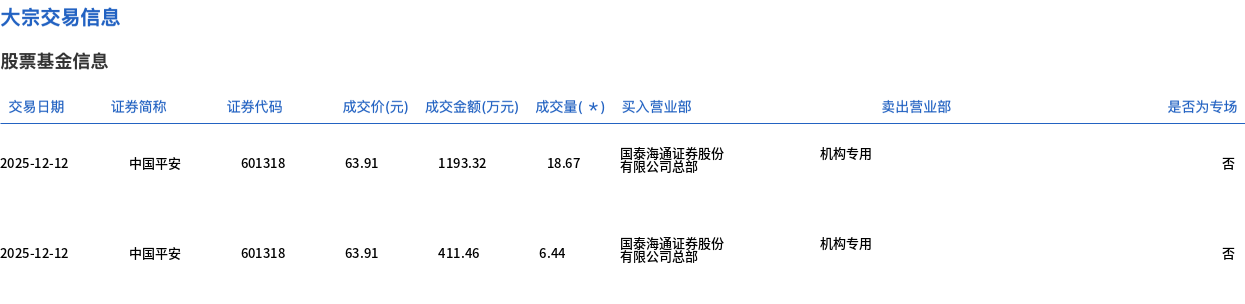
Group 1 - The core point of the news is that China Ping An conducted a block trade on December 12, with a total of 251,100 shares traded, amounting to 16.0478 million yuan, which represents 0.23% of the total trading volume for that day [1] - The transaction price was 63.91 yuan, which remained stable compared to the market closing price of 63.91 yuan [1] - The trading volume was split between two transactions, with one transaction amounting to 11.9332 million yuan for 18,670 shares and another for 4.1146 million yuan for 6,440 shares, both executed by Guotai Junan Securities [2]
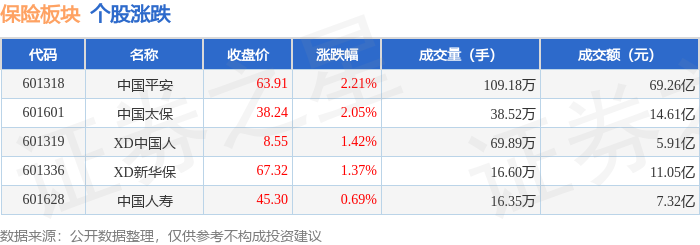
保险板块12月12日涨1.25%,中国平安领涨,主力资金净流入3.03亿元
Zheng Xing Xing Ye Ri Bao· 2025-12-12 09:12
Core Insights - The insurance sector experienced a rise of 1.25% on December 12, with China Ping An leading the gains [1] - The Shanghai Composite Index closed at 3889.35, up 0.41%, while the Shenzhen Component Index closed at 13258.33, up 0.84% [1] Insurance Sector Performance - China Ping An (601318) closed at 63.91, with a gain of 2.21% and a trading volume of 1.0918 million shares, amounting to a transaction value of 692.6 million yuan [1] - China Pacific Insurance (601601) closed at 38.24, up 2.05%, with a trading volume of 385,200 shares and a transaction value of 146.1 million yuan [1] - XD China Life (61319) closed at 8.55, increasing by 1.42%, with a trading volume of 698,900 shares and a transaction value of 591 million yuan [1] - XD Xinhua Insurance (601336) closed at 67.32, up 1.37%, with a trading volume of 166,000 shares and a transaction value of 1.105 billion yuan [1] - China Life Insurance (601628) closed at 45.30, with a modest gain of 0.69%, trading 163,500 shares for a total value of 73.2 million yuan [1] Capital Flow Analysis - The insurance sector saw a net inflow of 303 million yuan from institutional investors, while retail investors experienced a net outflow of 637 million yuan [1] - The overall capital flow indicates a preference for institutional investment in the insurance sector on that day [1]



做民生 “缓冲垫” 当产业 “压舱石” 重庆保险业惠企利民促发展
Zhong Guo Xin Wen Wang· 2025-12-12 08:10
Core Viewpoint - The insurance industry in Chongqing is transforming from a reactive compensation model to a proactive service model, focusing on risk prevention and tailored solutions to enhance both public welfare and industrial development [1][8]. Group 1: Insurance as a "Buffer" for Livelihood - A low-cost accident insurance for the elderly, costing only 50 yuan, provides a coverage of 6,000 yuan for medical expenses, demonstrating the industry's commitment to supporting senior citizens [2]. - The insurance has already covered over 25,000 individuals, providing a total risk coverage of 1.58 billion yuan by September 2025 [2]. - New employment sectors, such as delivery and ride-sharing, have been provided with specialized insurance, covering 120,000 workers and resulting in over 4,300 claims amounting to more than 50 million yuan since 2023 [3]. Group 2: Insurance as an "Anchor" for Industry - Customized insurance solutions for businesses, such as food safety and employee accident insurance, have provided over 100 million yuan in risk coverage for companies like Sanhui Catering Culture Co., Ltd [4]. - The insurance industry is actively involved in risk management, offering services like safety training and hazard inspections alongside traditional coverage [4]. - A new insurance product for autonomous vehicles has been launched, enhancing claims efficiency through an integrated solution for liability determination [5]. Group 3: Safety as a "Firewall" for Risk Prevention - The insurance sector is shifting towards preventive measures, such as the "Red and Green Light" initiative, which has reduced accident rates by 50% in high-risk areas through infrastructure improvements [7]. - Risk reduction services have been implemented in tourist areas, providing 40 million yuan in risk coverage and enhancing safety through various precautionary measures [7]. - The insurance industry is increasingly seen as a proactive player in community safety, offering solutions that go beyond mere compensation [8].


540亿投资打水漂?从联姻到决裂,平安起诉华夏幸福和王文学
Sou Hu Cai Jing· 2025-12-12 07:06
就在昨天,平安起诉了华夏幸福,还有华夏幸福的董事长王文学。两家公司之前积攒的矛盾,彻底爆发 了。 2018年,华夏幸福因为环京楼市限购,陷入困境。 2022年,反对华夏幸福的"以股抵债";后来又因为"2元置换带"方案,反对它2025年半年报净亏68亿, 然后减持股份; 中国平安与华夏幸福,彻底决裂了! 平安看中了它的产业新城模式,以"白马骑士"的身份两次入股,合计投入了180亿,拿下华夏幸福25% 的股权,成为了第二大股东。 却没想到,华夏幸福在2021年暴雷。原来的大股东华夏控股的质押股份被平仓,平安被动成为了第一大 股东。 平安本来想拉华夏幸福一把,买了它十几笔金融产品,新增了360亿的债权投资。前前后后,对华夏幸 福的风险敞口达到540亿。 从暴雷后到2021年,平安对华夏幸福一直是支持的态度,牵头成立债委会、帮助它推进债务重组。 但之后隔阂就产生了。 但华夏幸福也有苦衷,金融负债高达2192亿,从2021年债务重组到今年11月,虽然已经化解了将近1927 亿,但也只是解决了债务的"形式"问题。 现在已经资不抵债,现金流和资产变现能力,根本无法支撑还债,预重整是彻底解决的途径。 但平安认为,预重整的程序 ...

港股保险股涨幅扩大,中国太平、中国人寿、中国太保涨超4%,阳光保险、中国平安涨超3%!中国平安股价再创2021年6月以来新高
Ge Long Hui· 2025-12-12 05:51
Group 1 - The core viewpoint of the article highlights a significant increase in the stock prices of Hong Kong insurance companies, with notable gains for China Taiping, China Life, and China Pacific, all rising over 4% [1] - China Ping An's stock price has reached a new high since June 2021, indicating strong market performance [1] - The overall trend shows a positive sentiment in the insurance sector, as several companies are experiencing substantial stock price increases [1]
内险股午后全线拉升 保险投资股票风险因子调降 险企资本运用效率有望提升
Zhi Tong Cai Jing· 2025-12-12 05:47
Core Viewpoint - The insurance sector is experiencing a significant rally, driven by regulatory changes that lower investment risk factors for insurance companies, enhancing capital efficiency and supporting long-term value investment [1] Group 1: Stock Performance - As of the report, major insurance stocks have seen substantial gains: China Life (601628) up 4.4% to HKD 28, China Pacific Insurance (601601) up 4.09% to HKD 34.08, China Ping An (601318) up 2.85% to HKD 63.25, and China Property & Casualty Insurance (02328) up 0.96% to HKD 16.9 [1] Group 2: Regulatory Impact - On December 5, the Financial Supervisory Commission lowered the risk factors for insurance companies investing in related stocks, which is expected to reduce capital occupation pressure and enhance fund utilization efficiency [1] - The adjustment is anticipated to support the continuous guidance of insurance funds as "patient capital," further promoting technological innovation and empowering the real economy [1] Group 3: Industry Outlook - Donghai Securities noted that the insurance sector is currently in a historically undervalued range, suggesting a focus on large listed insurance companies with significant competitive advantages [1] - Guosheng Securities highlighted that the insurance industry will benefit from the trend of bank deposits moving, with diversified demands in pensions, healthcare, and savings expected to drive industry expansion [1] - Short-term progress in the insurance companies' New Year business is expected to boost liability performance in 2026, while the adjustment of product interest rates is likely to alleviate industry spread loss risks [1] - The "reporting and operation integration" is seen as a way to reduce internal competition and increase concentration among leading companies, indicating a positive outlook for the insurance sector's allocation value [1]