PING AN OF CHINA(601318)

Search documents
资金风向标 | 26日两融余额增加19.65亿元 有色金属行业获融资净买入居首
Sou Hu Cai Jing· 2026-01-27 01:52
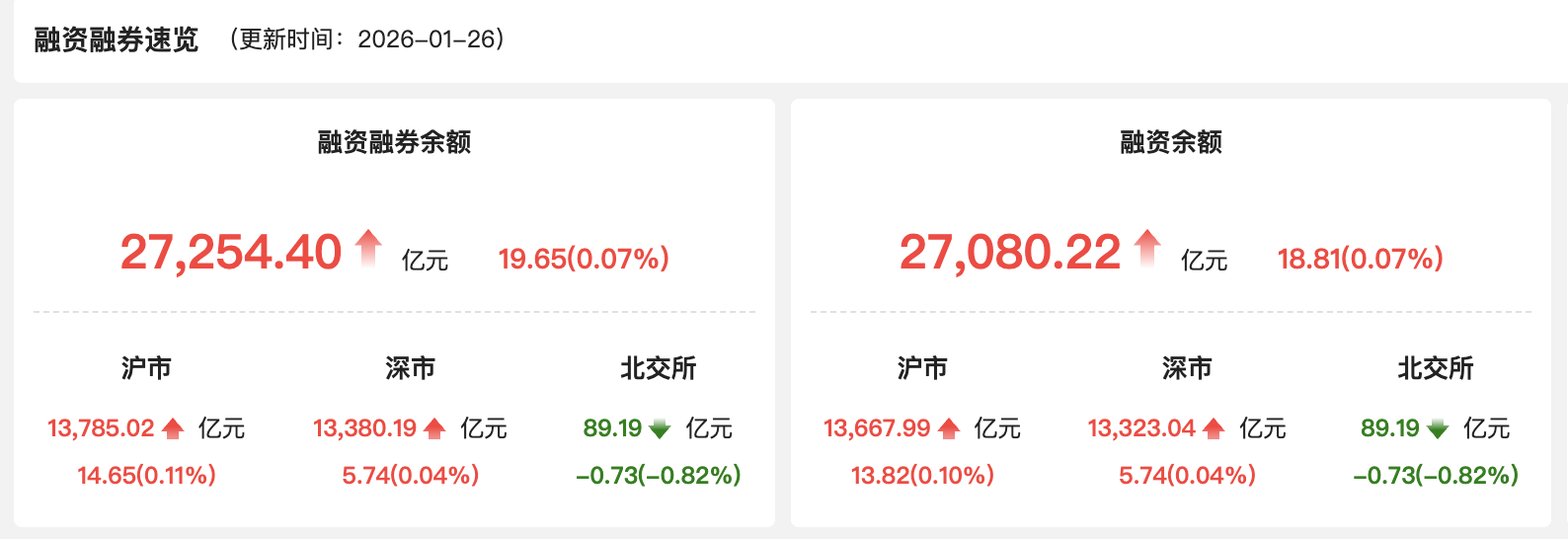
Group 1 - The total margin balance of A-shares reached 27,254.40 billion yuan on January 26, increasing by 19.65 billion yuan from the previous trading day, accounting for 2.62% of the A-share circulating market value [1] - The trading volume of margin transactions on the same day was 3,114.07 billion yuan, an increase of 79.37 billion yuan from the previous trading day, representing 9.48% of the total A-share trading volume [1] Group 2 - Among the 31 primary industries, 17 industries experienced net financing inflows, with the non-ferrous metals industry leading with a net inflow of 3.235 billion yuan [3] - Other industries with significant net financing inflows included electric power equipment, pharmaceutical biology, basic chemicals, and non-bank financials [3] Group 3 - A total of 53 stocks had net financing inflows exceeding 100 million yuan, with China Ping An leading at a net inflow of 444 million yuan [3] - Other notable stocks with high net financing inflows included Northern Rare Earth, China Aluminum, Western Mining, Maiwei Co., Oriental Fortune, Luoyang Molybdenum, Heng Rui Medicine, TBEA, and Industrial Bank [3][4]






上证180指数上涨0.22%,上证180ETF指数基金(530280)成立以来超越基准年化收益达2.32%
Xin Lang Cai Jing· 2026-01-27 01:48
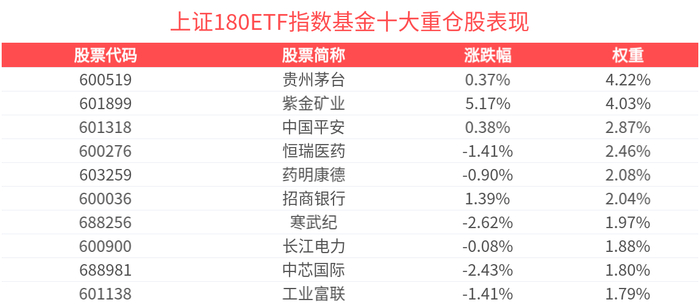
Core Viewpoint - The Shanghai 180 ETF Index Fund (530280) has shown a positive performance with a recent increase of 0.96%, reflecting a stable market trend and investor interest in the underlying assets [1]. Performance Summary - As of January 26, 2026, the Shanghai 180 Index (000010) increased by 0.22%, with notable gains from stocks such as Zijin Mining (up 10.00%) and China National Offshore Oil Corporation (up 6.66%) [1]. - The Shanghai 180 ETF Index Fund has experienced a cumulative increase of 0.24% over the past week [1]. - The fund's year-to-date maximum drawdown is 1.30%, with a relative benchmark drawdown of 0.06% [3]. Liquidity and Trading Activity - The trading volume for the Shanghai 180 ETF Index Fund was 6.07 thousand yuan, with a turnover rate of 0.1% [1]. - The average daily trading volume over the past year was 177.38 thousand yuan [1]. Risk and Return Metrics - The fund has a Sharpe ratio of 2.12 since its inception, indicating a favorable risk-adjusted return [2]. - The tracking error over the past three months is 0.022%, demonstrating the fund's close alignment with the Shanghai 180 Index [5]. Fee Structure - The management fee for the Shanghai 180 ETF Index Fund is 0.15%, while the custody fee is 0.05% [4]. Top Holdings - As of December 31, 2025, the top ten weighted stocks in the Shanghai 180 Index account for 25.29% of the index, with notable companies including Kweichow Moutai and Ping An Insurance [5]. - The top ten stocks and their respective weightings are as follows: - Kweichow Moutai: 4.22% - Zijin Mining: 4.03% - Ping An Insurance: 2.87% - Hengrui Medicine: 2.46% - WuXi AppTec: 2.08% - China Merchants Bank: 2.04% - Cambricon Technologies: 1.97% - Yangtze Power: 1.88% - SMIC: 1.80% - Industrial Fulian: 1.79% [5].




706股获融资买入超亿元,航天电子获买入24.34亿元居首
Xin Lang Cai Jing· 2026-01-27 01:13
A股1月26日共有3764只个股获融资资金买入,有706股买入金额超亿元。其中,航天电子、紫金矿业、 特变电工融资买入金额排名前三,分别获买入24.34亿元、20.14亿元、19.91亿元。从融资买入额占当日 总成交金额比重来看,台华新材、朗鸿科技、中创股份融资买入额占成交额比重排名前三,分别为 26.84%、26.28%、26.13%。从融资净买入金额来看,有53只个股获融资净买入超亿元。其中,中国平 安、北方稀土、中国铝业融资净买入金额排名前三,分别获净买入4.44亿元、4.17亿元、4.16亿元。 ...



A股“煤飞色舞”,卫星、半导体熄火!权重股“惊现”亿元压单
Guo Ji Jin Rong Bao· 2026-01-26 14:12
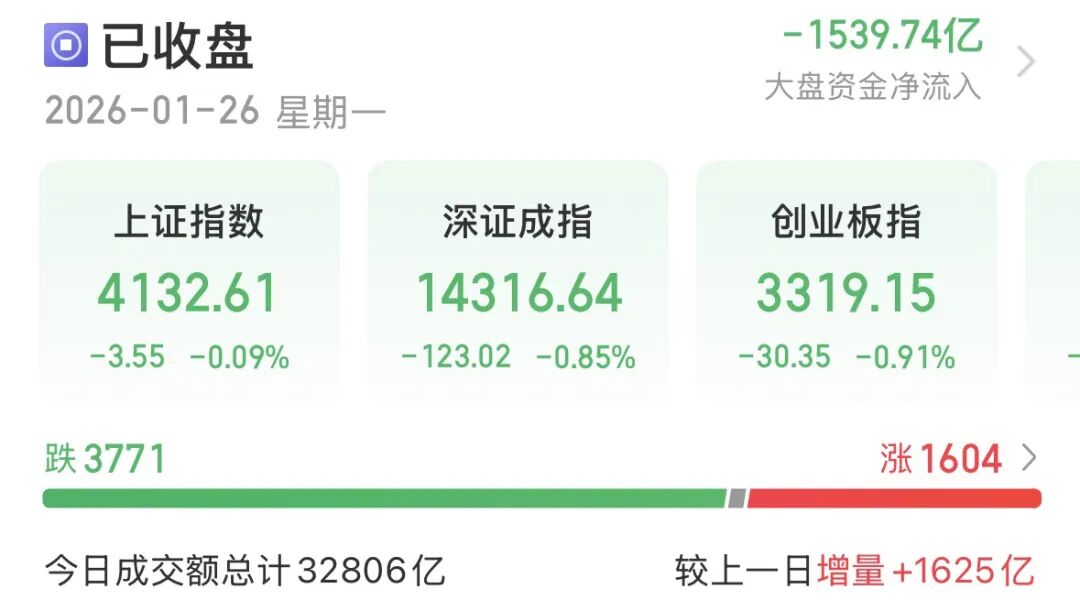
1月26日,市场交易放量突破3万亿元,指数却微幅收低,板块与个股呈现显著分化,3771只股票收盘下跌。沪指在有色、煤炭等周期股护盘下仅微跌,而 卫星、半导体等科技赛道集体回吐,双创指数跌近1%。 21只个股出现超1亿元的大额压单,集中在中国平安、贵州茅台(600519)等权重股,紫金矿业(601899)卖一挂出近41亿元巨额压单。 板块跌多涨少,分化显著。有色金属板块大涨4.57%,个股掀涨停潮;石油石化、煤炭跟进,和顺石油(603353)、洲际油气(600759)、中曼石油 (603619)均涨停,农林牧渔、非银金融、银行等板块护盘。 受访人士表示,资金并未撤离,只是从高位科技成长板块流向顺周期及避险方向,完成"高切低"。经历前期阶段性拉升后,资金分歧加大,后市大概率通 过震荡与结构性轮动消化涨幅。春季行情预期仍在,资金将围绕业绩验证与估值重估展开新一轮博弈。 黄金、煤炭、石油等大涨 截至收盘,沪指微跌0.09%收涨4132.61点,创业板指收跌0.91%报3319.15点,深证成指收跌0.85%。科创50、北证50均跌逾1%,沪深300、上证50微红。 今日沪深京三市量能温和放大,日成交额增加1627亿元 ...

行业研究|行业周报|投资银行业与经纪业:政策推动行业长期稳定发展,看好非银板块绩优个股-20260126
Changjiang Securities· 2026-01-26 13:43
Investment Rating - The report maintains a "Positive" investment rating for the non-bank financial sector [7] Core Insights - The non-bank sector has shown weak overall performance this week, but some companies have disclosed high profit growth forecasts for 2025. The China Securities Regulatory Commission (CSRC) has issued guidelines to promote the return to fundamentals in the public offering securities investment fund industry, which is expected to drive long-term stable development [2][4] - The market trading volume has decreased, yet remains at historically high levels. The report suggests monitoring the sector's future performance [4] - In the insurance sector, the third-quarter reports have confirmed the logic of deposit migration, increased equity allocation, and improved new policy costs. The certainty of ROE improvement has increased, and valuations are expected to accelerate recovery [4] - The report highlights the increasing cost-effectiveness of overall allocations and ongoing revaluation in the sector [4] Summary by Sections Non-Bank Sector Performance - The non-bank financial index decreased by 1.5% this week, with an underperformance of 0.8% relative to the CSI 300, ranking 29th out of 31 sectors [5] - Year-to-date, the non-bank financial index has decreased by 1.6%, underperforming the CSI 300 by 3.1% [5] Market Overview - The average daily trading volume in the two markets was 27,988.78 billion yuan, down 19.23% week-on-week, with a daily turnover rate of 2.68%, down 68.47 basis points [5] - The leverage capital scale has rebounded, with a margin balance of 2.72 trillion yuan, up 0.23% [5] Insurance Sector Insights - The cumulative insurance premium income for November 2025 reached 57,629 billion yuan, a year-on-year increase of 7.56% [23] - Life insurance income was 41,472 billion yuan, up 9.06% year-on-year, while property insurance income was 16,157 billion yuan, up 3.88% [24] Company Recommendations - The report recommends companies with stable profit growth and dividend rates, including Jiangsu Jinzu, China Ping An, and China Pacific Insurance, due to their strong business models and market positions [4] - Additional recommendations include New China Life, China Life, Hong Kong Exchanges and Clearing, CITIC Securities, Dongfang Caifu, Tonghuashun, and Jiufang Zhitu Holdings based on performance elasticity and valuation levels [4]



公募基金2025四季报调仓图谱:科技制造主线强化 传统蓝筹获回流布局 新能源内部分化(附加减仓TOP50榜单)
Xin Lang Cai Jing· 2026-01-26 12:17
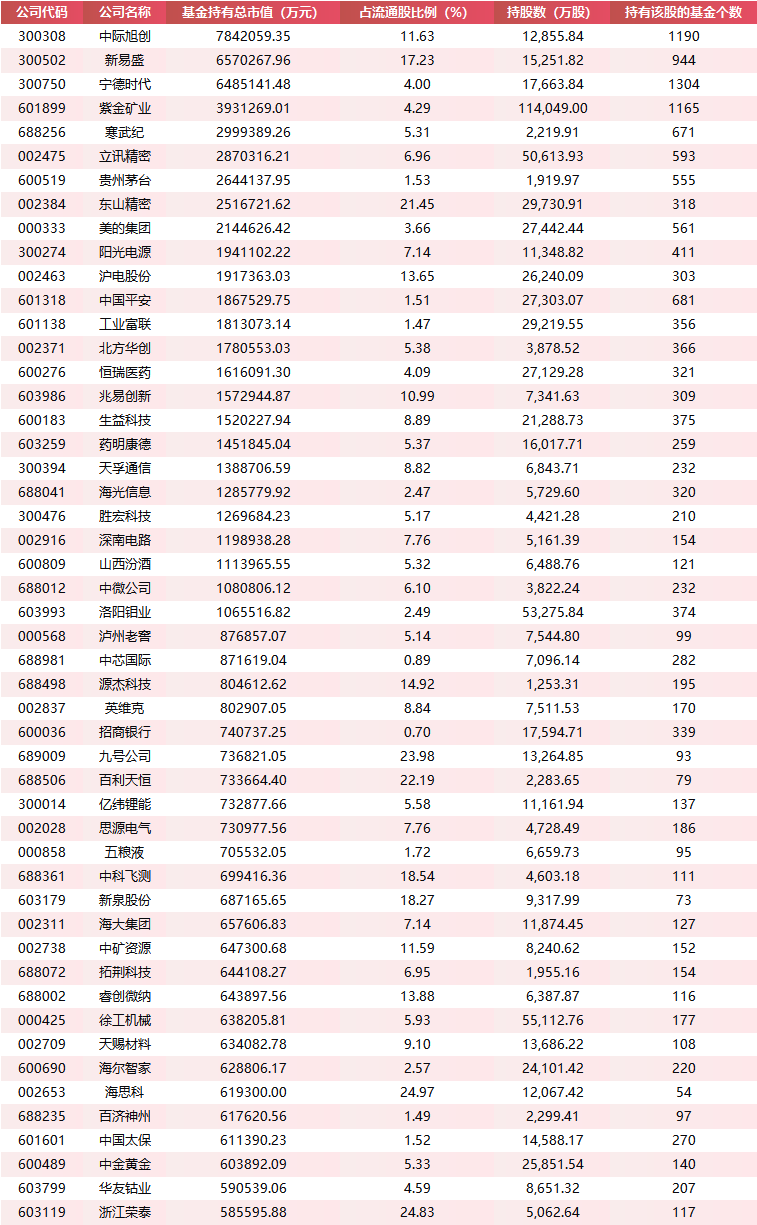
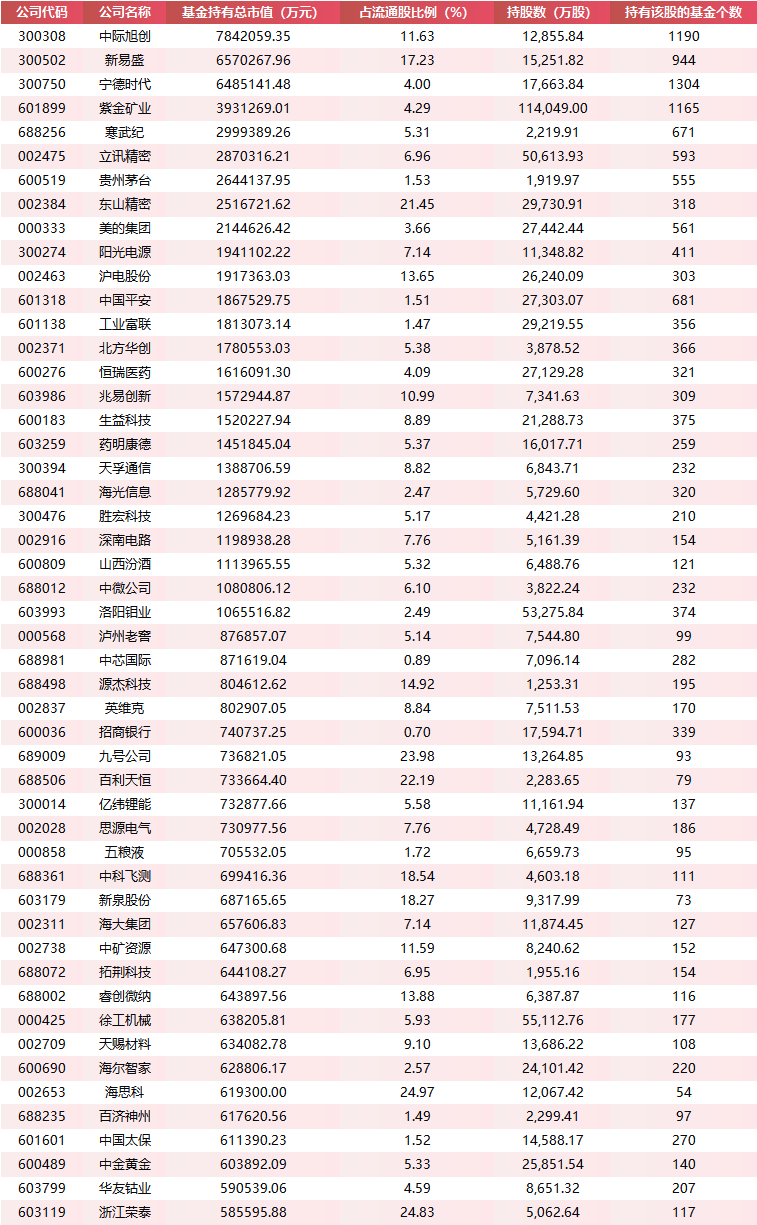
Core Insights - Public funds continue to focus on technology growth and high-end manufacturing, while also reallocating to consumer and financial leaders with returning valuations [1][14] - The structure of holdings indicates a significant increase in positions in AI computing, semiconductor equipment, and resource sectors, while reducing exposure to batteries, consumer electronics, and pharmaceuticals [14] Group 1: Fund Holdings Overview - As of Q4 2025, public fund holdings data shows that technology growth and high-end manufacturing remain core investment directions, with traditional industry leaders and some cyclical stocks also maintaining high allocation levels [1] - The top 50 heavy stocks include major players in technology sectors such as communication, AI, and electronics, reflecting institutional confidence in technological innovation and industrial upgrades [2][3] - Notable stocks like Ningde Times, Zhongji Xuchuang, and Zijin Mining are held by over a thousand funds, indicating strong consensus among institutions on these targets [4] Group 2: Increases in Holdings - The increase in holdings is prominently seen in technology stocks, with Zhongji Xuchuang receiving over 22.6 billion yuan in fund increases, ranking first, followed by Xinyi Sheng with approximately 9.6 billion yuan [5][6] - Traditional sectors also saw significant increases, with China Ping An gaining over 10.5 billion yuan, and other blue-chip stocks like Midea Group and Haier Smart Home returning to substantial increase lists [5] - Resource stocks such as Zijin Mining and Luoyang Molybdenum also experienced collective increases, reflecting high enthusiasm for non-ferrous and energy metal sectors amid global manufacturing recovery expectations [5] Group 3: Decreases in Holdings - Certain stocks in the consumer electronics and OEM sectors, including Industrial Fulian and Lixun Precision, faced collective reductions, indicating a cautious stance on their growth prospects [8] - The internal structure of the new energy vehicle supply chain showed differentiation, with battery leaders like Ningde Times and Yiwei Lithium Energy being reduced [8] - Pharmaceutical stocks like Heng Rui Medicine and WuXi AppTec also saw significant reductions due to industry policy uncertainties and valuation pressures [8] Group 4: New Entrants in Holdings - A number of new stocks have entered the fund's heavy holdings, characterized by small to mid-cap sizes and high growth expectations, covering advanced manufacturing and industrial upgrade sectors [11][12] - Notable new entrants include Chaojie Co. and Guocheng Mining, which have garnered attention from multiple funds, indicating potential focus areas for institutional investment [11][12]



非银金融25Q4重仓持股分析及板块最新观点:非银板块获增配、高景气延续,保持推荐-20260126
CMS· 2026-01-26 11:32
Investment Rating - The report maintains a "Recommend" rating for the non-bank financial sector, indicating a positive outlook for investment in this area [1][8]. Core Insights - The non-bank financial sector is experiencing a continued high level of activity, with significant increases in holdings in both the brokerage and insurance segments. The brokerage sector's holdings increased to 0.99%, while the insurance sector saw a substantial rise to 2.04% [1][7]. - The overall fund net asset value reached 36.8 trillion yuan, reflecting a year-on-year growth of 14% and a quarter-on-quarter increase of 2% [12]. - The brokerage sector is expected to benefit from improved market conditions, with a projected net profit increase of 26% year-on-year for Q4 2025 [19][20]. - The insurance sector is poised for strong performance in 2026, driven by favorable market conditions and a significant increase in new policy premiums [22][23]. Summary by Sections Public Fund Market Size - As of Q4 2025, the total net asset value of public funds was 36.8 trillion yuan, with a year-on-year increase of 14% and a quarter-on-quarter increase of 2% [12]. - The non-monetary fund size reached 21.7 trillion yuan, growing 16% year-on-year [12]. Non-Bank Sector Holdings Analysis Brokerage Sector - The brokerage sector's holdings increased to 0.99%, up 0.1 percentage points from the previous quarter, with a total of 7.71 billion shares held, reflecting a 17.9% quarter-on-quarter increase [20]. - Major brokerages such as CITIC Securities and Guotai Junan saw significant increases in their holdings, with respective increases of 0.14 and 0.07 percentage points [20][21]. Insurance Sector - The insurance sector's holdings rose to 2.04%, a significant increase of 0.97 percentage points from the previous quarter, exceeding the benchmark allocation [23]. - Key players like Ping An and China Life experienced notable increases in their holdings, with Ping An's allocation rising by 0.68 percentage points [23]. Investment Recommendations - The report suggests focusing on key stocks within the brokerage sector, including Guotai Junan, CITIC Securities, and Huatai Securities, as well as major insurance companies like Ping An and China Life [8].



多机构召开健康保险高质量发展工作座谈会点评:聚力赋能精耕细作,重塑健康险新生态
ZHONGTAI SECURITIES· 2026-01-26 11:06
Investment Rating - The report assigns an "Overweight" rating for the health insurance industry, indicating a positive outlook for the sector in the next 6 to 12 months [11]. Core Insights - The report highlights the importance of the health insurance sector in supporting China's health strategy, with multiple institutions collaborating to enhance product offerings and data capabilities [5][6]. - The shift from passive reimbursement to proactive engagement in commercial health insurance is emphasized, with the establishment of standardized terms and drug payment lists to stabilize market expectations [5]. - The report notes that the commercial health insurance sector is expected to see significant growth, particularly in the area of innovative drug payments, with a projected total compensation amount of approximately 14.7 billion yuan for innovative drugs in 2025 [5]. Summary by Sections Industry Overview - The health insurance industry is experiencing a transformation, with a focus on high-quality development and collaboration among various institutions [5]. - The total market capitalization of the industry is reported at 34,888.11 billion yuan, with the same figure for circulating market capitalization [3]. Market Trends - The report indicates that commercial medical insurance is entering a phase of refinement, with efforts to standardize product designs and payment lists to enhance industry competitiveness [5]. - The establishment of a new data infrastructure for health insurance is being prioritized to improve risk management and operational efficiency [5]. Company Strategies - Major insurance companies are diversifying their health insurance offerings, with each company focusing on different operational models to enhance their service ecosystems [10]. - The report identifies key players such as China Life, China Ping An, and China Pacific Insurance, highlighting their unique approaches to health insurance and the integration of health management services [10]. Investment Recommendations - The report suggests a continued focus on leading insurance companies, including China Life, China Pacific, and AIA, as they are expected to benefit from the ongoing developments in the health insurance sector [5].


公募基金调仓图谱:科技制造主线强化 传统蓝筹获回流布局 新能源内部分化(附加减仓TOP50榜单)
Xin Lang Cai Jing· 2026-01-26 10:09
截至2025年四季度末,公募基金持仓数据已随季报披露完毕。从整体配置看,科技成长与高端制造仍是基 金布局的核心方向,传统行业龙头及部分周期股也保持较高配置水平。 专题:聚焦2025基金四季报:AI应用、商业航天、核聚变,谁领2026投资主线? 公募基金Top50重仓股:科技成长与高端制造核心方向 超千只基金持有宁德时代、中际旭创、紫金矿业 在持股市值排名前50的个股中,前十大重仓股多集中于通信、AI、电子等科技板块,包括中际旭创、新易 盛、寒武纪、立讯精密等龙头,体现出机构对科技创新与产业升级的持续看好。新能源方向以宁德时代、 阳光电源为代表;资源股如紫金矿业、洛阳钼业配置稳定,反映对周期板块的结构性布局。消费行业仍以 贵州茅台、美的集团为核心持仓;医药板块中恒瑞医药、药明康德持续入选,但持股基金数量有所波动。 | 公司代码 | 公司名称 | 基金持有总市值 (万元) | 占流通股比例 (%) | 持股数 (万股) | 持有该股的基金个数 | | --- | --- | --- | --- | --- | --- | | 300308 | 中际旭创 | 7842059.35 | 11.63 | 12,855. ...
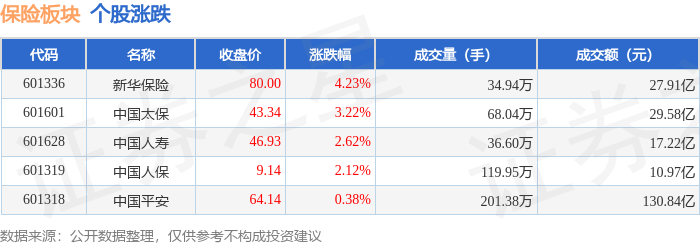
保险板块1月26日涨2.1%,新华保险领涨,主力资金净流入1.67亿元
Zheng Xing Xing Ye Ri Bao· 2026-01-26 09:34
Core Viewpoint - The insurance sector experienced a 2.1% increase on January 26, with New China Life leading the gains, while the overall stock market indices showed slight declines [1]. Group 1: Market Performance - The Shanghai Composite Index closed at 4132.61, down 0.09% [1]. - The Shenzhen Component Index closed at 14316.64, down 0.85% [1]. - New China Life's stock price rose by 4.23% to 80.00, with a trading volume of 349,400 shares and a transaction value of 2.791 billion [1]. Group 2: Individual Stock Performance - China Pacific Insurance rose by 3.22% to 43.34, with a trading volume of 680,400 shares and a transaction value of 2.958 billion [1]. - China Life Insurance increased by 2.62% to 46.93, with a trading volume of 366,000 shares and a transaction value of 1.722 billion [1]. - China Reinsurance gained 2.12% to 9.14, with a trading volume of 1,199,500 shares and a transaction value of 1.097 billion [1]. - Ping An Insurance saw a modest increase of 0.38% to 64.14, with a trading volume of 2,013,800 shares and a transaction value of 13.084 billion [1]. Group 3: Fund Flow Analysis - The insurance sector saw a net inflow of 167 million from institutional investors, while retail investors contributed a net inflow of 89.325 million [1]. - The table indicates that New China Life had a net inflow of 260 million from institutional investors, but a net outflow of 209 million from retail investors [2]. - China Pacific Insurance experienced a net inflow of 119 million from institutional investors, with a net outflow of 173 million from retail investors [2].