
PICC(601319)

Search documents
中国人保南昌市分公司开展工伤保险“新补充”、职业伤害“强保障”主题宣传活动
Zhong Guo Jin Rong Xin Xi Wang· 2025-11-24 09:00
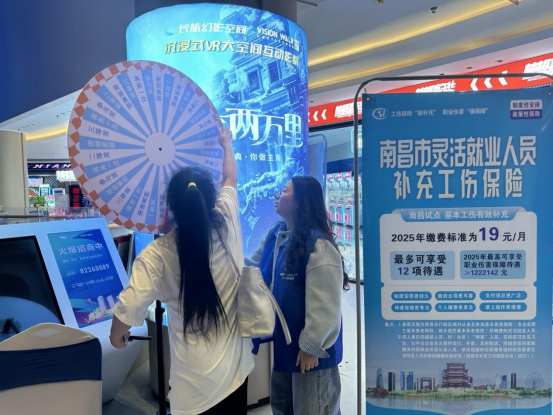
"以前总觉得补充工伤保险离自己很远,今天听了讲解才知道,我们快递行业也能参保,遇到意外还有 这么多保障!"刚咨询完的快递小哥拿着宣传册说道。活动中,工作人员还为有需求的从业者提供一对 一答疑服务,针对灵活就业人员参保、工伤待遇核算等热点问题耐心回应,现场氛围热烈而有序。不少 员工表示,这样的宣传活动送到"家门口",既不耽误工作,又能学到实用知识,让人心里格外踏实。 补充工伤保险是劳动者的"安全网""定心丸",更是企业稳健发展的"护航舰"。此次补充工伤宣传进商场 活动,旨在让商场从业者及过往市民都能了解补充工伤权益、掌握维权方法,让商户都能重视补充工伤 保障、规范用工管理。未来,人保财险南昌市分公司将持续开展多场景、多形式的补充工伤保险政策宣 传活动,把安心与保障送到更多劳动者身边,让补充工伤保险保障惠及全民,共同营造"人人懂工伤、 人人享保障"的良好社会氛围。(陶基恩) 转自:新华财经 为让补充工伤保障政策走进千家万户,近日,中国人民财产保险股份有限公司南昌市分公司(以下简 称"人保财险南昌市分公司")联合南昌市人力资源和社会保障局、南昌市社会保险事业服务中心,在南 昌江旅·都市方舟启动工伤保险"新补充"、职 ...


非银金融行业跟踪周报:证券行业并购稳步推进,保险业总资产突破40万亿-20251123
Soochow Securities· 2025-11-23 15:43
Investment Rating - The report maintains an "Overweight" rating for the non-bank financial industry [1] Core Insights - The non-bank financial sector is experiencing steady mergers and acquisitions, with the insurance industry's total assets surpassing 40 trillion yuan, reflecting a growth of 12.5% year-on-year [1][22] - The insurance sector has shown resilience, outperforming other sub-sectors in recent trading days, while the overall non-bank financial sector has seen a decline [10][11] - The report highlights the ongoing transformation in the securities industry, with significant mergers expected to enhance asset scales and market positioning [20][21] Summary by Sections Non-Bank Financial Subsector Performance - In the recent five trading days (November 17-21, 2025), only the insurance sector outperformed the CSI 300 index, with declines of 3.06% for insurance, 4.89% for securities, and 6.53% for diversified finance [10] - Year-to-date performance shows insurance up by 14.17%, diversified finance up by 5.05%, and securities up by 0.47% [11] Securities Sector Insights - Trading volume in November has decreased month-on-month, with an average daily trading volume of 23,101 billion yuan, down 10.22% from the previous month but up 7.83% year-on-year [15] - The China Securities Regulatory Commission is enhancing foreign institutional participation in the capital market, aiming to improve market stability [15][21] - A significant merger involving China International Capital Corporation (CICC), Dongxing Securities, and Xinda Securities is underway, expected to create a combined asset scale exceeding 1 trillion yuan [20] Insurance Sector Insights - As of Q3 2025, total assets in the insurance sector reached 40.4 trillion yuan, a year-to-date increase of 4.5 trillion yuan [22] - The insurance industry reported a premium income of 5.2 trillion yuan, reflecting an 8.5% year-on-year growth [22] - The sector's solvency ratios are robust, with a comprehensive solvency ratio of 186% and a core solvency ratio of 134% [22] Diversified Finance Sector Insights - The trust industry is entering a stable transformation phase, with total assets reaching 29.56 trillion yuan, a year-on-year growth of 23.58% [29] - The futures market saw a trading volume of 6.03 billion contracts in October, with a transaction value of 61.22 trillion yuan, indicating a 4.56% year-on-year increase [35] - The report suggests that innovation in risk management will be crucial for the future development of the futures industry [38] Industry Ranking and Key Company Recommendations - The report ranks the insurance sector highest, followed by securities and diversified finance, recommending companies such as China Life, Ping An, and CITIC Securities for investment [44]






保险行业周报(20251117-20251121):报行合一再深化,《人身险产品费用分摊指引》出炉-20251123
Huachuang Securities· 2025-11-23 09:45
Investment Rating - The report maintains a "Recommendation" rating for the insurance industry, expecting the industry index to outperform the benchmark index by over 5% in the next 3-6 months [21]. Core Insights - The insurance index fell by 3.06% this week, outperforming the broader market by 0.71 percentage points. Major insurance stocks experienced declines, with notable drops from Sunshine Insurance (-4.8%) and China Pacific Insurance (-4.57%) [1]. - The China Actuarial Society released the "Guidelines for Expense Allocation of Life Insurance Products," which aims to enhance the scientific management of expenses within insurance companies and supports the implementation of the "reporting and operation integration" policy [2][4]. - As of the end of 2024, 34 insurance asset management companies managed a total of CNY 33.30 trillion, reflecting a year-on-year growth of 10.60% [2]. - The report highlights that 172 insurance companies have disclosed their solvency data for Q3 2025, with 14 achieving an AAA risk rating, while 4 companies fell below solvency standards [2]. Summary by Sections Market Performance - The insurance sector's performance was characterized by a 3.06% decline in the insurance index, with individual stocks like China Life and Ping An also showing significant decreases [1]. Regulatory Developments - The newly released guidelines categorize life insurance business expenses into variable and fixed costs, specifying which expenses should not be allocated and providing methods for expense allocation [4]. Financial Data - The total market capitalization of the insurance sector is CNY 32,109.56 billion, with a circulating market value of CNY 22,103.29 billion [6]. Valuation Metrics - The report provides PEV valuations for major life insurance companies, with China Life at 0.83x and Ping An at 0.71x [5]. - For property insurance, the PB valuations are noted, with China Re at 0.58x and PICC at 1.2x [10]. Investment Recommendations - Short-term recommendations focus on companies with performance elasticity, suggesting investments in New China Life, China Property & Casualty, and China Life. Long-term recommendations include China Pacific Insurance and China Ping An based on fundamental and valuation considerations [10].



机器人闯祸了怎么办?保险公司密集研发具身智能保险
Di Yi Cai Jing· 2025-11-23 05:53
Core Insights - The rapid development of artificial intelligence and embodied intelligence technologies is leading to the commercialization of humanoid robots, but concerns about risks such as "not daring to use, fear of damage, and inability to afford" are bottlenecks for large-scale implementation [1][2] - Major domestic property insurance companies in China, including Ping An, Taikang, and PICC, have launched specialized insurance products for embodied intelligence to address these commercialization challenges [1][5] Industry Overview - Humanoid robots, integrating advanced technologies like AI and high-end manufacturing, are becoming a new frontier in technology competition, with the domestic market expected to reach 1.25 trillion yuan by 2027 [2] - These robots can fill labor gaps across various sectors, including industrial applications like welding and assembly, as well as service scenarios such as elderly care and massage [2] Risk Landscape - The market promotion and use of humanoid robots raise significant safety concerns, with users particularly focused on the risks of damage to the robots themselves and potential harm to people or property in their vicinity [3] - The lack of comprehensive international or industry standards for AI and embodied intelligence technologies poses compatibility and safety risks for products [3][4] Insurance Innovations - Since September, leading insurance companies have been actively launching insurance products related to embodied intelligence [5] - China Pacific Insurance has introduced a specialized product called "Smart Insurance," which offers comprehensive risk coverage across the entire supply chain, integrating various types of protection [6] - PICC has launched a comprehensive insurance product for embodied intelligence, covering both the robot's physical damage and third-party liability, addressing various scenarios including natural disasters and operational failures [6] - Ping An has developed a comprehensive financial solution for embodied intelligence enterprises, providing extensive risk coverage and support across multiple sectors [7]

2025中国保险业竞争力研究报告发布 高质量发展格局加速形成
2 1 Shi Ji Jing Ji Bao Dao· 2025-11-22 13:07
Core Insights - The report reveals the competitive landscape and development trends of China's insurance industry as it transitions from scale expansion to value creation, driven by policy guidance, technological empowerment, and market demand [5][6] Group 1: Overall Industry Performance - In the first half of 2025, China's insurance premium income reached 3.74 trillion yuan, a year-on-year increase of 5.04%, continuing the steady growth momentum during the 14th Five-Year Plan period [9] - As of June 2025, the balance of insurance fund utilization reached 36.23 trillion yuan, a 67% increase compared to the end of 2020 [9] - China's insurance premium income accounts for 10.2% of the global market share, solidifying its position as the second-largest insurance market globally [9] - The industry's solvency capacity has strengthened, with a comprehensive solvency adequacy ratio of 204.5% and a core solvency adequacy ratio of 147.8% as of June 2025, reflecting significant improvement in overall risk resistance [9] Group 2: Life Insurance Sector - The report evaluates 75 life insurance companies, with 58 participating in the ranking; China Life, Ping An Life, Taikang Life, New China Life, and China Pacific Life are the top five [10] - Ping An Life leads the industry with a net profit of 50.602 billion yuan [10] - The top ten life insurance companies accounted for 94.6% of the total profit of the participating companies, indicating a "Matthew Effect" where larger firms dominate [10] - There is a growing divide among smaller companies, with 18 companies reporting losses, highlighting challenges in governance and business transformation [10] Group 3: Property Insurance Sector - In the property insurance sector, PICC Property and Casualty, Ping An Property and Casualty, and Taikang Property and Casualty are the top three, with the top five companies accounting for approximately 80% of the total profit of participating companies [11] - PICC Property and Casualty reported a net profit of 24.376 billion yuan and a comprehensive cost ratio of 94.72%, showcasing strong profitability [11] - However, the industry faces significant underwriting pressure, with 40 out of 82 participating companies having a comprehensive cost ratio exceeding 100%, indicating that nearly half are operating at a loss [11] Group 4: Pension and Health Insurance Sectors - The pension insurance sector is experiencing growth opportunities driven by policy support, with Taikang Pension, Ping An Pension, and National Pension leading the market [12] - Ping An Pension achieved a net profit of 1.36 billion yuan in the first half of 2025, becoming the most profitable pension insurance company [12] - The health insurance market is highly concentrated, with China People's Health, Ping An Health, and Fosun United Health as the top four, where the top two companies account for over 80% of revenue and profit [12] - The report emphasizes that the insurance industry is at a critical juncture between the clearing of the "old model" and the establishment of a "new ecosystem," with value creation, risk management, product innovation, and service upgrades as core competitive factors [12]
【中国经济新看点】保险业服务全链条科技创新
Jing Ji Ri Bao· 2025-11-21 22:53
Group 1: Market Growth and Support - The technology insurance market in China has been experiencing rapid growth, supported by increasing policy backing and a richer product system, providing substantial risk protection for technological innovation [1] - During the "14th Five-Year Plan" period, technology insurance has provided cumulative risk protection exceeding 10 trillion yuan, with 3,600 projects supported for innovative applications [1] Group 2: Policy Support and Product Innovation - China Pacific Insurance has launched a dedicated insurance product called "Smart Insurance" for humanoid robots, addressing the risk protection needs associated with their commercialization [2] - Various provinces have introduced technology insurance policies, such as Beijing's subsidy for insurance premiums on major technological equipment, covering 80% of the premium costs up to 2 million yuan per enterprise annually [3] - The Ministry of Science and Technology and other departments have issued policies to enhance the technology finance system, emphasizing the importance of technology insurance in supporting innovation [3] Group 3: Reinsurance Functionality - Reinsurance serves as an effective risk management tool, providing support for major technology projects and facilitating international market interaction [4] - Reinsurance companies enhance risk protection for technological innovation by offering technical support and underwriting capacity, helping to mitigate and transfer risks [4] Group 4: Challenges and Future Directions - The technology insurance sector faces challenges such as inadequate risk protection capabilities and a lack of innovative products tailored to specific enterprise needs [7] - There is a need for improved risk pricing support and the development of mature pricing models to better assess risks associated with technology insurance [7] - Future efforts should focus on optimizing technology risk management models, enhancing insurance product innovation for strategic emerging industries, and building an information-sharing platform among government, technology enterprises, and insurance companies [8]

电厂 | 保险巨头迎来黄金周期 但如何才能进入“黄金时代”
Xin Lang Cai Jing· 2025-11-21 11:17
Core Insights - The insurance giants in China are experiencing a significant upturn, driven by a recovery in the capital markets and stable growth in the new business value of life insurance [1][4][10] - The combined revenue of the five major insurance companies reached 2.37 trillion yuan, with a net profit of 426.04 billion yuan in the first three quarters, indicating a revenue growth of 13.6% and a net profit growth of 33.54% [1][4] - The net profit growth in Q3 alone was remarkable, with an increase of 68.34%, surpassing market expectations [1][4] Revenue and Profit Growth - The five major insurance companies reported the following revenues for the first three quarters: China Ping An (832.94 billion yuan), China Life (537.895 billion yuan), China Pacific Insurance (344.904 billion yuan), China Property & Casualty Insurance (520.99 billion yuan), and New China Life (137.252 billion yuan) [4] - The corresponding profit figures were: China Ping An (132.856 billion yuan), China Life (167.804 billion yuan), China Property & Casualty Insurance (46.822 billion yuan), China Pacific Insurance (45.7 billion yuan), and New China Life (32.857 billion yuan) [4] - The net profit growth rates were significantly higher than revenue growth, with China Life and New China Life showing around 60% growth [4][7] Business Value and Channel Quality - The new business value for the five major insurance companies saw substantial increases, with China Life up 41.8%, Ping An Life and Health up 46.2%, and China Property & Casualty Insurance up 76.6% [7] - The improvement in channel quality and the growth of new business value were identified as key drivers for the profit increases [4][7] - The insurance giants are focusing on channel transformation, enhancing productivity, and developing bancassurance channels to boost new business value [4][6] Investment Performance - The total investment income for the five major insurance companies reached 887.5 billion yuan, a year-on-year increase of 35.64% [11] - The investment asset scale reached 20.26 trillion yuan, with significant growth in stock investments, which increased by 36.2% [11][13] - The companies are benefiting from a favorable capital market environment, which has strengthened their financial foundations [11][13] Cost Efficiency and Operational Improvements - The insurance sector has made notable progress in cost reduction and efficiency improvements, with life insurance companies reducing costs by 350 billion yuan since 2024 [14][15] - Companies are leveraging technology, such as AI, to enhance operational efficiency and reduce costs [15] - The overall industry is witnessing a shift towards more reliable and stable operations, driven by the reforms initiated by the major players [18] Industry Outlook - The insurance industry is entering a new growth phase, with the potential for high-quality development contingent on continuous internal improvements and reforms [18] - While the major companies are thriving, some smaller firms are struggling, indicating a polarization within the industry [16][18] - The overall health and standardization of the industry are expected to improve as the major companies lead the way in reforms and operational excellence [18]

金融行业双周报(2025、11、07-2025、11、20):银行:超配(维持)-20251121
Dongguan Securities· 2025-11-21 10:43
Investment Ratings - Banking: Overweight (Maintain) [1] - Securities: Market Weight (Maintain) [1] - Insurance: Overweight (Maintain) [1] Core Insights - The report highlights the emergence of a trillion-yuan brokerage firm through mergers, accelerating supply-side reforms in the securities industry [3] - The total assets of the new company formed by the merger of CICC, Dongxing Securities, and Xinda Securities are expected to reach 1009.583 billion yuan, making it the fourth largest securities company in A-shares [3] - The report indicates that the insurance sector is seeing a steady increase in stock investments, with a total balance of 3.62 trillion yuan, reflecting a shift towards equity investments to mitigate potential risks [4][46] Summary by Sections Market Review - As of November 20, 2025, the banking, securities, and insurance indices have changed by +1.69%, -3.36%, and +1.76% respectively, while the CSI 300 index decreased by -2.74% [12] - Among the sub-sectors, China Bank (+10.25%), Dongxing Securities (+5.38%), and China Life Insurance (+2.32%) performed the best [12] Valuation Situation - As of November 20, 2025, the PB ratio for the banking sector is 0.77, with state-owned banks, joint-stock banks, city commercial banks, and rural commercial banks having PB ratios of 0.83, 0.62, 0.73, and 0.65 respectively [22] - The securities sector's PB ratio is 1.49, indicating potential for valuation recovery [25] Recent Market Indicators - The average daily trading volume in A-shares was 1819.419 billion yuan, a decrease of 10.14% week-on-week [35] - The average margin balance was 2493.753 billion yuan, showing a slight decrease of 0.05% [35] Industry News - The report notes that the financial regulatory authority has implemented measures to enhance the supervision of pension institutions, which may impact banking operations [39] - The report also highlights a significant increase in bond underwriting by securities firms, particularly in technology and rural revitalization bonds [39] Company Announcements - CICC announced plans to merge with Dongxing Securities and Xinda Securities, with the merger expected to enhance its market position significantly [45] - Nanjing Securities plans to raise up to 5 billion yuan through a private placement to strengthen its capital base and enhance competitiveness [42] Weekly Perspectives - The banking sector is expected to benefit from a shift in funds towards safer investments, particularly in high-dividend, low-valuation bank stocks [44] - The insurance sector is encouraged to increase equity investment ratios, with a focus on returning to core protection functions [46]
保险板块11月21日跌2.39%,新华保险领跌,主力资金净流出8.56亿元
Zheng Xing Xing Ye Ri Bao· 2025-11-21 09:33
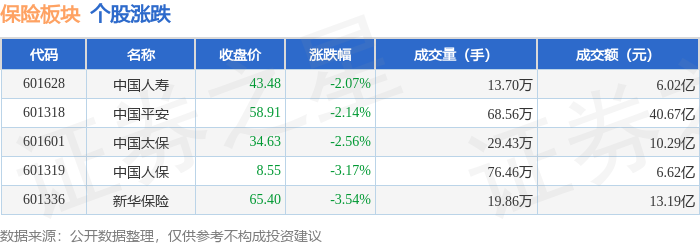
Core Points - The insurance sector experienced a decline of 2.39% on November 21, with Xinhua Insurance leading the drop [1] - The Shanghai Composite Index closed at 3834.89, down 2.45%, while the Shenzhen Component Index closed at 12538.07, down 3.41% [1] Insurance Sector Performance - China Life (601628) closed at 43.48, down 2.07% with a trading volume of 137,000 shares and a turnover of 602 million yuan [1] - Ping An Insurance (601318) closed at 58.91, down 2.14% with a trading volume of 685,600 shares [1] - China Pacific Insurance (601601) closed at 34.63, down 2.56% with a trading volume of 294,300 shares and a turnover of 1.029 billion yuan [1] - China Reinsurance (601319) closed at 8.55, down 3.17% with a trading volume of 764,600 shares and a turnover of 662 million yuan [1] - Xinhua Insurance (601336) closed at 65.40, down 3.54% with a trading volume of 198,600 shares and a turnover of 1.319 billion yuan [1] Capital Flow Analysis - The insurance sector saw a net outflow of 856 million yuan from institutional investors, while retail investors had a net inflow of 733 million yuan [1] - The detailed capital flow for individual stocks shows that China Reinsurance had a net outflow of 51.58 million yuan from institutional investors [2] - China Life experienced a net outflow of 52.08 million yuan from institutional investors, while retail investors contributed a net inflow of 64.48 million yuan [2] - China Pacific Insurance had a net outflow of 56.32 million yuan from institutional investors, with retail investors contributing a net inflow of 85.31 million yuan [2] - Xinhua Insurance faced a significant net outflow of 258 million yuan from institutional investors, while retail investors had a net inflow of 185 million yuan [2] - Ping An Insurance had a net outflow of 43.91 million yuan from institutional investors, with retail investors contributing a net inflow of 35.8 million yuan [2]
河南金融监管局同意撤销郑州市金水支公司新城办事处营销服务部等17家机构
Jin Tou Wang· 2025-11-21 04:22
Core Points - The Henan Financial Regulatory Bureau approved the request from China People's Property Insurance Company to revoke 17 marketing service departments in Zhengzhou [1][2] - The company is required to cease all operations of the revoked institutions and return their licenses within 15 working days [2] - The company must announce the revocation and inform policyholders and beneficiaries to make proper arrangements regarding insurance payments and claims [2]