
Industrial Securities(601377)

Search documents
业绩高增 + 政策利好 + 资金流入,证券ETF龙头(159993)涨近4%
Xin Lang Cai Jing· 2025-12-08 02:13
Group 1 - The core viewpoint of the news highlights a strong performance in the securities sector, with the National Securities Leading Index rising by 3.86% and individual stocks like Industrial Securities and Huatai Securities showing significant gains [1] - The Securities ETF Leader has seen continuous net inflows over the past three days, totaling 25.27 million yuan, with a peak single-day inflow of 12.74 million yuan [1] - The China Securities Regulatory Commission (CSRC) plans to enhance classified regulation, easing restrictions for high-quality institutions to improve capital efficiency [1] Group 2 - The report indicates that 43 listed securities firms achieved a year-on-year net profit growth of 64% in the first three quarters of 2025, significantly outperforming the market [1] - The adjustment of margin financing limits by leading brokerages is expected to face leverage constraints, which may impact the expansion of capital intermediary businesses [2] - The CSRC's emphasis on a capital-saving, high-quality development path for securities firms has led to a near halt in equity financing, highlighting the need for flexible capital supply and leverage utilization [2] Group 3 - The National Securities Leading Index closely tracks the performance of quality listed companies in the securities theme, providing investors with diversified index investment tools [3] - As of November 28, 2025, the top ten weighted stocks in the National Securities Leading Index account for 79.05% of the index, with companies like Dongfang Wealth and CITIC Securities among the top [3]






大金融股,强势拉升
Di Yi Cai Jing Zi Xun· 2025-12-08 02:09
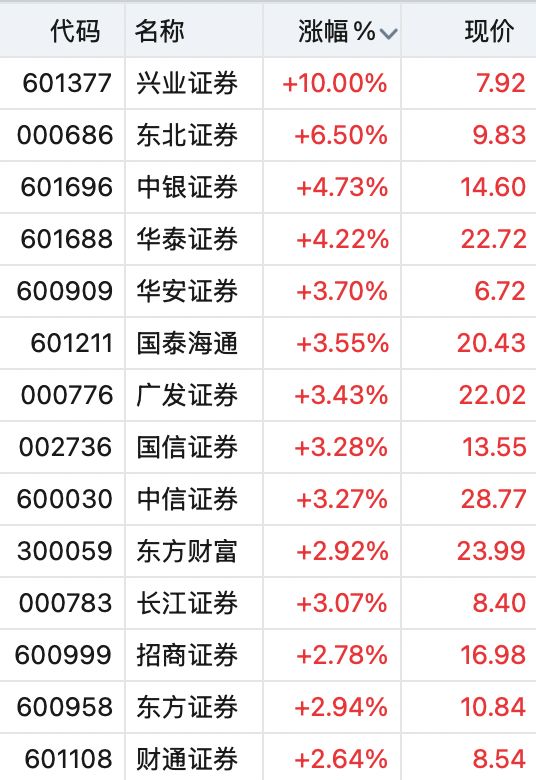
Group 1 - The financial sector continues to strengthen, with securities and futures leading the gains on December 8 [1] - Notable stock performances include: - Industrial Securities up by 10% to 7.92 [2] - Northeast Securities up by 6.5% to 9.83 [2] - Huatai Securities up by 4.22% to 22.72 [2] - Guotai Junan up by 3.55% to 20.43 [2] - GF Securities up by 3.43% to 22.02 [2] - Futures concept stocks also saw significant increases, with Ruida Futures up by 10% to 29.38 [3] - Other notable futures stocks include: - Hongye Futures up by over 8% [3] - Yong'an Futures up by 4.37% to 15.54 [3] - Nanhua Futures up by 3.27% to 20.22 [3]





吴清提出券商可适度加杠杆,券商ETF(159842)高开超1.5%,上周连续4日获资金净流入
2 1 Shi Ji Jing Ji Bao Dao· 2025-12-08 02:09
Group 1 - The A-share market indices opened higher on December 8, driven by positive news, with the brokerage sector showing strong performance, particularly the brokerage ETF (159842) which opened over 1.5% higher [1] - The brokerage ETF (159842) saw significant capital inflow, accumulating over 160 million yuan from December 2 to 5, indicating strong investor interest [1] - The brokerage sector rebounded from a period of decline, with major stocks like Zhongyin Securities and Dongfang Wealth experiencing significant gains, contributing to a broader market recovery [1] Group 2 - Guojin Securities noted a significant divergence between the performance and valuation of the brokerage sector, with some leading brokerages' price-to-book ratios remaining below the 20th percentile over the past three years, despite strong fundamentals [2] - The chairman of the CSRC emphasized the need for the industry to shift from price competition to value competition, encouraging leading firms to enhance resource integration and focus on creating internationally influential benchmark institutions [2] - The regulatory framework is set to strengthen differentiated supervision, optimizing evaluation metrics for quality institutions and exploring tailored policies for smaller and foreign firms, which is expected to promote specialized development [2]



券商板块强势拉升,兴业证券涨停,中信证券等走高
Zheng Quan Shi Bao Wang· 2025-12-08 02:09
Core Viewpoint - The brokerage sector experienced a strong rally on the 8th, with significant gains in various securities firms following positive regulatory signals from the China Securities Regulatory Commission (CSRC) [1] Group 1: Market Performance - As of the report, Xinyi Securities reached the daily limit increase, while Northeast Securities rose nearly 9%, Bank of China Securities and Huatai Securities increased over 5%, and CITIC Securities and Dongfang Wealth saw gains close to 4% [1] Group 2: Regulatory Developments - CSRC Chairman Wu Qing emphasized the need to accelerate the development of first-class investment banks and institutions, indicating a potential easing of regulations for quality institutions [1] - The CSRC plans to optimize risk control indicators and moderately open up capital space and leverage limits, exploring differentiated regulation for small and foreign brokerages [1] - Strict enforcement will be applied to a few problematic brokerages, with severe penalties for violations [1] Group 3: Industry Outlook - According to Kaiyuan Securities, the CSRC's positive stance signals a potential "policy easing period" for the industry, which may lead to an increase in leverage limits and a breakthrough in industry ROE [1] - CITIC Securities predicts a deep restructuring of the securities industry during the 14th Five-Year Plan, with ten leading comprehensive institutions expected to emerge [1] - The industry is anticipated to grow through internal growth and mergers and acquisitions, with asset allocation, comprehensive services, and international capabilities becoming key differentiators [1] - Two investment themes are suggested: 1) Leading securities firms aiming to become international first-class investment banks; 2) Medium to large securities firms with potential to enter the top tier [1]

A股集体高开,券商大爆发,兴业证券直线涨停,光模块多股大涨超6%
21世纪经济报道· 2025-12-08 02:04
记者丨黎雨桐 编辑丨金珊 12月8日,A股三大指数小幅高开,截至9:50左右,A股主要股指集体飘红。 | 上证指数 | 深证成指 | 北证50 | | --- | --- | --- | | 3906.27 | 13193.42 | 1418.69 | | +3.46 +0.09% +45.74 +0.35% +10.35 +0.73% | | | | 科创50 | 创业板指 | 万得全A | | 1332.26 | 3137.34 | 6275.00 | | +6.15 +0.46% +28.04 +0.90% +24.36 +0.39% | | | | 沪深300 | 中证500 | 中证A500 | | 4595.33 | 7118.50 | 5525.37 | | +10.79 +0.24% +20.66 +0.29% +11.61 +0.21% | | | A股券商股再度拉升,兴业证券直线涨停,东北证券涨超7%,中银证券、华泰证券、国泰海通、中信证券、广发证券等跟涨。 | 2 | | --- | CPO板块持续拉升,中际旭创股价一度创历史新高,报559.88元。天孚通信涨超11%,通宇通讯、中瓷电子 ...

A股异动丨券商股走强,兴业证券涨停,吴清称适度拓宽券商资本空间与杠杆上限
Sou Hu Cai Jing· 2025-12-08 01:52
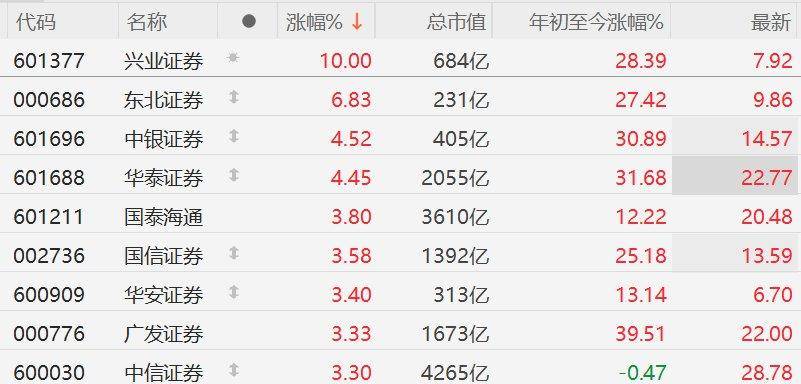
Group 1 - The A-share market continues to see a strong performance in brokerage stocks, with notable gains including a limit-up for Industrial Securities and nearly 7% increase for Northeast Securities [1] - The Chairman of the China Securities Regulatory Commission, Wu Qing, announced plans to enhance differentiated regulation, focusing on "supporting the strong and limiting the weak" [1] - The regulatory approach will involve easing restrictions for high-quality institutions, optimizing risk control indicators, and appropriately increasing capital space and leverage limits to improve capital utilization efficiency [1] Group 2 - Specific brokerage stocks reported significant price increases, with Industrial Securities up 10% to a market value of 68.4 billion, and Northeast Securities rising 6.83% to a market value of 23.1 billion [2] - Other notable performers include Bank of China Securities with a 4.52% increase and Huatai Securities with a 4.45% increase, reflecting year-to-date gains of 30.89% and 31.68% respectively [2] - The overall trend indicates a positive sentiment in the brokerage sector, with many firms experiencing substantial year-to-date growth, such as Guotai Junan Securities with a 20.48% increase [2]
份额逼近百亿大关!证券ETF(159841)跟踪指数强势涨超2.5%,近20日“吸金”5.62亿元
Sou Hu Cai Jing· 2025-12-08 01:51
Group 1 - The core viewpoint of the news highlights the significant growth in the Securities ETF (159841), with a turnover of 5.38% and a transaction volume of 578 million yuan as of December 5, 2025, alongside a strong performance of the underlying index, which rose by 2.54% [1] - The Securities ETF has seen a notable increase in scale, growing by 19.2 million yuan over the past two weeks and 514 million shares in the last month, reaching a total of 9.999 billion shares [1] - In terms of capital inflow, the Securities ETF attracted a total of 562 million yuan over the last 20 trading days, indicating strong investor interest [2] Group 2 - The Securities sector is characterized by a strong beta attribute, closely linked to the performance of the capital market, and is often referred to as the "flag bearer of bull markets" [3] - A recent notification from the National Financial Regulatory Administration aims to enhance the role of insurance funds as "patient capital," which is expected to further open up space for insurance capital in the market [4] - The notification includes adjustments to risk factors for insurance companies, such as reducing the risk factor for stocks held over three years from 0.3 to 0.27, which is anticipated to encourage long-term investments and positively impact the capital market [5][7] Group 3 - According to Zhongyuan Securities, the overall performance of the equity market is expected to remain relatively strong in 2026, with the securities industry continuing to be in an upward cycle [8] - It is anticipated that the brokerage sector will experience wide fluctuations in 2026, with leading listed brokerages likely to play a pivotal role during the next market rally [8]

5日两融余额减少21.94亿元 计算机行业获融资净买入居首
Sou Hu Cai Jing· 2025-12-08 01:45
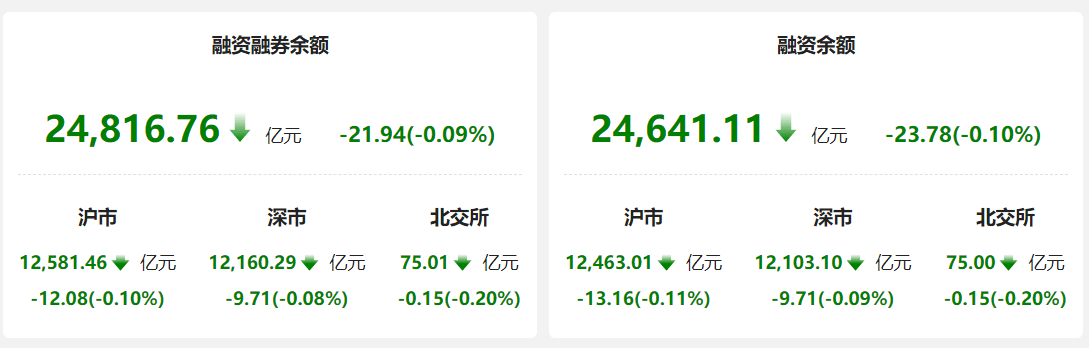
Group 1 - The total margin balance in A-shares is 24,816.76 billion yuan, a decrease of 21.94 billion yuan from the previous trading day, accounting for 2.57% of the A-share circulating market value [1][2] - The trading volume of margin financing and securities lending on that day was 1,794.53 billion yuan, an increase of 249.10 billion yuan from the previous trading day, representing 10.30% of the total A-share trading volume [1][2] Group 2 - Among the 31 primary industries in Shenwan, 11 industries experienced net financing inflows, with the computer industry leading with a net inflow of 999 million yuan [2] - Other industries with significant net financing inflows include defense and military, machinery and equipment, banking, non-banking financials, and agriculture, forestry, animal husbandry, and fishery [2] Group 3 - A total of 25 stocks had net financing inflows exceeding 100 million yuan, with Moer Thread leading at 1,701.21 million yuan [3][4] - Other notable stocks with high net financing inflows include Tianfu Communication, Guiding Compass, Dongfang Wealth, Shengtun Mining, Tonghuashun, Siling Co., International Composite Materials, Aerospace Power, and Industrial Securities [3][4]


大金融板块继续走强,瑞达期货2连板
Mei Ri Jing Ji Xin Wen· 2025-12-08 01:43
Group 1 - The financial sector continues to strengthen, with notable gains in stocks such as Ruida Futures, which has achieved two consecutive trading limits [1] - Other securities firms, including Industrial Securities, Guosen Securities, Huatai Securities, Xiangcai Securities, and Guotai Junan, opened higher [1]
券商股拉升,创业板指涨超1%
Hua Er Jie Jian Wen· 2025-12-08 01:41
Group 1 - The ChiNext Index rose over 1%, indicating a positive market sentiment in the A-share market [1] - Brokerage stocks in A-shares experienced significant gains, with Industrial Securities hitting the daily limit, Northeast Securities rising over 7%, and other major firms like Bank of China Securities, Huatai Securities, Guotai Junan, CITIC Securities, and GF Securities also seeing increases [1] - The Chairman of the China Securities Regulatory Commission, Wu Qing, announced on December 6 that regulatory measures will be strengthened, focusing on differentiated supervision, optimizing evaluation indicators for quality institutions, and appropriately expanding capital space and leverage limits to enhance capital utilization efficiency [1]
