ICBC(601398)

Search documents
2026年起数字人民币余额计息 年利率0.05%仅限实名钱包
Sou Hu Cai Jing· 2026-01-04 03:38
Core Points - Starting from January 1, 2026, interest will be paid on the balances in real-name digital RMB wallets [1] - Ten official designated operating institutions, including major banks like ICBC, ABC, BOC, and CCB, have announced this adjustment [1] - The interest rate will be based on the bank's current deposit benchmark rate, which is currently 0.05% annually [1] Summary by Categories Interest Payment Implementation - The interest payment feature is a result of the People's Bank of China's recent action plan to enhance the management and service system for digital RMB [1] - Banks are required to comply with self-discipline agreements on deposit rate pricing [1] Wallet Classification and Eligibility - The interest payment feature is only available to users of real-name wallets [1] - Digital RMB wallets are categorized into four types based on customer identity verification strength, with only authenticated wallets eligible for interest [1] - Balances in anonymous wallets, which can be opened with just a phone number, will not earn interest [1] Digital RMB App Upgrade - The digital RMB App has been upgraded to version 2.0 to support the new interest payment functionality [1] - Users can check interest details on the wallet asset page after the quarterly interest settlement date [1]




回望2025,盘点银行业十大关键词
Xin Lang Cai Jing· 2026-01-04 01:17
Core Viewpoint - In 2025, the Chinese banking industry is entering a transformative phase focused on high-quality development, with a clear strategic direction to accelerate the construction of a financial powerhouse and empower new productive forces [1] Policy Level Summary - The government has implemented targeted measures for risk resolution and transformation of local small and medium financial institutions, emphasizing market-oriented and legal approaches [1] - The Financial Regulatory Bureau has intensified efforts to address "involution" competition, guiding the industry to shift from "scale competition" to "value creation" [1] - The Central Economic Work Conference has set priorities for 2026, focusing on the "reduction and quality improvement" of small and medium financial institutions [1] Industry Practice Summary - State-owned banks are experiencing a new wave of capital replenishment supported by special government bonds, enhancing their risk resistance and credit issuance capabilities [2] - The adjustment of deposit interest rates has deepened, entering the "1 era," with high-interest long-term products gradually being phased out [2] - The governance structure of banks has undergone historic reforms, with many banks abolishing supervisory boards and transferring oversight functions to audit committees [2] - The banking sector has seen a significant revaluation of undervalued bank stocks, with a notable increase in stock prices across the board [2] Financial for the People Summary - Policies aimed at improving financial services for the public have been implemented, such as exempting large cash withdrawals from registration, enhancing service efficiency and safeguarding individual financial autonomy [2] - A personal credit repair policy has been introduced to assist individuals with credit damage due to non-malicious overdue situations, facilitating their reintegration into economic activities [2] Key Terms Summary - **Involution Competition Rectification**: The banking industry has reached a consensus on combating "involution," with associations issuing self-regulatory agreements to promote healthy development [3] - **Reduction and Quality Improvement of Small Financial Institutions**: Over 400 financial institutions have exited the market in 2025, with a focus on optimizing structure and enhancing service capabilities [4] - **Bank Stock Value Revaluation**: The banking sector has seen a significant increase in stock prices, with 35 out of 42 A-share listed banks reporting positive growth [5] - **Declining Deposit Rates**: The net interest margin for commercial banks has decreased to 1.42%, leading to a widespread reduction in deposit rates [6][7] - **Exit of Supervisory Boards**: A wave of governance reforms has led to the abolition of supervisory boards in favor of audit committees, enhancing governance efficiency [8][9] - **Core Capital Supplementation for Major Banks**: Major state-owned banks have initiated a new round of capital replenishment, with plans to raise significant funds through stock issuance [10] - **Expansion of AIC**: The issuance of AIC licenses has resumed, allowing more banks to establish financial asset investment companies [11][12] - **Exemption from Registration for Withdrawals Over 50,000**: New regulations will simplify the process for large withdrawals, balancing financial security and service convenience [13] - **Personal Credit Repair Policy Implementation**: A one-time credit repair policy has been introduced to support individuals with overdue credit issues [14][15] - **Deepening the "Five Major Articles"**: The financial sector has made significant progress in implementing the "Five Major Articles" strategy, with a notable increase in loans to key areas [16][17]
国内首个反映熊猫债市场情况的债券系列指数发布——吸引更多境外投资者参与我国债券市场
Jing Ji Ri Bao· 2026-01-03 22:06
Core Viewpoint - The launch of the "China Bond - ICBC Panda Bond Series Index" marks a significant milestone in reflecting the Panda bond market, enhancing market transparency and liquidity, and supporting the internationalization of the RMB [1][3]. Group 1: Panda Bond Market Overview - The Panda bond market has evolved over 20 years, transitioning through various stages including strict regulations, policy relaxation, and institutional improvements [2]. - The total issuance of Panda bonds is projected to reach CNY 1,544.5 billion in 2023 and CNY 1,948 billion in 2024, with cumulative issuance expected to exceed CNY 1 trillion by July 2025 [2]. Group 2: Market Structure and Participants - The market structure of Panda bonds has improved, now encompassing four types of issuers: international development institutions, foreign governments, overseas financial institutions, and non-financial enterprises [2]. - The participation of foreign government agencies, international development institutions, and multinational corporations in Panda bond issuance is expected to significantly increase in 2025 compared to 2024, indicating a diversification and internationalization of market participants [2]. Group 3: Impact of the New Index - The introduction of the Panda bond series index is expected to enhance market transparency and liquidity, providing authoritative benchmarks for market participants and attracting more foreign investors [3]. - The index will facilitate the design and issuance of related derivatives, promoting market depth and product innovation through standardized, trackable benchmarks [3]. Group 4: Future Prospects - The Panda bond market is poised for unprecedented growth, driven by China's ongoing financial opening and the continued attractiveness of relatively low financing costs for foreign issuers [4]. - The combination of stable economic growth expectations in China and the role of Panda bonds as a key tool for RMB internationalization suggests a sustained expansion of the market [4].
吸引更多境外投资者参与我国债券市场
Jing Ji Ri Bao· 2026-01-03 22:00
Core Viewpoint - The launch of the "China Bond - ICBC Panda Bond Series Index" marks a significant milestone in the development of the Panda bond market, enhancing market transparency and liquidity, and supporting the internationalization of the Renminbi [1][3]. Group 1: Panda Bond Market Overview - The Panda bond market has evolved over 20 years, transitioning through various stages including strict regulation, policy relaxation, and institutional improvements [2]. - The total issuance of Panda bonds is projected to reach 154.45 billion yuan in 2023 and 194.8 billion yuan in 2024, with cumulative issuance expected to surpass 1 trillion yuan by July 2025 [2]. Group 2: Market Structure and Participants - The market structure of Panda bonds is diversifying, with issuers now including international development institutions, foreign governments, and both financial and non-financial enterprises [2]. - The activity of foreign government institutions, international development agencies, and multinational corporations in issuing Panda bonds is expected to significantly increase in 2025 compared to 2024 [2]. Group 3: Institutional and Regulatory Developments - The expansion and quality improvement of the Panda bond market are attributed to ongoing institutional reforms and enhanced convenience in cross-border fund usage, accounting, auditing, and information disclosure [3]. - The introduction of the series index is expected to provide authoritative benchmarks for market participants, attracting more foreign investors to China's bond market [3]. Group 4: Future Prospects - The Panda bond market is poised for unprecedented growth, driven by China's commitment to high-level financial openness and the continued attractiveness of relatively low financing costs for foreign issuers [4]. - The market's expansion is anticipated to continue, supported by stable economic growth expectations in China [4].
工农建交邮储等大行宣布数字人民币余额计息点评:数币余额开始付息,供需双向促规模增长
GUOTAI HAITONG SECURITIES· 2026-01-03 11:07
Investment Rating - The report assigns an "Overweight" rating for the industry, indicating a projected performance that exceeds the Shanghai and Shenzhen 300 Index by more than 15% [4][10]. Core Insights - Major banks, including ICBC, ABC, CCB, BOC, and PSBC, announced that starting January 1, 2026, digital RMB wallets will earn interest based on the current deposit rate, which is expected to enhance the promotion of digital RMB and drive its growth [2][4]. - The introduction of interest on digital RMB wallets marks a transition from a cash-like version (1.0) to a deposit currency version (2.0), addressing previous limitations that hindered user adoption and bank promotion [4]. - The interest policy is anticipated to activate both supply and demand sides of the digital RMB ecosystem, enhancing banks' willingness to promote digital RMB and increasing user interest due to the potential for earning interest on idle funds [4]. Summary by Sections Industry Overview - The report highlights the shift in digital RMB from a non-interest-bearing currency to an interest-bearing asset, which is expected to attract more users and expand the ecosystem [4]. Policy Implications - The interest payment policy aligns with the central bank's action plan, facilitating the integration of digital RMB into the banking system and allowing banks to utilize wallet balances for lending, thus generating interest income [4]. User Engagement - The report notes that the interest incentive will likely increase user retention of funds in digital RMB wallets, encouraging merchants to expand acceptance scenarios and promoting the continuous growth of the digital RMB ecosystem [4]. Investment Recommendations - The report suggests that digital RMB is transitioning into a digital deposit currency era, with banks likely to actively participate in its development. Companies providing compatible digital RMB terminal devices and services, such as Lakala, Yika, and Lianlian Digital, are recommended for investment [4][5].




近30笔千万级罚单!2025年银行业罚单大盘点
证券时报· 2026-01-03 05:27
Core Viewpoint - In 2025, the Chinese banking industry is undergoing significant regulatory scrutiny characterized by "strict regulation, strong accountability, and zero tolerance," leading to a notable increase in both the quantity and severity of penalties imposed on banks [1]. Group 1: Regulatory Environment - The number of penalties exceeding 10 million yuan in the banking sector reached nearly 30, affecting various types of institutions including state-owned banks, policy banks, joint-stock banks, city commercial banks, private banks, and bank-affiliated wealth management subsidiaries [2]. - Regulatory focus has expanded beyond traditional areas like credit management to include corporate governance, related party transactions, anti-money laundering, data security, and wealth management business oversight [2][4]. Group 2: Major Penalties - Major state-owned banks such as Bank of China, Industrial and Commercial Bank of China, and Agricultural Bank of China received substantial fines, with Bank of China facing a fine of 97.9 million yuan for issues related to corporate governance and asset quality management [4]. - In December 2025, China Communications Bank was fined 68.07 million yuan for violating multiple regulations, including account management and anti-money laundering obligations [4][5]. Group 3: Compliance and Risk Management - The penalties highlight a trend of inadequate compliance and risk management across various banking operations, including loan management, interbank transactions, and wealth management [7][10]. - The regulatory environment has intensified scrutiny on compliance with anti-money laundering regulations, with significant fines imposed for failures in customer identity verification and transaction reporting [8][9]. Group 4: Emerging Business Areas - New banking business models, such as wealth management subsidiaries and direct banks, are also facing strict regulatory penalties, indicating that the regulatory environment is not limited to traditional banking practices [13]. - For instance, Jiaoyun Wealth Management was fined 17.5 million yuan for non-compliance in product information disclosure and post-investment management [13]. Group 5: Double Penalty System - The implementation of a "double penalty system" has become prevalent, where not only institutions are fined but also individual responsible parties face penalties, enhancing accountability within financial institutions [15]. - This system links the career prospects of involved personnel directly to the compliance performance of their institutions, thereby increasing regulatory pressure [15]. Group 6: Future Outlook - The ongoing trend of strict regulation and accountability is expected to continue, prompting banks to improve their internal governance structures and compliance management systems [16]. - The adjustments in business processes and increased technological investments are anticipated to have a profound impact on the operational models and competitive landscape of the banking industry [16].




2025年银行股结构性上涨跑输大盘 2026年市场叙事逻辑如何?
Xin Hua Cai Jing· 2026-01-03 05:25
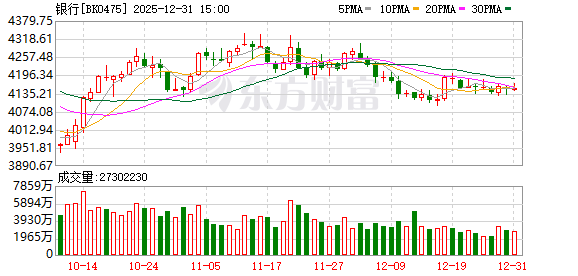
Core Viewpoint - In 2025, A-share bank stocks experienced a "high first, low later" trend, with a total market capitalization exceeding 15 trillion yuan, but overall performance lagged behind the broader market, particularly the CSI 300 index, by over 10 percentage points [2][5][9]. Market Performance - The banking sector's index rose by 7% in 2025, underperforming the CSI 300 index, which reflects a shift from broad-based gains to structural differentiation [2][5]. - The first half of 2025 saw a strong performance, with the banking index increasing by 13.1%, outperforming other major indices, while the second half faced a correction, particularly from July to September, where the index fell by approximately 14% [5][6]. - By the end of 2025, 35 out of 42 bank stocks had risen, with Agricultural Bank of China leading with a 52.66% increase, followed by Xiamen Bank at 35.78% and Shanghai Pudong Development Bank at 24.56% [6][9]. Notable Individual Performances - Agricultural Bank of China emerged as a standout performer, surpassing Industrial and Commercial Bank of China in market capitalization for a brief period, reaching 2.55 trillion yuan [7]. - The overall market capitalization of the banking sector reached 15.7 trillion yuan, with significant contributions from major state-owned banks [5][7]. Valuation and Dividend Appeal - The banking sector's price-to-book ratio (PB) improved to 0.62 by the end of 2025, indicating a marginal recovery from the "broken net" situation, with some banks briefly exceeding a PB of 1 [9][10]. - The average dividend yield for bank stocks was 4.99%, significantly higher than the market average and the yield on 10-year Chinese government bonds, making them attractive for long-term investment [9][10]. Future Outlook - Experts suggest that the banking sector is transitioning from "valuation repair" to "value re-evaluation," with future performance dependent on macroeconomic stability, supportive policies, and confirmation of profit turning points [10]. - Predictions for 2026 indicate a stabilization of net interest margins and overall asset quality, although challenges remain in retail and real estate sectors [10].
金改前沿丨2025年银行股结构性上涨跑输大盘 2026年市场叙事逻辑如何?
Xin Hua Cai Jing· 2026-01-03 05:21
Core Viewpoint - In 2025, A-share bank stocks experienced steady growth but underperformed the broader market, with a total market capitalization exceeding 15 trillion yuan, reaching 15.7 trillion yuan [2][5]. Market Performance - The bank sector showed a "high first, low later" trend in 2025, with the Shenwan Bank Index rising by 7%, lagging over 10 percentage points behind the CSI 300 Index [2][5]. - The bank stocks transitioned from broad-based gains to structural differentiation, with six bank stocks rising over 20% [5][6]. - Agricultural Bank of China emerged as a standout performer, leading with a 52.66% increase in stock price, briefly surpassing Industrial and Commercial Bank of China in market capitalization [2][7]. Market Dynamics - The bank sector's performance was characterized by an initial strong start in the first half of 2025, followed by a correction from July to September, and a recovery in October [5][6]. - During the correction phase, the Shenwan Bank Index fell approximately 14%, ranking last among 31 Shenwan primary industries [6]. - By the end of 2025, 35 bank stocks increased in value, while 7 declined, with notable declines in Huaxia Bank, Zhengzhou Bank, and Beijing Bank [6]. Valuation and Investment Appeal - The banking sector remains undervalued, with a price-to-book ratio (PB) of 0.62, indicating marginal improvement from previous years [8]. - The dividend yield for bank stocks was 4.99%, significantly higher than the market average and the yield on 10-year Chinese government bonds [8]. - Experts suggest that the narrative for bank stocks is shifting from "valuation repair" to "value re-evaluation," influenced by macroeconomic stability, supportive policies, and confirmation of profit turning points [9]. Future Outlook - The outlook for bank stocks in 2026 will depend on macroeconomic recovery, ongoing policy support, and the stabilization of profit margins [9]. - Analysts predict that the banking sector will experience a "shaky upward, structurally differentiated" trend, with a focus on sustainable dividends and stable payout ratios [9].

见证历史!6万亿之上
Xin Lang Cai Jing· 2026-01-03 04:50
Group 1 - The core theme of the article is the significant growth of the ETF market in China, with the total market size reaching 6.02 trillion yuan by the end of 2025, marking a 61.33% increase from the previous year [4][6][33] - The number of ETF products increased to 1,401, reflecting a growth of 33.93% from the end of 2024, indicating a robust expansion in the market [4][27] - Major players in the ETF market include Huaxia, E Fund, and Huatai-PB, which dominate the management scale, with Huaxia leading at 957.16 billion yuan [23][24] Group 2 - The performance of ETFs showed structural differentiation, with six ETFs achieving a unit net value growth rate exceeding 100%, particularly in sectors like communication, artificial intelligence, and non-ferrous metals [6][7] - Conversely, some ETFs tracking food and beverage indices experienced declines, with the wine ETF dropping by 12.96% [9][6] - The top ten ETFs by net inflow included the Hong Kong Stock Connect Internet ETF, which attracted over 566 billion yuan, highlighting the strong demand for cross-border investment products [17][10] Group 3 - The bond ETF market also saw explosive growth, with the total size surpassing 800 billion yuan, driven by the popularity of the Sci-Tech Bond ETF, which accounted for over 50% of the annual growth in this segment [29][28] - The A500 ETF segment became a focal point of competition, with total assets exceeding 300 billion yuan and significant net inflows recorded in December 2025 [31][32] - The ETF issuance market experienced a historic surge, with 362 new ETFs launched in 2025, surpassing the total from the previous two years combined [27][28] Group 4 - The ETF custody market also expanded, with the top five custodians holding approximately 75% of the total ETF market size, indicating a concentration of assets among leading institutions [33] - A trend towards standardization in ETF naming was observed, with major firms like E Fund completing the renaming of their products to align with new regulatory guidelines [34]


重拳出击!近30笔千万级罚单!2025年银行业罚单大盘点
券商中国· 2026-01-03 03:33
Core Viewpoint - In 2025, the Chinese banking industry is undergoing significant regulatory scrutiny characterized by "strict regulation, strong accountability, and zero tolerance," leading to a notable increase in both the quantity and amount of penalties imposed on various banking institutions [1]. Regulatory Penalties Overview - The number of penalties exceeding ten million yuan has reached nearly 30, affecting a wide range of institutions including state-owned banks, policy banks, joint-stock banks, city commercial banks, private banks, and bank-affiliated wealth management subsidiaries [1]. - Penalties are not limited to traditional areas like credit management but also extend to corporate governance, related party transactions, anti-money laundering, data security, and wealth management [2]. Corporate Governance and Compliance - Major state-owned banks such as Bank of China, Industrial and Commercial Bank of China, and Agricultural Bank of China have received substantial fines for issues related to corporate governance and business management [3]. - The largest penalty of the year was imposed on Bank of China, amounting to 97.9 million yuan for various management issues [3]. - Regulatory focus has shifted to deeper issues such as the effectiveness of board responsibilities and the integrity of internal control processes [3]. Compliance and Anti-Money Laundering - There has been an intensified crackdown on compliance, particularly in the anti-money laundering sector, with significant fines imposed on banks for failing to adhere to basic financial management regulations [4]. - For instance, China Merchants Bank was fined 68.07 million yuan for violating 11 regulations related to account management and anti-money laundering [4]. Business Management Issues - The primary reasons for penalties in the banking sector include: - Inadequate management across various business areas such as loans, interbank transactions, and wealth management [6]. - Non-compliance with anti-money laundering responsibilities, including failure to identify customers and report suspicious transactions [7]. - Violations in foreign exchange and investment operations, including illegal currency transactions and improper investment disclosures [8]. - Insufficient implementation of regulatory requirements, leading to non-compliance in data reporting and employee management [9]. Emerging Business Areas - New banking business models, including wealth management subsidiaries and direct banks, have also faced penalties, indicating strict regulatory oversight in these emerging sectors [11]. - For example, a wealth management subsidiary was fined 17.5 million yuan for non-compliance in product information disclosure and post-investment management [12]. Double Penalty System - The implementation of a "double penalty system" has become a significant aspect of regulatory actions, where both institutions and responsible individuals face penalties [13]. - This system aims to link the career prospects of involved personnel directly to the compliance performance of their institutions, thereby enhancing accountability [14]. Summary of Penalties - A detailed overview of penalties reveals that various banks have faced significant fines for a range of compliance failures, with amounts often exceeding ten million yuan [15][16].