
ICBC(601398)

Search documents
临汾金融监管分局核准张建伟工商银行临汾分行副行长任职资格
Jin Tou Wang· 2026-02-05 03:29
二、中国工商银行应要求上述核准任职资格人员严格遵守金融监管总局有关监管规定,自中国工商银行 政许可决定作出之日起3个月内到任,并按要求及时报告到任情况。未在上述规定期限内到任的,本批 复文件失效,由决定机关办理行政许可注销手续。 三、中国工商银行应督促上述核准任职资格人员持续学习和掌握经济金融相关法律法规,牢固树立风险 合规意识,熟悉任职岗位职责,忠实勤勉履职。 2026年1月28日,临汾金融监管分局发布批复称,《中国工商银行(601398)山西省分行关于张建伟同 志任职资格审核的请示》(工银晋报〔2025〕197号)收悉。经审核,现批复如下: 一、核准张建伟中国工商银行临汾分行副行长的任职资格。 ...

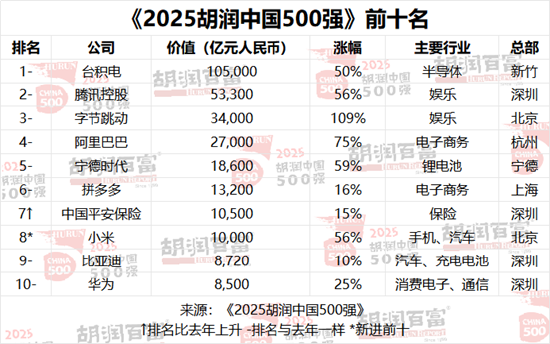
2025胡润中国500强:最具价值国企前三名为农业银行、工商银行、国家电网
Xin Lang Cai Jing· 2026-02-05 03:06
Core Insights - The "2025 Hurun China 500" report highlights TSMC as the highest-valued private enterprise in China, with a valuation increase of 3.5 trillion RMB, reaching 10.5 trillion RMB [1][4] - Tencent follows as the second highest, with a valuation growth of 1.9 trillion RMB, totaling 5.3 trillion RMB [1][4] - ByteDance ranks third, increasing its value by 1.8 trillion RMB to 3.4 trillion RMB [1][4] - Xiaomi enters the top ten for the first time, with a valuation increase of 357 billion RMB, reaching 1 trillion RMB [1][4] Top Ten Private Enterprises - TSMC: Valuation of 105,000 million RMB, growth of 50% [2][5] - Tencent: Valuation of 53,300 million RMB, growth of 56% [2][5] - ByteDance: Valuation of 34,000 million RMB, growth of 109% [2][5] - Alibaba: Valuation of 27,000 million RMB, growth of 75% [2][5] - CATL: Valuation of 18,600 million RMB, growth of 59% [2][5] - Pinduoduo: Valuation of 13,200 million RMB, growth of 16% [2][5] - Ping An Insurance: Valuation of 10,500 million RMB, decline of 15% [2][5] - Xiaomi: Valuation of 10,000 million RMB, growth of 56% [2][5] - BYD: Valuation of 8,720 million RMB, growth of 10% [2][5] - Huawei: Valuation of 8,500 million RMB, growth of 25% [2][5] Top Ten State-Owned Enterprises - Agricultural Bank: Valuation of 202,000 million RMB [3][6] - Industrial and Commercial Bank: Valuation of 274,000 million RMB [3][6] - State Grid: Valuation of 266,000 million RMB [3][6] - China National Railway Group: Valuation of 224,000 million RMB [3][6] - China Construction Bank: Valuation of 203,000 million RMB [3][6] - Kweichow Moutai: Valuation of 182,000 million RMB [3][6] - China Petroleum: Valuation of 176,000 million RMB [3][6] - Bank of China: Valuation of 170,000 million RMB [3][6] - China Mobile: Valuation of 175,000 million RMB [3][6] - CITIC Group: Valuation of 156,000 million RMB [3][6]




金融润“繁花” 信贷织“汉裳”
Jin Rong Shi Bao· 2026-02-05 02:12
Group 1: Core Insights - The city of Heze, known as the "Peony Capital of China," is experiencing a vibrant atmosphere as it prepares for the upcoming Spring Festival, showcasing its unique industries such as peony cultivation and Hanfu culture [1] - Heze Agricultural Commercial Bank has introduced flexible credit products, including an 800,000 yuan "Peony and Chinese Herbal Medicine Loan," to support local farmers in preparing for the peak sales season of peony pots and cut flowers [1] - The People's Bank of China Heze Branch has been actively promoting financial services to support local enterprises, having visited over 400 peony industry entities and established credit files for more than 200, with a total of over 50 million yuan in credit funds disbursed [2] Group 2: Industry Developments - The Hanfu industry in Heze is witnessing a surge in online sales, with a 60% year-on-year increase in sales during the New Year shopping festival, driven by live-streaming sales efforts [2] - Financial institutions in Heze, including Hengfeng Bank, have launched specialized loan products for the Hanfu industry, with loan approval times reduced to within two working days, resulting in a total credit amount of 3.647 billion yuan for the industry, a 43.28% year-on-year increase [3] - As of the end of 2025, the balance of inclusive small and micro loans in Heze reached 94.47 billion yuan, growing by 20.28%, which is significantly higher than the overall loan growth rate [4]

强化财政金融协同联动 合力推动经济高质量发展
Zheng Zhou Ri Bao· 2026-02-05 00:51
Group 1 - The meeting between An Wei, the Secretary of the Zhengzhou Municipal Committee, and Liu Jun, the Vice Chairman and President of the Industrial and Commercial Bank of China (ICBC), highlights the importance of collaboration for economic development in Zhengzhou [2][3] - An Wei expressed gratitude for ICBC's long-term support in the economic and social development of Zhengzhou, emphasizing the city's commitment to high-quality development and innovation-driven growth during the 14th Five-Year Plan period [2] - Zhengzhou aims to enhance its competitiveness and improve the well-being of its citizens by implementing innovative strategies and governance models, while also seeking to leverage opportunities from the comprehensive reform pilot for market-oriented allocation of factors [2][3] Group 2 - Liu Jun outlined ICBC's domestic and international business operations, reaffirming the bank's commitment to fulfilling its responsibilities as a state-owned bank and supporting high-quality economic development in collaboration with Zhengzhou [3] - The discussion included exploring new mechanisms for financial collaboration and the role of finance in empowering economic growth and efficient governance [3]
并购贷款新规落地满月:银行战略棋局浮出水面
Zhong Guo Zheng Quan Bao· 2026-02-04 20:29
Core Insights - The implementation of the new regulations for merger and acquisition (M&A) loans has prompted banks to actively expand their M&A loan business, aiming to establish competitive advantages through early entry into the market [1][2] - The new regulations have broadened the scope of M&A loans, allowing for equity acquisitions and optimizing loan conditions, which is expected to enhance banks' asset yield [2][3] Group 1: Market Dynamics - Several banks, including Industrial and Commercial Bank of China (ICBC), China Construction Bank, and Shanghai Pudong Development Bank, have entered the M&A loan market since the new regulations were introduced on December 31, 2025, initiating a "first deal competition" [1][2] - Beijing Bank successfully executed the first M&A loan under the new regulations, providing 21 million yuan to support a private technology company's acquisition of a 35% stake in another firm, with a financing ratio of 60% and a three-year term [1] Group 2: Regulatory Changes - The new M&A loan regulations have evolved from strict to more flexible frameworks, introducing three key changes: expanding the applicable scope of M&A loans, optimizing loan conditions, and setting differentiated qualification requirements for banks [2][4] - The regulations allow for a higher proportion of control-type M&A loans in relation to the total transaction value and extend the maximum loan term [2] Group 3: Strategic Importance - M&A loans are increasingly recognized for their potential to enhance banks' asset yields, especially in the context of narrowing interest margins and sluggish growth in traditional lending [3] - The M&A loan business is characterized by strong customer loyalty, high comprehensive returns, and significant barriers to entry, making it a strategic focus for banks aiming to differentiate themselves in a competitive landscape [3] Group 4: Challenges and Opportunities - Despite the growth potential, the complexity and specialization required for M&A loans present challenges for banks, which must navigate multiple stakeholders and legal relationships [4] - Banks are encouraged to develop a comprehensive ecosystem that includes M&A facilitation, financing, and post-investment management to effectively compete in the M&A finance sector [4]




业务增长新风口!银行拓展并购贷款业务
Zhong Guo Zheng Quan Bao - Zhong Zheng Wang· 2026-02-04 15:49
Core Insights - The implementation of the "Commercial Bank M&A Loan Management Measures" has created new growth opportunities for commercial banks, with several banks actively expanding their M&A loan business to build competitive advantages through case accumulation and brand development [1][4] Group 1: Regulatory Changes and Market Response - The new M&A loan regulations allow for a broader application of loans, including support for equity-based mergers, which is expected to facilitate resource optimization and transformation for traditional industries [1][4] - Banks like Shanghai Pudong Development Bank view the new regulations as a chance to enhance service capabilities and expand their service boundaries, leading to a multi-faceted growth in M&A loan business across various branches [2][3] Group 2: Initial Successes and Competitive Landscape - Since the introduction of the new regulations, banks have begun a "first deal competition," with Beijing Bank successfully providing a loan of 21 million yuan for a 35% equity stake in a private listed technology company, marking one of the first innovative practices under the new guidelines [3] - Industrial and Commercial Bank of China issued a 299 million yuan loan to support a company's acquisition of core assets, representing the first control-type M&A loan after the new regulations came into effect [3] Group 3: Growth Potential and Profitability - The M&A loan business has seen a compound annual growth rate of nearly 30% among leading banks, indicating a growing recognition of the financial value of M&A loans as a means to enhance intermediate business and overall revenue amid narrowing interest margins [4][5] - The new regulations are expected to release significant market potential, particularly in key national strategic areas such as technological innovation and manufacturing upgrades, allowing banks to rapidly scale their business [5] Group 4: Challenges and Strategic Shifts - Despite the growth potential, the complexity and specialization of M&A loans present challenges for commercial banks, necessitating a shift from being mere credit providers to offering comprehensive financial services that include financing, advisory, and post-transaction management [6][7] - Banks are encouraged to build specialized teams and enhance their understanding of industries to better match the complexity of M&A loans with appropriate risk management systems [7]

郑州市委书记安安伟会见中国工商银行党委副书记、行长刘珺一行
Xin Lang Cai Jing· 2026-02-04 12:43
Core Viewpoint - The meeting between An Wei, the Secretary of the Zhengzhou Municipal Committee, and Liu Jun, the Deputy Secretary and President of the Industrial and Commercial Bank of China (ICBC), emphasizes the collaboration between finance and fiscal policies to promote high-quality economic development in Zhengzhou [2][3]. Group 1: Economic Development Strategies - Zhengzhou is committed to implementing the important directives from General Secretary Xi Jinping regarding the work in Henan and Zhengzhou, focusing on innovation-driven development and constructing a modern industrial system [2][6]. - The city aims to enhance its governance efficiency through a "Party building + grid + big data" model, addressing urgent public concerns effectively [2][6]. - Zhengzhou plans to strengthen its urban competitiveness and ensure significant progress towards socialist modernization during the "14th Five-Year Plan" period [2][6]. Group 2: Collaboration with ICBC - ICBC is recognized as a world-class bank with significant strengths in the global financial sector, and both parties aim to seize opportunities for comprehensive reform in the market-oriented allocation of factors in Zhengzhou [2][7]. - The bank will actively undertake its responsibilities as a state-owned enterprise, focusing on enhancing factor security and exploring new paths for financial empowerment of high-quality economic development [3][7]. - The collaboration aims to create a new mechanism for fiscal and financial synergy, contributing to the construction of Zhengzhou as a regional financial center [2][7].
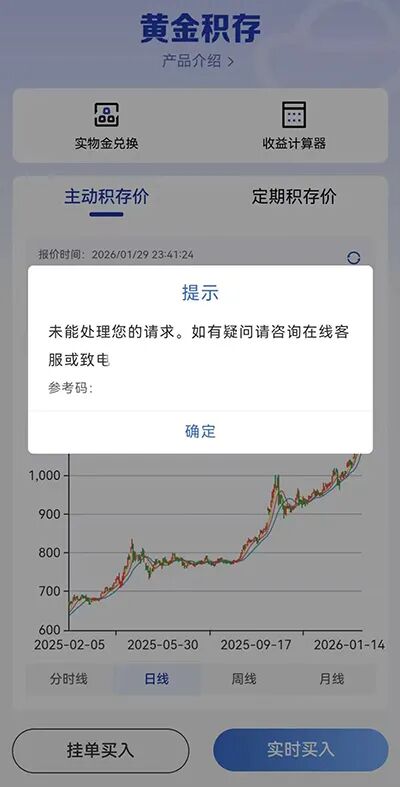
“密码按烂了都买不进”,金价暴跌,年轻人抄底黄金却被“拒之门外”
Hua Xia Shi Bao· 2026-02-04 11:49
Core Viewpoint - The recent surge in trading demand for gold accumulation products has overwhelmed the banking system's capacity, leading to transaction failures and delays, which are attributed to operational issues rather than systemic market risks [1][5][6]. Group 1: Trading Demand and Market Behavior - There has been a significant increase in trading activity for gold accumulation products, driven by fluctuations in gold prices, which has exceeded the banks' operational capabilities [1][6]. - Investors have reported difficulties in executing trades during periods of high demand, with many experiencing failed transactions and system overloads [5][6]. - The current trading frenzy is characterized by a mix of speculative behavior and a lack of available trading platforms, leading to frustration among investors [4][5]. Group 2: Bank Responses and Policy Adjustments - Several banks have raised the minimum purchase amounts for gold accumulation products in response to the increased trading volume and associated risks [7][8]. - Banks are likely to implement stricter trading limits, adjust transaction fees, and enhance their product offerings to manage the surge in demand and mitigate risks [6][9]. - Risk assessment requirements for investors have been tightened, with banks now requiring a risk tolerance evaluation before allowing participation in gold accumulation activities [8][9]. Group 3: Future Outlook and Recommendations - Analysts predict that the growth rate of gold accumulation products will slow down, shifting the focus from scale to quality in the industry [9]. - There is a call for improved risk education and information disclosure from banks to help investors make informed decisions based on their risk tolerance [9]. - The market is expected to evolve towards more standardized and differentiated products, potentially including structured products linked to gold for various risk profiles [9].


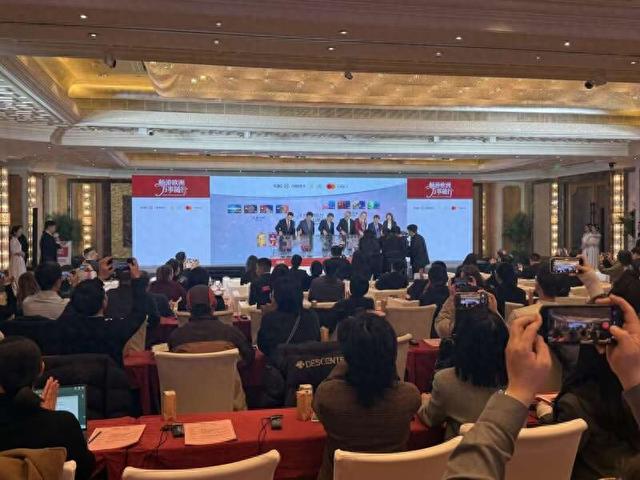
中国出境游消费模式更新,“旅游+金融”勾勒服务新图景
Zhong Guo Qing Nian Bao· 2026-02-04 10:35
Group 1 - The outbound tourism market in China is recovering, with its scale nearly returning to 2019 levels, but the nature and structure of travel have significantly changed, shifting towards experiential consumption rather than shopping [1] - The China Industrial and Commercial Bank (ICBC) launched a co-branded credit card with Mastercard and the European Travel Commission to facilitate smoother travel experiences for tourists, supporting payments in multiple currencies without foreign exchange fees [1] - The spending habits of Chinese tourists are evolving, with the proportion of shopping in their average expenditure in the UK dropping from 39% in 2019 to an expected 21% by 2025, indicating a preference for immersive local experiences [1] Group 2 - The "14th Five-Year Plan" emphasizes expanding high-level opening-up and enhancing cooperation in tourism, which is a key area for China's international engagement [2] - The ICBC European travel credit card aims to provide a secure payment tool for Chinese tourists and businesses, supporting deeper cultural and tourism cooperation between China and Europe [2]

2026年1月社融前瞻:预计社融增速8.3%
GF SECURITIES· 2026-02-04 09:47
Investment Rating - The industry investment rating is "Buy" with a previous rating of "Buy" as well [5]. Core Views - The report forecasts a social financing growth rate of 8.3% for January 2026, with an expected increase in RMB loans of CNY 5.34 trillion, which is a year-on-year increase of CNY 0.12 trillion. The total social financing increment is projected to be CNY 7.55 trillion, a year-on-year increase of CNY 0.49 trillion. By the end of January, the social financing stock is expected to reach CNY 449.5 trillion, with a year-on-year growth rate of 8.25%, reflecting a slight month-on-month decline of 0.02 percentage points [5][8]. Summary by Sections Credit Outlook - The report anticipates a strong demand for corporate credit, with a significant year-on-year increase expected. Retail loans are projected to remain stable, supported by a recovering second-hand housing market in core cities and extended personal consumption loan interest subsidies until the end of 2026. The expected monthly increment of RMB loans in January is CNY 5.34 trillion, with a notable increase in loans directed towards the real economy, amounting to CNY 6.1 trillion, a year-on-year increase of CNY 0.4 trillion [5][8]. Bond Market - Government and credit bond net financing is expected to rebound significantly in January, with government bond net financing projected at CNY 1.2 trillion, a year-on-year increase of CNY 0.49 trillion. Credit bond financing is expected to reach CNY 0.50 trillion, a year-on-year increase of CNY 0.05 trillion [5][8]. Monetary Growth - The report predicts that M1 and M2 growth rates will remain relatively high, with M2 growth expected to rise by 0.3 percentage points to approximately 8.8%, and M1 growth expected to increase by 0.2 percentage points to around 4.0%. This is attributed to delayed cash withdrawal effects from the late Lunar New Year and increased government bond net financing [5][8].