China Life(601628)

Search documents
从风险补偿到全生命周期服务 AI大模型重构保险价值链
2 1 Shi Ji Jing Ji Bao Dao· 2025-10-09 11:43
Core Insights - The digital transformation of the insurance industry in China is accelerating due to multiple factors including policy guidance, market drivers, and technological advancements, fundamentally reshaping service models and core processes [1][2] - The industry is transitioning from being "risk compensators" to "lifecycle service providers," with technology as the core driving force behind this transformation [1] Policy and Market Drivers - The development of digital finance is crucial for deepening financial system reforms and promoting the integration of the real economy with the digital economy, enhancing service efficiency and reducing costs [2] - Regulatory bodies, such as the former China Banking and Insurance Regulatory Commission, have issued guidelines to accelerate the digital transformation of the banking and insurance sectors, aiming for high-quality development and a new digital financial landscape [2] Customer-Centric Transformation - Over the past decade, the insurance industry has shifted from "scale-driven" to "customer-oriented," with increasing demand for online, scenario-based, and personalized services [3] - Companies are focusing on enhancing customer experience as a key competitive advantage, necessitating the reconstruction of traditional core systems to improve flexibility and responsiveness [3][4] Technological Advancements - AI and big data technologies are reshaping core insurance processes, enabling precise decision-making and efficiency improvements in underwriting and claims processing [6] - For instance, China Life has achieved a 95.17% intelligent underwriting review rate and an 83.9% online reinsurance rate, maintaining industry-leading claims processing times [6] Operational Efficiency - The digital transformation is not only enhancing customer service but also streamlining every aspect of the insurance value chain, leading to significant improvements in operational efficiency [5] - China Life has implemented an intelligent claims processing system that can complete payouts in as little as three minutes, showcasing the effectiveness of automation [6] Future Trends - The future of insurance technology is expected to focus on three core trends: cloud-native technologies, artificial intelligence, and data intelligence [7] - Cloud-native technology will facilitate the transition from closed systems to open ecosystems, while AI will enable personalized interactions and proactive risk management [7][8] Data Management - China Life manages a vast amount of insurance data, covering over 32 billion policies and 600 million customers, with daily data flow exceeding 110 billion records [8] - The company has achieved the highest level of data management capability certification, becoming the first in the insurance industry to do so [8]

2025上半年内含价值增长7.7%,期初内含价值预计回报影响2.8%、新业务价值创造影响2.6%、投资回报差异影响1.4%!
13个精算师· 2025-10-09 11:04
Core Viewpoint - The article discusses the analysis of the embedded value changes of listed life insurance companies for the first half of 2025, highlighting a 7.7% growth in embedded value, driven by various factors including expected returns and new business value creation [2][14]. Summary by Sections Embedded Value Changes - The embedded value of listed life insurance companies increased by 7.7% in the first half of 2025, with the expected return on the initial embedded value contributing 2.8%, new business value creation contributing 2.6%, investment return differences contributing 1.4%, and operational experience deviations contributing 0.83% [14][26]. ROEV Analysis - The overall Return on Embedded Value (ROEV) for listed life insurance companies was 6.3%, a decrease of 0.5 percentage points year-on-year. Companies like China Life, Ping An Life, and Taiping Life saw a decline in ROEV, while New China Life, AIA, and Sunshine Life experienced improvements [29][30]. Factors Influencing Embedded Value - The factors influencing the embedded value changes are ranked as follows: expected return on embedded value, new business value creation, investment return differences, operational experience deviations, and changes in assumptions and models [16][18]. Detailed Breakdown of Influencing Factors - **Expected Return on Embedded Value**: Averaged 2.8%, down 0.5 percentage points year-on-year, with most companies (except AIA) showing a decline [18]. - **New Business Value Creation**: Contributed 2.56%, down 0.2 percentage points year-on-year, with some companies like Ping An Life and New China Life showing improvements while others declined [18]. - **Operational Experience Deviations**: Averaged 0.83%, up 0.1 percentage points year-on-year, indicating positive impacts from actual operational experiences [23]. - **Investment Return Differences**: Averaged 1.4%, up 0.5 percentage points year-on-year, with most companies reporting positive deviations [26]. Company-Specific Insights - Sunshine Life reported the highest ROEV at 11.1%, followed by AIA at 8.6% and Ping An Life at 7.5% [30].



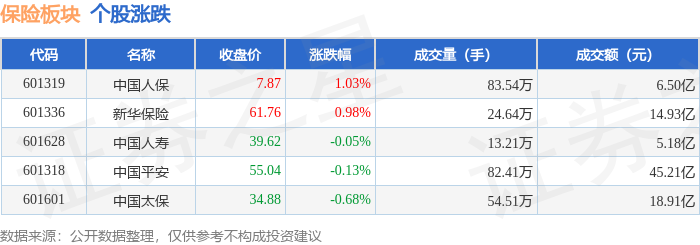
保险板块10月9日涨0.06%,中国人保领涨,主力资金净流出10.09亿元
Zheng Xing Xing Ye Ri Bao· 2025-10-09 09:03
证券之星消息,10月9日保险板块较上一交易日上涨0.06%,中国人保领涨。当日上证指数报收于 3933.97,上涨1.32%。深证成指报收于13725.56,上涨1.47%。保险板块个股涨跌见下表: | 代码 | 名称 | 收盘价 | 涨跌幅 | 成交量(手) | 成交额(元) | | --- | --- | --- | --- | --- | --- | | 61319 | 中国人保 | 7.87 | 1.03% | 83.54万 | 6.50亿 | | 601336 | 新华保险 | 61.76 | 0.98% | 24.64万 | 14.93 乙 | | 601628 | 中国人寿 | 39.62 | -0.05% | 13.21万 | 5.18亿 | | 601318 | 中国平安 | 55.04 | -0.13% | 82.41万 | 45.21亿 | | 601601 | 中国太保 | 34.88 | -0.68% | 54.51万 | 18.91亿 | 以上内容为证券之星据公开信息整理,由AI算法生成(网信算备310104345710301240019号),不构成投资建议。 从资金流向上来看,当 ...


中国人寿跌2.02%,成交额1.16亿元,主力资金净流出1284.96万元
Xin Lang Cai Jing· 2025-10-09 03:59
Core Viewpoint - China Life Insurance's stock price has experienced a decline of 6.34% year-to-date, with a recent drop of 2.02% on October 9, 2023, indicating potential challenges in market performance [1]. Financial Performance - For the first half of 2025, China Life reported a net profit of 40.931 billion yuan, reflecting a year-on-year growth of 6.93% [2]. - The company has cumulatively distributed dividends amounting to 219.617 billion yuan since its A-share listing, with 44.376 billion yuan distributed over the past three years [3]. Shareholder Information - As of June 30, 2025, the number of shareholders decreased by 11.88% to 103,800, while the average number of circulating shares per person increased by 17.09% to 257,573 shares [2]. - Major shareholders include Hong Kong Central Clearing Limited, which holds 79.9389 million shares, an increase of 6.0926 million shares from the previous period [3]. Stock Market Activity - On October 9, 2023, China Life's stock traded at 38.84 yuan per share, with a total market capitalization of 1,097.801 billion yuan [1]. - The stock has seen a trading volume of 116 million yuan, with a turnover rate of 0.01% [1]. Business Segmentation - The company's main business segments include life insurance (78.78%), health insurance (14.22%), other businesses (4.27%), and accident insurance (2.73%) [1]. Industry Classification - China Life is classified under the non-banking financial sector, specifically in the insurance industry [1]. - The company is associated with various concept sectors, including "Zhong Te Gu," "Zhong Zi Tou," "Zheng Jin Hui Jin," "Xiong An New Area," and H-shares [1].
钱从“楼”中来:险资加码收租型资产
Zhong Guo Zheng Quan Bao· 2025-10-09 02:06
Core Insights - Insurance companies are increasingly investing in commercial real estate and office buildings, with significant investments reported this year, totaling several billion yuan, which is a notable increase compared to the same period last year [1][3] - The focus of these investments is primarily on rental-type assets such as commercial offices and logistics real estate, which are seen as high-quality targets due to their stable cash flows and long-term appreciation potential [1][3] Investment Trends - Major insurance firms like China Life, Pacific Life, and Ping An Life have made over ten large real estate investments this year, with a concentration on income-generating properties [1][3] - The recent listing of Huaxia Kaide Commercial REIT, backed by significant insurance capital, highlights the trend of insurance companies participating in public REITs and standardized investment products [2][3] Rental Housing Market - Insurance capital is emerging as a new core buyer in the rental housing market, with significant investments in long-term rental housing projects in major cities like Beijing and Shanghai [5][6] - The characteristics of rental housing assets, such as low volatility and predictable cash flows, align well with the risk profiles and investment strategies of insurance companies [6][10] Policy Support - Recent regulatory frameworks have facilitated insurance companies' entry into the rental housing market, allowing them to invest through various financial instruments [7][8] - The establishment of a closed-loop system for fundraising, investment, management, and exit has alleviated concerns for insurance capital, making it easier to invest in long-term rental housing projects [8] Market Dynamics - The demand for stable cash flow assets has intensified among insurance companies due to declining yields on fixed-income assets, prompting them to seek high-yield rental properties [9][10] - The rental yield for commercial real estate in first-tier cities remains attractive, with rates between 5.5% and 6.5%, which enhances the overall investment returns for insurance capital [11]
新疆金融监管局同意中国人寿财险经济技术开发区支公司变更营业场所
Jin Tou Wang· 2025-10-08 23:24
二、中国人寿财产保险股份有限公司应按照有关规定及时办理变更及许可证换领事宜。 2025年9月25日,新疆金融监管局发布批复称,《关于中国人寿(601628)财产保险股份有限公司乌鲁 木齐市经济技术开发区支公司变更营业场所的请示》(国寿财险乌发〔2025〕29号)收悉。经审核,现 批复如下: 一、同意中国人寿财产保险股份有限公司将经济技术开发区支公司营业场所变更为:新疆维吾尔自治区 乌鲁木齐市经济技术开发区喀纳斯湖北路455号新疆软件园创智大厦B座23层2309室。 ...
钱从“楼”中来:险资加码收租型资产
Zhong Guo Zheng Quan Bao· 2025-10-08 20:46
Core Insights - The article discusses the increasing involvement of insurance capital in the commercial real estate sector, particularly in REITs and rental housing projects, highlighting a strategic shift towards stable income-generating assets [1][2][3][4][5][6][7] - Insurance companies are focusing on high-quality, stable rental properties as they seek to balance cost and returns amid a challenging interest rate environment [1][2][6][7] Investment Trends - Insurance capital is increasingly investing in commercial real estate, including shopping centers and office buildings, with a notable example being the strategic allocation by Caixin Life in the Huaxia Kaide Commercial REIT, amounting to approximately 50 million yuan [1][2] - The investment strategy has shifted from non-standard private equity products to standardized products like public REITs and ABS, indicating a broader diversification in investment types [2][5] Market Dynamics - The rental housing market is emerging as a new focal point for insurance capital, with significant investments in long-term rental housing projects in major cities like Beijing and Shanghai [4][5][6] - The demand for stable cash flow assets is heightened due to declining yields on fixed-income investments, prompting insurance companies to explore high-yield rental properties [6][7] Performance Metrics - The occupancy rates of key assets are critical, with the Changsha Kaide Plaza reporting an occupancy rate of approximately 97%, showcasing the attractiveness of well-leased properties [1] - The rental yield for commercial properties in first-tier cities is reported to be between 5.5% and 6.5%, which is favorable compared to the yields on 10-year government bonds, enhancing the appeal of commercial real estate investments [7] Regulatory Environment - Recent regulatory support from financial authorities encourages insurance capital to invest in rental housing projects, facilitating a more structured approach to funding and investment [5][6] - The establishment of a closed-loop system for fundraising, investment, management, and exit strategies is becoming more defined, addressing concerns about liquidity and investment returns for insurance companies [5][6]
险资“南下”秀肌肉 频频出手港股IPO
Zheng Quan Shi Bao· 2025-10-08 17:37
Core Insights - Zijin Mining's subsidiary, Zijin Gold International, has successfully listed on the Hong Kong Stock Exchange, marking it as the second-largest IPO in Hong Kong this year [2][3] - The IPO attracted 29 cornerstone investors, including major insurance companies such as Taikang Life and China Pacific Insurance, highlighting the significant role of insurance capital in Hong Kong IPOs this year [1][3] Group 1: IPO Participation - Taikang Life has participated in at least five Hong Kong IPOs this year, with a total investment exceeding 1.4 billion HKD across various projects [2][3] - China Pacific Insurance has also been active in the IPO market, matching Taikang Life's investment scale in the same projects [3] - Other insurance companies, such as Dajia Life and China Post Life, have also made notable investments in recent IPOs, indicating a trend of increased participation from insurance capital [3] Group 2: Investment Strategies - Insurance capital is increasingly focusing on equity investments, not only in IPOs but also in the primary and secondary markets [4][5] - China Life has emerged as a strategic investor in the largest A-share IPO of the year, Huadian New Energy, showcasing the growing influence of insurance funds in various market segments [4] - Recent regulatory changes have improved the allocation advantages for insurance capital in IPOs, allowing them to secure a larger share of new offerings [5] Group 3: Market Performance - The performance of newly listed stocks has been favorable, with many IPOs achieving significant gains on their first trading day, such as Zijin Gold International, which rose over 68% [7] - The overall trend indicates that insurance capital has been able to realize substantial floating profits from their IPO investments, although the long-term profitability remains uncertain due to lock-up periods [7]




浮动收益型保险添新军!人身险产品转型纵深推进
券商中国· 2025-10-08 13:35
Core Viewpoint - The return of participating health insurance marks a significant shift in China's insurance market, driven by regulatory support and the need for product diversification in a low-interest-rate environment [1][2][4]. Group 1: Return of Participating Health Insurance - Participating health insurance is making a comeback after 22 years, with regulatory support aimed at enhancing the growth potential of the health insurance market [1][2]. - The previous halt in the sale of participating critical illness insurance in 2003 was due to sales misconduct and management challenges, but the current regulatory environment encourages its return [2][3]. - The reintroduction aligns with the trend of floating yield insurance, which is seen as a necessary step for the transformation of personal insurance products in China [4][5]. Group 2: Floating Yield Insurance Development - Floating yield insurance, which includes participating, universal, and investment-linked insurance, is becoming a key focus for the industry as it adapts to low-interest rates [3][5]. - The maximum guaranteed interest rate for personal insurance products has been reduced from 4.025% to 2.0% over the past six years, indicating a shift towards floating yield products [5][6]. - Companies are increasingly adjusting their product structures to enhance the proportion of floating yield products, particularly participating insurance, to meet market demands [6][7]. Group 3: Market Trends and Company Strategies - Major insurance companies, such as China Life and China Pacific Insurance, have reported significant growth in participating insurance, with it accounting for over 50% of new premium income in some channels [6][7]. - The industry is facing challenges related to interest rate spreads, prompting companies to focus on controlling liability costs and transitioning to participating insurance as a strategic response [6][7]. - Global insurance trends show that companies often shift towards products that transfer risk to customers during periods of declining interest rates, a strategy that is being mirrored in the Chinese market [7].

16年老股东"清仓式撤退"!从杭州银行赚走38亿,中国人寿转身离场
Sou Hu Cai Jing· 2025-10-03 09:48
Core Insights - China Life Insurance has completely divested its stake in Hangzhou Bank after 16 years, selling 50.79 million shares for approximately 833 million yuan, marking the end of its investment journey [2][3] - The decision to exit was influenced by the need for asset reallocation, as the bank's stock price had fluctuated within a range that diminished its attractiveness for investment [6][7] Investment Performance - China Life's total investment in Hangzhou Bank was 1.635 billion yuan, resulting in a net profit of 2.24 billion yuan, yielding an investment return rate exceeding 137% [4] - Including dividends received over the 16 years, the total return rate surpassed 150% [4] Market Context - Hangzhou Bank has grown significantly, with total assets exceeding 2.2 trillion yuan and a revenue of 20.093 billion yuan, net profit of 11.662 billion yuan, reflecting a year-on-year growth of 16.66% [4] - The banking sector has faced challenges such as narrowing net interest margins and tightening regulatory policies, leading to lower valuations across the board [7][11] Shareholder Dynamics - As China Life exits, New China Life Insurance has entered, purchasing 329 million shares for 4.317 billion yuan, indicating continued institutional interest in Hangzhou Bank [9] - The shift from China Life's "value realization" strategy to New China Life's focus on potential growth reflects changing investment philosophies [9][16] Risk and Future Outlook - Despite a low non-performing loan ratio of 0.76% and a high provision coverage ratio of 520%, there are concerns about the declining trend in the coverage ratio and the bank's reliance on corporate loans [10] - The future growth potential of Hangzhou Bank remains promising, driven by local economic developments and digital transformation, although it may not replicate past high growth rates [16][17]