GWMOTOR(601633)

Search documents
长城汽车申请碰撞假人专利,能够提高碰撞测试数据的可靠性
Jin Rong Jie· 2025-12-06 09:55
国家知识产权局信息显示,长城汽车股份有限公司申请一项名为"碰撞假人"的专利,公开号 CN121068236A,申请日期为2025年11月。 声明:市场有风险,投资需谨慎。本文为AI基于第三方数据生成,仅供参考,不构成个人投资建议。 财经频道更多独家策划、专家专栏,免费查阅>> 专利摘要显示,本申请提供了一种碰撞假人,涉及碰撞假人技术领域,能够提高碰撞测试数据的可靠 性。碰撞假人的胸段脊柱结构包括至少两个第一刚性胸椎件和至少两个柔性胸椎件,沿胸段脊柱结构的 延伸方向,第一刚性胸椎件与柔性胸椎件交替设置,依次首尾相接,肋骨件与第一刚性胸椎件固定连 接,肋骨件与第一刚性胸椎件一一对应设置,沿胸段脊柱结构的延伸方向,至少两个肋骨件均与胸骨件 滑动连接。本申请提供的碰撞假人,柔性胸椎件的压缩与伸展,使得胸段脊柱结构可以产生弯曲、伸展 和侧弯等运动,使得碰撞假人能够产生前俯、后仰和侧转等响应,使得碰撞假人在碰撞中的受伤情况与 真实人体的受伤情况较为一致,能够提高碰撞测试数据的可靠性。 天眼查资料显示,长城汽车股份有限公司,成立于2001年,位于保定市,是一家以从事汽车制造业为主 的企业。企业注册资本855894.5933 ...

特朗普松绑油耗标准:全球车企抢跑“油电同强时代”
智通财经网· 2025-12-06 09:08
Core Viewpoint - The proposal by former President Trump to terminate strict fuel economy standards set by the Biden administration poses a significant challenge to Europe's aggressive policies on banning fuel vehicles, highlighting a shift in the automotive industry's dynamics towards a more sustainable and diversified future led by China's oil-electric hybrid strategy [1][9]. Group 1: Policy Changes and Impacts - Trump's proposal aims to reduce the average cost of purchasing new cars by $1,000, potentially saving Americans $109 billion over five years [3]. - The new fuel efficiency standard proposed by Trump's administration requires vehicles to achieve approximately 34 miles per gallon by 2031, compared to Biden's target of 50 miles per gallon [2]. Group 2: Industry Dynamics - The automotive industry's core profits are derived from fuel vehicles, and the transition to electric vehicles represents a significant restructuring of interests, with traditional automakers facing survival pressures due to lost profits from engine manufacturing and after-sales services [4]. - The shift in stance among U.S. automakers from supporting electric vehicle initiatives to opposing stringent regulations reflects the industry's struggle with profit erosion amid changing policies [4]. Group 3: European Market Challenges - European automakers are under severe pressure from the EU's legislation to ban fuel vehicles by 2035, which is seen as overly ambitious and detrimental to businesses [5]. - The EU's "Fit for 55" plan aims for a 55% reduction in new car carbon emissions by 2030, with a complete transition to zero emissions by 2035, but this has led to some companies planning to abandon engine development altogether [5]. Group 4: Global Automotive Trends - The trend of oil-electric hybrid strategies is gaining traction globally, with Asian automakers, particularly Chinese brands like BYD, Geely, and Chery, significantly increasing their market share [7][8]. - The global automotive market remains predominantly fuel-based, with 73% of vehicles still using fuel, indicating that a rapid transition to electric vehicles is unlikely in the short term [8]. Group 5: China's Strategic Position - China's oil-electric hybrid strategy is viewed as a successful model, with the recent release of the 3.0 roadmap emphasizing the continued importance of internal combustion engines alongside electric vehicles [10]. - By 2040, it is projected that 85% of new passenger vehicles in China will be electric, with a significant market still remaining for non-pure electric models, positioning Chinese automakers as key players in the global automotive technology landscape [10].




融了20亿的超级独角兽,停工了
3 6 Ke· 2025-12-06 08:01
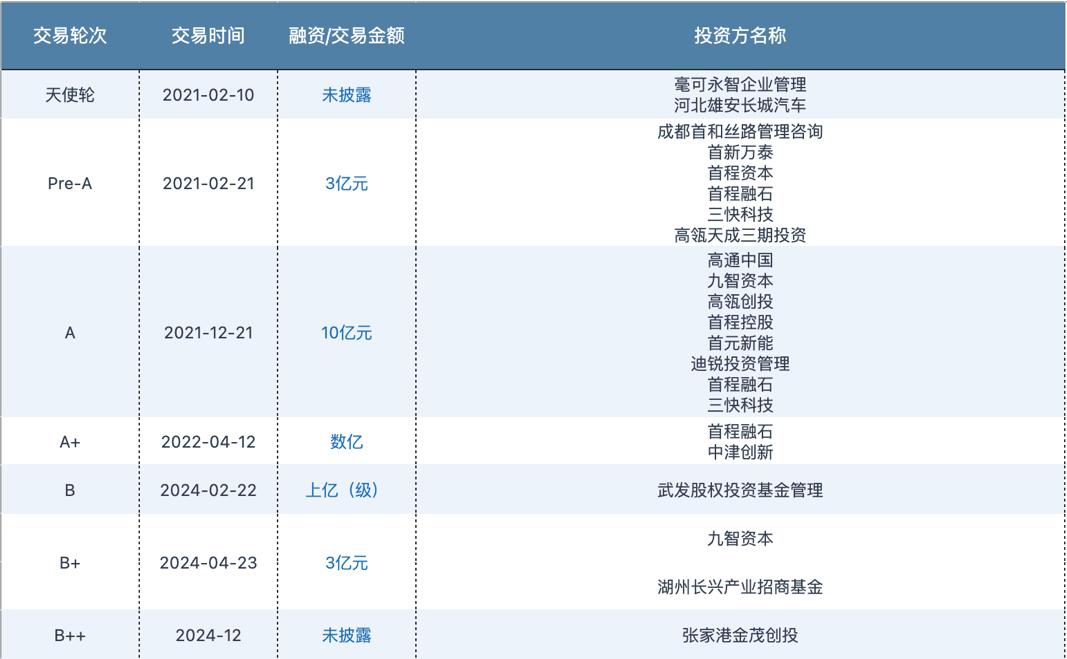
Core Viewpoint - The sudden announcement of a work stoppage at Haomo Zhixing has led to a complete halt in operations, raising concerns among employees about compensation and future arrangements [1][2]. Company Background - Founded in 2019, Haomo Zhixing emerged as a latecomer in the autonomous driving sector, entering a market that was transitioning from hype to rational pursuit [3]. - The company was established as a spin-off from Great Wall Motors, aiming to focus on autonomous driving technology amid industry transformation [4]. - Haomo Zhixing's leadership includes experienced executives from Great Wall Motors, reflecting the company's ambitious goals in the autonomous driving space [4][5]. Growth and Achievements - Haomo Zhixing quickly gained attention in the industry, developing a data intelligence system and launching its HPilot system across over 20 vehicle models, achieving over 1 billion yuan in revenue by the end of 2021 [7]. - The company reported a total driving distance of over 250 million kilometers by 2024, showcasing its rapid growth in user engagement [7]. Challenges and Decline - Despite initial success, Haomo Zhixing faced significant challenges, including delays in product delivery and the inability to launch its urban NOH feature, which contributed to its decline [8][9]. - The company began to lose favor with Great Wall Motors, which started exploring partnerships with other firms for smart driving solutions, further marginalizing Haomo Zhixing [9]. Financial Backing and IPO Plans - Haomo Zhixing has attracted substantial investment, raising approximately 2 billion yuan across seven funding rounds, with notable investors including Meituan and Hillhouse Capital [10][12]. - The company had plans for an IPO, initially targeting the Sci-Tech Innovation Board in 2023, but faced delays and is now considering a potential listing in Hong Kong in 2024 [13]. Internal Turmoil - Internal issues have been evident, with reports of layoffs and high-level executive departures, indicating a deteriorating organizational structure [14]. - Financial difficulties have emerged, with cash flow issues leading to delayed salary payments and challenges in meeting business targets [14]. Industry Context - The autonomous driving sector is experiencing a competitive landscape, with significant investment activity and a trend towards consolidation among major players [15]. - Haomo Zhixing's situation serves as a cautionary tale for companies reliant on single corporate partners, highlighting the risks of dependency in a rapidly evolving industry [15].
长城汽车取得消除显示屏拖影的方法、装置及可读存储介质专利
Jin Rong Jie· 2025-12-06 04:55
声明:市场有风险,投资需谨慎。本文为AI基于第三方数据生成,仅供参考,不构成个人投资建议。 财经频道更多独家策划、专家专栏,免费查阅>> 国家知识产权局信息显示,长城汽车股份有限公司取得一项名为"消除显示屏拖影的方法、装置以及可 读存储介质"的专利,授权公告号CN119380672B,申请日期为2024年11月。 天眼查资料显示,长城汽车股份有限公司,成立于2001年,位于保定市,是一家以从事汽车制造业为主 的企业。企业注册资本855894.5933万人民币。通过天眼查大数据分析,长城汽车股份有限公司共对外 投资了75家企业,参与招投标项目2813次,财产线索方面有商标信息5000条,专利信息5000条,此外企 业还拥有行政许可640个。 ...
2025年1-10月中国汽车产量为2732.5万辆 累计增长11%
Chan Ye Xin Xi Wang· 2025-12-06 02:43
Group 1 - The core viewpoint of the articles highlights the growth in China's automotive production, with a reported production of 3.28 million vehicles in October 2025, reflecting a year-on-year increase of 11.2% [1] - Cumulative automotive production from January to October 2025 reached 27.325 million vehicles, marking an overall growth of 11% [1] - The report by Zhiyan Consulting provides a deep assessment of the Chinese automotive industry and forecasts investment opportunities from 2025 to 2031 [1] Group 2 - Listed companies in the automotive sector include BYD, Great Wall Motors, SAIC Motor, GAC Group, FAW Jiefang, Dongfeng Motor, and Seres [1] - The data source for the automotive production statistics is the National Bureau of Statistics, with the information organized by Zhiyan Consulting [2]





前11月易方达消费行业股票基金牛市没赚钱?规模169亿
Zhong Guo Jing Ji Wang· 2025-12-05 12:11
Group 1 - The core point of the article highlights that among 970 ordinary equity funds, only 29 funds experienced a decline in value, including the E Fund Consumer Industry Stock managed by renowned fund manager Xiao Nan, which saw a decrease of 0.14% in return for the first 11 months of 2025 [1][2] - The E Fund Consumer Industry Stock primarily invests in the consumer sector, with a significant portion of its top ten holdings being in the liquor industry, including major stocks like Kweichow Moutai, Shanxi Fenjiu, and Wuliangye [1] - As of December 4, 2025, the cumulative return of the E Fund Consumer Industry Stock since its inception on August 20, 2010, is 254.2%, with a total asset size of 16.949 billion yuan as of the end of the third quarter of this year [1][2]






销量、营收、核心市场份额占比不断提升,海外市场成新增长极
Zhong Guo Qi Che Bao Wang· 2025-12-05 09:57
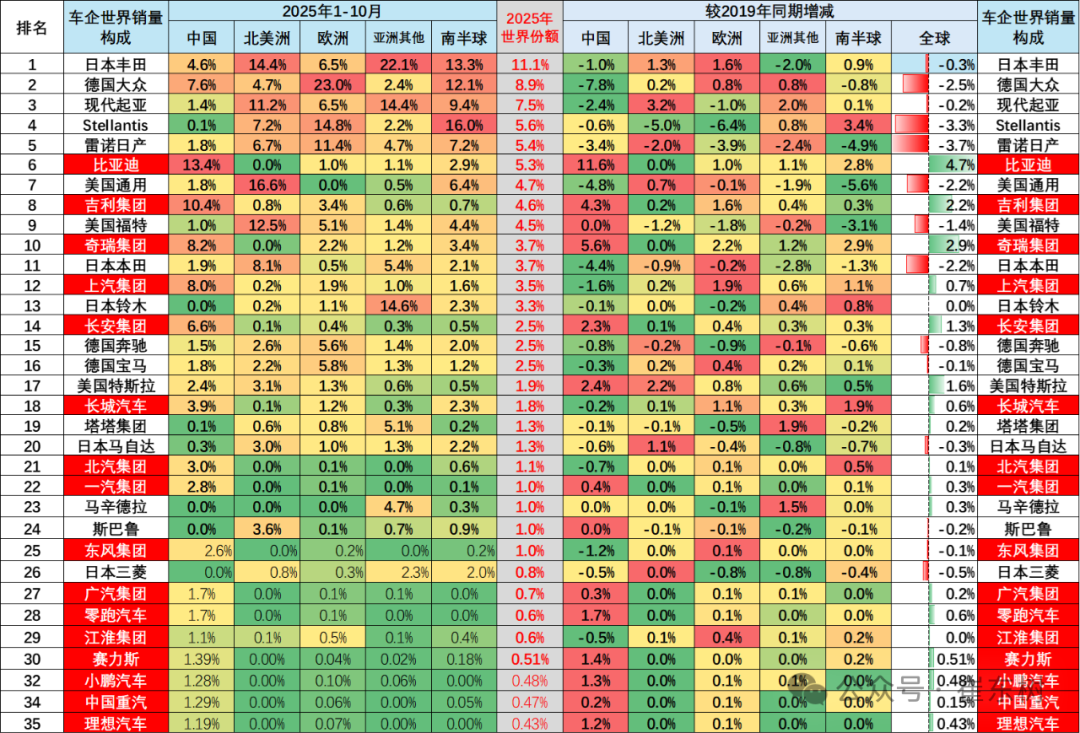
Core Viewpoint - The Chinese automotive industry is transitioning from incremental competition to stock competition, with overseas markets becoming a new growth driver as domestic competition intensifies [4][8]. Export Growth - In October, China's automotive exports reached 666,000 units, a month-on-month increase of 2.1% and a year-on-year increase of 22.9%. From January to October, exports totaled 5.616 million units, up 15.7% year-on-year [4]. - The export growth rate is outpacing domestic production and sales growth, indicating a shift in focus for Chinese automakers towards international markets [4]. Company Performance - Chery's overseas sales for January to October reached 1.06 million units, accounting for 46% of total sales, with a year-on-year growth of 13% [5]. - BYD's overseas sales for the same period were 780,000 units, a significant increase of 130%, raising its export share to 21% [5]. - Great Wall Motors reported overseas sales of 454,100 units, making up nearly 37% of total sales, with a 44.61% increase compared to 2023 [5]. - Geely's overseas sales reached nearly 300,000 units, with a remarkable 214% increase in exports of new energy vehicles [6]. Market Expansion - GAC's overseas terminal sales grew by 36.5%, covering 85 countries and regions, with over 570 sales outlets [7]. - Chinese automotive brands are increasingly penetrating mature markets like the EU, with a record 7.4% market share in the European passenger car market as of September 2025, doubling from 3.3% year-on-year [14]. Revenue Contribution - Chery's revenue for the first three quarters of 2025 was 214.83 billion yuan, a 17.9% increase year-on-year, with exports contributing significantly to this growth [10]. - BYD's overseas revenue share increased from 28% in 2024 to 36.5% in the third quarter of 2025, with a net profit margin of 4.2% [11]. - Great Wall Motors' overseas revenue surged to 80.3 billion yuan, accounting for 39.69% of total revenue [12]. Strategic Insights - Chinese automakers are focusing on localizing products to meet diverse market needs, which is essential for integrating into local markets [9][20]. - The shift from product export to ecological output is becoming a key strategy for Chinese car manufacturers, enhancing their competitiveness in international markets [13][19]. - The global market share of Chinese automobiles is expected to exceed 38% by 2025, with significant growth in emerging markets like Southeast Asia and Africa [14][16]. Future Projections - By 2030, it is anticipated that Chinese automotive brands will achieve over 12% market share in overseas markets, with sales reaching nearly 10 million units [18]. - The global expansion of Chinese car manufacturers is accelerating, with strategies focusing on building a global vehicle that meets diverse market demands [19].

去伪存真,聚焦景气赛道核心资产
HTSC· 2025-12-05 09:05
Group 1: Core Insights - The report emphasizes the importance of focusing on high-end and export opportunities in the automotive sector, particularly for domestic brands like BYD, Geely, Great Wall, and Leap Motor [1][2] - The automotive industry is expected to see a stable growth in 2026, with wholesale and retail sales projected to increase by 3% and decrease by 1% respectively, indicating a flat overall market [2][18] - The report highlights the significant growth potential in the European electric vehicle market, forecasting a 35% year-on-year increase in sales to reach 3.65 million units in 2026, driven by carbon emission regulations and high-quality new vehicle supply [2][18] Group 2: Passenger Vehicles - Domestic brands have increased their market share from 60% to 66% in the first ten months of 2025, with mid-to-low-end segments experiencing the fastest growth [26][28] - The report identifies key models in the five/six-seat SUV market, including Xiaomi's YU9, NIO's ES7, and others, as significant contributors to the high-end market push [2][18] - The report anticipates intensified competition among domestic car manufacturers, particularly in the high-end segment, as they aim to capture a larger share of the market [2][18] Group 3: Auto Parts - The auto parts sector is focusing on globalization and new technological avenues, with an emphasis on opportunities in Europe and advancements in AI and robotics [3][4] - The report suggests that the auto parts industry will benefit from structural opportunities as traditional international giants undergo transformation [3][4] - Key companies recommended for investment in the auto parts sector include Minth Group, Xingyu, and others, which are expected to leverage their technological advantages for growth [3][4] Group 4: Intelligent Driving - The report predicts that by 2026, high-speed NOA (Navigation on Autopilot) will become a standard feature priced between 100,000 to 150,000 yuan, with penetration rates expected to reach 43% for high-speed NOA and 24% for urban NOA [4][5] - The acceleration of L4 commercial deployment is anticipated, with many scenarios expected to complete technical validation by 2025, leading to a rapid commercialization phase in 2026 [4][5] - Recommended companies in the intelligent driving space include Horizon Robotics, Black Sesame, and others, which are positioned to benefit from the growing demand for AI applications in vehicles [4][5] Group 5: Robotics - The robotics sector is expected to experience significant growth in 2026, driven by advancements in technology and production capabilities, particularly with Tesla's V3 technology [5][6] - The report highlights the importance of domestic companies in the robotics field, which are likely to see valuation increases as they innovate and expand their production capabilities [5][6] - Key players in the robotics sector recommended for investment include Xpeng and others, which are expected to benefit from the evolving landscape of robotics technology [5][6]


【联合发布】一周新车快讯(2025年11月29日-12月05日)
乘联分会· 2025-12-05 08:39
Core Viewpoint - The article provides an overview of new vehicle launches scheduled for late 2025, detailing specifications, pricing, and market segments for various manufacturers [2][70]. Group 1: Vehicle Launches - Chery Automobile is set to launch the Exeed ET5 on November 28, 2025, positioned as a B SUV with a price range of 144,900 to 159,900 CNY [7][4]. - FAW-Volkswagen will introduce the Volkswagen Tayron L on the same date, also classified as a B SUV, with prices ranging from 207,900 to 259,900 CNY [15][12]. - Beijing Off-road will release the BJ60 on November 30, 2025, categorized as a C SUV with a price of 295,800 CNY [23][20]. - Dongfeng Nissan's Nissan N6 is scheduled for December 1, 2025, as a B NB vehicle with prices from 99,900 to 129,900 CNY [31][28]. - Seres Automotive will launch the Blue Electric E5 Plus on December 3, 2025, a B SUV priced between 139,800 and 143,800 CNY [39][36]. - Changan Ford's Mondeo will debut on December 4, 2025, as a B NB vehicle with a price range of 149,800 to 199,800 CNY [47][44]. - Great Wall Motors will introduce the Tank 300 Hi4-T on the same day, classified as an A SUV with a price of 249,800 CNY [55][52]. - NIO will launch the L60 on December 5, 2025, a B SUV priced at 211,900 CNY [63][60]. Group 2: Technical Specifications - The Exeed ET5 features a 1.5T range extender engine with an electric motor, offering a pure electric range of 210 km and a battery capacity of 32.66 kWh [7][6]. - The Volkswagen Tayron L offers multiple engine options, including a 1.5T and a 2.0T, with power outputs ranging from 118 kW to 162 kW [15][14]. - The BJ60 is equipped with a 1.5T range extender engine and has a battery capacity of 40.3 kWh, providing a pure electric range of 152 km [23][22]. - The Nissan N6 features a 1.5L plug-in hybrid engine with a battery capacity of 20.3 to 21.1 kWh, offering a pure electric range of 170 to 180 km [31][30]. - The Blue Electric E5 Plus has a 1.5L plug-in hybrid engine and offers a pure electric range of 155 to 230 km, depending on the variant [39][38]. - The Mondeo features a 1.5T hybrid engine with a maximum power output of 140 kW and a torque of 222 Nm [47][46]. - The Tank 300 Hi4-T is powered by a 2.0T plug-in hybrid engine, delivering 185 kW and 385 Nm of torque [55][52]. - The L60 is a fully electric vehicle with a power output of 240 kW and a battery capacity of 60 kWh, providing a range of 530 km [63][60].


比亚迪赚走6成利润,6家新势力亏掉107亿,14大车企前三季度业绩锐评
3 6 Ke· 2025-12-05 02:56
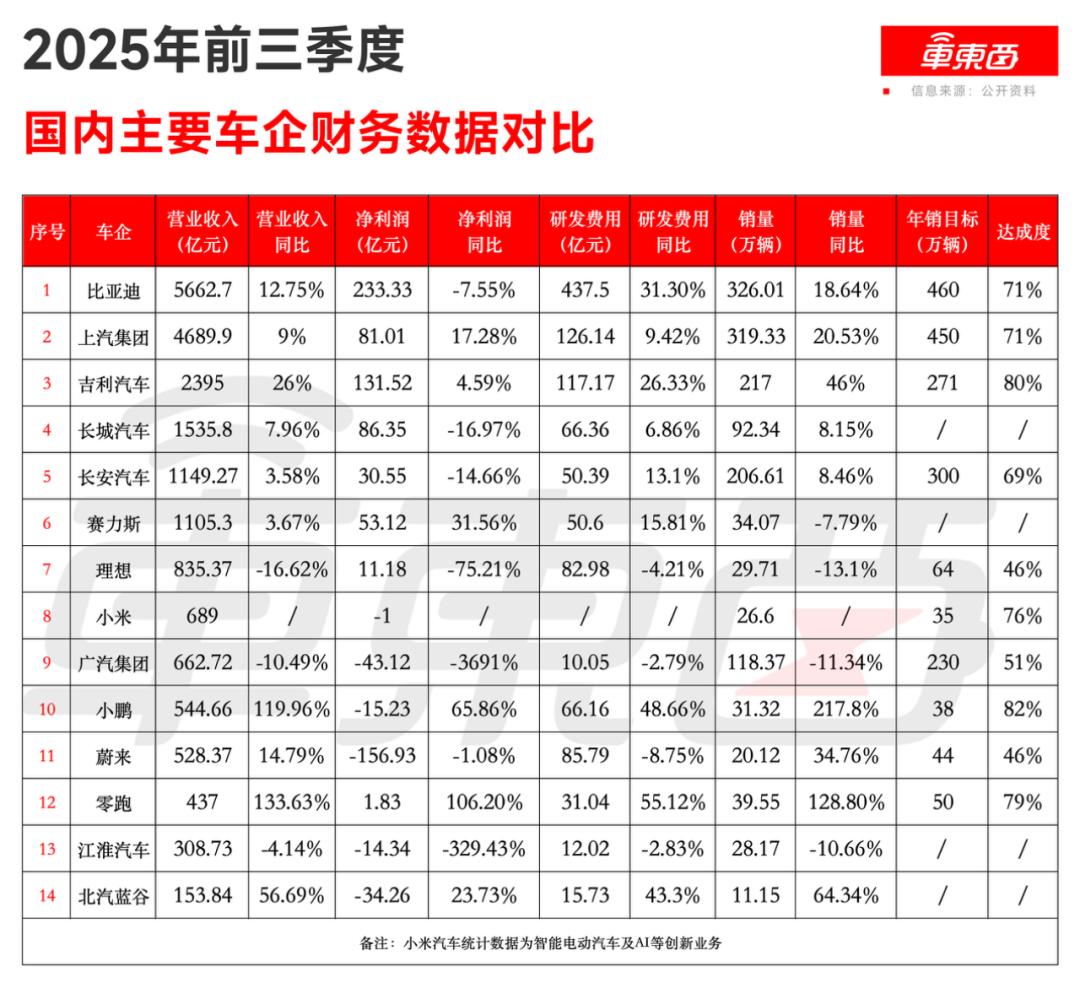
Core Insights - The financial reports of 14 major domestic car manufacturers for the first three quarters of 2025 show a total revenue of 2.07 trillion yuan and a net profit of 364 billion yuan, resulting in a net profit margin of only 1.76% [2][6][22]. Group 1: Financial Performance - Among the traditional car manufacturers, eight companies reported a combined net profit exceeding 471 billion yuan, with BYD leading with a net profit of 233 billion yuan, accounting for 64% of the total net profit of the 14 companies [4][8]. - Geely's revenue reached 239.5 billion yuan, a 26% increase year-on-year, with a net profit of 131.52 billion yuan, benefiting from its accelerated transition to new energy vehicles [8][22]. - The new energy vehicle sector is experiencing significant losses, with six new entrants collectively losing 107 billion yuan, while only Seres, Li Auto, and Leap Motor reported profits [4][6][22]. Group 2: Revenue and Profit Comparison - BYD's revenue was 566.27 billion yuan, a 12.75% increase, while its net profit decreased by 7.55% [5][7]. - SAIC Group reported a revenue of 468.99 billion yuan and a net profit of 81.01 billion yuan, both showing growth [11][22]. - NIO's revenue was 528.37 billion yuan, with a significant net loss of 156.93 billion yuan, highlighting the challenges faced by the company [22][24]. Group 3: R&D Investment - BYD led in R&D investment with 437.5 billion yuan, a 31.3% increase, indicating a commitment to technological expansion despite a slight decline in net profit [25][29]. - Geely's R&D expenditure was 117 billion yuan, up 26%, reflecting its focus on innovation [29][32]. - NIO, despite its losses, invested 85.79 billion yuan in R&D, maintaining a strong commitment to technology development [32][36]. Group 4: Sales Performance - The total sales volume for the 14 companies reached 15 million units, with BYD, SAIC, Geely, and others achieving significant growth [37][41]. - BYD sold 3.26 million vehicles, a year-on-year increase of 18.64%, while SAIC's sales reached 3.19 million units, growing by 20.53% [38][45]. - New entrants like Leap Motor and Xpeng saw substantial sales increases, with Leap Motor's sales up 128.8% and Xpeng's up 217.8% [49][50]. Group 5: Market Dynamics - The competitive landscape in the automotive industry is intensifying, with companies facing pressures from supply chain costs, rapid technological changes, and the need for substantial R&D investments [52]. - The performance of these 14 companies reflects a growing divide in profitability, with only a few achieving a balance between revenue growth and profit margins [22][52].