GWMOTOR(601633)

Search documents
长城汽车:销量新高,高端化升级,预测全年营业收入2474.84~2898.00亿元
Xin Lang Cai Jing· 2026-02-03 12:53
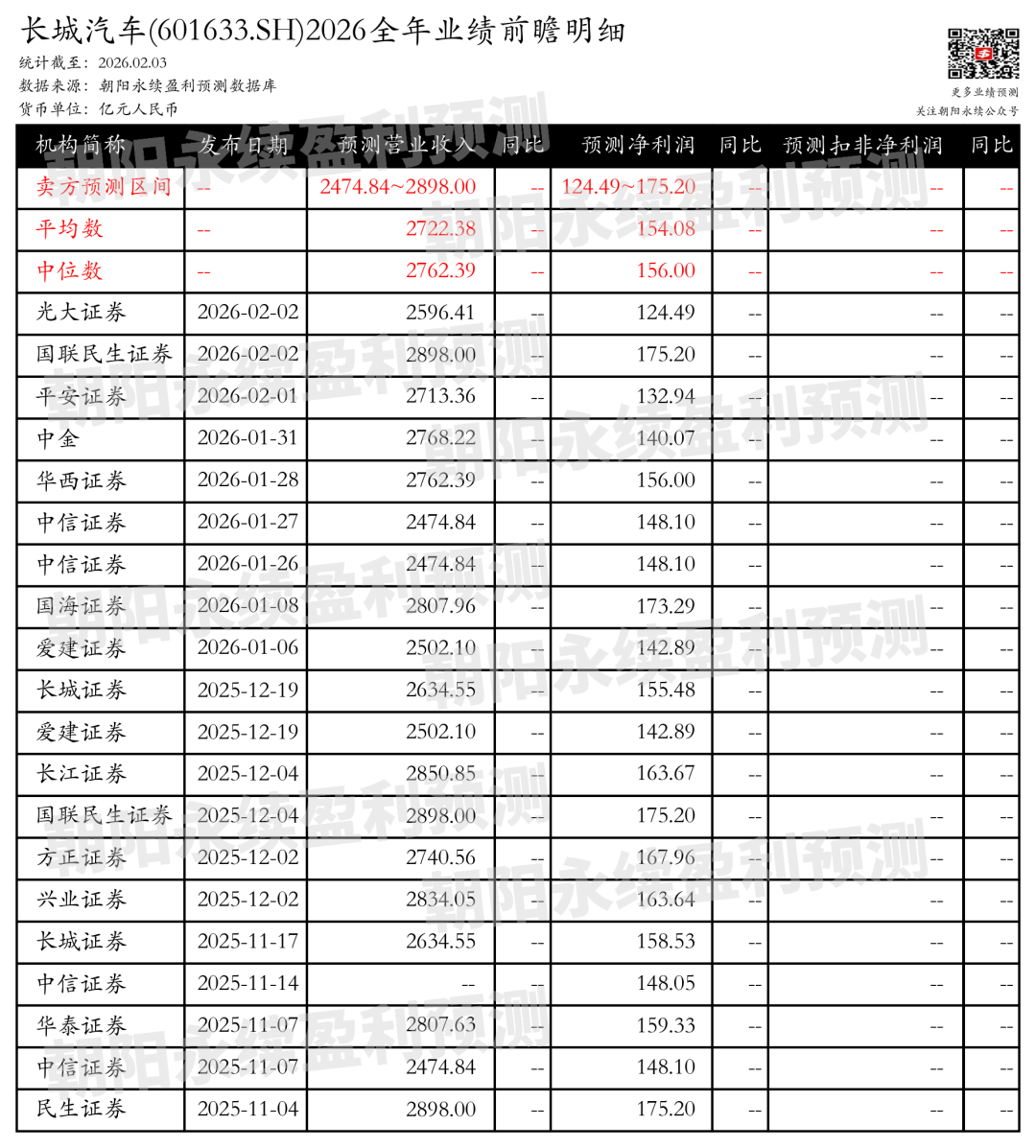
Core Viewpoint - The forecast for Changcheng Automobile's revenue for 2026 is between 247.48 billion to 289.80 billion yuan, with a net profit forecast of 12.45 billion to 17.52 billion yuan, indicating potential for exceeding expectations in future financial disclosures [1][8]. Revenue and Profit Forecast - The predicted revenue range is 2474.84 to 2898.00 million yuan, with an average forecast of 2722.38 million yuan and a median of 2762.39 million yuan [2][9]. - The predicted net profit range is 124.49 to 175.20 million yuan, with an average of 154.08 million yuan and a median of 156.00 million yuan [2][9]. Sales Performance - Changcheng Automobile achieved a total sales volume of 1.324 million units in 2025, marking a year-on-year increase of 7.3%, setting a historical record [3][10]. - WEY brand sales reached 102,000 units, showing a significant year-on-year growth of 86.3% [4][10]. - Haval brand sales totaled 759,000 units, with a year-on-year increase of 7.4% [3][10]. - Tank brand sales were 233,000 units, reflecting a slight year-on-year increase of 0.7% [5][10]. - Overseas sales reached 506,000 units, representing a year-on-year growth of 11.7% [11]. New Product Developments - The company launched the world's first native AI all-power platform, named "Guiyuan," which supports five types of power configurations and aims to introduce over 50 models across seven categories [12]. - The platform features a pure electric range of up to 363 kilometers and a comprehensive WLTC range of 1393 kilometers, with rapid charging capabilities [12].


长城、上汽、东风1月销量公布,出口成共同亮点
Jing Ji Guan Cha Wang· 2026-02-03 12:34
Group 1 - In January 2026, Great Wall Motors sold 90,300 new vehicles, representing a year-on-year increase of 11.59% but a month-on-month decline of 27.18% [1] - Overseas sales for Great Wall Motors increased by 43.77% year-on-year [1] - The Haval brand sold 50,500 vehicles, up 4.03% year-on-year; the Wey brand sold 7,873 vehicles, up 57.24%; and the Tank brand sold 14,500 vehicles, up 12.92% [1] Group 2 - SAIC Motor Group did not disclose overall sales figures, but some business units reported data [1] - SAIC Passenger Vehicle's Roewe and MG brands had retail sales exceeding 78,000 units, a year-on-year increase of 9.8% [1] - SAIC-GM Wuling's global sales in January reached 105,800 units, while SAIC-GM's terminal deliveries were 51,000 units, up 8.2% year-on-year [1] Group 3 - Dongfeng Motor's Lantu brand delivered 10,500 vehicles in January, a year-on-year increase of 31% [1] - Yipai Technology's sales reached 21,300 vehicles, a significant year-on-year increase of 145% [1] - The Mengshi brand sold 1,008 vehicles, marking a year-on-year growth of 300% [1]


同比普涨、环比普跌,1月车企销量“开门红”成色不足
经济观察报· 2026-02-03 12:15
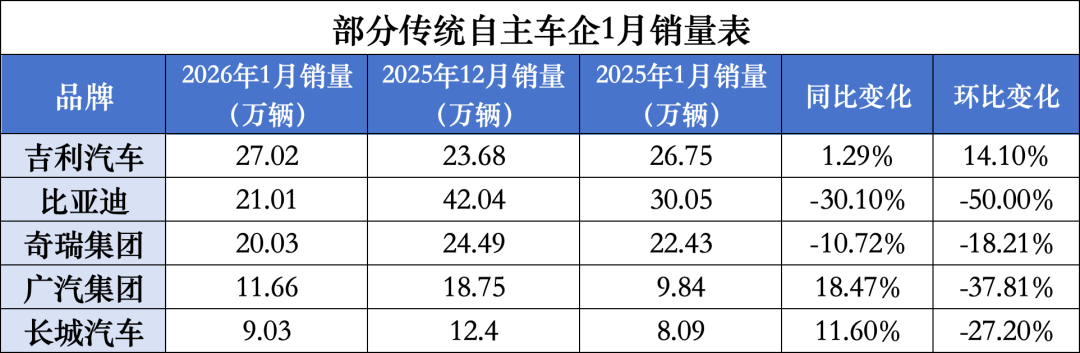
Core Viewpoint - The automotive industry experienced a mixed performance in January 2026, with many companies reporting year-on-year sales growth due to a low sales base from the previous year, but a significant month-on-month decline due to the end of full tax exemptions and consumer hesitation [2][3]. Group 1: Overall Market Performance - In January 2026, the automotive industry achieved a positive year-on-year growth, largely influenced by the low sales base from January 2025 when the Spring Festival occurred [2]. - Month-on-month sales for most companies declined significantly, attributed to the end of full tax exemptions for new energy vehicles and the lack of clear local subsidy policies, leading to consumer hesitation [2][3]. Group 2: Company-Specific Performance - Geely's sales reached 270,200 units in January, a year-on-year increase of 1.29% and a month-on-month increase of 14%. New energy vehicle sales accounted for 46% of total sales [3][4]. - BYD sold 210,100 units in January, with overseas sales of 100,000 units showing a year-on-year growth of 43.3% [4]. - Chery Group's sales were 200,300 units, down 10.72% year-on-year and 18.23% month-on-month, with new energy vehicle sales at 52,100 units [5]. - GAC Group reported sales of 116,600 units, a year-on-year increase of 18.47%, but a month-on-month decline of 37.79% [5]. - SAIC Group's sales data showed a retail volume of over 78,000 units for its passenger vehicle segment, a year-on-year increase of 9.8% [6]. Group 3: New Energy Vehicle Segment - New energy vehicle sales for Geely were 124,300 units, with a year-on-year growth of 3% [4]. - BYD's new energy vehicle sales were 177,500 units, contributing significantly to its overall performance [4]. - The new energy vehicle segment is showing resilience, with companies like AITO (问界) and Xiaomi Auto reporting substantial year-on-year growth [7][8].




销冠易主,小鹏垫底,车市开年大洗牌
Guo Ji Jin Rong Bao· 2026-02-03 10:41
Core Insights - January saw a significant reshuffling in the domestic automotive market, with new energy vehicle (NEV) purchase tax reinstatement and demand being pulled forward due to promotions leading to changes in rankings among new players [1] - New energy vehicle companies showed a clear divergence in January sales, with Zeekr, NIO, and Xiaomi Auto experiencing over 90% year-on-year growth, while Li Auto and Xpeng faced declines [1][2] Sales Performance - Hommage Zhixing delivered 57,900 vehicles in January, with the AITO brand contributing 40,000 units, accounting for 69.1% of total deliveries [2] - Xiaomi Auto delivered over 39,000 vehicles, marking a 95% year-on-year increase, despite a 22% month-on-month decline [2] - Leap Motor's January deliveries reached 32,100 units, with plans to hit a sales target of 1 million vehicles in 2026 [2] - Li Auto's deliveries were 27,700 units, entering a self-adjustment phase due to supply chain issues affecting production [3] - NIO delivered 27,200 vehicles, with a significant year-on-year increase of 163% driven by the new ES8 model [3] - Xpeng delivered approximately 20,000 vehicles, focusing on new product launches for 2026 [4] Traditional Automakers - Geely topped the sales chart in January with 270,200 units sold, a 1.29% year-on-year increase and a 14.08% month-on-month increase, driven by the Zeekr brand [5][6] - BYD's sales fell to 210,100 units, a 30.11% year-on-year decline, primarily due to weak domestic demand [6] - GAC Group reported sales of 116,600 units, an 18.47% year-on-year increase, although it faced a 37.81% month-on-month decline [7][8] - Chery Group's total sales were 190,000 units, down 10.7% year-on-year, with only the Chery brand showing growth [8] - Great Wall Motors sold 90,300 vehicles, an 11.60% year-on-year increase, with a notable 30% growth in NEV sales [9]


乘用车板块2月3日涨1.12%,赛力斯领涨,主力资金净流出1.17亿元
Zheng Xing Xing Ye Ri Bao· 2026-02-03 09:03
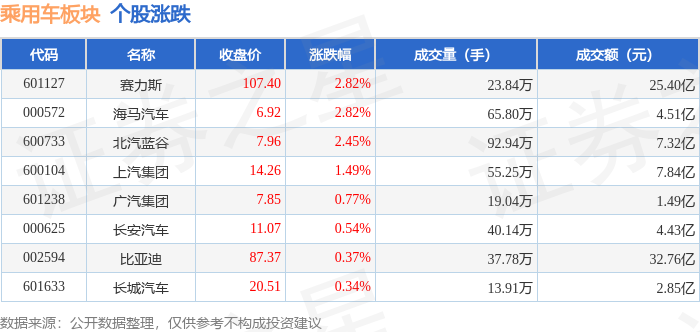
Group 1 - The passenger car sector increased by 1.12% on February 3, with Seres leading the gains [1] - The Shanghai Composite Index closed at 4067.74, up 1.29%, while the Shenzhen Component Index closed at 14127.1, up 2.19% [1] - Key stocks in the passenger car sector showed varied performance, with Seres and Haima Auto both rising by 2.82% [1] Group 2 - The net outflow of main funds in the passenger car sector was 117 million yuan, while retail investors saw a net inflow of 314 million yuan [1] - Detailed fund flow data indicated that Seres had a main fund net inflow of 172 million yuan, but retail investors had a net outflow of 85 million yuan [2] - BYD experienced a significant net outflow of 379 million yuan from main funds, despite a retail net inflow of 386 million yuan [2]




交银国际:维持长城汽车“买入”评级 目标价22.50港元
Zhi Tong Cai Jing· 2026-02-03 07:36
交银国际发布研报称,认为长城汽车(601633)(02333)中期仍受益于"高端化+新能源+出海"方向,但 4Q25已体现投入加大对利润的阶段性挤压。暂维持"买入"评级与目标价22.50港元,待年报披露后重点 跟踪费用结构、单车盈利与渠道效率变化并更新预测。 交银国际主要观点如下: 2025年业绩:销量与营收增长,利润受战略投入拖累 4Q25长城营收692.08亿元(同比+15.46%,环比+13%),单车收入17.29万元;销量超40万台(同比 +5.49%,环比+13.22%),其中新能源销量12.52万台、海外销量17.19万辆,均保持较强增长。4Q25净 利润为12.77亿元,环比下滑44.4%,主要为一次性计提全年年终奖所致;管理层披露2025年预提年终奖 约46亿元(同比+8亿元),还原后盈利基本面依旧稳健。同时,直营费用同比增加17亿+、广告投入同 比增长,叠加新店爬坡期(约6个月)导致费用效率尚未完全体现,影响季度利润表现。 2026展望:出海上量+直营提效,有望带来利润修复 长城提出2026年海外销量挑战60万台,且4Q25已在多区域加快渠道签约,为2026年增量获取奠定基 础。直营方面,长 ...
交银国际:维持长城汽车(02333)“买入”评级 目标价22.50港元
智通财经网· 2026-02-03 07:32
智通财经APP获悉,交银国际发布研报称,认为长城汽车(02333)中期仍受益于"高端化+新能源+出 海"方向,但4Q25已体现投入加大对利润的阶段性挤压。暂维持"买入"评级与目标价22.50港元,待年报 披露后重点跟踪费用结构、单车盈利与渠道效率变化并更新预测。 交银国际主要观点如下: 2026展望:出海上量+直营提效,有望带来利润修复 长城提出2026年海外销量挑战60万台,且4Q25已在多区域加快渠道签约,为2026年增量获取奠定基 础。直营方面,长城预计2026年魏牌将进入"提效+上规模"阶段,并认为规模化后有助将部分渠道利润 回流至企业端;同时管理层亦表示直营费用未来增量不会太大、效率将持续改善。需要关注的风险包括 原材料价格波动及海外政策节奏(如俄罗斯报废税返还确认时点差)。 风险变量方面关注三点 其一,大宗与锂价波动对行业成本的压力仍在,但长城提出2026年直材年化降本目标约5%,并将透过 平台化、规模效应与多维降本对冲原材料上行。其二,俄罗斯"报废税/返还"节奏会带来季度间扰动, 管理层称4Q25收到的是3Q25及以前的综合结算、4Q25当期尚未收到。其三,直营渠道仍处效率爬坡 期,管理层预期2 ...
里昂:下调长城汽车(02333)目标价至15港元 维持“跑赢大市”评级
智通财经网· 2026-02-03 06:10
智通财经APP获悉,里昂发布研报称,长城汽车(02333,601633.SH)公布2025年初步业绩,收入同比增长 10%,但净利润同比下降22%。年终奖金拨备或影响第四季净利润约30亿元人民币,若剔除延迟的俄罗 斯报废车税退税影响,该行估计第四季单车利润可按季上升约2,000元至10,500元。展望2026年,该行预 计长城国内销售将受内需减弱影响,而俄罗斯市场的影响可能持续。因此下调长城汽车2026年及2027年 净利润预测分别为19%及3%,并下调目标市盈率倍数,将H股目标价由21港元下调至15港元,A股目标 价则由36元下调至24元。然而,该行维持"跑赢大市"评级,因预期长城在行业波动中仍将保持韧性。 ...
长城汽车 | 2025年营收稳步增长 战略投入压制利润【国联民生汽车 崔琰团队】
汽车琰究· 2026-02-03 04:59
Event Overview - The company reported its 2025 annual performance, achieving total revenue of 222.79 billion yuan, a year-on-year increase of 10.19%. The net profit attributable to shareholders was 9.91 billion yuan, down 21.71% year-on-year. The net profit excluding non-recurring items was 6.16 billion yuan, down 36.48% year-on-year. Basic earnings per share were 1.16 yuan, down 22.15% year-on-year. As of the end of 2025, total assets were 225.59 billion yuan, up 3.62% year-on-year, and equity attributable to shareholders was 87.93 billion yuan, up 11.32% year-on-year. The total vehicle sales reached 1.32 million units, up 7.33% year-on-year, with new energy vehicle sales at 403,700 units, up 25.44% year-on-year, and overseas sales at 506,000 units, up 11.68% year-on-year, accounting for over 38% of total sales [2]. Revenue and Profit Analysis - Revenue grew steadily, with a 10.19% year-on-year increase, benefiting from sales growth and product structure upgrades. The average revenue per vehicle reached 168,300 yuan, an increase of approximately 4,400 yuan year-on-year, setting a new historical high. However, net profit attributable to shareholders and net profit excluding non-recurring items decreased by 21.71% and 36.48% respectively, primarily due to increased strategic investments in new user channels, new model launches, and brand enhancement, which pressured short-term profits. The total liabilities decreased by 0.76% year-on-year, while equity attributable to shareholders increased by 11.32%, indicating a stable financial condition [3]. Sales and Market Performance - Vehicle sales increased by 7.33% year-on-year, with a well-structured product matrix. The Haval and Ora brands focused on the mainstream price range of 100,000 to 200,000 yuan, while the Tank and Wey brands targeted the mid-to-high-end market, with Tank models above 300,000 yuan accounting for 38.5% of sales. The new energy business became a core growth engine, with global sales up 25.44% and domestic penetration of new energy passenger vehicles reaching 51.5%. The overseas market also saw significant growth of 11.68%, with over 57,000 units sold in December alone. The company is enhancing its global presence with the launch of its Brazil factory and localizing ethanol hybrid models, while the Tank 700 has established a high-value image in the Middle East, with plans to expand into the South American market [4]. Technological Innovation - The company has a strong technological foundation, with its hybrid four-wheel drive intelligent off-road technology awarded a prestigious industry prize. The Super Intelligent HEV is pushing hybrid technology into a new era, achieving a maximum fuel consumption reduction of 14.4%. The world's first native AI all-power platform has been implemented, accommodating various power forms, and high-level intelligent driving will be extended to more models and overseas adaptations. The company emphasizes "testing cars through competitions" to enhance production vehicle quality, laying a solid foundation for long-term high-quality growth [5]. Financial Forecast - The company has adjusted its profit forecast, expecting revenues of 226.78 billion yuan, 289.80 billion yuan, and 318.78 billion yuan for 2025-2027, with net profits attributable to shareholders of 12.67 billion yuan, 17.52 billion yuan, and 19.40 billion yuan for the same period. The corresponding earnings per share are projected to be 1.48 yuan, 2.05 yuan, and 2.27 yuan, with price-to-earnings ratios of 14, 10, and 9 respectively [6][7].
1月车市环比多暴跌,出口成“救命稻草”
Xin Lang Cai Jing· 2026-02-03 04:12
Core Viewpoint - The automotive market in January 2026 showed a slight year-on-year increase but a significant month-on-month decline, primarily due to policy changes and demand exhaustion, with exports becoming a crucial growth driver for companies [1][22]. Group 1: Market Performance - The overall automotive market experienced a year-on-year increase but a month-on-month decline, with some companies facing drastic reductions in sales [1]. - The core reasons for the market's sluggish start include the reduction of the new energy vehicle purchase tax and a mismatch in demand due to the timing of the Spring Festival [1]. - Exports have emerged as a vital growth area for automotive companies, helping to offset domestic market fluctuations [1][6]. Group 2: Company Sales Data - BYD sold 210,100 vehicles in January, a year-on-year decline of 30.11% and a month-on-month decline of 50.04%, heavily impacted by the new energy vehicle tax policy [3][5]. - Geely's sales reached 270,200 units, showing a year-on-year increase of 1.29% and a month-on-month increase of 14.08%, with significant export growth [5][6]. - SAIC Group reported sales of 327,000 units, a year-on-year increase of 23.9%, with a notable increase in overseas sales [8]. Group 3: New Energy Vehicle Trends - The new energy vehicle market is facing challenges due to policy changes, leading to a cautious consumer sentiment [1][3]. - Companies are increasingly relying on exports to sustain growth in the new energy vehicle segment, as domestic competition intensifies [6][22]. Group 4: Competitive Strategies - Companies are engaging in aggressive promotional strategies, including long-term financing options and price reductions, to stimulate sales amid a cooling market [15][17]. - The automotive industry is shifting towards a more competitive landscape, focusing on comprehensive service offerings beyond just product pricing [17][22]. - Traditional luxury brands are facing pressure from the rise of domestic electric vehicle manufacturers, leading to significant price reductions to maintain market share [20][22].