HTSC(601688)

Search documents
HTSC(06886) - 二零二五年中期股息每股人民币0.15元(「二零二五年中期股息」)股息货币...
2025-11-07 08:30
+ CCS3548 HUSH + NAME(S) AND ADDRESS OF REGISTERED SHAREHOLDER(S) 登記股東之姓名及地址 (A joint stock company incorporated in the People' s Republic of China with limited liability under the Chinese corporate name 华泰证券股份有限公司 and carrying on business in Hong Kong as HTSC) (於中華人民共和國註冊成立的股份有限公司, 中文公司名稱為华泰证券股份有限公司,在香港以 HTSC 名義開展業務) (Stock Code 股份代號:6886) DIVIDEND CURRENCY ELECTION FORM FOR 2025 INTERIM DIVIDEND OF RMB 0.15 PER SHARE ("2025 INTERIM DIVIDEND") 二零二五年中期股息每股人民幣 0.15 元(「二零二五年中期股息」) 股息貨幣選擇表格 Registered sharehol ...
华泰证券2026年度投资峰会:中国资产重估将进一步纵深
Sou Hu Cai Jing· 2025-11-07 03:58
华泰证券机构业务委员会主席梁红在致辞中表示,2025是"十四五"收官之年,中国经济展现更多的确定 性。"十五五"规划建议重提以经济建设为中心,明确提出要提高居民消费占GDP的比例,将从出口、投 资驱动的模式迈向消费为主、内需驱动的增长模式。展望明年,相信中国资产的重估将会进一步走向纵 深,权益投资者从过去两年"左手红利、右手科技"的策略,可能会逐步关注与经济基本面改善更加密切 的能源、消费、地产等顺周期板块,尤其是这些"老经济"板块中的优质龙头企业。 明年宏观政策如何演进,经济形势将有哪些变化?华泰证券首席宏观经济学家易峘认为,出口方面, 2025年中国出口韧性成为市场强共识,预计2026年仍保持较强韧性,产业升级成为主要叙事;财政政策 将保持温和扩张态势,为去杠杆周期"收尾"提供支持;地产去杠杆对信用周期和企业现金流的冲击边际 缓解、甚至消失。海外来看,美国政策"无序性"边际下降,全球财政、货币政策同步宽松,中美经贸关 系波动性有望回落。 2026年股市和债市如何发展、关注点有哪些?华泰证券研究所所长、固收首席张继强指出,今年股市主 要由情绪、资金和估值驱动,市场认知和叙事变化驱动行情,明年有望转向业绩验证 ...
华泰证券研究张继强:明年大量中长期存款再配置或利好股市
Xin Lang Cai Jing· 2025-11-07 02:45
Core Insights - The stock market this year has been primarily driven by sentiment, capital, and valuation, with a shift in market perception and narrative influencing trends. There is an expectation for a transition to performance verification in the coming year [1] - The bond market has experienced a correction from excessive gains at the beginning of the year, and it is anticipated to return to a fundamental logic next year, focusing on nominal GDP, financing demand, and the stock-bond valuation ratio [1] - A significant point to note is that next year will see a large amount of medium- to long-term deposits maturing, which may lead to a reallocation of funds that could benefit the stock market [1] Market Trends - Short-term predictions suggest that the stock market may undergo a period of consolidation, while the bond market has a slightly higher probability of success but with average returns. However, in the first quarter of next year, the likelihood of stocks outperforming bonds remains high [1] - The bond market faces primary pressures from improved fundamental expectations, adjustments in institutional behavior, and the stock-bond valuation ratio. Despite this, the supportive stance of monetary policy and the need for recovery in financing demand limit the potential for interest rate increases, leading to an overall slightly weaker and more volatile market outlook [1]
华泰证券何康:岁末年初注意平衡价值与成长
Xin Lang Cai Jing· 2025-11-07 02:45
Core Viewpoint - The new economy represented by AI is supported by performance growth, interest rate cuts, and domestic and international industrial trends, but the technology sector appears crowded with high valuation premiums, leading to a more favorable outlook for the "old economy" sector going forward [1] Group 1: Reasons for Favoring Old Economy - There is a positive correlation between new and old economies; strong performance in the new economy typically boosts growth in the old economy [1] - The old economy sector currently has low valuations, low chip holdings, and low market expectations [1] - The bottom of the cycle has accumulated strong recovery potential [1] - From a funding perspective, new incremental funds such as insurance and foreign capital are expected to favor value styles next year [1] Group 2: Investment Strategy Recommendations - Investors are advised to balance value and growth in their allocations, utilizing methods such as dollar-cost averaging and phased entry [1] - Historically, funding allocations tend to focus on risk aversion towards the end of the year, with value styles being relatively dominant, making the period from year-end to the first quarter of the following year a favorable window for positioning [1]
华泰证券梁红:“老经济”优质龙头关注度有望提升
Zheng Quan Shi Bao Wang· 2025-11-07 02:33
Core Viewpoint - The "14th Five-Year Plan" emphasizes a shift towards a consumption-driven growth model, increasing the proportion of resident consumption in GDP, moving away from reliance on exports and investments [1] Group 1: Economic Outlook - The expectation for the next year is that the revaluation of Chinese assets will deepen, with equity investors shifting focus from the previous two years' strategies of "left-hand dividends, right-hand technology" to sectors more closely tied to economic fundamentals [1] Group 2: Sector Focus - There will be increased attention on cyclical sectors such as energy, consumption, and real estate, particularly on high-quality leading companies within these "old economy" sectors [1]
A股三大指数低开,存储器板块跌幅居前
Feng Huang Wang Cai Jing· 2025-11-07 01:36
Market Overview - A-shares opened lower with the Shanghai Composite Index down 0.34%, Shenzhen Component down 0.54%, and ChiNext down 0.72% [1] - U.S. stock indices also declined, with the S&P 500 down 1.12% to 6720.32 points, Nasdaq down 1.9% to 23053.99 points, and Dow Jones down 0.84% to 46912.3 points, influenced by signs of a deteriorating job market and misinterpretations of comments from OpenAI executives [2] Chinese Concept Stocks - The Nasdaq China Golden Dragon Index saw mixed results, with Alibaba up 1.69%, JD down 0.28%, Baidu up 3.01%, and NIO down 1.78%. Notably, XPeng Motors surged 9.64% after unveiling its second-generation VLA [3] Sector Insights Robotics Sector - CITIC Securities suggests that the robotics sector is entering a phase of consolidation after significant adjustments in October, with expectations for new catalysts or industry rhythm to support market sentiment. Key developments include Tesla's Optimus mass production orders and prototype releases [4] Power Equipment Sector - Huatai Securities reports a significant performance divergence in the power equipment sector for Q3, with non-UHV main networks showing a 38.2% increase in net profit, while distribution and meter segments faced declines of 23.6% and 28.4%, respectively. The non-UHV segment benefits from strong overseas demand and ongoing domestic infrastructure needs [5] Aluminum Supply - CITIC Securities indicates that global electrolytic aluminum supply and demand will remain balanced over the next three years, contingent on China's production levels and new overseas capacities. Any supply disruptions could lead to price increases due to the current high-profit environment [6] Quantum Computing - CICC highlights that quantum computing is at a critical juncture transitioning from research breakthroughs to commercial applications, with hardware expected to lead in industrialization. The global quantum computing market is projected to grow from $5 billion in 2024 to over $800 billion by 2035, with a CAGR exceeding 55% [8]


券商晨会精华 | 量子计算正处于由科研突破向商业落地的关键拐点
智通财经网· 2025-11-07 01:00
Market Overview - The market experienced a strong rebound yesterday, with the Shanghai Composite Index rising nearly 1% to reclaim the 4000-point level. The total trading volume in the Shanghai and Shenzhen markets reached 2.06 trillion yuan, an increase of 182.9 billion yuan compared to the previous trading day. The Shanghai Composite Index rose by 0.97%, the Shenzhen Component Index by 1.73%, and the ChiNext Index by 1.84% [1]. Aluminum Supply and Demand - CITIC Securities indicated that the global supply and demand for electrolytic aluminum will remain balanced over the next three years, contingent on China's full production and the timely release of new overseas electrolytic aluminum capacity. Any supply disruptions could lead to a supply shortage. The high price and profit margins create a foundation for price increases, especially as the AI investment race in Europe and the U.S. faces electricity supply constraints, potentially threatening over 4 million tons of existing supply and accelerating aluminum prices upward [1]. Power Grid Equipment Performance - Huatai Securities reported significant performance differentiation in the power grid equipment sector for Q3. The revenue growth rates for various segments were as follows: non-UHV main grid at 38.2%, UHV main grid at 5.2%, distribution at -23.6%, and electric meters at -28.4%. The non-UHV main grid performed well due to strong overseas demand and ongoing domestic construction needs, with projected bidding amounts for 2024 and 2025 showing year-on-year increases of 8.2% and 19.5%, respectively. In contrast, the distribution segment faced challenges from domestic price reductions and weakened demand, while electric meter companies struggled with declining prices and increased competition in overseas markets [2]. Quantum Computing Development - CICC noted that quantum computing is transitioning from experimental validation to commercial application, marking a critical turning point. With advancements from global tech giants like Google, IBM, and Microsoft, and China's progress with prototypes, the global quantum computing market is expected to grow from $5 billion in 2024 to over $800 billion by 2035, with a CAGR exceeding 55%. The hardware segment is anticipated to benefit first, with core devices like measurement control systems and dilution refrigerators entering mass production soon [2].

华泰证券:坚定看好中国资产重估 明确看好“老经济”!
Zhong Guo Ji Jin Bao· 2025-11-06 13:43
Group 1 - The 2026 Investment Summit hosted by Huatai Securities focused on macroeconomic trends and market opportunities in the context of China's 14th Five-Year Plan and the upcoming 15th Five-Year Plan [1][3] - The summit highlighted a shift towards a consumption-driven growth model, emphasizing the importance of improving the proportion of household consumption in GDP [3] - Huatai Securities predicts a deepening revaluation of Chinese assets, with a focus on cyclical sectors such as energy, consumption, and real estate, particularly favoring high-quality leaders in the "old economy" [3][4] Group 2 - Huatai Securities' Chief Macro Economist provided forecasts indicating that China's nominal GDP growth in USD terms could rebound to 8.6% in 2026, marking the first visible acceleration since 2021 [4] - The expected appreciation of the RMB is projected to reach an exchange rate of 6.82 against the USD by the end of 2026 [4] - The stock market is anticipated to shift from being driven by sentiment and valuation to a focus on earnings verification in 2026 [5] Group 3 - The bond market is expected to return to a fundamental logic, with key factors such as nominal GDP, financing demand, and stock-bond valuation ratios becoming critical [5] - The overall market may experience a slightly weaker and more volatile pattern due to limited upward pressure on interest rates, despite supportive monetary policy [6] - A diversified asset allocation strategy is recommended, utilizing a "all-weather" approach to mitigate risks and achieve stable long-term returns [6] Group 4 - The "old economy" is viewed positively due to its low valuations, low market expectations, and strong recovery potential from cyclical lows [8] - Investment strategies should balance value and growth, with a recommendation for dollar-cost averaging and phased entry into positions, particularly during the end of the year and early next year [8] - The market is expected to gradually rebalance from growth to cyclical and value styles, with an emphasis on low-valuation, high-capitalization companies with strong profitability [9]


重磅发声!坚定看好中国资产重估,明确看好“老经济”!
中国基金报· 2025-11-06 13:01
Core Viewpoint - The 2026 Investment Summit hosted by Huatai Securities focuses on the macroeconomic landscape and market opportunities in the context of China's 14th and 15th Five-Year Plans, emphasizing a shift towards a consumption-driven growth model [2][5]. Group 1: Economic Outlook - The economic growth rate for China is expected to rebound to 8.6% in 2026, marking the first visible acceleration since 2021, driven by improved corporate profitability and a stable export outlook [7]. - The fiscal policy is anticipated to maintain a moderately expansionary stance, supporting the end of the deleveraging cycle [7]. - The real estate sector's deleveraging impact on credit cycles and corporate cash flows is expected to diminish [7]. Group 2: Market Trends - The focus for equity investors is shifting from technology and dividends to cyclical sectors such as energy, consumption, and real estate, particularly high-quality leaders in the "old economy" [6][11]. - The stock market is predicted to transition towards performance verification in 2026, moving away from sentiment-driven dynamics [9]. Group 3: Investment Strategies - Huatai Securities emphasizes the importance of balancing value and growth in investment strategies, particularly favoring the "old economy" due to its low valuations and market expectations [12]. - Investors are advised to adopt a dollar-cost averaging approach, particularly in the latter part of the year, as historical trends suggest a preference for value styles during this period [12]. - The recommendation includes focusing on "true value" sectors, particularly those with low valuations and strong profitability, primarily in domestic and Hong Kong financial and consumer sectors [13].

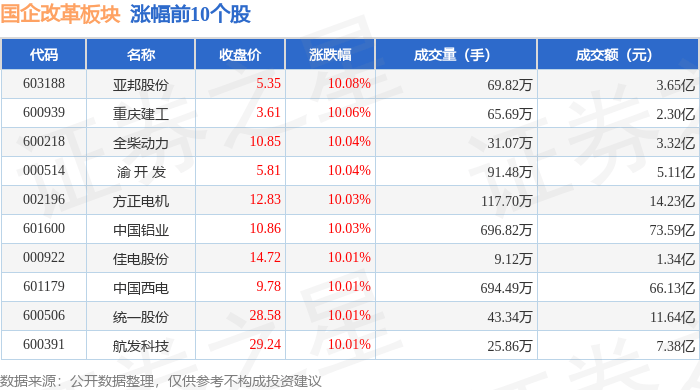
国企改革板块11月6日涨0.82%,亚邦股份领涨,主力资金净流出13.72亿元



Sou Hu Cai Jing· 2025-11-06 09:22
Market Performance - The state-owned enterprise reform sector rose by 0.82% compared to the previous trading day, with Yabong Co., Ltd. leading the gains [1] - The Shanghai Composite Index closed at 4007.76, up 0.97%, while the Shenzhen Component Index closed at 13452.42, up 1.73% [1] Top Gainers - Yabong Co., Ltd. (603188) closed at 5.35, with a gain of 10.08% and a trading volume of 698,200 shares, amounting to a transaction value of 365 million [1] - Other notable gainers include: - Cheqing Construction (600939) at 3.61, up 10.06% [1] - Quanchai Power (600218) at 10.85, up 10.04% [1] - Yudai Development (000514) at 5.81, up 10.04% [1] - Fangzheng Electric (002196) at 12.83, up 10.03% [1] Top Losers - Daya Energy (600403) saw a decline of 10.04%, closing at 8.15 with a trading volume of 1,588,600 shares, resulting in a transaction value of 1.317 billion [2] - Other significant losers include: - Standard Co. (600302) at 66.01, down 9.99% [2] - Guangdong Media (002181) at 11.84, down 9.96% [2] - Jishi Media (601929) at 4.44, down 9.94% [2] Capital Flow - The state-owned enterprise reform sector experienced a net outflow of 1.372 billion from institutional investors, while retail investors saw a net inflow of 4.833 billion [2][3] - The capital flow for key stocks in the sector indicates varying trends, with some stocks experiencing significant net inflows from retail investors despite overall outflows from institutional and speculative funds [3]