
EBSCN(601788)

Search documents
万怡医学递表港交所 光大证券国际为独家保荐人
Zheng Quan Shi Bao Wang· 2026-01-05 00:11
Company Overview - Wanyiyi Medical has submitted a listing application to the Hong Kong Stock Exchange, with Everbright Securities International as the sole sponsor [1] - The company is positioned as a leading AI-driven solution provider in China, focusing on physician talent development, academic exchange, education, and research outcome transformation [1] Market Position - According to Frost & Sullivan, Wanyiyi Medical ranks first in the comprehensive AI solution market for medical academia, education, and research in China based on comparable revenue for 2024 [1] Core Business - The core business includes two types of AI-driven revenue-generating solutions: a full-process solution for medical academic activities provided through the MedEvent platform, and digital solutions for medical learning and education offered via the MedAssistant system [1] - Wanyiyi Medical has also launched the MedEvidence intelligent tool suite, which includes an AI evidence assistant to support physician-led research processes [1] Market Growth - The market for medical academic, education, and research solutions in China is continuously growing, with the comprehensive AI solution market expected to have a compound annual growth rate (CAGR) of 34.8% from 2024 to 2030, reaching a market size of 33.9 billion RMB by 2030 [1]

【光大研究每日速递】20260105
光大证券研究· 2026-01-04 23:04
Group 1 - The A-share market experienced a steady upward trend in December, with major indices showing increased trading volume and a gradual recovery in market sentiment, indicating a shift from trading factors to fundamental factors dominating the market [4] - The total outstanding credit bonds in China reached 31.29 trillion yuan by the end of December 2025, with a net financing of 176.67 billion yuan for the month, despite a 17.19% month-on-month decline in issuance [4] - The new public fund sales regulations released by the China Securities Regulatory Commission on December 31, 2025, are expected to impact bank wealth management asset allocation behaviors, with public funds held amounting to 1.34 trillion yuan as of Q3 2025 [5] Group 2 - The Hong Kong insurance sector is anticipated to benefit from a strong "opening red" performance, driven by favorable sales in January and a positive investment return outlook due to a stable equity market [6] - The direct and indirect exports of steel, copper, and aluminum are projected to account for 24%, 17%, and 21% of domestic production in 2024, with expectations of improved export conditions in 2026 due to easing US-China trade tensions [6] - The annual long-term electricity price in Guangdong for 2026 is expected to reflect current operating costs of thermal power, with average profitability estimated at 0.02 yuan per kilowatt-hour based on average coal prices from 2025 [7] Group 3 - Tesla's Q4 2025 deliveries fell short of expectations, while NIO regained the top position among new energy vehicle manufacturers in December, with the continuation of the trade-in subsidy policy likely to boost sales in 2026 [8]

【银行】日本90年代银行危机及风险处置——海外银行镜鉴日本系列之二(王一峰/赵晨阳)
光大证券研究· 2026-01-04 11:33
Core Viewpoint - The article analyzes the evolution of Japan's banking crisis in the 1990s, highlighting the stages of crisis development, causes, reforms, and the subsequent recovery of the real estate and banking sectors [4][5][6][7]. Group 1: Stages of the Banking Crisis - The banking crisis in Japan during the 1990s can be divided into three stages: 1. Following the "Plaza Accord," the Bank of Japan significantly lowered interest rates, leading to increased speculation in the stock and real estate markets as investment returns weakened in the real economy [4]. 2. In the early 1990s, policies shifted to burst the asset bubble, severely damaging the balance sheets of households and businesses, with risks accumulating [4]. 3. The increase in "special loans" and deteriorating asset quality, compounded by the Asian financial crisis, led to risks spreading from small to large institutions [4]. Group 2: Causes of the Crisis - The main causes of the banking crisis include: 1. The wave of financial liberalization intensified "disintermediation," with a lax regulatory environment and aggressive operational styles among institutions, leading to increased stock investments and a focus on real estate lending [5]. 2. The main bank system created a strong bond between banks and enterprises, hindering the timely disposal of problematic assets and increasing risk contagion [5]. 3. The "escort fleet" mechanism resulted in a lack of risk isolation among institutions, with strong administrative protection hindering the clearance of non-performing assets [5]. Group 3: Reforms Post-Crisis - The post-crisis period saw two major phases of concentrated reforms aimed at risk disposal: 1. The late 1990s financial "big bang" reforms abandoned government protection, established the Financial Supervisory Agency, and improved regulatory effectiveness, alongside legal processes for handling failing institutions [6]. 2. The "Financial Revitalization Plan" focused on the disposal of non-performing assets and initiated business rectification for poorly performing institutions, while the government used "preferred shares with conversion rights" to enhance market operations and expedite capital recovery [6]. Group 4: Structural Recovery in Real Estate - In the post-crisis era, Japan's real estate sector experienced structural recovery with regional differentiation: - Major urban areas like Tokyo, Osaka, and Nagoya saw net population inflows, supporting the real estate market, with a rapid recovery in apartment transaction volumes and prices [7]. - The development of REITs in the early 21st century improved financing channels for real estate companies, enhancing transaction liquidity [7]. - Leading real estate firms shifted from a heavy asset and capital model to a more refined approach, increasing the proportion of light asset and light cycle businesses while expanding into overseas markets [7]. Group 5: Changes in Banking Operations - The banking sector in Japan post-crisis exhibited five key characteristics: 1. The pace of scale expansion slowed, with a focus on defensive asset allocation, increasing the proportion of high liquidity and low-risk assets [8]. 2. Different types of banks showed varied asset allocation behaviors, with urban banks diversifying their business structures and increasing overseas asset allocations [8]. 3. The liability side showed a clear trend towards savings and demand deposits, with a widening duration gap in asset-liability management [8]. 4. Overseas investment styles remained conservative, primarily focusing on investment-grade corporate bonds, with a relatively weak stability in funding sources [8]. 5. The contribution of fee-based and intermediary business revenues increased, with urban banks showing a distinct advantage [8]. Group 6: Lessons from Risk Disposal and Development - Four key lessons can be drawn from Japan's experience in risk disposal and post-crisis development: 1. Risk evolution is characterized by time lags, non-linearity, and diffusion, with regulatory laxity exacerbating crises [10]. 2. Excessive reliance on fiscal injections and administrative restructuring for non-performing asset disposal has slowed the establishment of market competition mechanisms [10]. 3. Caution is needed in overseas expansion regarding geopolitical, exchange rate, and maturity mismatch risks, necessitating dynamic hedging mechanisms for global asset allocation [10]. 4. In an aging and low-interest environment, institutional innovation is required to reshape the financial intermediary function and break inefficient equilibria [10].

乘风出发,追光前行|光大证券研究所祝您2026元旦快乐!
光大证券研究· 2026-01-04 11:33
光大证券研究所 祝您2026元旦快乐 光大 证券 EVEBRIGHT SECURITIES 1 点击上方"光大证券研究"可以订阅哦 ...

光大证券:对春季行情保持耐心
Xin Lang Cai Jing· 2026-01-04 08:53
来源:光大证券 核心观点一:从震荡的四季度到春季行情。2025年12月A股先跌后涨,整体窄幅震荡。但月中,中长期 资金开始逐步入市,其再次成为了市场的稳定器,叠加居民资金的持续流入,十二月下旬市场持续上 行,春季行情表现值得期待。 核心观点三:春季行情的风格与方向。历史上春季行情通常以成长与顺周期两条主线为主。从往年春季 行情中各板块的表现来看,成长板块在大多数时候均有不错的表现,此外,顺周期板块成为主线的次数 也较高,而成长+周期双主线的情景在过去13次春季行情中共出现过6次。相关行业的行情短期有较强 持续性,不过春季行情中的强势行业未必会成为年度主线。对于今年而言,我们认为消费与成长有望成 为春季行情的两条主线。 核心观点一:从震荡的四季度到春季行情。2025年12月A股先跌后涨,整体窄幅震荡。但月中,中长期 资金开始逐步入市,其再次成为了市场的稳定器,叠加居民资金的持续流入,十二月下旬市场持续上 行,春季行情表现值得期待。 核心观点二:对春季行情保持耐心。春季行情多数年份都存在,不过表现有明显差异,当前来看,12月 下旬的上涨或许就是本轮春季行情的起点。不过需要注意的是,从历史规律来看,上证指数当年1月 ...
光大证券:消费与成长有望成为春季行情的两条主线
Di Yi Cai Jing· 2026-01-04 07:15
(文章来源:第一财经) 光大证券研报表示,当前来看,2025年12月下旬的上涨或许是本轮春季行情起点。对于1月份指数的行 情,投资者或许应该保持耐心。消费与成长有望成为今年春季行情的两条主线。1月行业配置方面,关 注电子、电力设备、有色金属、汽车等。若市场风格为成长,五维行业比较框架打分靠前的行业分别为 电子、电力设备、通信、有色金属、汽车、国防军工;若1月份市场风格为防御,五维行业比较框架打 分靠前的行业分别为非银金融、电子、有色金属、电力设备、汽车、交通运输等。 ...
光大证券公告金通灵财务造假案宣判 金通灵赔7.75亿元
Zhong Guo Jing Ji Wang· 2026-01-03 07:51
光大证券作为金通灵公司2018年发行股份购买资产并募集配套资金项目独立财务顾问,为本案的26 名被告之一。 光大证券表示,鉴于对公司等其他25名被告承担民事赔偿责任的诉讼请求将继续审理并另行制作裁 判文书,公司最终涉诉金额存在不确定性,暂无法判断对公司本期利润或期后利润的影响。 南京中院民事判决书,判决如下: (责任编辑:魏京婷) 中国经济网北京1月3日讯 光大证券(601788.SH)近日披露《重大诉讼进展公告》。 1.被告金通灵公司于本判决发生法律效力之日起十日内赔偿原告叶小明等43269名投资者投资损失 共计774785993.38元,并承担相关律师费、案件受理费等。 公告称,公司前期披露了金通灵科技集团股份有限公司(以下简称"金通灵公司")证券虚假陈述责 任纠纷案(以下简称本案)相关诉讼情况。2025年12月31日,公司收到江苏省南京市中级人民法院(以 下简称南京中院)民事判决书。 2.对公司等其他25名被告承担民事赔偿责任的诉讼请求继续审理,并另行制作裁判文书。 ...
光大证券:维持微创医疗(00853) “买入”评级 降本增效成果显著
智通财经网· 2026-01-02 01:51
Core Viewpoint - The report from Everbright Securities indicates that MicroPort Medical (00853) is expected to achieve continuous loss reduction due to factors such as the impact of centralized procurement, cost reduction measures, and a focus on core business, with net profit forecasts for 2025 and 2026 adjusted to -30 million and -96 million USD respectively, and a new forecast for 2027 set at 133 million USD [1] Group 1: Company Announcements - The company recently announced that it will terminate the consolidation of MicroPort Brain Science due to its inability to control it, while still maintaining significant influence [2] - MicroPort Heart Communication held a shareholders' meeting to approve a major asset restructuring proposal for the acquisition of MicroPort Rhythm Management, which will enhance the integration of its structural heart disease and rhythm management core business segments [2] Group 2: Governance and Growth - The governance structure has improved with the strategic investment from a fund under Shanghai Shenda Capital, which is expected to inject new momentum into governance and business development [3] - The recent restructuring of the rhythm management and structural heart disease business aims to create a comprehensive heart disease platform, integrating AI diagnostic and algorithm technology with existing treatment technologies [3] - The company is actively building a global commercialization platform to support the international expansion of its products, with overseas revenue reaching 59.8 million USD in the first half of 2025, a year-on-year increase of 57.3% [3] Group 3: Financial Performance - The company has significantly improved its profitability through a focus on core business and resource optimization, with a revenue of 548 million USD in the first half of 2025, a year-on-year decrease of 2.0% [4] - The net loss narrowed significantly from 107 million USD in the same period last year to 36.36 million USD, indicating a turning point in operations [4] - The improvement in profitability is attributed to effective cost control, with operational expense ratio optimized by 8.1 percentage points and R&D expense ratio reduced from 20.6% to 13.2% [4] - The company has set performance targets to limit net losses to no more than 110 million USD in the first half of 2025 and no more than 55 million USD for the entire year, with a target of achieving net profits of at least 45 million USD in the first half of 2026 and at least 90 million USD for the full year [4]
2025券商金股业绩出炉,TOP10全破50%收益,科技赛道成核心引擎
Xin Lang Cai Jing· 2026-01-02 01:16
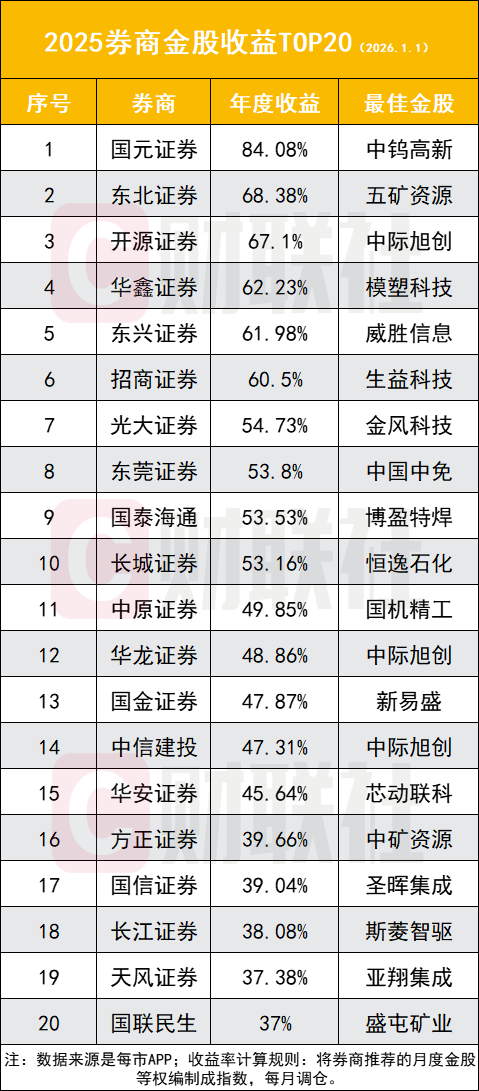
Core Insights - The A-share market in 2025 closed positively, with major indices showing significant gains, and brokerage "golden stock" portfolios delivering impressive results [1] - The top ten brokerage golden stock portfolios achieved returns exceeding 50%, with the highest being Guoyuan Securities at 84.08% [1][5] Brokerage Performance - Guoyuan Securities led with a return of 84.08%, with its best stock being Zhongtung Gaoxin [2][5] - Northeast Securities ranked second with a return of 68.38%, highlighting its best stock as Wukuang Resources [2][6] - Other notable performers include Kaiyuan Securities (67.1%), Huaxin Securities (62.23%), and Dongxing Securities (61.98%) [2] Stock Selection Strategies - Guoyuan Securities focuses on selecting stocks based on China's new economic growth drivers and emerging industries, aiming to identify companies with strong fundamentals and market expectations [5] - Northeast Securities employs a collaborative approach with nearly 30 teams contributing to stock recommendations, emphasizing technology and cyclical sectors [6][7] - Dongguan Securities utilizes a systematic research framework that integrates macroeconomic analysis with industry insights to select high-quality stocks [8] Research Methodologies - Huazhong Securities emphasizes a dual approach, combining top-down macroeconomic analysis with bottom-up stock selection to identify high-potential sectors and individual stocks [9] - The overall performance of brokerage golden stock portfolios in 2025 significantly outperformed previous years, with the lowest return among the top 20 brokerages nearing 40% [5]




上海万怡医学科技股份有限公司向港交所提交上市申请书,独家保荐人为光大证券国际。
Xin Lang Cai Jing· 2026-01-01 11:26
Group 1 - Shanghai Wanyue Medical Technology Co., Ltd. has submitted a listing application to the Hong Kong Stock Exchange [1] - The exclusive sponsor for the listing is Everbright Securities International [1]