Bank of Chengdu(601838)

Search documents
银行行业7月23日资金流向日报
Zheng Quan Shi Bao Wang· 2025-07-23 09:13
Core Viewpoint - The banking sector experienced a slight increase of 0.40% on July 23, with a net inflow of 4.91 billion yuan in main capital, indicating positive investor sentiment towards the sector [1][2]. Market Performance - The Shanghai Composite Index rose by 0.01% on the same day, with eight industries showing gains, particularly non-bank financials and beauty care, which increased by 1.29% and 0.59% respectively [1]. - The banking sector's performance was supported by 28 out of 42 listed banks experiencing price increases, while nine saw declines [2]. Capital Flow - The non-bank financial sector led the net capital inflow with 28.59 billion yuan, followed by the banking sector with 4.91 billion yuan [1]. - A total of 23 industries faced net capital outflows, with the power equipment sector experiencing the largest outflow of 101.71 billion yuan [1]. Individual Bank Performance - Agricultural Bank of China topped the net inflow list with 6.33 billion yuan, followed by China Bank and China Merchants Bank with inflows of 3.34 billion yuan and 1.83 billion yuan respectively [2]. - Notable outflows were observed in Industrial Bank, Minsheng Bank, and Chengdu Bank, with outflows of 2.58 billion yuan, 1.30 billion yuan, and 1.20 billion yuan respectively [2]. Detailed Bank Data - The top-performing banks in terms of capital flow included: - Agricultural Bank: +2.46% with a main capital flow of 633.09 million yuan [3] - China Bank: +0.90% with a main capital flow of 334.19 million yuan [3] - China Merchants Bank: +0.40% with a main capital flow of 183.25 million yuan [3] - Conversely, banks like Industrial Bank and Minsheng Bank reported significant capital outflows, with -25.75 million yuan and -13.03 million yuan respectively [4].





2025年银行股表现:分红浪潮下的市场起伏与结构性机遇
Tai Mei Ti A P P· 2025-07-23 04:39
Core Viewpoint - 2025 is a pivotal year for the Chinese banking industry, marked by unprecedented dividend distributions and a volatile market performance for bank stocks, with a mid-year dividend total exceeding 200 billion yuan [2][3]. Dividend Distribution - The banking sector led the market in dividend payouts, with a total cash dividend of 420.63 billion yuan in the first half of 2025, with Industrial and Commercial Bank of China (ICBC) leading at 109.77 billion yuan [3]. - State-owned banks generally offered dividend yields exceeding 4%, with China Construction Bank achieving a yield of 4.44%, significantly higher than the 10-year government bond yield [3]. Market Performance - The banking sector recorded a 13.1% increase in stock prices in the first half of 2025, ranking second among all industries, with 41 out of 42 bank stocks rising [5]. - The stock prices of major state-owned banks reached historical highs by the end of June, reflecting the long-term attractiveness of high-dividend assets [4]. Investment Dynamics - The surge in bank stock prices was driven by three main factors: the appeal of low valuations and high dividends in a weak global economic recovery, supportive policy expectations, and the ongoing popularity of dividend-paying assets [6]. - Institutional ownership in ICBC increased from 35% to 38% following the announcement of its dividend plan, indicating strong investor interest [4]. Future Outlook - The performance of bank stocks in the second half of 2025 will depend on the balance between policy measures and economic resilience, with expectations of a "shifting upward" trend in stock prices [10]. - Analysts suggest that state-owned banks will continue to be stable investments due to their large customer bases and low non-performing loan ratios, while smaller banks may need to focus on niche business areas to achieve valuation premiums [11]. Stock Recommendations - Specific banks are highlighted for their strong potential: - Shanghai Pudong Development Bank, benefiting from management reforms, with a stock price increase of 34.89% [11]. - Industrial Bank, recognized for its growth in investment banking and green finance [12]. - Agricultural Bank of China, noted for its high dividend yield of 5.2% and low deposit costs [12]. Conclusion - The banking sector in 2025 illustrates that while dividends can enhance valuations, they cannot replace strong fundamentals. Only banks with a combination of high dividend safety, regional economic resilience, and wealth management transformation will thrive amid cyclical fluctuations [13].





A股三大指数开盘涨跌不一,沪指高开0.2%
Feng Huang Wang Cai Jing· 2025-07-23 01:38
凤凰网财经讯 7月23日,A股三大指数开盘涨跌不一,沪指涨0.2%,深成指涨0.01%,创业板指跌 0.12%。超级水电、煤炭、有色金属等板块指数涨幅居前,创新药、CPO、军工等板块指数跌幅居前。 华泰证券表示,国内反内卷不断加码,叠加近期海外财政货币双宽松的氛围等,金属板块整体表现较 佳:多晶硅价格成功持续修复,给予市场较大的信心,目前已外溢至碳酸锂和氧化铝。锂、钴、稀土从 成本角度均已寻到价格底部,近期还有独立因素推波助澜触发价格上涨:锂基于矿权审核趋严、钴基于 刚果金出口禁令、稀土是战略性提升与短缺预期共振。基本金属上涨行情中,铝的关注点是红利、铜的 关注点是成长性;此外建议关注加工板块。钢铁交易逻辑或从炉料让利为主转向供给收缩与炉料下跌共 同改善行业景气度。 中信建投:可控核聚变产业进入发展快车道 预计将对产业链产生积极影响 华泰证券:反内卷搭台,金属机遇不断 中信建投表示,上交所举办可控核聚变产业沙龙,国内首台商业直线型聚变装置成功点亮等离子体,我 国可控核聚变产业多条技术路线齐头并进,随着技术的持续突破、项目融资的持续开展、政策层面重视 程度的持续提升,我国可控核聚变产业进入发展快车道。目前相关项 ...




行情短期调整不改长期向好逻辑
Tianfeng Securities· 2025-07-22 10:13
Industry Investment Rating - The industry investment rating is maintained at "Outperform the Market" [1][27]. Core Viewpoints - Despite a recent pullback in bank stock prices, the long-term positive outlook for the banking sector remains intact due to several factors, including expected marginal improvements in fundamentals and ongoing valuation recovery driven by increased capital inflows [2][21]. Summary by Relevant Sections Recent Market Performance - Since July 11, bank stock prices have experienced a notable decline, with the banking index down 3.41% as of July 18. This pullback is attributed to strong prior gains, profit-taking by investors, and short-term selling pressure from dividend-related strategies [2][12]. Fundamental Improvements - The first half of 2025 is expected to reflect some marginal improvements in bank performance, driven by stabilized net interest margins, improved non-interest income, and a favorable asset quality outlook [2][13][14]. - Net interest margins are projected to stabilize due to easing credit supply-demand imbalances and the expiration of high-interest deposits [17]. - Non-interest income is anticipated to improve as the decline in management fees narrows and the bond market recovers [17]. Valuation Recovery - The banking sector's valuation recovery is expected to continue, supported by low interest rates and a scarcity of attractive assets, making bank stocks appealing due to their high dividend yields [18][20]. - As of July 18, the banking sector's dividend yield stands at 4.47%, with a price-to-book (PB) ratio of 0.73, indicating a low valuation compared to other sectors [20]. - The influx of incremental capital, including long-term funds and public fund reforms, is likely to sustain the valuation recovery trend in the banking sector [20][21]. Investment Recommendations - The report recommends focusing on quality regional small banks such as Chengdu Bank and Changshu Bank, as well as major state-owned banks including Industrial and Commercial Bank of China, Agricultural Bank of China, Bank of China, and Postal Savings Bank of China [21].
成都银行(601838) - 成都银行股份有限公司关于高管任职资格获监管机构核准的公告
2025-07-22 09:15
近日,成都银行股份有限公司(以下简称"公司")收到《四川 金融监管局关于游先伟成都银行股份有限公司总经济师任职资格的 批复》(川金监复〔2025〕176 号),国家金融监督管理总局四川监 管局已核准游先伟先生公司总经济师的任职资格。 游先伟先生的简历详见公司于 2024 年 12 月 24 日刊登于上海证 券交易所网站的《成都银行股份有限公司第八届董事会第八次会议决 议公告》。 特此公告。 成都银行股份有限公司董事会 证券代码:601838 证券简称:成都银行 公告编号:2025-040 成都银行股份有限公司 关于高管任职资格获监管机构核准的公告 本公司董事会及全体董事保证本公告内容不存在任何虚假记载、 误导性陈述或者重大遗漏,并对其内容的真实性、准确性和完整性承 担法律责任。 2025 年 7 月 23 日 1 ...
成都银行(601838) - 成都银行股份有限公司2024年年度权益分派实施公告
2025-07-21 09:30
证券代码:601838 证券简称:成都银行 公告编号:2025-039 成都银行股份有限公司 2024年年度权益分派实施公告 本公司董事会及全体董事保证本公告内容不存在任何虚假记载、误导性陈述或者重大遗 漏,并对其内容的真实性、准确性和完整性承担法律责任。 重要内容提示: 每股分配比例 A 股每股现金红利0.891元(含税) 相关日期 | 股份类别 | 股权登记日 | 最后交易日 | 除权(息)日 | 现金红利发放日 | | --- | --- | --- | --- | --- | | A股 | 2025/7/25 | - | 2025/7/28 | 2025/7/28 | 差异化分红送转:否 一、 通过分配方案的股东大会届次和日期 本次利润分配方案经成都银行股份有限公司(以下简称"公司"或"本公司)2025 年 6 月 25 日的2024年年度股东大会审议通过。 1. 发放年度:2024年年度 2. 分派对象: 三、 相关日期 | 股份类别 | 股权登记日 | 最后交易日 | 除权(息)日 | 现金红利发放日 | | --- | --- | --- | --- | --- | | A股 | 2025/7/ ...
为什么联名信用卡越来越少?
3 6 Ke· 2025-07-21 04:38
Core Viewpoint - The credit card industry in China is experiencing a significant transformation, shifting from expansion to a focus on quality and efficiency, as evidenced by the increasing number of banks discontinuing co-branded credit card products [12][19]. Group 1: Market Trends - Since January 1, 2025, at least seven major banks have announced the discontinuation of at least 22 co-branded credit card products, indicating a trend of product adjustments in the credit card market [2][6]. - Major banks, including China Bank and Citic Bank, have stopped issuing various co-branded credit cards, with reasons primarily cited as "business adjustments" or "contract expiration" [4][6]. Group 2: Product Adjustments - Co-branded credit cards, which are partnerships between banks and profit-oriented institutions, are being phased out due to their unsustainable cooperation models and imbalanced overall returns [9][10]. - Banks are transitioning to standard credit cards for existing co-branded cardholders, with changes in reward structures and benefits [4][6]. Group 3: Regulatory Environment - The regulatory framework has tightened, with new guidelines from the former CBIRC and the People's Bank of China mandating banks to focus on quality over quantity in credit card issuance [10][12]. - The new regulations require banks to limit the ratio of dormant credit cards to no more than 20%, prompting a reevaluation of credit card strategies [10][12]. Group 4: Consumer Behavior - The credit card market is increasingly catering to younger consumers, who have diverse interests and consumption needs, necessitating banks to innovate and tailor products accordingly [18][19]. - The decline in credit card issuance and usage reflects a broader trend of market saturation and the need for banks to refine their customer engagement strategies [12][13]. Group 5: Future Outlook - The discontinuation of co-branded credit cards is seen as a necessary step towards a more refined and efficient credit card business model, focusing on high-value customer segments and innovative product offerings [15][19]. - The industry is expected to evolve towards precision marketing and enhanced customer experiences, leveraging digital technologies and data analytics [7][19].


A股银行板块震荡走弱,齐鲁银行、厦门银行、成都银行、浙商银行、上海银行、南京银行均跌超1%。
news flash· 2025-07-21 02:26
A股银行板块震荡走弱,齐鲁银行、厦门银行、成都银行、浙商银行、上海银行、南京银行均跌超 1%。 ...


天风证券:如何看待银行股价和基本面的背离?
智通财经网· 2025-07-19 09:55
Core Viewpoint - The banking sector is currently under pressure, but the market's preference for high dividend strategies is driving a notable upward trend in bank stocks. The release of policy dividends, along with increased participation from insurance funds, active funds, and passive funds, is expected to provide stable incremental capital for bank stocks, enhancing the sustainability of valuation recovery [1][2]. Group 1: Current Banking Fundamentals - The banking sector's fundamentals are still under pressure but show signs of marginal improvement. The net interest margin is expected to decline significantly less in 2025 due to the expiration of high-interest liabilities and a slowdown in loan pricing declines. The estimated net interest margins for state-owned and joint-stock banks are projected to be 1.34% and 1.55%, respectively, down 12 and 9 basis points from the end of 2024 [2]. - The asset quality is expected to improve while remaining stable. As of Q1 2025, the non-performing loan ratio for commercial banks was recorded at 1.51%, only slightly up by 1 basis point from the end of 2024. The provision coverage ratio stands at 208%, down 3.06 percentage points, indicating ample room above the regulatory requirement of 150% [2]. Group 2: Valuation Recovery and Market Dynamics - The core logic driving the current market rally is the valuation recovery fueled by the funding environment. This trend is expected to continue, supported by low interest rates and an asset shortage, which highlight the advantages of high dividends and quasi-fixed income characteristics of bank stocks. As of July 11, the banking sector's dividend yield was 4.87%, significantly enhancing its investment appeal due to stable dividends and sound operations [3]. - Continuous inflow of incremental capital is driving a noticeable recovery in bank stock valuations. Policies such as the introduction of mid- to long-term capital into the market and new regulations for public funds have significantly increased the demand for bank stock allocations. As of July 11, the banking sector's price-to-book (PB) ratio was 0.75, indicating substantial room for recovery towards a PB of 1 [3].

“红包雨”来了!30余家上市行年度分红“到账”,哪家出手最阔绰?
Xin Lang Cai Jing· 2025-07-16 00:40
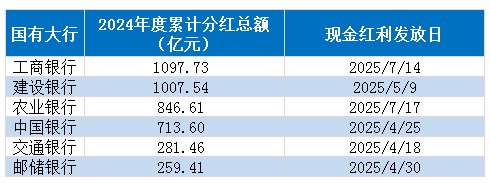
Core Viewpoint - A-share listed banks are experiencing a peak in dividend distribution for the 2024 fiscal year, with over thirty banks having completed their annual dividends and several others announcing dividend implementation plans [1][3][4]. Group 1: 2024 Annual Dividends - The Industrial and Commercial Bank of China (ICBC) leads with a total cash dividend of approximately 109.77 billion yuan for the previous year [3][4]. - The six major state-owned banks have collectively distributed over 420 billion yuan in dividends for 2024, with ICBC, China Construction Bank, Agricultural Bank of China, and Bank of China being the top contributors [4][6]. - Other banks such as China CITIC Bank and Beijing Bank have also announced significant cash dividends, with CITIC Bank distributing around 19.46 billion yuan [4][5]. Group 2: 2025 Mid-Year Dividend Plans - Several banks, including China Merchants Bank and Hangzhou Bank, have initiated plans for mid-year dividends in 2025, aiming to enhance investor returns [1][8][10]. - The focus on mid-year dividends is seen as a strategy to improve liquidity and provide more consistent cash flow to investors, which may support long-term stock price appreciation [10]. - Banks like Su Nong Bank and Changsha Bank have expressed intentions to implement mid-year dividend plans based on their financial performance and regulatory requirements [8][9]. Group 3: Stock Performance and Market Trends - The banking sector has shown strong performance in the A-share market, with several banks achieving significant stock price increases in the first half of the year [12][13]. - The overall dividend yield of the banking sector remains attractive, particularly in a low-interest-rate environment, making it appealing for long-term investors [10][13]. - Some banks have faced challenges in executing share buyback plans due to stock price fluctuations, indicating a cautious approach to capital management [11][14].